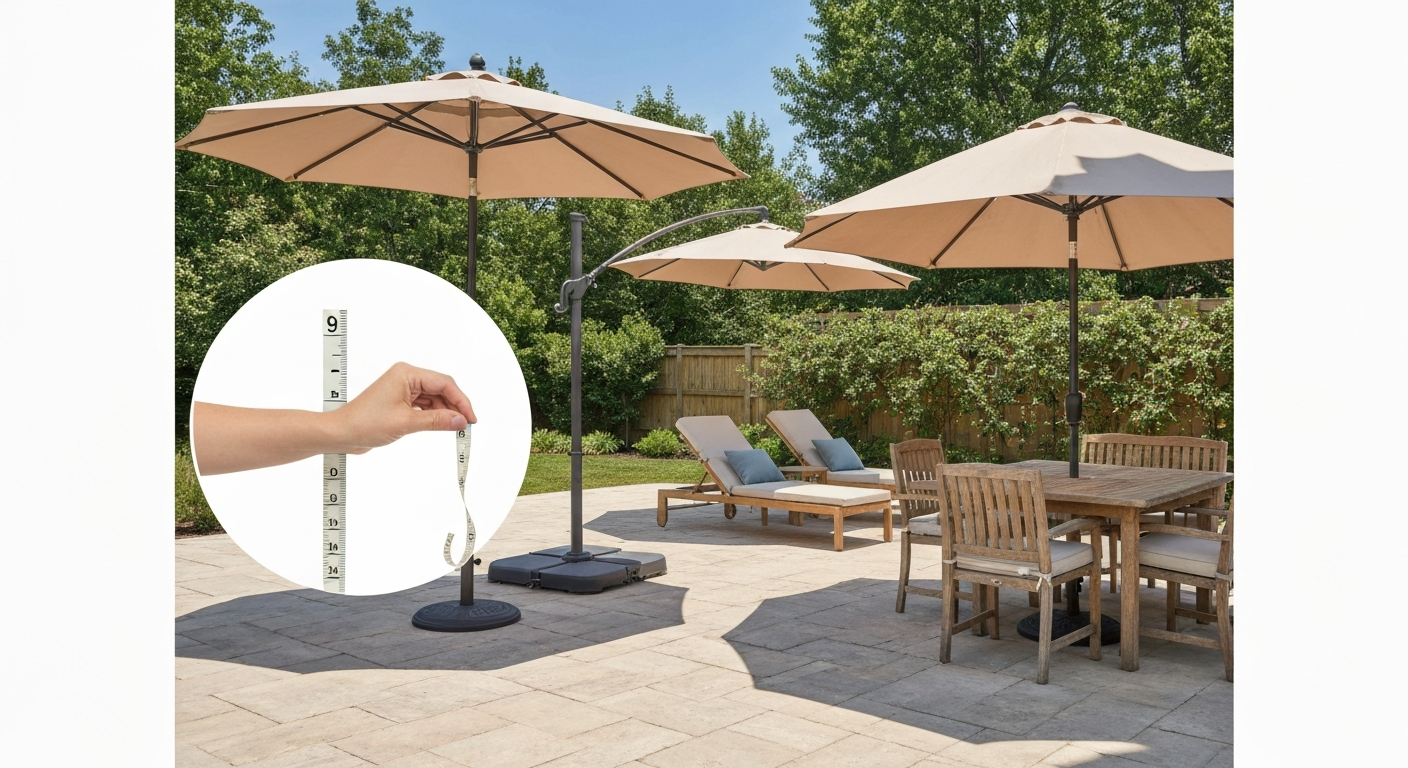
The best patio umbrella in 2025 depends on your setup, but for most homeowners with a standard dining table, a 9-foot market umbrella with a powder-coated aluminum pole, Sunbrella-grade solution-dyed acrylic fabric, and at least a 90-lb base will cover 90% of needs at a reasonable price. If you want shade without a center pole in the way, a cantilever or offset umbrella gives you that freedom but asks for a heavier base and a bigger budget. Here's how to pick the right one for your space. If you want a quick starting point, searching for the best patio umbrella on Amazon for your size and wind conditions can narrow the options fast.
Best Patio Umbrella 2025 Buying Guide by Size, Wind, Value

Kent Lang
17 May 2026
What 'Best' Actually Means in 2025: The Priority Checklist
The umbrella market hasn't changed dramatically in recent years, but the bar for what counts as 'good' has risen. More buyers are spending time outside, expecting their gear to last more than two seasons, and getting burned (literally and figuratively) by cheap canopies that fade, frames that corrode, or stands that tip over in the first real windstorm. Before you look at any specific model, run through this checklist to anchor your expectations.
- Wind stability: Will it stay put in a 20-30 mph gust without bolting to your neighbor's yard? Vented canopies and heavy bases are non-negotiable here.
- UV protection: A UPF 50+ rated canopy blocks over 98% of UV rays. This matters for skin protection, not just shade.
- Water and mold resistance: Solution-dyed acrylic fabrics repel moisture and resist mildew far better than polyester alternatives.
- Frame durability: Aluminum won't rust; fiberglass ribs flex instead of snapping; steel looks sturdy but corrodes without a quality powder coat.
- Ease of use: A smooth crank open and a push-button or auto-tilt mechanism means you'll actually use the umbrella daily instead of fighting it.
- Right size for your space: An undersized canopy leaves half your table baking; an oversized one overwhelms a small deck.
- Base compatibility: Every umbrella needs a properly weighted stand. Getting this wrong is the single most common setup mistake.
If an umbrella checks all seven boxes, it's a serious contender regardless of brand. If you are specifically shopping for the best patio umbrellas 2024, use this same checklist to narrow down the most durable, wind-ready models. If it skips even one (say, a flimsy 35-lb base with an 11-foot canopy), that's a real-world problem waiting to happen.
Top Picks by Umbrella Type: Market, Cantilever, and Offset
Market Umbrellas: The Reliable Everyday Pick
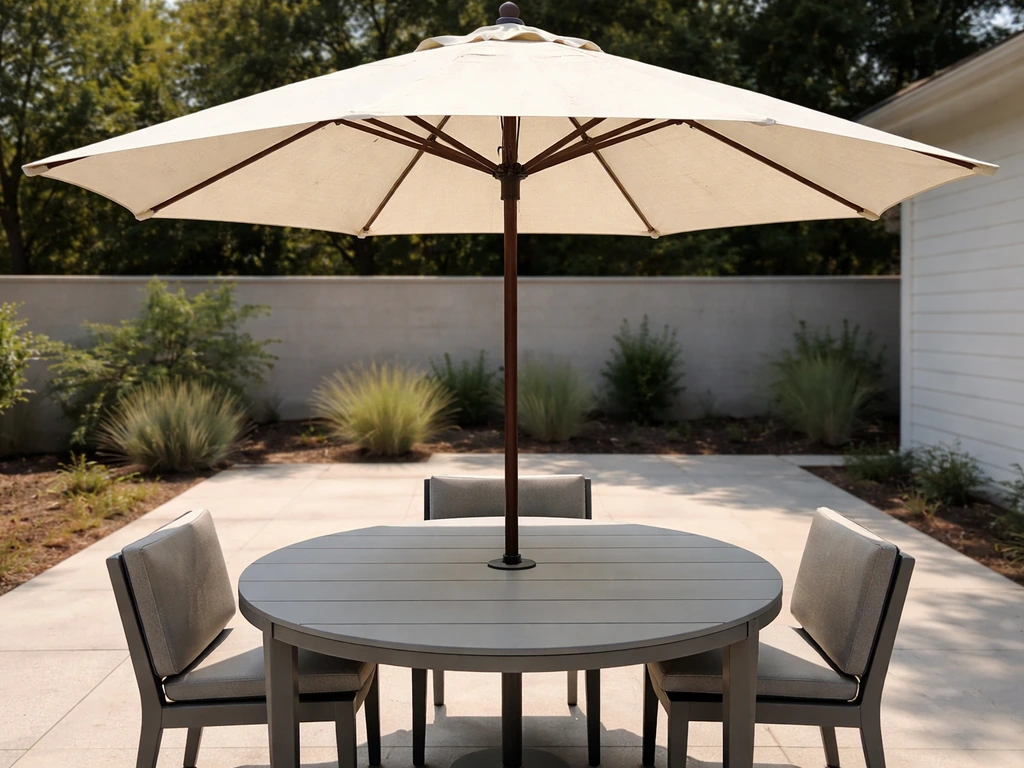
Market umbrellas have a center pole that runs straight through a hole in your patio table. They're the most common style for good reason: they're stable, straightforward, widely available, and range from $80 budget buys to $600+ commercial-grade options. The sweet spot for most homeowners is a 9-foot aluminum-frame model with a crank lift and push-button tilt, running $150 to $350. At the commercial end, brands like American Holtzkraft build market umbrellas with rotating canopies and double venting that survived 74.5 mph winds in tunnel testing. That level of engineering is overkill for most patios, but it tells you what quality construction can handle. For everyday buyers, look for double-vented canopies, a 1.5-inch or larger pole diameter, and solution-dyed acrylic fabric.
Market umbrellas are best for: anyone with a standard round or square dining table who wants a clean, no-fuss setup. If you hate the idea of a pole in the middle of your table, though, this style isn't for you.
Cantilever Umbrellas: Maximum Shade Flexibility
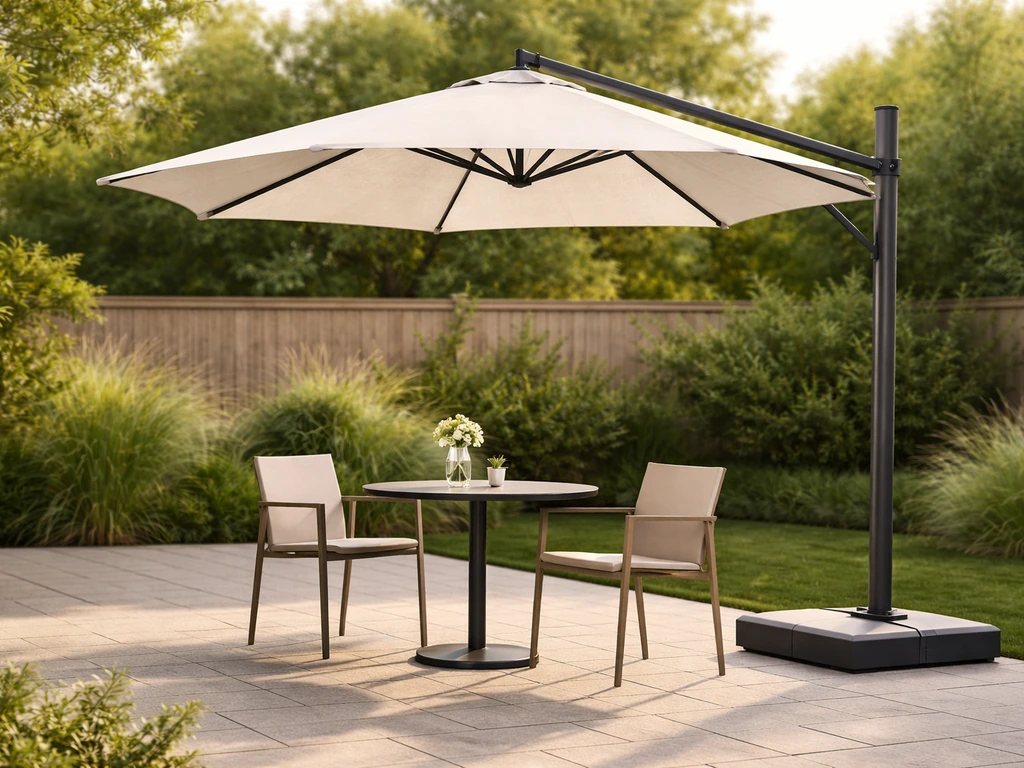
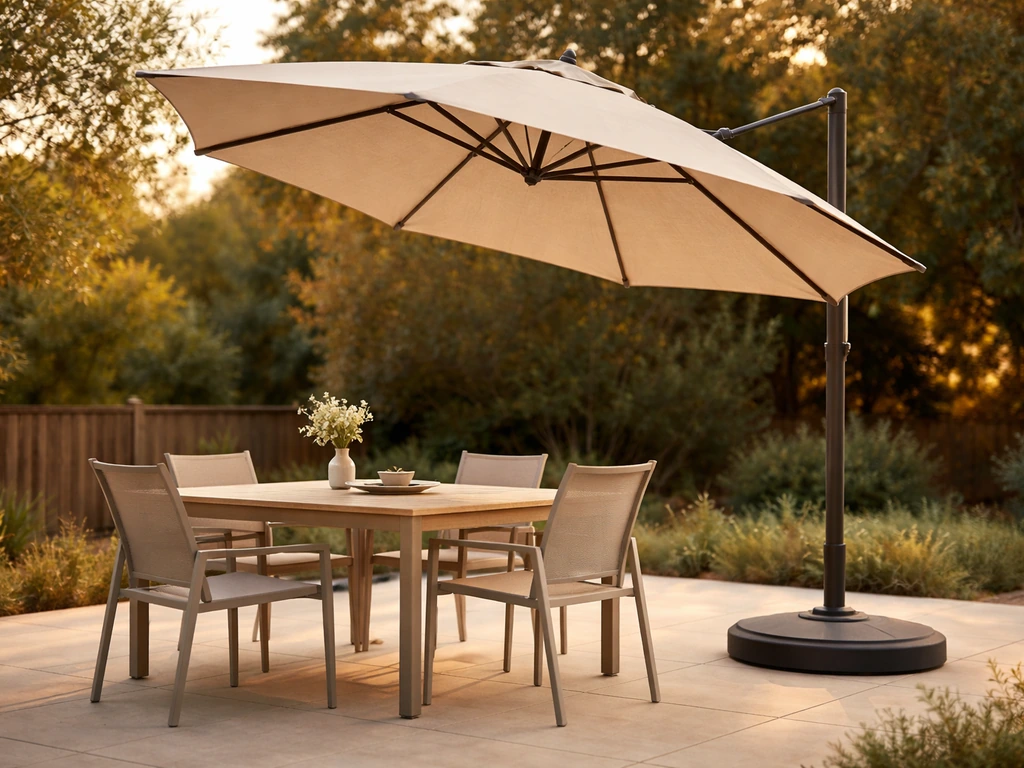
Cantilever umbrellas have an offset arm that extends the canopy out from a side post, leaving the area underneath completely open. No pole through your table, no obstruction in the middle of your seating area. Treasure Garden's AG25T is a well-regarded 11.5-foot cantilever that's been a benchmark in this category, featuring infinite tilting front-to-back and left-to-right, a built-in light adapter, a double wind vent, and a protective cover included. Their AKZP Plus model similarly offers crank lift with infinite tilt plus lateral adjustment angles. These aren't cheap (expect $500 to $1,500+), but they deliver genuine shade control you simply can't get from a market umbrella. The trade-off is that cantilevers demand serious base weight, sometimes 150 lbs or more depending on canopy size, and the arm structure means they catch more wind force than a straight-pole design.
Cantilever umbrellas are best for: lounge seating areas, sectional sofas, or any space where a center pole would be in the way. They're also excellent for covering a hot tub or poolside chairs where you need shade to track the sun through the day.
Offset Umbrellas: The Overlapping Category
In the industry, 'offset' and 'cantilever' are often used interchangeably, and for practical purposes they describe the same basic design: a side-mounted pole with an extending arm. Some manufacturers use 'offset' specifically for smaller, more budget-friendly versions (8 to 10 feet, single-pivot tilt) while reserving 'cantilever' for larger, multi-directional premium models. If you see an offset umbrella under $300, it's likely a lighter-duty version of the cantilever concept. These can work fine for occasional use, but don't expect the same wind performance or tilt precision you'd get from a true cantilever. For regular daily use in a windy area, step up to a proper cantilever with a heavy cross base.
Getting the Size Right for Your Table and Space
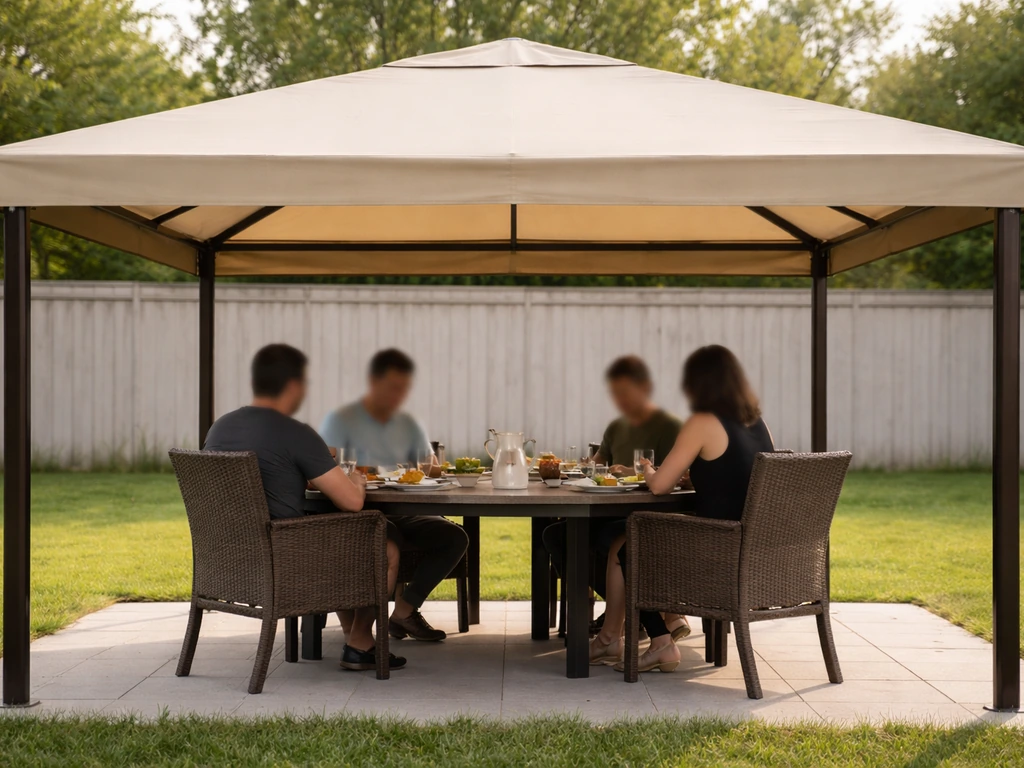
Sizing is where a lot of buyers go wrong. The goal is to have the canopy extend at least 2 feet beyond the edge of your table on all sides, so seated guests stay shaded even when the sun is at an angle. A 9-foot umbrella works well for a 4-seat table up to about 48 inches in diameter. A larger 6-seat or 8-seat table typically needs an 11-foot canopy. Bar-height tables add another wrinkle: the standard umbrella pole height may leave guests ducking under the canopy edge, which is why some manufacturers offer bar-height specific models or pole extenders.
| Table Size / Use Case | Recommended Canopy Diameter | Typical Coverage Area | Height Consideration |
|---|---|---|---|
| Small bistro or 2-seat table (up to 36") | 7 to 7.5 feet | ~38 sq ft | Standard pole height works |
| 4-seat dining table (up to 48") | 9 feet | ~64 sq ft | Standard pole height works |
| 6-seat dining table (up to 60") | 10 to 11 feet | ~79-95 sq ft | Confirm clearance for seated guests |
| 8-seat or large dining table (60"+) | 11 to 13 feet | ~95-133 sq ft | May need extended pole or cantilever |
| Lounge / sectional / pool area | 11 to 13 feet cantilever | ~95-133 sq ft | Cantilever arm adjusts to coverage zone |
| Bar-height table | 9 feet (bar-height model) | ~64 sq ft | Use bar-height umbrella or pole extender |
One practical note on height: the Treasure Garden AG25T 11.5-foot cantilever publishes specific canopy height and valance clearance specs in its spec sheet, and this kind of documentation is worth checking before you buy any large umbrella. Clearance at seated and standing height matters more than people expect, especially under a pergola or covered deck edge.
Wind Stability and Base Setup: Don't Get This Wrong
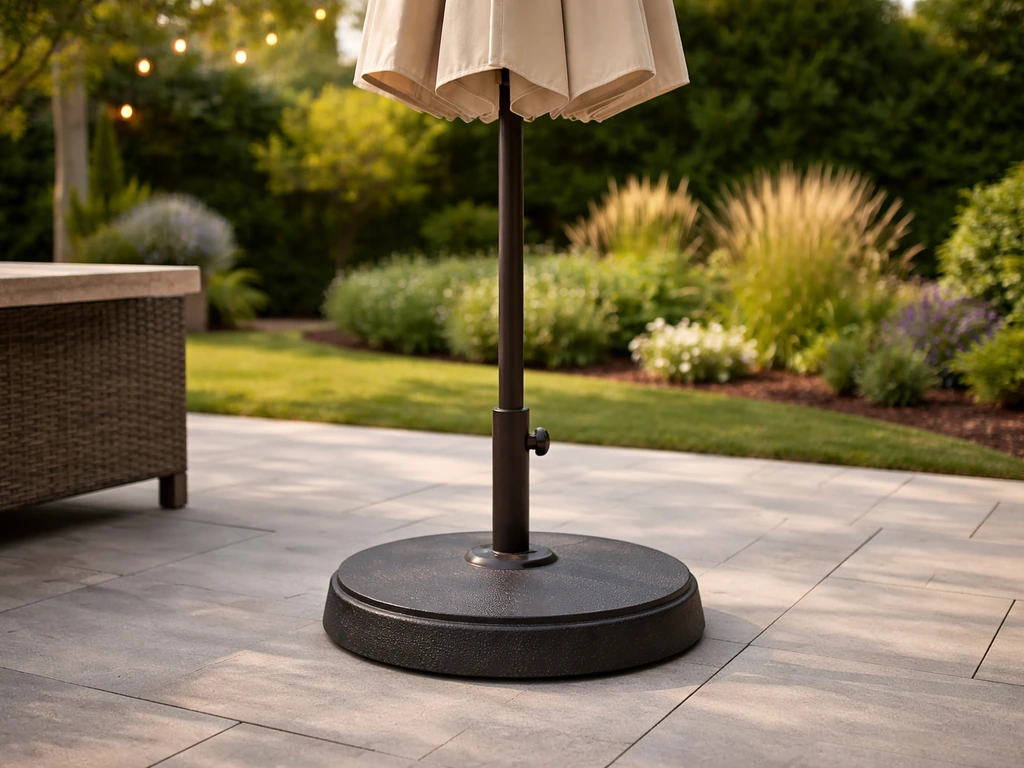
The number one complaint about patio umbrellas, across every price range, is that they tip over or blow away. This is almost always a base weight problem, not an umbrella quality problem. The widely used guideline is 10 pounds of base weight per foot of canopy diameter. That means a 9-foot umbrella needs at least a 90-lb base, and an 11-foot umbrella needs at least 110 lbs. These are minimums for low-wind conditions. If you're in a breezy area or on an elevated deck, add more weight or look for cross-base designs that distribute load more effectively.
For cantilever umbrellas, the offset arm creates more leverage, so the base weight requirements jump considerably. Many quality cantilever setups use cross bases with multiple fill chambers for water or sand, letting you add 150 to 200 lbs of ballast. Even then, it's worth anchoring the base to a deck if the option exists.
Vents, Cranks, and Structure
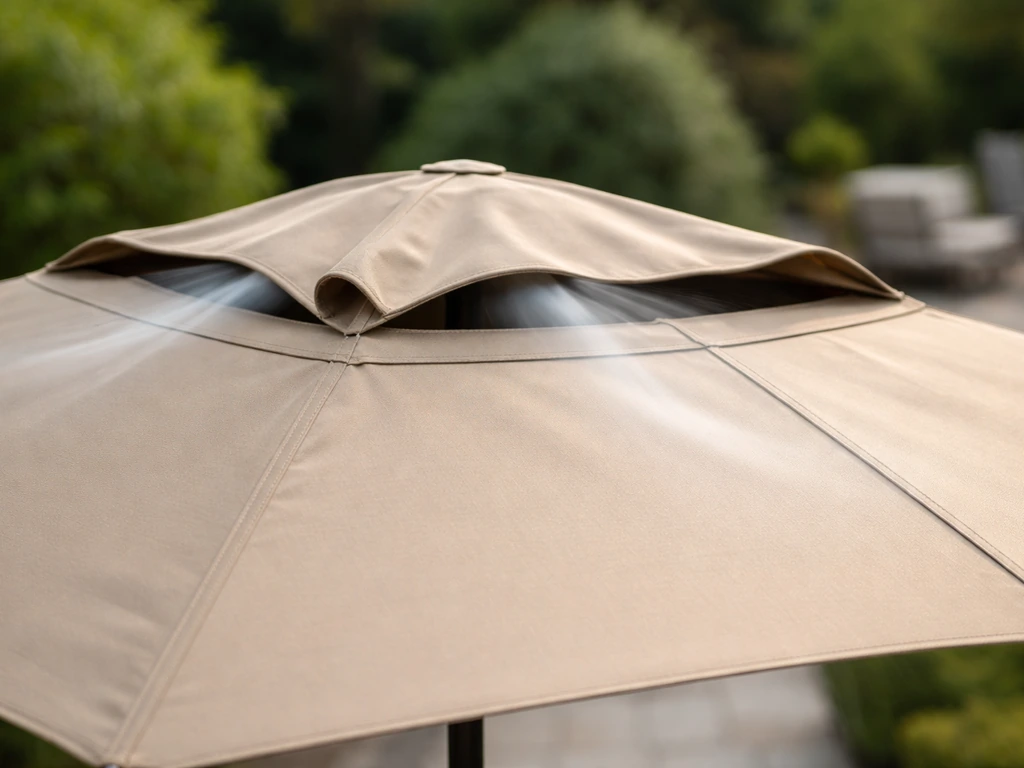
Double wind vents in the canopy make a real difference. The vents let wind pass through instead of lifting the canopy like a sail, which dramatically reduces the force transferred to the pole and base. Single-vent designs help; double vents help more. On the mechanism side, a crank-lift open is the standard and works well. What separates good cranks from bad ones is gear quality: a cheap crank will strip or freeze after a couple of seasons. The Treasure Garden AKZP Plus uses a crank lift paired with infinite tilt, which is the combination to look for: smooth open and precise angle control without having to fight the mechanism.
One important note: most manufacturer warranties, including Treasure Garden's 2025 catalog language, explicitly exclude wind damage from coverage. That means the responsibility for proper base setup falls entirely on you. No umbrella, regardless of price, is warranted against being knocked over in a storm.
Materials and Durability: Frame and Fabric Breakdown
Frame Materials
| Frame Material | Rust/Corrosion Resistance | Weight | Durability | Best For |
|---|---|---|---|---|
| Aluminum (powder-coated) | Excellent | Light | Very good | Most setups, especially coastal or humid climates |
| Fiberglass ribs + aluminum pole | Excellent | Light to medium | Excellent (ribs flex in wind) | Windy areas, everyday heavy use |
| Steel (powder-coated) | Fair (rusts if coating chips) | Heavy | Good short-term | Budget setups in mild climates |
| Wood (teak or hardwood) | Good with treatment | Heavy | Excellent aesthetics, needs maintenance | Traditional or luxury aesthetic setups |
For most buyers, an aluminum frame with fiberglass ribs is the practical best choice. The aluminum won't corrode, and fiberglass ribs flex under wind load rather than snapping like aluminum ribs can. Steel looks sturdy in photos but is a liability once moisture gets through the powder coat. Teak looks gorgeous but needs annual oiling and costs significantly more.
Canopy Fabric
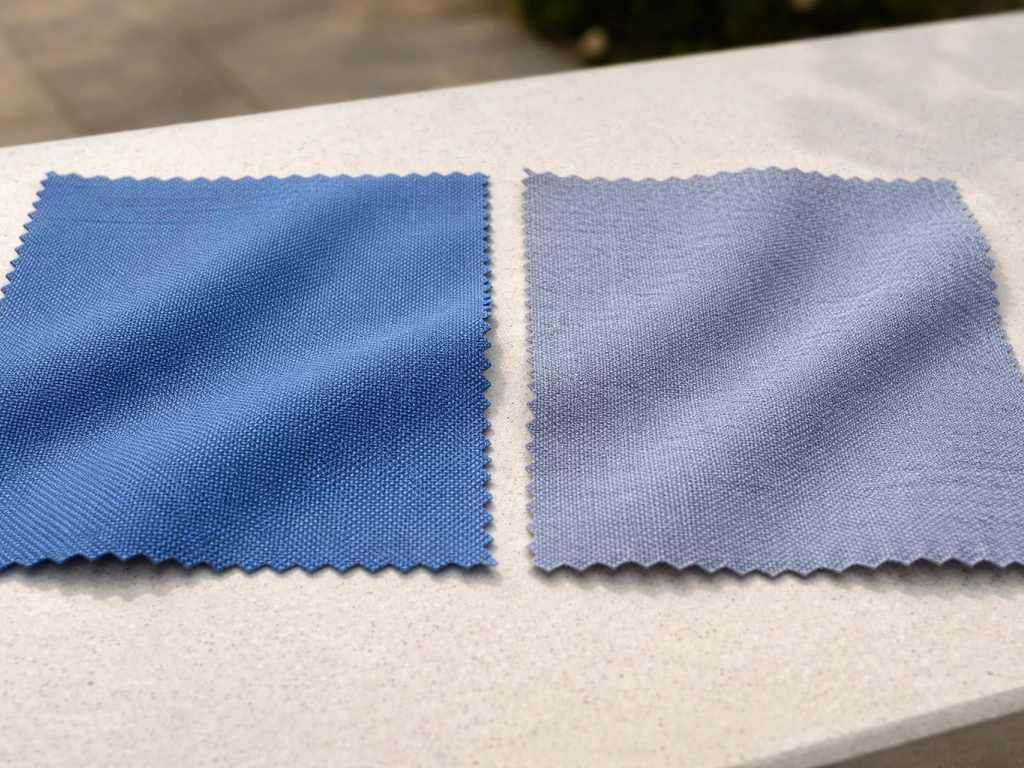
Fabric is where you feel the difference between a $150 umbrella and a $400 one most acutely after two summers. Solution-dyed acrylic, most famously made by Sunbrella, is the benchmark. The dye is embedded in the fiber before it's spun, meaning the color goes all the way through. Sunbrella specifically states their fabrics are resistant to mold and mildew, and that colors stay brilliant over time regardless of environment. That's not marketing fluff in this case: the solution-dyed process genuinely outperforms surface-printed polyester, which fades visibly within one to two seasons in direct sun. Look for UPF 50+ ratings and check whether the fabric is solution-dyed (usually listed in specs) or merely treated with a UV-resistant coating, which degrades over time.
Performance Features Worth Prioritizing in 2025
The umbrella feature set hasn't been completely reinvented, but a few things have become table stakes in the current market that were once premium add-ons.
- Infinite tilt (not just 3-position): Older tilting mechanisms click into three preset angles. Infinite tilt, like what Treasure Garden uses on the AG25T and AKZP Plus, lets you angle the canopy to exactly follow the sun. It's noticeably better for afternoon shade when the sun is low.
- Multi-directional tilt (cantilevers): Front-to-back tilt alone limits your shade control. Models with both front-to-back and left-to-right adjustment give you full range to track the sun through the day without moving the base.
- Double wind vents: Standard on better models; skip any umbrella that doesn't include at least one vent if you're in an area with wind.
- Built-in LED lighting: Some cantilever models, including the Treasure Garden AG25T, have a built-in light adapter. Useful if you use the patio into the evening. It's not a dealbreaker, but it's a legitimate quality-of-life feature.
- Protective cover inclusion: A storage cover protects the canopy from UV degradation and pollen when not in use. Some brands include it; others charge extra or don't offer one at all.
- Crank with gear stop: Cheap cranks can be wound too far and damage the ribs. A gear stop or auto-stop crank is a small but meaningful detail on daily-use umbrellas.
- Pole collar compatibility: If you're inserting a market umbrella into a table with a different pole hole diameter than your umbrella pole, check for collar adapters. Most quality umbrellas ship with one or more collar sizes.
Budget vs. Splurge: Where to Put Your Money
There are genuinely good umbrellas at every price tier, but the performance gaps are real. Here's an honest breakdown of what you get at each level.
Best Budget: Under $150
At this price, you're getting a 9-foot steel or basic aluminum market umbrella with a polyester canopy, a simple push-button tilt, and no wind vents. It'll work. The canopy will start fading by year two, and the frame may show corrosion in humid climates. The base is almost certainly sold separately and you'll need to budget another $40 to $80 for a decent one. Budget picks are fine for occasional use or a rental property, but don't expect them to last more than three seasons. If this is your starting point, prioritize a model with at least one vent and a crank lift instead of a simple push-pole mechanism.
Best Midrange: $150 to $400
This is where patio umbrellas get genuinely good. At $200 to $350, you can find a 9-foot aluminum-frame umbrella with fiberglass ribs, a solution-dyed acrylic canopy (sometimes Sunbrella or a comparable brand-name fabric), double vents, infinite or multi-position tilt, and a smooth crank. This is the sweet spot for most homeowners. Brands like California Umbrella, Abba Patio, and others offer strong options in this range. You'll still want to invest in a proper base, which typically runs $60 to $120 for a sand-fill or water-fill stand at this tier. A midrange setup done right can easily last five to seven years.
Best Splurge: $400 to $1,500+
Above $400, you're buying commercial-grade construction, premium brand fabrics (Sunbrella, Outdura), and features like infinite multi-directional tilt, integrated lighting, and heavier-duty hardware throughout. Cantilever models from Treasure Garden, Galtech, or Frankford sit in the $500 to $1,200 range and represent a significant quality step up in frame engineering and weather resistance. At $1,000+, you're looking at the kind of umbrella that a restaurant patio uses: built to take daily abuse for a decade. For most homeowners, the $400 to $700 range is the practical ceiling where diminishing returns kick in. If you're covering a large lounge area, want a cantilever with full multi-directional tilt, or live somewhere with serious wind or salt air, the splurge is worth it. If you just need shade over a 4-seat table on a calm suburban patio, $200 to $300 gets you there.
Value Guidance: How to Compare Options Quickly
When you're comparing two umbrellas at similar price points, check these four things in order: fabric type (solution-dyed acrylic beats everything else), frame material (aluminum with fiberglass ribs beats steel), vent count (two beats one), and tilt mechanism (infinite beats 3-position). If one umbrella wins three of four, it's probably the better buy. Also check whether a base is included or separate, because a $250 umbrella bundled with a 50-lb base is often a worse deal than a $280 umbrella sold without a base when you factor in buying a proper 90-lb stand separately.
One last practical note: reviews skew more useful on platforms with verified purchase data, and community discussions, including reader threads comparing year-over-year models and options from 2024 back through earlier seasons, often surface real-world durability data that spec sheets won't show. If you are shopping around the best patio umbrellas from 2017, use those verified-owner reviews to compare how older models held up best patio umbrellas 2017. If you are trying to narrow down the best patio umbrella, looking at Reddit discussions and owner threads can also surface real durability and wind-performance insights. If you're deciding between two finalists, search for owner reviews after the first full summer season, not just unboxing impressions.
FAQ
If I’m choosing between a 9-foot and an 11-foot umbrella, how do I know which one will shade my whole dining table?
A good quick rule is to measure the table edge and aim for the canopy to reach at least 24 inches beyond the table on each side when fully opened. If you are between sizes, go larger for dining, because tilt, sun angle, and uneven placement will reduce effective coverage.
How can I tell if my existing umbrella base will actually fit and work with the new umbrella I want?
Before buying, confirm whether the base you plan to use is a compatible stand, a removable filling tray, or a designed cross base. Many bases are sold separately and are only sized for market umbrellas, not cantilevers, so a “heavy” base can still be the wrong shape or mounting style.
What should I do differently for wind if the umbrella already has double vents?
If you live in a breezy area, don’t rely on minimum base weight alone. Increase ballast, add more base surface area (cross-base if available), and keep the umbrella closed during gusts or storms, since vents reduce lift but they do not eliminate wind load on the pole.
How do I verify whether a patio umbrella fabric is solution-dyed versus just UV-coated?
Solution-dyed acrylic is usually listed as “solution-dyed” or under a brand fabric spec, while UV-resistant coating sounds similar but is a surface treatment. If the listing does not clearly state solution-dyed and UPF rating, assume it will fade faster in direct sun and budget accordingly.
What features should I prioritize to avoid a crank or tilt mechanism failing after a year?
With a crank lift, the key wear points are the gears and the latch. Look for descriptions that mention stainless or corrosion-resistant hardware, smooth operation after opening, and a tilt system that uses multiple positions or continuous infinite tilt, then check for reviews that specifically mention crank reliability after a couple of seasons.
How do I make sure an umbrella will fit under my pergola or patio cover when fully tilted?
If the umbrella is going under a pergola or near a roof edge, clearance matters more than overall height. Look for canopy height, valance clearance, and whether the pole sits low or high relative to your seating, then dry-test opening and tilting with the umbrella in place (even before filling the base).
Will a standard umbrella work for a bar-height dining set, or do I need a special model or pole extender?
For bar-height seating, the umbrella needs either a bar-height specific model or a pole extender that preserves stability. Also confirm that the tilt still clears the table and that the canopy edge won’t drop low enough to force guests to duck.
Is it worth installing anchors for an umbrella base, and when should I avoid anchoring?
Don’t anchor the base unless your setup allows it. If there is no anchoring option, use a cross-base where available, keep the base centered on the load path, and consider adding ballast to reach or exceed the higher end of the recommended weight for your canopy size.
Does patio umbrella warranty coverage include damage from wind, or am I always responsible?
Most warranties exclude wind damage and often require that the umbrella be in the closed or secured position in certain conditions. Even if your umbrella is covered for fabric or frame defects, improper base setup may still leave you without protection for tip-overs.
When evaluating a sale, how do I decide whether a bundled base is actually a good value?
Yes, but it’s not always the best “value” choice. A bundled base can be underweight or the wrong type for cantilevers, so compare total cost to buy a properly sized stand (for example, meeting the canopy-to-base weight guideline) and check compatibility before you judge the deal.
What kind of review information should I look for if I’m trying to predict long-term durability in 2025?
Often, the most useful reviews are those posted after at least one full summer, not just after delivery. Filter for comments mentioning fading timeline, corrosion in humid areas, and whether the crank or tilt still operates smoothly after repeated adjustments.
Why does my umbrella keep tipping on a deck even if the base seems heavy enough?
If you are placing the umbrella on an elevated deck, minimum base weight may not be enough due to stronger gust effects and reduced friction. Raise your target ballast, prefer cross-base designs, and make it a habit to close it at the first sign of sustained gusts.