The best patio umbrella with lights is a cantilever or offset style with built-in LED strips running along the ribs, paired with a solar or rechargeable battery power system, and a heavy base of at least 50 lbs. That combination gives you the most flexible shade coverage, ambient light right where people sit, and zero cord management headaches.
Best Patio Umbrella With Lights: Offset and Cantilever Guide

Kent Lang
15 May 2026
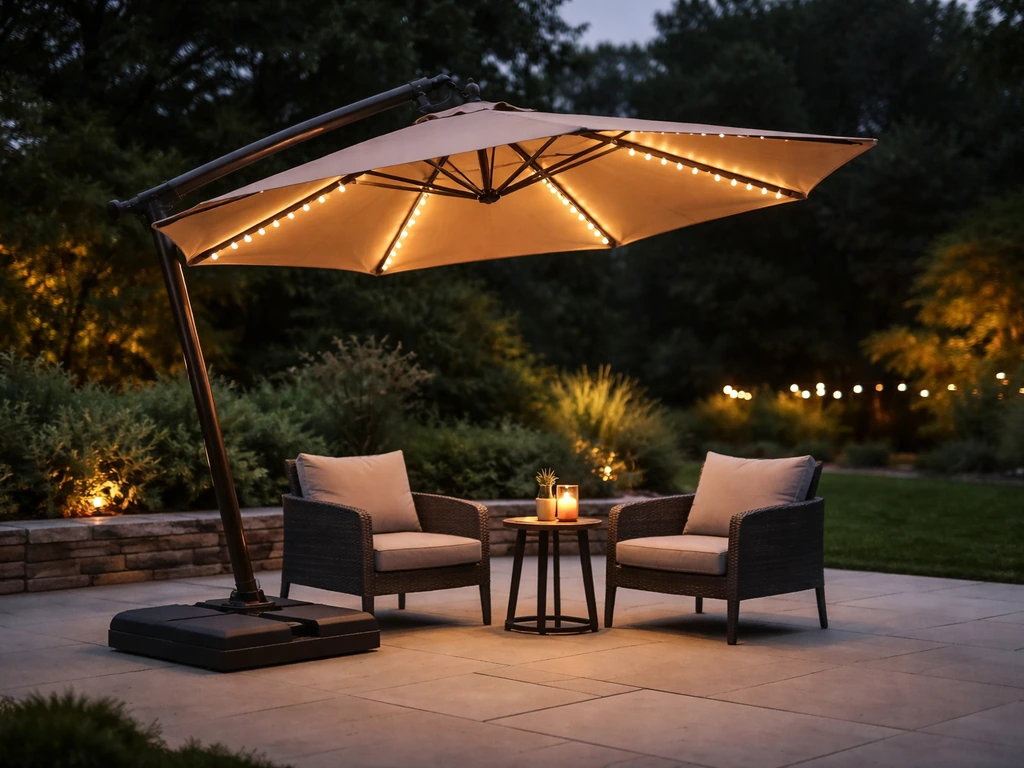
If you already own a quality umbrella, a rechargeable add-on light like the Treasure Garden VEGA-L (36 LEDs, 385 lumens, 6000K) clips onto the center pole and handles a 4 to 6 hour evening without running a single wire. Neither approach is perfect for every patio, so this guide walks through exactly how to pick the right setup for yours.
If you're specifically shopping for the best patio parasol, the same shade and lighting considerations help you pick a model that performs well in real outdoor conditions.
How to choose the best patio umbrella with lights
Start with the umbrella itself, not the lights. It sounds obvious, but a lot of buyers get dazzled by LED specs and end up with an underpowered canopy that doesn't actually shade their table or a frame that collapses in the first real wind. The lights are a feature; the umbrella is the product. Once you've nailed down the right style, size, and frame material, you layer in the lighting decision.
The four things that matter most, in rough order of importance: umbrella style and canopy placement relative to your seating area, light brightness and color temperature (lumens and Kelvin), power source practicality for your patio layout, and wind resistance with the added weight of lighting components. Everything else is secondary.
On brightness: patio umbrella LEDs are ambient light, not task lighting. Home Depot's outdoor lighting guidance places patio use in the "soft functional glow" category, which means you're targeting something in the 200 to 500 lumen range for the umbrella itself, supplemented by other light sources if needed.
Home Depot’s outdoor lighting guide explains that patio lighting is meant for a soft functional glow, which helps inform practical lumen targets like this range targeting something in the 200 to 500 lumen range for the umbrella itself. The Treasure Garden VEGA-L at 385 lumens sits right in that zone.
Reviewers consistently note that many LED umbrella systems look underwhelming once the sun is fully down and no other lights are on, so don't expect an umbrella light to replace a string light setup or porch sconce. Plan for it to add atmosphere and a usable glow over the table, not floodlight your yard.
Color temperature makes a real difference to how the light feels. The VEGA-L runs at 6000K, which is a cool, blue-white daylight tone. That's energizing, not relaxing. For evening entertaining, most people prefer 2700K to 3000K (warm white), which reads as softer and more inviting. If you're buying a pre-lit umbrella, check the Kelvin rating. Many budget options default to whatever LED is cheapest, which is usually cool white. Paying a little more for warm white LEDs, or choosing an umbrella with adjustable color temperature, is worth it.
LED vs built-in vs add-on: which light system actually works
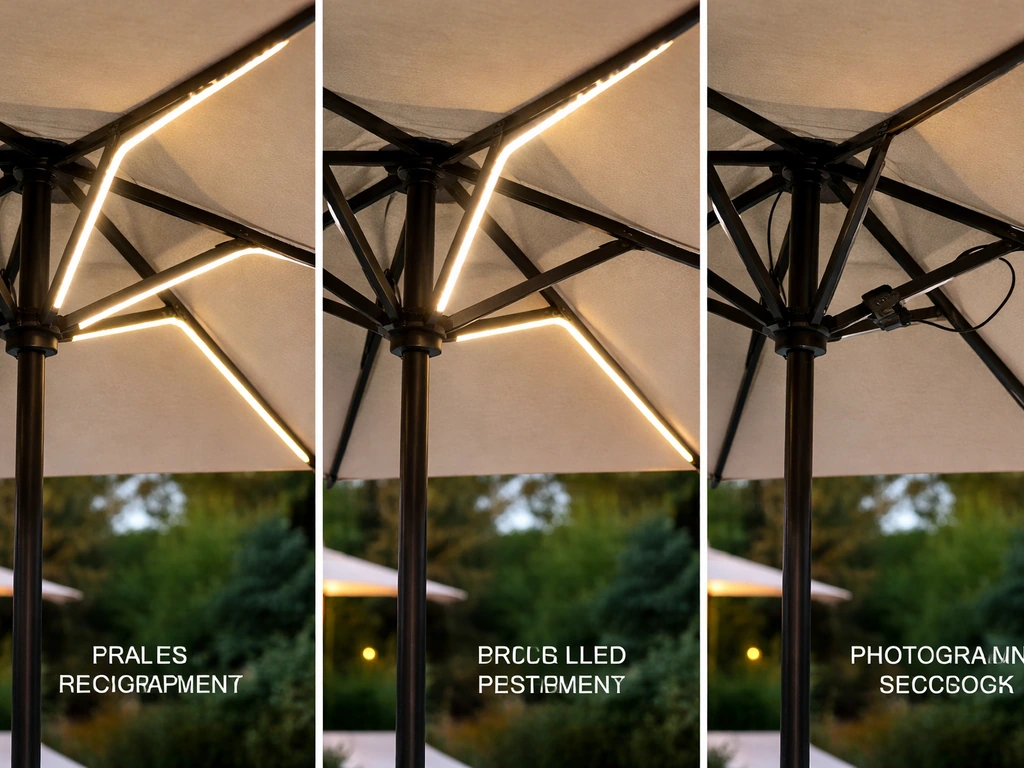
There are three real categories here, and they behave very differently in practice.
| Light System Type | How It Works | Best For | Key Limitation |
|---|---|---|---|
| Built-in integrated LEDs | LED strips wired into the ribs or canopy frame at the factory; controlled by a switch or remote | Clean look, consistent coverage, no add-on shopping | Can't be upgraded or replaced easily; tied to umbrella lifespan |
| Rechargeable add-on (e.g., VEGA-L) | Battery-powered light module clips onto center pole; charged separately via 110V outlet | Existing umbrellas, portability, no wiring | 4–6 hour runtime; not waterproof; requires remembering to charge |
| Solar-powered built-in | Panel on canopy top charges internal battery during the day; lights run at night automatically | Off-grid convenience, low maintenance | Dim in low-sun climates; panel placement limits canopy aesthetics |
Built-in factory LEDs, like those on the Galtech 986 auto-tilt umbrella, wire the control housing near the tilt and crank mechanism. That's elegant and durable when new, but it means any electrical fault requires professional repair or full umbrella replacement. The integration is clean and the light coverage across the ribs is usually even, but you're committing to that umbrella for the long run.
Rechargeable add-ons like the VEGA-L are genuinely useful if you already own a good umbrella or you want flexibility. The VEGA-L attaches to center poles up to 2 inches in diameter and also supports cantilever umbrella adapters, so it fits most setups. The catch: it takes about 6 hours to fully charge and gives you 4 to 6 hours of light. The manual is very clear that it is not waterproof, only tolerating light moisture, so you need to bring it inside or cover it before rain. That's a real maintenance commitment that a lot of buyers underestimate.
Solar-powered integrated systems are convenient but usually the dimmest option. They're worth considering if your patio gets 6-plus hours of direct sun daily and you want zero cord management. For an option that prioritizes daylight charging over plug-in wiring, see also the best solar patio umbrellas for guidance on panel expectations and brightness limits.
For more detail on solar-specific options, the guides on best patio umbrellas with solar lights and best solar patio umbrellas go much deeper on panel specs and brand comparisons. If you want a solar option, look for models like the better homes and gardens patio umbrella with solar lights that are designed for real outdoor sun exposure.
For a deeper look at solar options and panel performance, check the guide on the best patio umbrellas with solar lights solar panel on the canopy top.
Cantilever vs offset vs standard market umbrella: which style suits your setup
The style of umbrella determines where the canopy sits relative to your seating, and that directly affects how useful the integrated lights actually are. A light mounted inside a canopy that's centered over nothing is decorative at best.
Standard market umbrella
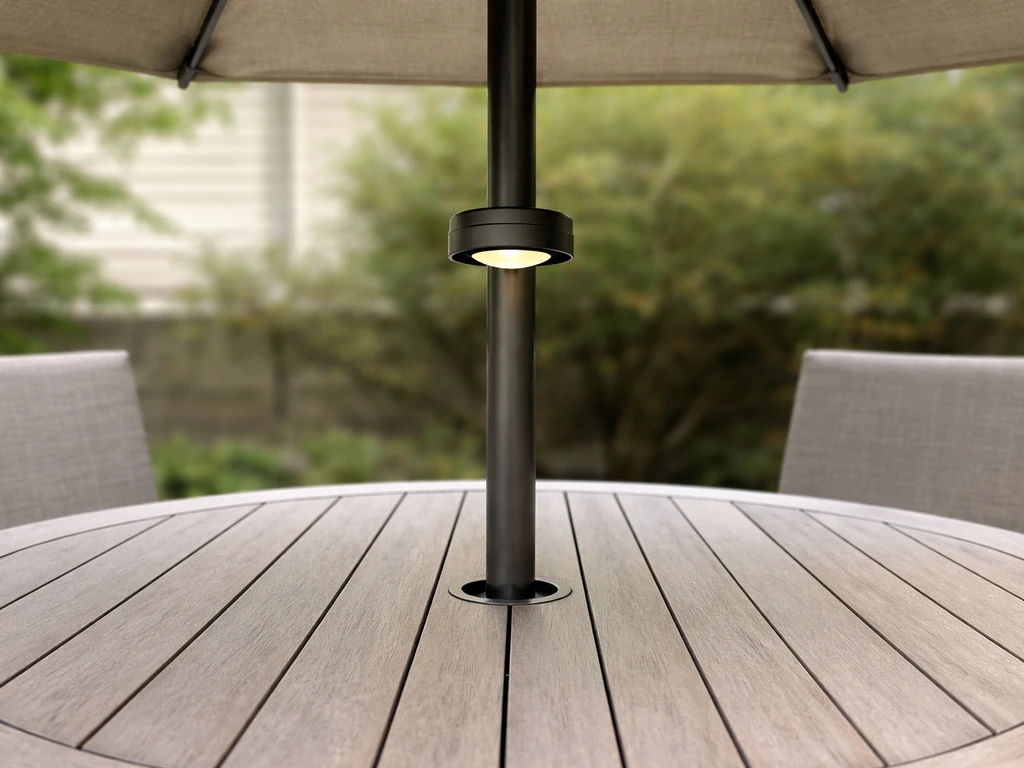
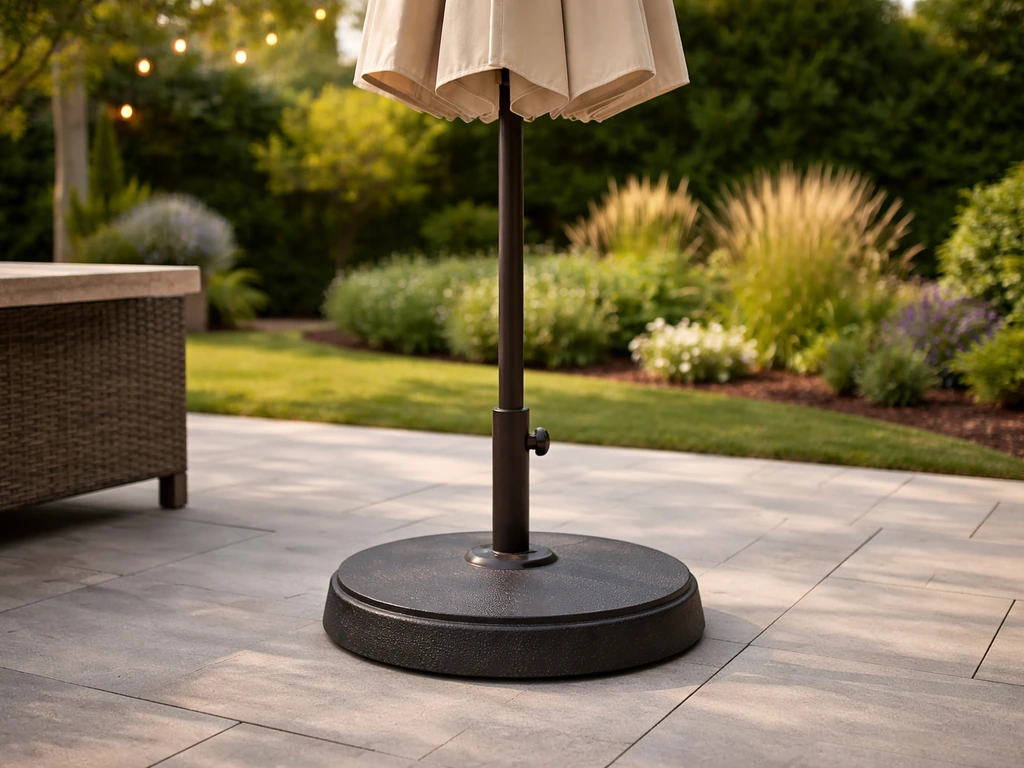
A center-pole market umbrella fits through a hole in your patio table, which puts the pole and any pole-mounted lights directly above the table center. This is the most stable and usually least expensive option. The light shines straight down onto the table, which is practical for dining but doesn't spread much to surrounding seating. If your setup is a single table with chairs, this works well. LED strips along the ribs help push some light outward. The Galtech 986 is a good example: its auto-tilt allows up to 30 degrees of canopy angle, which shifts both shade and light coverage, though integrated lights will angle with the canopy and may create some glare if tilted toward eye level.
Offset and cantilever umbrellas
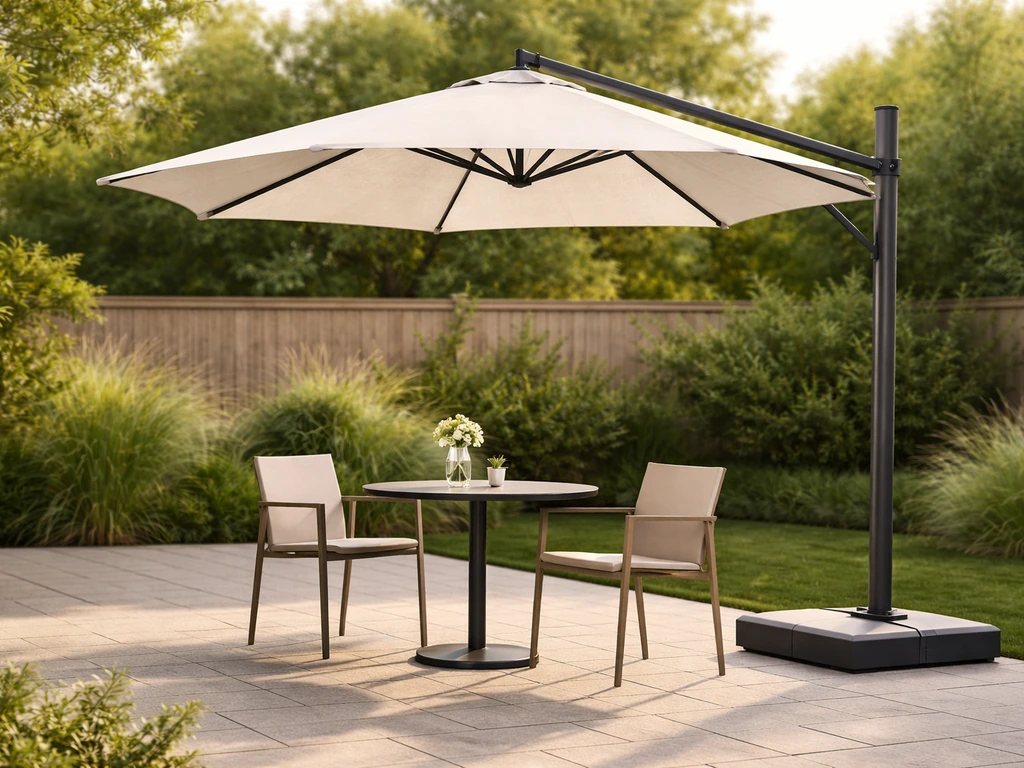
Cantilever and offset umbrellas both position the pole to the side, leaving the canopy floating free over the seating area with no pole in the way. This is the better choice for lounge chairs, sofas, or any seating arrangement that doesn't have a center hole for the pole. Lighting-wise, integrated LEDs on a cantilever canopy shine down on the whole seating zone without a pole blocking sightlines.
The trade-off is weight and base requirements: cantilever umbrellas need significantly heavier bases because the canopy is off-center, and that weight requirement only increases if you're adding a battery module or light hardware. Many buyers searching for the best offset patio umbrella with lights or best cantilever patio umbrella with lights underestimate how much base weight they need. Plan for a minimum 75 to 100 lbs for a cantilever in any exposed location.
If you're comparing these styles more broadly, the best lighted patio umbrella guide covers top-rated models across all three style categories with brand-specific recommendations.
Sizing and placement: getting the light where it needs to go
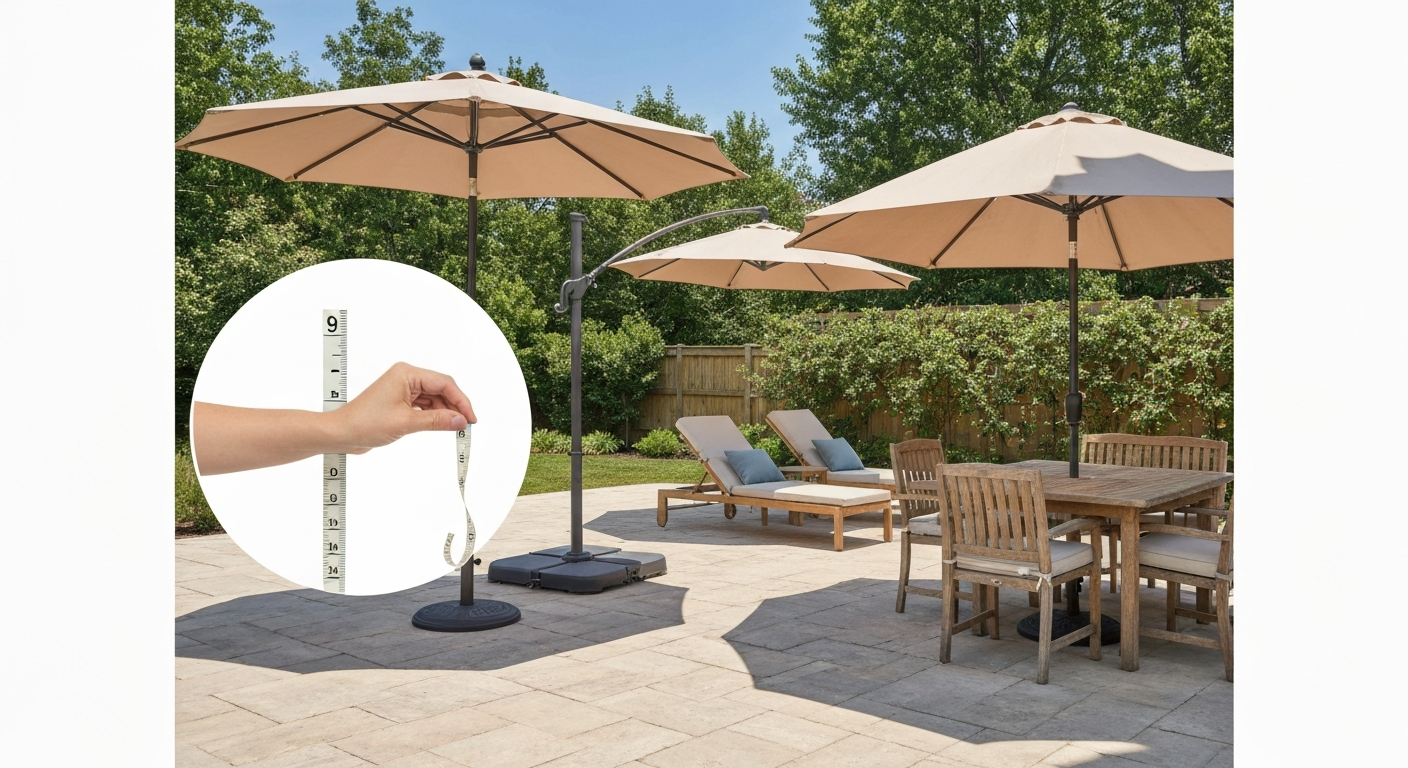
Umbrella sizing guidance from PatioWell and other manufacturers generally recommends going 2 feet larger than the seating area you want to cover on each side. A 6-foot diameter table typically needs a 9-foot umbrella. For cantilever styles covering a lounger or sectional, you might be looking at an 11-foot or larger canopy. This sizing logic applies directly to lighting: a properly sized canopy puts integrated LEDs directly above the people using the space. PatioWell’s patio umbrella measuring guide recommends sizing the umbrella for the seating area and accounting for wind-resistance needs based on local conditions before you choose an illuminated option. An undersized canopy means the lights are off to the side of where people actually sit.
Clearance matters too. Cantilever umbrellas typically hang 7 to 8 feet above ground at the canopy edge. For dining, you want the underside of the canopy to clear seated head height by at least 18 to 24 inches; for standing clearance near a grill or bar, aim for 6.5 feet minimum. If the umbrella hangs lower than expected, integrated rib-mounted LEDs can shine directly into seated guests' eyes. The Galtech 986's 30-degree tilt is a good reminder that tilt angle affects glare, especially with LEDs that have a narrow beam angle.
Wind stability when your umbrella is carrying lights
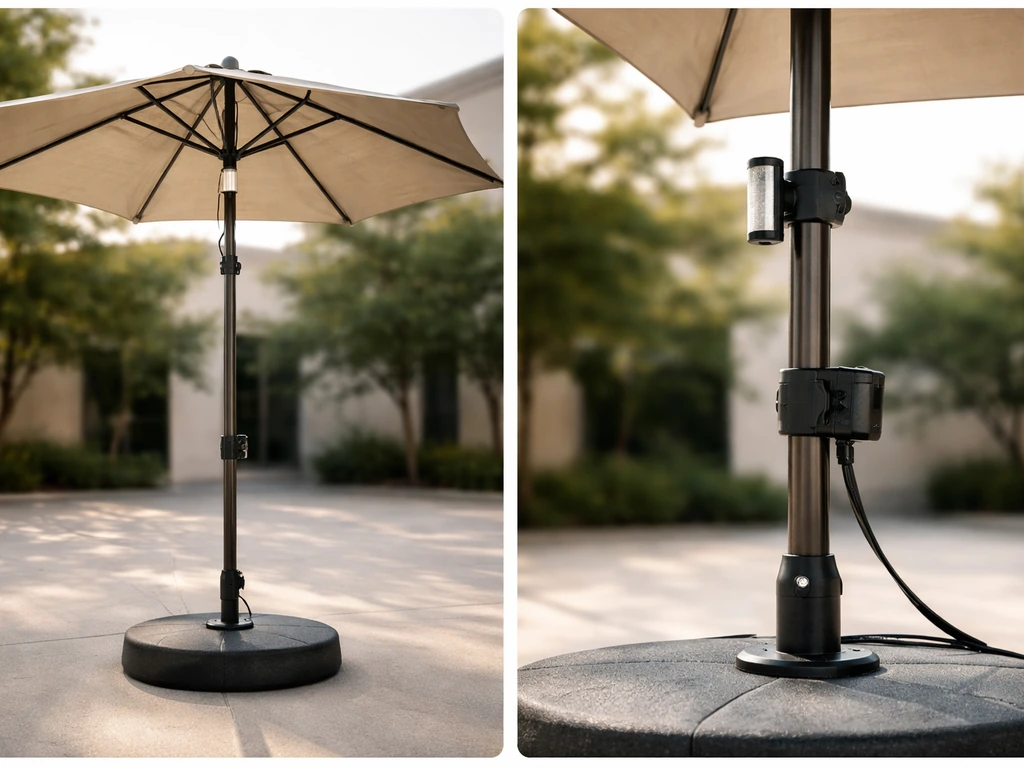
Adding lighting hardware to an umbrella, whether that's a battery module clamped to the pole or factory-wired LEDs in the ribs, adds weight and in some cases wind resistance. The general rule is that a center-pole market umbrella handles wind better than a cantilever because the pole is directly below the canopy's center of gravity. Bob Vila's patio umbrella wind guidance reinforces this, noting that cantilever umbrellas can still perform well in wind if they have proper wind-resistant features, but they require more care and heavier bases.
The practical threshold most manufacturers suggest is to close any umbrella when sustained winds exceed 20 to 25 mph, and close cantilever styles even sooner, around 15 to 20 mph, especially if the base isn't maxed out in weight. If you live somewhere with regular afternoon gusts, this matters a lot for your lighting investment: a battery module like the VEGA-L can take physical impact damage if the umbrella whips in wind with the module clamped on. Built-in LEDs wired into the ribs are more protected because the wiring is inside the frame, but a hard gust-driven inversion of the canopy can still damage LED strips along the ribs.
- Close any lighted umbrella when sustained wind hits 20 mph or more
- For cantilever styles with add-on battery modules, the threshold drops to around 15 mph
- Remove or detach clip-on light modules before storing the umbrella for the season or before storms
- Look for umbrella frames with fiberglass or flexible ribs, which flex instead of snapping in gusts
Power options and weather safety
This is where a lot of buyers get into trouble, either by ignoring safety entirely or by overcomplicating a system that just needs a GFCI outlet and a covered plug.
Battery-powered
Rechargeable battery systems like the VEGA-L are the simplest and safest option for most patios. No outdoor wiring, no extension cords across the patio, no GFCI concerns. The downside is runtime: 4 to 6 hours per charge means a long dinner party or late evening on the patio might outlast the battery. Charge it the day before, not the hour before, since a full charge takes about 6 hours from a 110V outlet. Charge it fully before first use and before storing it at the end of the season. Because it's not waterproof, bring the module inside if rain is expected.
Solar-powered
Solar is the lowest-maintenance option but the most weather-dependent. In a climate with reliable summer sun, a solar panel on the canopy top can charge enough for 4 to 6 hours of low-level light. In a cloudy or tree-shaded patio, you'll often get an hour or two at best. Solar-specific comparisons are worth reviewing separately if this is your preferred approach.
Plug-in (hardwired or cord-connected)
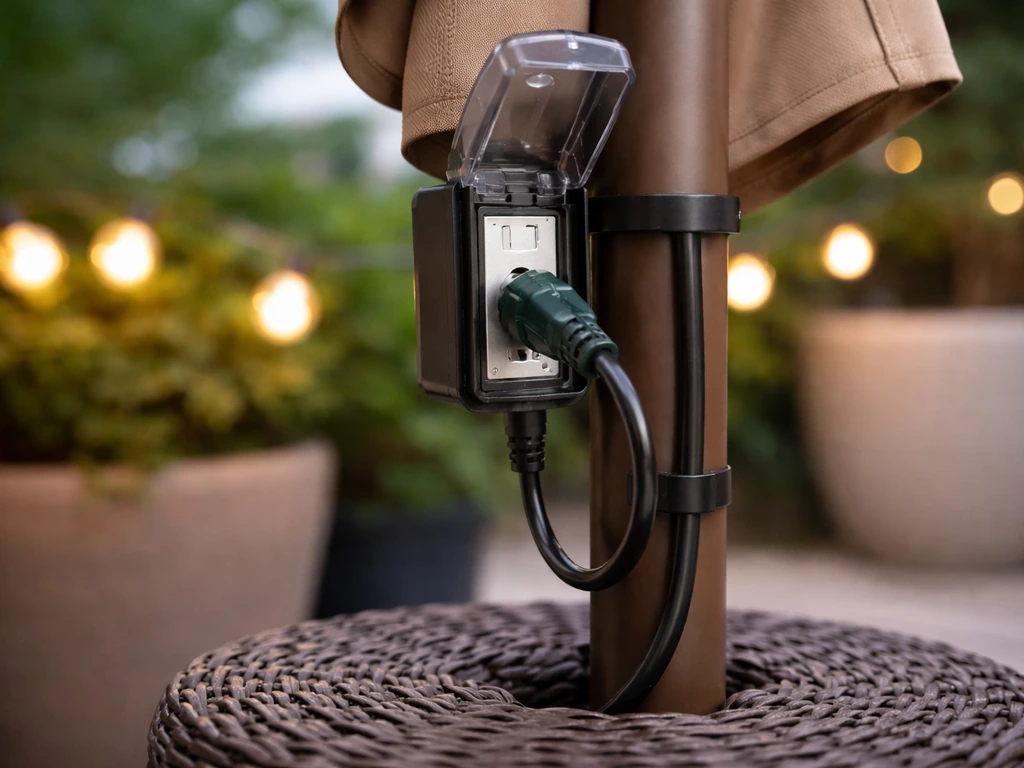
If you want consistent, bright light every night without thinking about charging, a plug-in LED system is the answer, but it comes with real safety requirements. Any outdoor outlet used for umbrella lighting must be GFCI-protected and have a weather-resistant in-use cover. This is not optional; it's NEC code and the guidance from both IAEI and manufacturers like Feit Electric is consistent on this point.
String lights added around or inside an umbrella canopy should meet UL 588 Supplement SD (the outdoor string light safety standard) and plug into that covered GFCI outlet only. Don't run extension cords from an unprotected interior outlet. If your patio doesn't have a GFCI outlet, have one installed by an electrician before you set anything up.
Base requirements and setup for lighted umbrellas
A lighted umbrella is heavier than a plain one. Even a relatively light battery module adds a pound or two clamped near the top of the pole, which raises the umbrella's center of gravity slightly and increases tip-over risk if the base is undersized. Here are the baseline recommendations by style:
| Umbrella Style | Minimum Base Weight | Notes |
|---|---|---|
| Standard 7.5 to 9 ft market | 50 lbs | Table-mount base counts toward this if the table is heavy enough |
| Standard 10 to 11 ft market | 75 lbs | Increase to 100 lbs in any exposed or windy location |
| Offset / cantilever 10 to 11 ft | 75 to 100 lbs | Off-center load demands more base weight; don't go under 75 lbs |
| Cantilever 13 ft or larger | 100 lbs or more | Consider a freestanding concrete or sand-fill base rated for the specific model |
Pole diameter is also a compatibility issue for add-on lighting. The VEGA-L, for example, maxes out at a 2-inch center pole diameter. Most standard market umbrellas use a 1.5-inch pole, which is fine. Some heavy-duty commercial-grade or extra-large umbrellas use 2.5-inch or even 3-inch poles, which won't fit standard clip-on accessories without an adapter. Check your existing pole diameter before ordering any add-on light system.
Clearance from the ground to the underside of the canopy is often listed in the umbrella specs. For cantilever models, the canopy typically clears 7 to 8 feet. For market umbrellas through a table, the canopy bottom may only be 5.5 to 6.5 feet off the ground, which means taller guests need to be aware of rib ends, especially if there are light housings on the rib tips.
Budget vs durability: what your money actually buys
At the under-$100 range for umbrella-plus-lights combos, you're almost always looking at a polyester canopy, steel or thin aluminum frame, and integrated LEDs that run on AA batteries or a basic USB-rechargeable module. These work fine for occasional use in calm conditions. The lights are dim, the color quality is often poor, and the canopy fabric fades or tears within a season or two in UV-heavy climates. Don't expect the lights to be the limiting factor; the umbrella itself usually goes first.
In the $150 to $350 range, you start getting Sunbrella or equivalent solution-dyed acrylic canopies that hold color and resist UV damage for 5 to 7 years. Frames move to powder-coated aluminum or fiberglass-reinforced ribs. LED systems at this tier are more often integrated properly into the frame rather than stapled on. This is the sweet spot for most homeowners.
Above $400, you're in commercial-grade territory: thicker-gauge aluminum frames, higher-quality base hardware, brighter and more durable LED installations, and better wind-rated engineering. Brands like Galtech build products at this level. The Galtech 986's LED control housed near the tilt mechanism is an example of engineering that protects the electronics from the wear that comes with daily opening and closing. These umbrellas are worth it if your patio sees heavy use or if you're in a climate with strong UV and regular afternoon wind.
One important caveat on brightness and price: reviewers and testing consistently show that higher price doesn't always mean brighter integrated lights. Many LED umbrella systems at every price point produce light that's "barely noticeable" once full darkness sets in and other ambient sources are around. If actual usable brightness is your priority, consider a mid-range umbrella with a quality dedicated add-on light system, or supplement any lighted umbrella with outdoor string lights on a separate circuit. Focusing entirely on umbrella-brand LED specs alone will often disappoint.
Your next steps: narrow it down fast
Before you buy anything, answer these four questions. They'll cut through 90% of the confusion.
- What's your seating footprint? Measure the area you want shaded and add 2 feet per side to get your minimum canopy diameter. This determines whether you're shopping 9 ft, 11 ft, or larger.
- Where does the pole go? If your table has a center hole, a market umbrella works. If you have a sectional, lounge chairs, or no center hole, you need a cantilever or offset style.
- Do you have a GFCI outlet within reach? If yes, a plug-in add-on or hardwired LED system is practical. If not, go battery or solar and skip the wiring complexity.
- How much wind does your patio get? If you're in a regular wind zone, prioritize a heavier base and close the umbrella proactively. Add-on battery modules should come off before any wind event above 15 to 20 mph.
Once you've answered those, match your style choice to your seating layout, size it properly, and then decide whether you want integrated LEDs from the factory or a quality add-on system like the VEGA-L. If you want to go deeper on specific product reviews and brand comparisons, the guides on best lighted patio umbrella, best outdoor patio umbrella lights, and solar patio umbrella lights reviews cover the top-rated options across each category in detail.
If you want to go deeper on specific product reviews and brand comparisons, the guides on best lighted patio umbrella, best outdoor patio umbrella lights, and solar patio umbrella lights reviews cover the top-rated options across each category in detail. If you want to compare real-world performance and brightness differences, the solar patio umbrella lights reviews section is a good next stop.
If you're still deciding, check our picks for the best lighted patio umbrella options by style and power type.
FAQ
How do I choose the right brightness for a lighted patio umbrella, if I already have porch or string lights?
Treat the umbrella LEDs as ambient fill, not the main light source. If you already run porch sconces or string lights, aim for the lower end of the “soft glow” range, then use the umbrella placement to control how much light lands on your seating. If you will rely on the umbrella alone, upgrade to a higher-lumen integrated option or pair with a separate task light over the table (for example, a small lantern or tabletop LED) to avoid a dim “pretty but not usable” setup.
Can I add lights to an umbrella that has a different pole diameter than the add-on supports?
No, not safely without an adapter designed for that exact pole size. Clip-on systems depend on a specific center pole diameter (for example, some add-ons max out around a 2-inch pole). If your umbrella uses a larger or smaller pole (common on commercial or extra-large umbrellas), you can end up with a loose clamp that vibrates in wind, which can damage the module or the ribs over time.
What should I do about charging schedule and weather for rechargeable battery light modules?
Charge the module the day before you plan to use it, since full charging can take most of a working evening, and runtime is only a few hours. Also, because many modules are only lightly moisture-tolerant (not waterproof), check the forecast and bring the module inside before rain or cover the umbrella during storms. If you store the unit for the season, store it fully charged or at least “near full” to reduce battery aging.
Will warm-white lights actually look warmer outdoors, or do they still appear bluish?
Warm-white (roughly 2700K to 3000K) usually reads softer outdoors, but surroundings matter. If your other outdoor lighting is cool white (for example, 5000K bulbs), the overall scene can still tilt bluish. To get the inviting look, match the umbrella’s Kelvin rating to the rest of your patio lighting, or add warm-colored string lights on a separate circuit.
Is solar power ever enough for a lighted umbrella, or will it always be too dim?
Solar can be adequate if your patio gets consistent direct sun for much of the day, and you understand it is highly variable. If your umbrella is under trees, faces away from the sun, or the area is shaded by buildings, expect short runtime and dim output. For more predictable results, choose a rechargeable or plug-in system when you frequently host later evenings or when summers are cloudy.
Do I need a GFCI outlet even if I only use a plug-in light for a few hours?
Yes, for any outdoor outlet feeding umbrella lighting. A GFCI outlet with an in-use weather cover is the safety baseline, even for short sessions. Do not run extension cords from indoor outlets, because the added exposure and lack of outdoor-rated protection can create a real shock hazard.
How can I prevent glare from integrated rib LEDs when the canopy is tilted?
Control tilt angle and seating height. If your umbrella has an adjustable tilt (and lights are mounted on ribs), avoid tilting toward guests at eye level. Raise overall canopy height if your model allows it, and ensure the underside clearance is sufficient for taller guests near the perimeter. If glare persists, add a separate warm light source indirectly (like a lantern or shaded string lights) rather than relying on direct LED hits from the ribs.
What base weight should I actually use if my cantilever umbrella is also carrying a battery module?
Start at the higher base end for cantilever designs, then account for the added top weight from battery or light hardware. If you are near exposed winds (open patios, elevated decks, coastal areas), choose heavier-than-minimum bases and avoid partial weight adjustments. The goal is to reduce wobble during breeze so the canopy is less likely to slam or whip in gusts, which is when LEDs and modules are most vulnerable.
How do I know if my umbrella will be safe in windy conditions with lights installed?
Follow a conservative closing threshold, and close earlier for cantilevers than for center-pole umbrellas. After any windy event, visually inspect rib wiring areas, LED housings, and the battery module clamp for looseness or impact marks. If the umbrella ever whips hard even once, treat it as a “check before next use” situation, since small internal damage can show up later.
Can I run umbrella lights for a full night (like a long dinner or party)?
Usually not with rechargeable modules that provide only a few hours of runtime. If your evening is longer, plan to recharge between sessions, rotate battery units if your system supports it, or supplement with separate patio lighting (string lights or lanterns) on a different power source. For plug-in systems, ensure the outlet is properly protected and rated for outdoor use.
Are under-$100 lighted umbrella kits a bad choice, or are they fine for occasional use?
They can be acceptable for occasional, short uses in mild conditions, but expect trade-offs. The canopy fabric often fades or tears faster under UV, frames may be thinner, and integrated LEDs may be too dim once darkness fully sets in. If you buy this tier, set expectations that the umbrella’s shade performance and frame durability matter more than the light output, and consider using additional patio lighting for usability.
What is the biggest mistake people make when buying the “best patio umbrella with lights”?
They focus on LED specs and ignore the umbrella’s real-world shade and placement relative to seating. Lights only help if the canopy is correctly sized and positioned so the glowing ribs sit above where people sit. If the canopy is undersized, the lights will be off to the sides even if the LEDs are bright on paper.