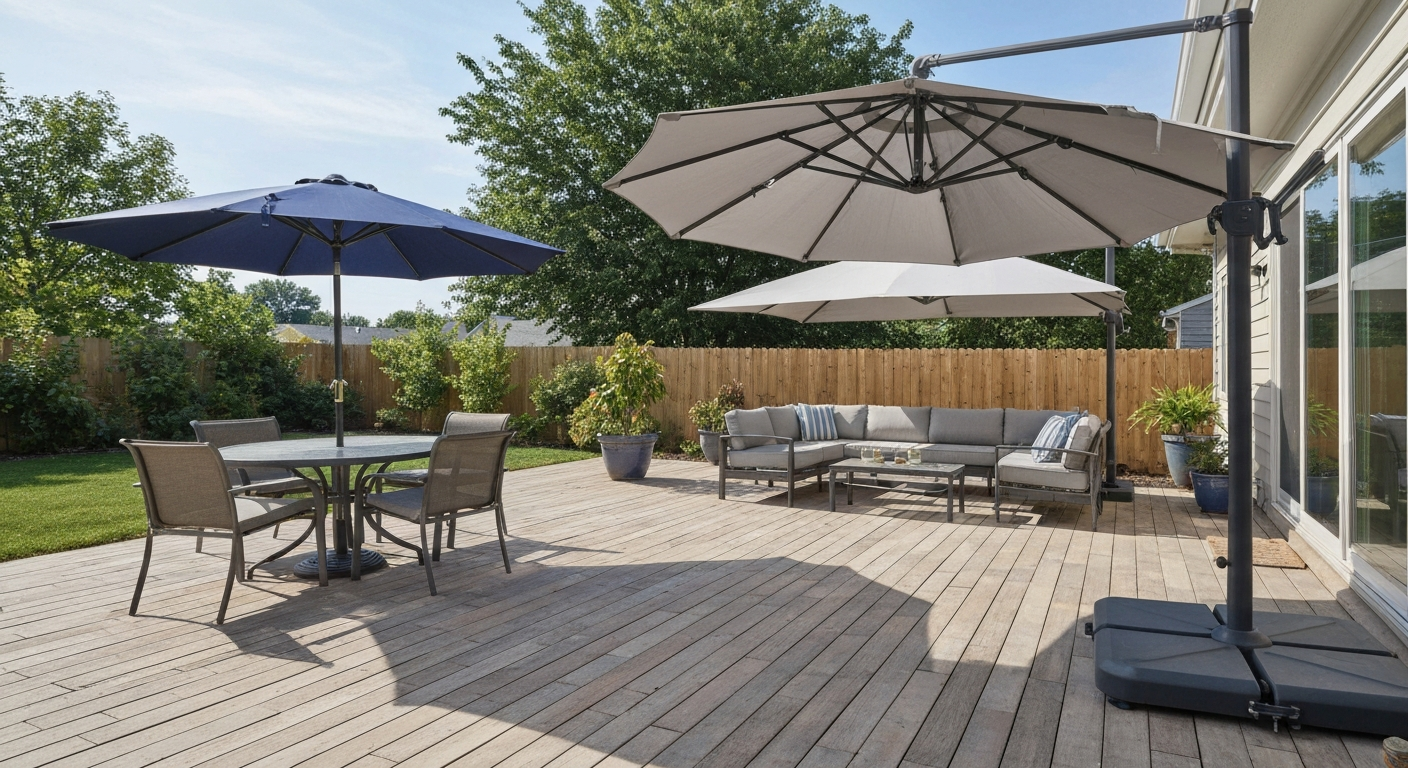
Patio umbrellas are sold at a wide range of places: big-box home improvement stores like Home Depot and Lowe's, mass-market retailers like Walmart, Target, Costco, and Sam's Club, large online marketplaces like Amazon, Wayfair, and Overstock, specialty and designer furniture retailers like Pottery Barn, Crate & Barrel, Frontgate, and Restoration Hardware, brand-direct and manufacturer dealer networks like Treasure Garden and Tropitone, and locally at garden centers, nurseries, Ace Hardware, True Value, and independent outdoor furniture dealers. Warranty | Sunbrella notes that Sunbrella (leading premium outdoor fabric supplier) states that Sunbrella shade/marine fabrics carry long limited warranties (commonly 5‑year limited for many fabrics and up to 10 years for select shade/marine fabrics) and offers a downloadable warranty document and claims process guidance for fabric-only warranty claims. The right place to buy depends on your budget, the style you need, and how much service you want before and after the sale.
Who Sells Patio Umbrellas: Where to Buy & What to Know

What this guide covers and who it's for
If you've typed "who sells patio umbrellas" into a search engine, you're probably somewhere between "I need shade" and "there are way too many options." This guide is for homeowners at both ends of that spectrum. It walks through every major category of seller, explains what each type typically carries (styles, sizes, price points, canopy materials), and lays out the honest trade-offs so you can figure out where it actually makes sense to buy. Along the way it touches on key product factors, frame materials, canopy fabrics, wind resistance, UV protection, base requirements, and how long a well-chosen umbrella should realistically last, because where you buy and what you buy are questions you have to answer together. For a quick answer on lifespan, see our guide on how long do patio umbrellas last.
The quick rundown: who sells patio umbrellas
- Big-box home improvement: Home Depot, Lowe's
- Mass-market retail: Walmart, Target, Costco, Sam's Club
- Online marketplaces: Amazon, Wayfair, Overstock
- Specialty and designer furniture: Crate & Barrel, Pottery Barn, Frontgate, Restoration Hardware, West Elm, Ballard Designs, IKEA
- Brand-direct and manufacturer dealers: Treasure Garden, Tropitone, Tuuci, Abba Patio, SunVilla
- Garden centers and nurseries (seasonal)
- Local hardware and independent dealers: Ace Hardware, True Value, local outdoor furniture stores
Each of these channels has a different sweet spot. Budget buyers do well at Walmart or Amazon. Shoppers who want to see an umbrella open before buying it will find better in-store experiences at Home Depot, Lowe's, or a local outdoor furniture dealer. People prioritizing longevity and custom fabric choices should be looking at specialty retailers or going direct to a brand like Treasure Garden. The sections below go channel by channel.
Big-box home improvement stores: Home Depot and Lowe's
Home Depot and Lowe's are the first stop for most homeowners, and they earn that habit. Both maintain active patio umbrella categories with filters for canopy diameter, shape (round, square, rectangular), tilt mechanism (push-button, crank), and in-store availability. Home Depot maintains an active Patio Umbrellas category with filters for canopy diameter, shapes, tilt/crank mechanisms, and in-store availability (center-post and cantilever options), blank" rel="noopener noreferrer">Patio Umbrellas - The Home Depot. You'll find center-post (market-style) umbrellas in 7.5 ft, 9 ft, and 11 ft diameters, cantilever/offset models in the 10 ft to 13 ft range, and a solid selection of bases and accessories. Brands vary by season but typically include Hampton Bay (Home Depot's house brand) and a rotating set of mid-market names.
The main advantage here is the in-store experience. You can look at the pole diameter, feel how the crank operates, and compare canopy fabric weight in person, which matters more than most buyers realize. A flimsy 180g polyester canopy and a 260g solution-dyed acrylic feel completely different, and you can't assess that from a product photo. Prices at both chains tend to run $50 to $350 for standard market umbrellas, with cantilever models from about $150 to $600 depending on size and mechanism. Pro tip: both stores mark down patio inventory aggressively in late July and August, so if timing is flexible, waiting can save 30 to 50 percent.
The downside is that neither store goes deep on premium or commercial-grade product. If you need a Sunbrella canopy, a heavy-duty aluminum pole rated for sustained winds above 35 mph, or a base heavier than 50 lbs, you'll find slim pickings at both chains. Returns are generally straightforward, and Home Depot in particular lets you filter by in-store availability online before you make the drive.
Mass-market retail: Walmart, Target, Costco, and Sam's Club
Walmart's patio umbrella category leans heavily budget-focused. You'll see entry-level market umbrellas in the $30 to $80 range under the Mainstays label, plus a mix of third-party marketplace listings for offset and cantilever models. If you need a basic 9 ft polyester canopy for a season or two without a big investment, Walmart delivers. The trade-off is that quality control is inconsistent across marketplace sellers, and return logistics for a large boxed umbrella can be a hassle. Target operates similarly, with private-label brands (Threshold, Room Essentials) filling out the affordable end and a filter set for diameter, shape, and tilt type. Target's aesthetic tends to lean a little more designed, you're more likely to find a striped or patterned canopy there than at Walmart.
Costco is a different story. Their SunVilla-branded umbrellas are among the best value propositions in the mid-market segment, often offering commercial-style cantilever or market models with Sunbrella-equivalent canopies and heavier-gauge poles at prices that would be $100 to $200 more at a specialty retailer. The catch is that Costco carries umbrellas seasonally and SKUs change year to year, you may not find the same model twice. Their member satisfaction guarantee on seasonal items is a genuine perk for a product category where you often don't know if you've made a good choice until after the first windy afternoon. Sam's Club carries Member's Mark and seasonal cantilever models in its outdoor/gazebo section, often overlapping with Costco in price range but with a slightly smaller selection.
Online marketplaces: Amazon, Wayfair, and Overstock
For sheer selection, nothing beats the major online marketplaces. Amazon carries thousands of patio umbrella listings across every style, size, and price point, but sorting through them requires patience. A lot of what you'll find under $100 from unfamiliar brands is essentially the same product sourced from the same factories, differentiated mainly by color and listing photos. The reviews can be helpful, but watch the date range: a product that was well-reviewed two years ago may have had a quiet material change since then. Verified reviews mentioning durability after a full season are more informative than fresh five-star ratings.
Wayfair has invested heavily in its patio umbrella assortment, operating curated subpages for cantilever umbrellas, LED/solar-lit models, extra-large canopies, and replacement canopies. Their filtering is genuinely useful (canopy shape, pole material, tilt type, wind resistance rating) and they frequently run sales events. Shipping on large items to your door is a real convenience, though returns on a 50-lb umbrella box have friction. Overstock (now operating as part of the Overstock/Bed Bath & Beyond brand family) carries a broad mid-market selection with regular sale pricing, and is worth checking specifically for rectangular and oversized canopies (13 ft plus) where other channels run thin.
The general rule with online-only purchases: check the pole diameter (a 1.5-inch pole is marginal; 1.91 inches or thicker is a meaningfully sturdier standard for a 9 ft umbrella), confirm base compatibility before you order, and read the fine print on return shipping costs. Shipping a 25-lb box back at your own expense is a common gotcha on budget platforms.
Specialty and designer furniture retailers
Pottery Barn, Crate & Barrel, and Frontgate
Pottery Barn maintains a dedicated patio umbrella category with round, rectangular, and cantilever options, most offered with Sunbrella canopies. Sunbrella's shade and marine fabrics carry limited warranties of five to ten years depending on the fabric line, which is a meaningful durability statement compared to the 180g polyester you'll find at mass-market retailers. Pottery Barn publishes assembly, warranty, and maintenance documentation for their umbrella SKUs, the kind of after-purchase support that signals a brand taking product quality seriously. Prices run roughly $350 to $900 for market umbrellas and $700 to $1,400 for cantilever models.
Frontgate goes further into premium territory and publishes umbrella buying guides alongside its products, their editorial content covers pole materials, base sizing, wind performance, and fabric options in real depth. Their customization options (fabric colors and patterns, pole finishes, frame materials) are more extensive than what you'd find at big-box chains, which appeals to buyers who want an umbrella to match a specific furniture set or architectural style. Crate & Barrel occupies a similar space at a slightly lower price point, with clean, contemporary styling and a smaller but curated selection.
Restoration Hardware, West Elm, and Ballard Designs
Restoration Hardware, West Elm, and Ballard Designs all sell premium patio umbrellas as part of their outdoor collections, with rectangular, round, cantilever, and offset options, mostly with Sunbrella or Sunbrella-equivalent canopies. These retailers skew toward design-forward buyers who want the umbrella to function as part of a coordinated outdoor space rather than just a shade solution. Expect pricing in the $400 to $1,200 range, with the trade-off being that product selection is curated (perhaps 15 to 30 SKUs total) rather than comprehensive. RH in particular tends toward larger formats, 10 ft and above, suited to formal dining or entertaining setups.
IKEA
IKEA occupies a unique position: their outdoor umbrella lineup (center-post and hanging/balcony models with specific model names and published dimensions) hits a price point between mass-market and mid-range, typically $80 to $250. Their product specs are transparent, which makes it easy to verify pole diameter and canopy dimensions before visiting a store. The selection is deliberately limited, IKEA stocks only a handful of models at any given time, but the value-to-quality ratio on their core models tends to be solid for a seasonal-use umbrella.
Brand-direct sites and manufacturer dealer networks
Buying directly from a manufacturer or through their authorized dealer network is the path that serious buyers eventually find. Treasure Garden is the largest umbrella manufacturer serving the North American residential market, and they sell through a network of independent outdoor furniture dealers and design showrooms rather than direct to consumers. Their warranty schedule is detailed: fabric warranty lengths vary by canopy material (Sunbrella and Outdura canopies on some lines carry five-year fade warranties), while frame components are covered under separate multi-year terms depending on the specific model series. Filing a warranty claim goes through the dealer, a good reason to keep your purchase receipt and dealer contact.
Tropitone is another manufacturer-dealer network player focused on the higher end of the residential and commercial market, with a strong reputation for frame durability and fade resistance. Tuuci, a Florida-based manufacturer, positions at the premium end of the category: certain Ocean Master MEGA/MAX lines carry a 15-year structural frame warranty, which is exceptional for this product category and reflects construction quality that costs accordingly. Abba Patio is a direct-to-consumer brand that sells primarily through Amazon and their own site, more accessible pricing than Tropitone or Tuuci, with decent mid-market quality.
The case for buying through a manufacturer's authorized dealer rather than a third-party marketplace comes down to warranty, expertise, and continuity. If the umbrella ships damaged or a pulley mechanism fails after 18 months, a dealer who sells that brand year-round will handle it far more efficiently than a generic marketplace seller who may not even be listed when you need them. If you're spending $600 or more, the dealer channel is worth the extra effort of finding it.
Garden centers, nurseries, and seasonal pop-ups
From April through July, many independent garden centers and nurseries stock a seasonal selection of patio umbrellas alongside their furniture and planting goods. The selection is typically limited to 10 to 20 SKUs covering basic center-post market umbrellas (7.5 ft to 9 ft) and sometimes a cantilever or two, but the quality tends to be a step above what you'd find at Walmart. Garden center staff are often more knowledgeable about outdoor products than big-box floor staff, and if you're also shopping for planters, furniture, or garden supplies, it can be a practical one-stop visit.
Seasonal pop-ups (temporary patio and outdoor living displays at strip malls and in parking lots) run from late spring through early summer in many markets. These are worth knowing about because they often carry mid-market and commercial-grade product at competitive prices, and the staff are typically outdoor furniture specialists. The downside: no fixed location for warranty support after the season ends. Get the manufacturer's contact and warranty documentation at point of sale, not just the pop-up's.
Local hardware stores and independent dealers
Ace Hardware and True Value
Ace Hardware and True Value franchise locations vary in outdoor inventory by owner, but many carry a seasonal patio umbrella selection in the spring and early summer. You'll typically find center-post market umbrellas in the 7.5 ft to 9 ft range, plus a base or two, useful if you need a replacement or starter umbrella and want to handle it before buying. The real value here is local expertise: staff at independently owned hardware stores often know their regular customers' setups and can advise on base compatibility, pole diameter for an existing table hole, or which models have held up in local weather conditions. Don't overlook these stores for accessories like replacement canopies, tie-down straps, and repair parts either.
Independent outdoor furniture dealers
Independent outdoor furniture stores, the kind that carry Tropitone, Woodard, or Treasure Garden alongside their furniture collections, offer the most hands-on buying experience in the category. You can see full-size umbrellas open, compare canopy fabric weights and weave patterns side by side, and ask specific questions about wind ratings and base pairing. Many offer delivery and setup services, which matters for large cantilever umbrellas where incorrect assembly leads to premature wear or tipping. These dealers also tend to carry replacement parts and offer seasonal storage advice, both of which directly affect how long your umbrella lasts.
Used and refurbished options: garage sales, consignment, and Facebook Marketplace
Used patio umbrellas show up regularly at garage sales, estate sales, consignment furniture stores, and Facebook Marketplace. A lightly used Treasure Garden or Tropitone umbrella purchased secondhand at 40 to 60 percent of retail can be an excellent value, especially if the frame is in good shape and only the canopy needs replacing (replacement canopies are widely available from manufacturers and third parties). What to check before buying used: inspect the pole for corrosion or bending, operate the tilt mechanism and crank fully, and look at the canopy fabric for UV degradation (a chalky, faded feel means the fabric's UV-blocking capacity is depleted). Avoid used umbrella bases with cracks in cast iron or concrete, since a compromised base is a wind-safety issue.
How sellers compare at a glance
| Seller Type | Typical Styles | Price Range | Warranty Support | In-Store Experience | Best For |
|---|---|---|---|---|---|
| Home Depot / Lowe's | Market, cantilever, tilt/crank | $50–$600 | Varies by brand; store return policy | Good — can inspect in person | Mid-budget, in-person shopping |
| Walmart / Target | Market, offset (mostly online) | $30–$250 | Manufacturer warranty; returns vary | Limited floor display | Budget, convenience |
| Costco / Sam's Club | Market, cantilever (seasonal) | $150–$500 | Member satisfaction guarantee | Seasonal floor display | Value, Sunbrella-tier fabrics |
| Amazon | All styles, huge SKU count | $40–$1,000+ | Seller-dependent | None | Research + price comparison |
| Wayfair / Overstock | All styles; strong cantilever/oversized | $80–$1,200 | Manufacturer warranty; return fees possible | None | Online selection, oversized models |
| Pottery Barn / Frontgate / RH | Premium market, cantilever, custom fabric | $350–$1,400+ | Sunbrella fabric + retailer warranty | Good in flagship stores | Design-focused, Sunbrella canopies |
| IKEA | Center-post, balcony/hanging | $80–$250 | IKEA standard return policy | Good — see open in-store | Budget-to-mid, compact spaces |
| Brand-direct / Dealer (Treasure Garden, Tropitone, Tuuci) | Full range, custom options | $400–$3,000+ | Detailed multi-year manufacturer warranty | Excellent — specialist dealers | Longevity, warranty, custom specs |
| Garden centers / Nurseries | Basic market, occasional cantilever | $100–$400 | Manufacturer warranty varies | Good — seasonal specialty staff | Convenience with outdoor context |
| Local hardware / Independent dealers | Market, cantilever, accessories | $80–$1,500+ | Full manufacturer warranty + local support | Best — hands-on, installation help | Expert guidance, installation, repair |
What to think about before you buy, regardless of where you shop
Style: market (center-post) vs. cantilever (offset)
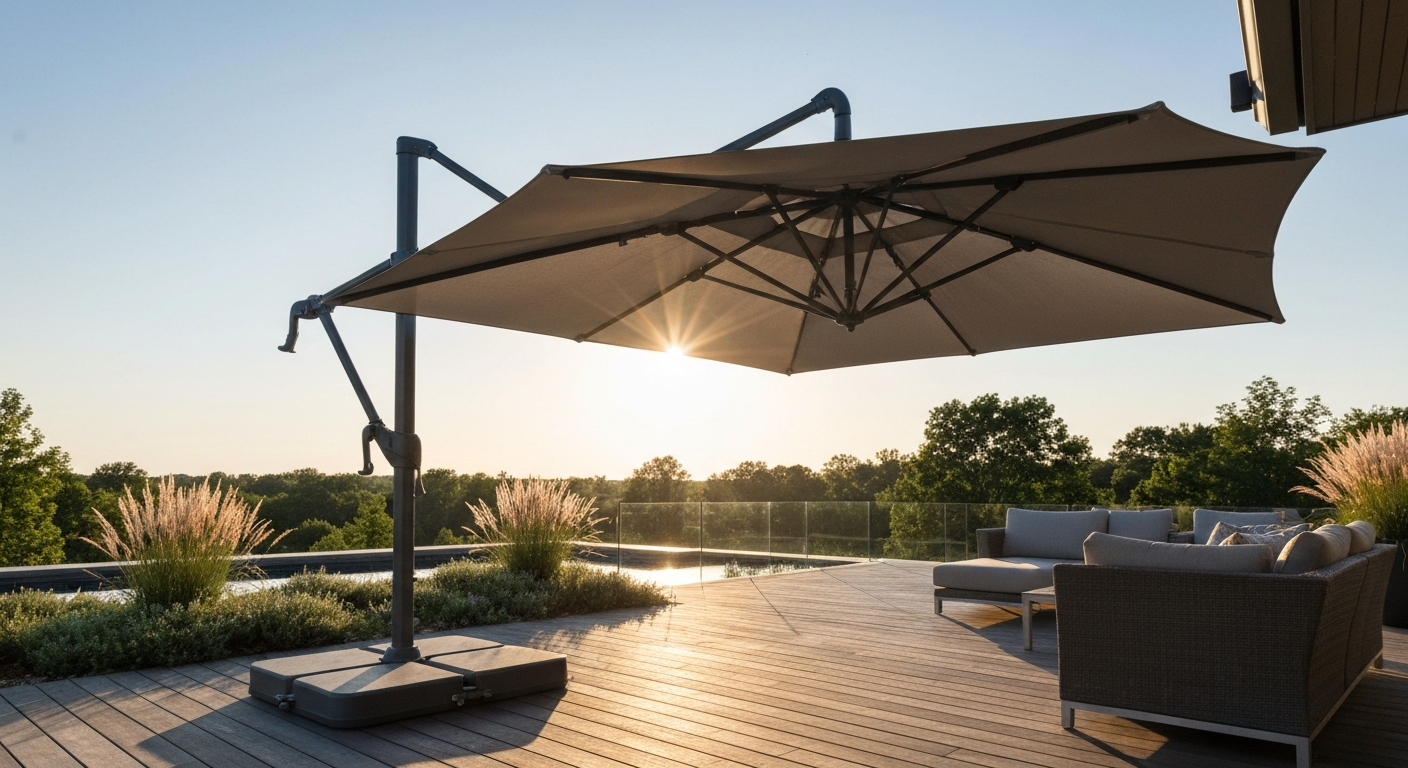
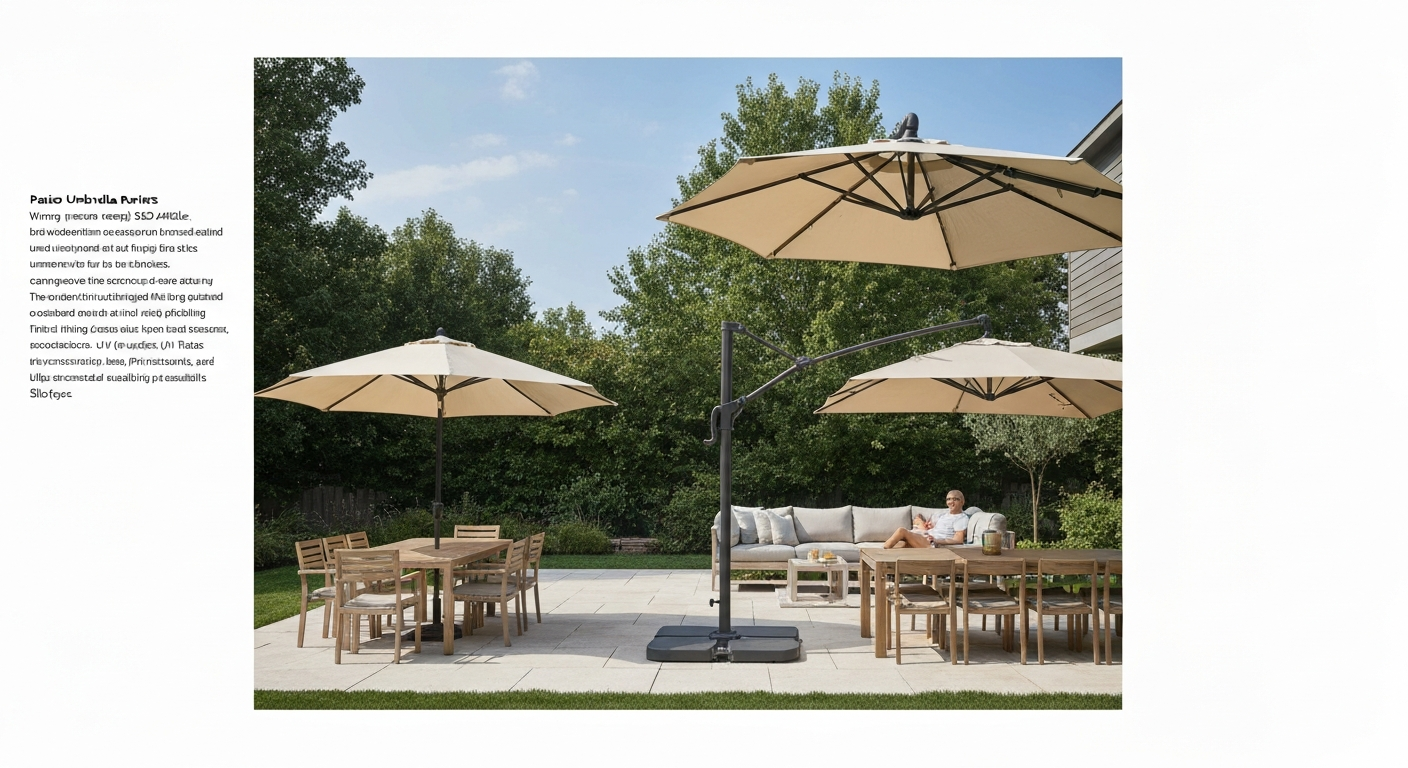
A market umbrella has a center pole that goes through a hole in your table, simple, stable, and widely available. A cantilever or offset umbrella has the pole to the side, which lets the shade overhang a seating area without a pole in the middle of the table. Cantilever models need a larger, heavier base (typically 50 lbs minimum, often more), cost more, and have more mechanical components that can wear. For a standard dining table, a 9 ft market umbrella is usually the right starting point. For a lounge area, sectional sofa, or large dining setup where you want to seat six or more without working around a pole, a cantilever in the 10 ft to 13 ft range makes sense.
Canopy fabric matters more than most listings tell you
The canopy is the part that takes the most abuse, UV rays, wind, rain, and temperature swings. For a detailed breakdown of canopy and frame options, see our guide on what material are patio umbrellas made of. Entry-level umbrellas use spun polyester, which fades noticeably within one to two seasons in direct sun and provides limited UV protection. Solution-dyed acrylic (Sunbrella is the best-known brand; Outdura is another) is the meaningful step up: the color is woven into the fiber rather than surface-printed, so it resists fading far better, and Sunbrella's limited warranty on shade fabrics runs five to ten years depending on the fabric line. If you're buying a cantilever umbrella above $400, a Sunbrella or comparable solution-dyed acrylic canopy should be the baseline expectation. The fabric warranty and UV protection ratings are legitimate differentiators, not marketing extras.
Frame and pole material
Aluminum is the most common and practical pole material: lightweight, rust-proof, and available at every price tier. Powder-coated aluminum in 1.91-inch or 2-inch diameter is the standard for quality market umbrellas; thinner poles (1.5 inches) flex more in wind and fatigue faster. Fiberglass ribs are more flexible and wind-tolerant than aluminum ribs, which is why better umbrellas use fiberglass for the canopy frame even with an aluminum center pole. Wood poles (typically teak or eucalyptus) look beautiful but require more maintenance, oiling annually in humid climates. Steel poles are heavier and rust-prone unless coated carefully; avoid them in coastal environments.
Wind resistance and base weight
Wind is the most common reason patio umbrellas get damaged or become dangerous. Most residential umbrellas are designed for moderate wind conditions (under 25 to 30 mph with the canopy tilted down), they are not rated for sustained high winds and should be closed and secured when storms are approaching. That said, construction quality dramatically affects how a moderate-wind event plays out. A heavier base (50 lbs for a 9 ft market umbrella; 75 to 100 lbs or more for a large cantilever) keeps the pole from tipping. Fiberglass ribs flex rather than snap in gusts. A vented canopy (double-layer canopy with an air gap at the top) reduces uplift. If you live somewhere consistently windy, the coast, the plains, an exposed hillside, these three features together should be non-negotiable.
Price ranges and what you get at each level
| Price Range | Typical Quality Tier | Expected Lifespan | Canopy Fabric | Frame | Where to Buy |
|---|---|---|---|---|---|
| $30–$100 | Budget/entry | 1–2 seasons | Spun polyester | Thin aluminum or steel | Walmart, Target, Amazon |
| $100–$300 | Mid-market | 3–5 years | Better polyester or basic acrylic | 1.91" aluminum, some fiberglass ribs | Home Depot, Wayfair, Costco, IKEA |
| $300–$700 | Upper-mid | 5–8 years | Solution-dyed acrylic (often Sunbrella) | Heavy aluminum or powder-coated steel, fiberglass ribs | Pottery Barn, Crate & Barrel, Wayfair, Costco |
| $700–$1,500+ | Premium residential | 8–15 years | Sunbrella or Outdura with multi-year warranty | Commercial-grade aluminum, stainless hardware | Frontgate, Tropitone dealer, Treasure Garden dealer |
| $1,500–$3,000+ | Commercial/high-end | 15+ years | Custom Sunbrella or proprietary fabric | Marine-grade aluminum, stainless components | Tuuci, specialty dealers, brand-direct |
If you're buying for a rental property or a patio that gets hard use and minimal off-season storage, the $300 to $700 tier tends to be the most cost-effective over a five-year period. For more on what drives cost differences, including materials, warranties, and engineering, see why are patio umbrellas so expensive. A $75 umbrella that needs replacing every two years costs more than a $400 umbrella that lasts eight. That math changes if you're careful about closing and storing the umbrella seasonally, a budget umbrella that's stored indoors through winter and consistently closed in wind will outlast a premium one left outside year-round. For a detailed breakdown of typical prices by style and quality, see our guide on how much does a patio umbrella cost.
Timing your purchase to save money
Patio umbrellas follow a predictable seasonal pricing cycle. Prices are highest from late April through June when demand peaks. By mid-July, most retailers start marking down remaining seasonal inventory, and by August the discounts at big-box and mass-market retailers routinely hit 30 to 50 percent off original prices. For more on timing and seasonal discounts, see best time to buy patio umbrellas. If you can wait until late summer, you can often buy a Costco or Home Depot umbrella that was $250 in May for $120 in August. The trade-off is color and size selection, the most popular options (neutral solids in 9 ft round) sell out first. Specialty retailers and brand-dealer networks discount less aggressively, but end-of-season sales are still common in September and October for the following year's inventory cycle.
Questions about where patio umbrellas are made
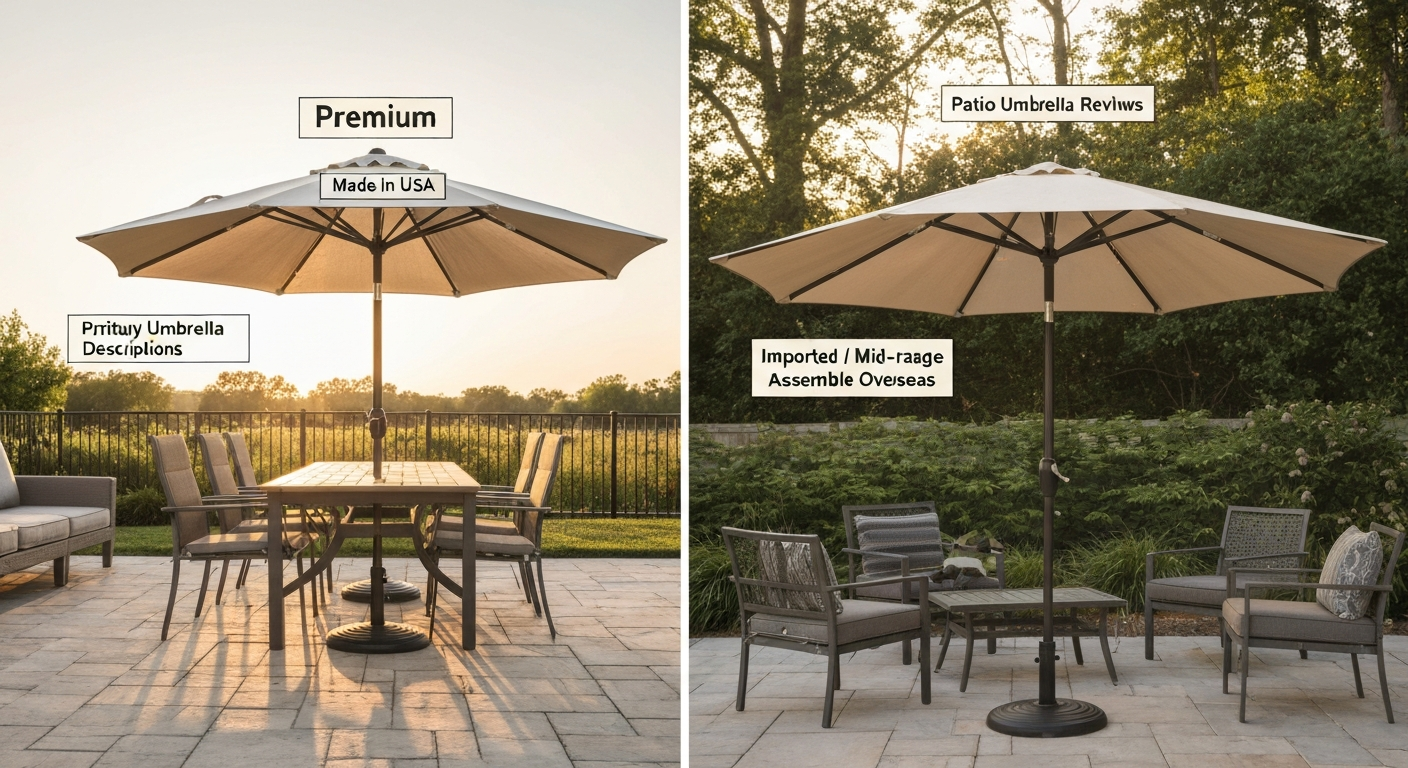
The vast majority of patio umbrellas sold in the U.S., across every price tier, are manufactured in China. This includes products sold under well-regarded brands and at premium price points. Manufacturing origin doesn't automatically predict quality: a product made in China to tight specifications with quality materials (marine-grade aluminum, Sunbrella fabric, stainless hardware) will outlast a domestically assembled product using inferior components. Where manufacturing origin becomes relevant is in quality control consistency, environmental standards, and lead times for warranty replacement parts. A handful of manufacturers maintain U.S.-based assembly or quality inspection operations, and Tuuci (based in Miami) is often cited as a domestic manufacturer, though component sourcing is global. If domestic manufacturing is important to you, it's worth confirming directly with the brand rather than relying on marketing descriptions. Are any patio umbrellas made in the USA? (See brand-specific manufacturing details.).
How to decide where to buy: a practical framework
Start with your budget and how long you want the umbrella to last. If you need basic seasonal shade for one or two years without a large investment, Walmart, Target, or Amazon at the $50 to $150 range is entirely sensible. If you want something that handles five or more seasons in regular use, step up to the $250 to $500 range and look at Costco, Wayfair, or Home Depot's better-stocked online selection where Sunbrella or solution-dyed acrylic canopies appear. For anything above $500, the independent dealer or specialty retailer route earns its premium: the warranty support, the ability to inspect quality in person, and the installation and service options are genuinely worth it at that price point.
- Decide on style first: center-post market umbrella for a dining table; cantilever for a seating area or when a center pole is in the way.
- Match umbrella size to coverage area: a 9 ft umbrella covers roughly a 5 ft to 6 ft diameter table; a 13 ft cantilever covers a large sectional or dining set for six.
- Check table hole diameter before buying a market umbrella — standard is 1.5 inches to 2 inches, but older tables vary.
- Size your base to the umbrella: a 9 ft market umbrella needs at minimum 50 lbs; a 13 ft cantilever needs 100 lbs or more, sometimes anchored.
- Prioritize canopy fabric at or above $300: look for solution-dyed acrylic with a published UV rating and fabric warranty.
- If buying online, confirm pole diameter, base compatibility, and return shipping costs before completing the order.
- Shop late July through September if flexibility on timing allows — discounts at big-box and mass-market stores are substantial.
- For premium or commercial-grade purchases, find an authorized dealer who can provide manufacturer warranty support and local service.
The patio umbrella market is genuinely wide, which means there's a right answer at almost every budget and use case, but it also means there are plenty of wrong answers if you buy on price alone without thinking through style, size, fabric, and where you'll actually get help if something goes wrong. The seller you choose is part of that calculation, not just the product.
FAQ
Who sells patio umbrellas — what seller types should I consider?
Heading: Seller types that sell patio umbrellas Paragraph: Patio umbrellas are sold by several seller types. Each offers different selection, price points and services. List: - Big‑box retailers (Home Depot, Lowe’s, Walmart, Target) — carry entry to mid‑level center‑post and some cantilever umbrellas, many mass‑market brands, seasonal stock in store and online. - Warehouse clubs (Costco, Sam’s Club) — curated seasonal deals on mid‑to‑upper value SKUs, often bundled with bases and with favorable return policies for members. - Online marketplaces (Amazon, Wayfair, Overstock) — largest selection (economy to premium), many third‑party sellers, frequent sales and user reviews; replacement canopies and accessories widely available. - Specialty outdoor/furniture retailers (Frontgate, Pottery Barn, West Elm, Restoration Hardware, Ballard Designs) — premium models, higher‑quality fabrics (often Sunbrella), customization and design‑focused options. - Manufacturer/brand direct (Tuuci, Treasure Garden, Tropitone, Treasure Garden) — premium parasols, long warranties, dealer networks for installation and service. - Garden centers and nurseries — mid‑range decorative umbrellas and bases, seasonal local stock. - Local hardware and independent dealers — small selection, ability to see product, local installation/repair services. Paragraph: Use this list to map what matters most to you (price, selection, warranties, in‑person inspection, installation).
Which major retailers sell patio umbrellas and what styles/sizes do they typically carry?
Heading: Major retailers and their typical offerings Paragraph: Below are representative retailer profiles and common styles/sizes they carry. List: - Home Depot: wide range — center‑post market umbrellas (6–11 ft round), cantilever/offset (9–13 ft), rectangular and vented canopies; tilt and crank mechanisms; in‑store pickup for many models. - Lowe’s: similar to Home Depot — center‑post, cantilever, bases and replacement canopies; brand mix of economy and name brands. - Walmart: strong on entry‑level and economy brands (Mainstays, third‑party marketplace sellers); mostly center‑post and some offset options (6–11 ft typical). - Target: mass‑market models (6–9 ft), decorative designs, center‑post and tilt; seasonal availability. - Costco / Sam’s Club: selected mid‑range market and cantilever umbrellas (often SunVilla or Member’s Mark), bundled bases, larger sizes (10–13 ft) during season. - Wayfair / Overstock / Amazon: very broad selection — small (6–7 ft) to mega canopies (11–13 ft), rectangular/oval/round shapes, LED/solar lit options and replacement canopies. - IKEA: budget‑friendly center‑post and hanging/balcony umbrellas with clear dimensions and seasonal stock. - Pottery Barn / Frontgate / West Elm / Restoration Hardware: premium center‑post and cantilever, custom fabric options (Sunbrella common), larger sizes and rectangular formats. - Tuuci, Treasure Garden, Tropitone (manufacturer/brand sites): high‑end parasols, modular canopies, large commercial sizes, multiple canopy shapes and heavy‑duty frames. Paragraph: Typical canopy shapes include round, rectangular, square and vented (for wind). Sizes run from small 6 ft (bistro) to 13+ ft (commercial/cantilever). Center‑post is common for table use; cantilever is best for unobstructed shade.
What are the pros and cons of buying from each seller type?
Heading: Seller pros and cons (selection, price, warranty, shipping, returns) Paragraph: Quick comparison to match priorities. List: - Big‑box retailers (Home Depot, Lowe’s): - Pros: broad selection, competitive prices, in‑store inspection, easy returns and local pickup, bases and accessories available. - Cons: mid‑range quality common, seasonal stock limits model depth, warranties vary by brand. - Warehouse clubs (Costco, Sam’s Club): - Pros: good value bundles, strong return policies, limited curated higher‑value SKUs. - Cons: limited selection and sizes; must be a member. - Online marketplaces (Wayfair, Amazon, Overstock): - Pros: largest variety, user reviews, frequent sales, replacement parts easy to find. - Cons: inconsistent seller quality, shipping damage risk, returns can be harder; verify seller warranty handling. - Specialty/furniture retailers (Pottery Barn, Frontgate): - Pros: premium fabrics (Sunbrella), design options, better customer service, clear warranty documentation. - Cons: higher price, less inventory turnover (seasonal), shipping time and costs. - Manufacturer/brand direct (Tuuci, Treasure Garden): - Pros: best warranties, dealer support, high durability, custom options and commercial‑grade engineering. - Cons: top price, may require dealer installation, longer lead times. - Local garden centers and independent dealers: - Pros: see product in person, local service and installation, often more flexible on repair/parts. - Cons: smaller selection, prices may be higher than big chains for comparable models. Paragraph: Choose sellers based on whether immediate pickup, warranty and quality, or lowest upfront price is most important.
What product factors should buyers evaluate (materials, wind resistance, UV protection, base requirements)?
Heading: Key product factors to evaluate List: - Canopy fabrics: - Common: polyester (budget), olefin/solution‑dyed acrylic (e.g., Sunbrella) for better UV, colorfastness and mildew resistance. - Consider fabric weight, UV rating (UPF), and whether a replacement canopy is available. - Frame materials: - Aluminum: lightweight, corrosion‑resistant (mid to high quality). - Steel: heavier and strong but can rust without proper finish. - Teak/wood: aesthetic but requires maintenance and can be pricier. - Reinforced composites (high‑end brands): durable and low maintenance. - Wind resistance: - Vented canopies reduce uplift; heavier frames and quality ribs improve performance. - Cantilevers require a larger base or permanent anchoring; most umbrellas are not intended for high winds — close at threshold (often 15–25 mph depending on model). - UV protection: - Check UPF or UV block percentage; solution‑dyed acrylics (Sunbrella) typically offer strong UV resistance. - Base requirements: - Center‑post: base weight depends on umbrella size (6–8 ft: 25–35 lb min; 9–11 ft: 50–100+ lb; larger: consider in‑ground or filled bases). - Cantilever/offset: often need much heavier bases or multiple pavers, concrete footings, or sand/ water‑filled bases; manufacturer specs must be followed. - Durability and expected lifespan: - Economy polyester umbrellas: 1–3 seasons outdoors if exposed to sun/wind. - Mid‑range (coated polyester/olefin): 3–6 years with proper care. - Premium solution‑dyed acrylic (Sunbrella) with aluminum/aluminum‑alloy frames: 7–15+ years depending on exposure and maintenance. Paragraph: Match fabric/frame selection to local climate (sun intensity, coastal salt exposure, typical wind) and how often you’ll leave umbrella deployed.
How do prices vary by style and quality, and when is the best time to buy?
Heading: Typical price ranges and timing to buy List: Typical price ranges (USD, approximate retail) - Economy center‑post (polyester, basic crank): $30–$120. - Mid‑range center‑post (heavier frames, better fabric): $120–$400. - Economy cantilever/offset: $150–$400. - Mid‑range cantilever (larger sizes, better mechanics): $400–$900. - Premium center‑post with Sunbrella or teak frame: $400–$1,200+. - Premium cantilever and commercial parasols (Tuuci, Treasure Garden): $1,000–$5,000+ depending on size and customization. Paragraph: Why prices vary - Materials (frame metal, canopy fabric quality) and manufacturing precision. - Brand engineering (mechanism complexity for cantilevers, tilt, crank, gas spring systems). - Warranty length and dealer support. - Volume and channel: mass‑market sellers undercut with scale; specialty brands price for quality and customization. List: Best time to buy - End of summer/early fall: clearance sales as retailers make room for other seasons (largest discounts). - Pre‑season (late winter/early spring): good selection, some early promotions but higher prices. - Holiday sales (Memorial Day, Fourth of July, Labor Day): common discounts from both mass and specialty sellers. Paragraph: If you need an umbrella for immediate summer use, expect to pay more than off‑season clearance prices.
Are patio umbrellas made in the USA — how does origin affect quality?
Heading: Manufacturing origin and quality considerations Paragraph: Most patio umbrellas sold in big‑box and online marketplaces are manufactured overseas (commonly Asia). However, some premium brands design and assemble in the USA or have specific lines made domestically. List: - Made in USA examples: select high‑end manufacturers or custom shops may produce frames or assemble units in the USA — Tuuci and some specialty manufacturers have U.S. engineering and limited domestic production or assembly for certain lines; always check brand product pages for country of origin details. - Overseas manufacturing: many mid‑to‑economy umbrellas are produced in China, Vietnam or other Asian countries — quality varies by factory, materials and quality control. Paragraph: How origin affects quality - Domestic production can mean tighter QA, higher price, and better access to parts and service; warranties tend to be clear and dealer support more direct. - Overseas manufacturing does not necessarily imply poor quality; many premium brands source components internationally but maintain strict specs and use premium materials (Sunbrella fabric often made in the USA but can also be globally sourced). Paragraph: For long service life, prioritize documented materials (Sunbrella/solution‑dyed acrylic, anodized aluminum), official warranties, and reputable dealers over origin alone.