Patio umbrellas are expensive because the materials, engineering, and testing required to make one that actually lasts outdoors cost real money. A canopy fabric that resists fading, mildew, and UV damage for five-plus years is fundamentally more expensive to produce than a printed polyester cover. A powder-coated aluminum frame with fiberglass ribs that flex in wind costs more than a plain steel pole. Add a smooth crank-and-tilt mechanism, a wind-tunnel validation, a meaningful warranty, and freight shipping for a heavy, oversized box, and a $300–$600 price tag starts making sense. The honest question is not why good ones cost so much, but whether a cheaper one will cost you more in replacements over time.
Why Are Patio Umbrellas So Expensive? Cost Drivers & Buyer's Guide

Kent Lang
20 Jul 2026
What this guide covers and how to use it
This article breaks down every factor that drives up the price of a patio umbrella, from canopy fabric and frame construction to shipping costs and warranty terms. It gives you realistic cost ranges by umbrella type and feature level, explains what you get for each price step, and helps you decide where it makes sense to spend more and where you can safely save. If you are also wondering about specific brands, where umbrellas are made, which retailers carry them, or the best time to buy, those angles are covered too. Think of it as a full-cost and value briefing before you make a purchase.
When a higher-priced umbrella actually pays off
Spending more makes clear sense in three situations: you live somewhere with intense sun and heat (UV-rated acrylic fabric earns its cost fast), your umbrella stays outside and unsheltered for most of the season, or you are buying a large cantilever or freestanding model where a flimsy frame is a genuine safety risk. A $150 polyester umbrella that fades and warps in two seasons ends up costing more than a $400 Sunbrella-canopy model that holds up for seven or eight years. If your umbrella sits under a covered porch for six months of the year and rarely sees a real windstorm, a midrange option is probably fine.
Every factor that drives up the price
There is no single reason patio umbrellas are expensive. Price is the result of stacking several independent cost drivers, and understanding each one helps you evaluate whether a higher price is justified or just markup. Here is every major factor.
Canopy fabric and UV coatings
The canopy is the most visible cost separator. Budget umbrellas use printed polyester, which is cheap to produce but fades quickly, especially in direct sun. Premium umbrellas use solution-dyed acrylic, most commonly Sunbrella by Glen Raven. For a deeper look at common canopy and frame materials, see our guide on what material are patio umbrellas made of. In solution-dyed acrylic, the color is baked into the fiber itself during manufacturing rather than printed onto the surface, which is why it resists fading and bleaching far better than polyester alternatives. Sunbrella fabric carries a 5-year manufacturer warranty against color loss and strength degradation. It also achieves UPF 50, meaning it blocks roughly 98% of UV radiation, which is relevant both for shade performance and canopy longevity. The trade-off is cost: solution-dyed acrylic fabric runs roughly 2 to 3 times the wholesale price per yard compared with commodity polyester. Vendor and wholesale guides report a roughly 2–3× (or greater) per‑yard price premium for solution‑dyed acrylic versus commodity polyester Vendor and wholesale guides report a roughly 2–3× (or greater) per‑yard price premium for solution‑dyed acrylic versus commodity polyester.. Commercial specifications, like those used by hospitality brands, call for 8 oz/yd² solution-dyed acrylic as the baseline for pool and patio umbrellas built to last. That fabric weight and specification adds meaningful cost before anything else is attached to it.
Frame material and engineering
Most umbrella poles are aluminum, but not all aluminum is equal. Premium frames use extruded 6061 or 6063 alloy tubing, which is lighter and more corrosion-resistant than basic steel. Die-cast aluminum or zinc handles the hubs and collars. In coastal environments, some commercial units use stainless steel (grade 316) for hardware that is submerged or constantly salt-sprayed. The finish matters too: anodizing creates a hard oxide layer that is integral to the metal surface and resists chips and corrosion better than a plain coat, while high-performance powder-coat systems (rated to AAMA 2604 or 2605 standards) offer a thick, durable color layer. Both are more expensive to apply than basic paint. Fiberglass ribs on the canopy frame are another premium upgrade: fiberglass flexes under wind pressure and springs back without taking a permanent bend, which is exactly what you want in a gust. Budget models use aluminum or steel ribs that stay bent after a hard wind. That flex-and-recover capability is why fiberglass ribs are standard on wind-rated and commercial umbrellas.
Mechanisms: crank, tilt, and slide systems
A basic pulley-and-cord system costs almost nothing to manufacture. A smooth auto-tilt crank with a collar-locking mechanism or a push-button tilt system takes more precision parts and assembly. Cantilever umbrellas add more complexity still: a rotating 360-degree hub, a multi-position locking arm, and a counterweight or tension system all require engineered components. These mechanisms are where cheap umbrellas fail first. Replacement crank handles and pulley kits are inexpensive at retail (crank handles commonly sell for $6 to $25), but they are only useful if your umbrella brand actually stocks replacement parts. Many mass-market importers do not. Reputable brands like California Umbrella and Treasure Garden maintain parts pages, which is part of what you pay for with a name-brand product.
Size and canopy coverage
Larger canopies require more fabric, longer poles, heavier ribs, and stronger hubs. A 9-foot market umbrella uses roughly twice the canopy fabric of a 6-foot model. A 13-foot offset cantilever uses even more, plus a structural arm engineered to hold that canopy weight at a lateral angle without collapsing. Size-related costs compound: bigger canopies need heavier bases, bigger boxes, and more expensive freight. Every foot of diameter adds cost in materials and logistics.
Wind ratings and testing
Most budget umbrellas have no documented wind rating at all. Premium and commercial umbrellas are increasingly validated through professional wind-tunnel testing. Some boutique brands use full-scale aerodynamic facilities and report survival speeds in Beaufort scale equivalents or miles per hour. One example is Alizé, which tested a prototype in an A2 wind tunnel and reported survival to approximately 38 to 42 mph under controlled conditions. That kind of validation costs money and signals genuine engineering investment. UV performance testing is similar: the credible standard is UPF testing per AATCC 183 or UV Standard 801, not just a marketing claim on the label. A review on NCBI/PMC discusses AATCC 183, UV Standard 801, and recent ASTM activity around umbrella testing, including ASTM F3681 A review on NCBI/PMC discusses AATCC 183, UV Standard 801, and recent ASTM activity around umbrella testing, including ASTM F3681.. Umbrellas that carry verified UPF ratings cost more to produce and certify, but those ratings mean something concrete.
Base and mounting requirements
The umbrella price you see is often just the canopy and pole. Bases are frequently sold separately and are not cheap if you need adequate weight. Practical guidance from retailers and industry sources suggests roughly 35 to 50 lb for a 6- to 9-foot table umbrella, 50 to 100 lb for a freestanding 9- to 11-foot market umbrella, and 100 to 250 lb or a permanent in-ground mount for an 11- to 13-foot cantilever. A 150 lb commercial-grade base can easily cost $150 to $400 on its own. Treasure Garden's warranty explicitly requires adherence to base weight guidance and excludes wind damage, which means an underpowered base does not just risk toppling, it voids your coverage.
Brand, manufacturing origin, and warranty
Where an umbrella is made and by whom affects both cost and quality consistency. Most patio umbrellas sold in the US are manufactured in China or Southeast Asia, including models from well-known brands. A smaller number are made domestically or in Europe, typically at a significant price premium. Brands that invest in quality control, use third-party tested materials, and back products with meaningful warranties charge more because those things cost more. A 5-year fabric fade warranty and a 3-year frame warranty from a known brand like Treasure Garden is worth something compared to a 90-day warranty from an anonymous importer. If you are curious which brands manufacture domestically, that is a question worth researching specifically, as the landscape shifts. See our guide Are any patio umbrellas made in the USA for a current list of brands that manufacture domestically and what to expect on price and availability.
Shipping and retail markup
Patio umbrellas are awkward to ship: they are long, relatively heavy, and require careful packaging to avoid pole and rib damage in transit. A 10-foot umbrella in its box can weigh 30 to 50 lb and measure over 6 feet in length, which triggers dimensional weight pricing with most freight carriers. That shipping cost is either absorbed into the retail price or charged separately. Large retailers like Home Depot carry umbrellas both in-store and online, which gives you the option to buy in-store and skip freight entirely for some models. Buying direct from specialty retailers or brand websites often includes faster delivery and better post-purchase support, but the price reflects that service.
Accessory costs that add up
Beyond the base, there are covers, LED lighting kits, replacement canopies, and mounting hardware. A quality UV-resistant umbrella cover adds $30 to $80 but meaningfully extends canopy life by protecting it during off-season storage. Replacement canopies for premium umbrellas can run $100 to $300, which matters if you want to swap colors or replace a worn one without buying a new frame. These add-ons are part of the true total cost of ownership, especially over a 5- to 10-year lifespan.
How each price driver affects long-term value
Not every price driver has equal impact on long-term value. Here is how they rank from a total-cost-of-ownership perspective.
- Canopy fabric: The single biggest long-term differentiator. A Sunbrella canopy on a well-maintained frame can last 7 to 10 years. A printed polyester canopy typically shows significant fading within 2 to 3 seasons. The per-year cost of a premium canopy almost always wins.
- Frame material and finish: Aluminum with quality anodizing or powder coat outlasts plain steel by years in wet or coastal environments. Fiberglass ribs prevent wind damage that would otherwise total a cheaper umbrella after one bad storm.
- Mechanisms: Smooth crank and tilt systems improve daily usability and tend to last longer because they put less stress on the canopy and pole. Parts availability matters more here than raw quality.
- Wind ratings and testing: Documented wind resistance is not just a premium feature — it is a safety and longevity feature. An umbrella that fails in a 25 mph gust costs you the replacement price plus potential property damage.
- Base weight: Under-weighting a base is the most common and costly mistake homeowners make. A tipped umbrella breaks frames and canopies. Spending adequately on the base protects the rest of your investment.
- Brand and warranty: A 5-year fabric warranty and a meaningful frame warranty reduce your replacement risk. Brands that stock parts extend useful life significantly.
- Shipping and markup: These are real costs but do not affect the product's durability. They can sometimes be reduced by buying in-store or during seasonal sales.
- Accessories: Protective covers and quality storage are high-ROI investments. Proper off-season storage is the single cheapest way to extend umbrella lifespan.
The three main umbrella types and what makes them different
Understanding umbrella types helps you match price to actual need. Each style has different engineering demands, which is reflected in its cost range.
Market umbrellas (center-pole)
Market umbrellas are the most common style: a straight center pole with a canopy that opens above it. They are the simplest to engineer and the least expensive to produce. They fit through the center hole of a patio table or stand in a weighted base beside one. A basic 9-foot market umbrella with a polyester canopy and aluminum pole starts around $60 to $100. A midrange version with Sunbrella fabric and a smooth crank-tilt mechanism runs $250 to $450. A commercial-grade version with full fiberglass ribs, heavy-duty hardware, and a premium fabric warranty can reach $500 to $900 or more. The center pole limits flexibility, you cannot position shade without moving the base or table.
Cantilever and offset umbrellas
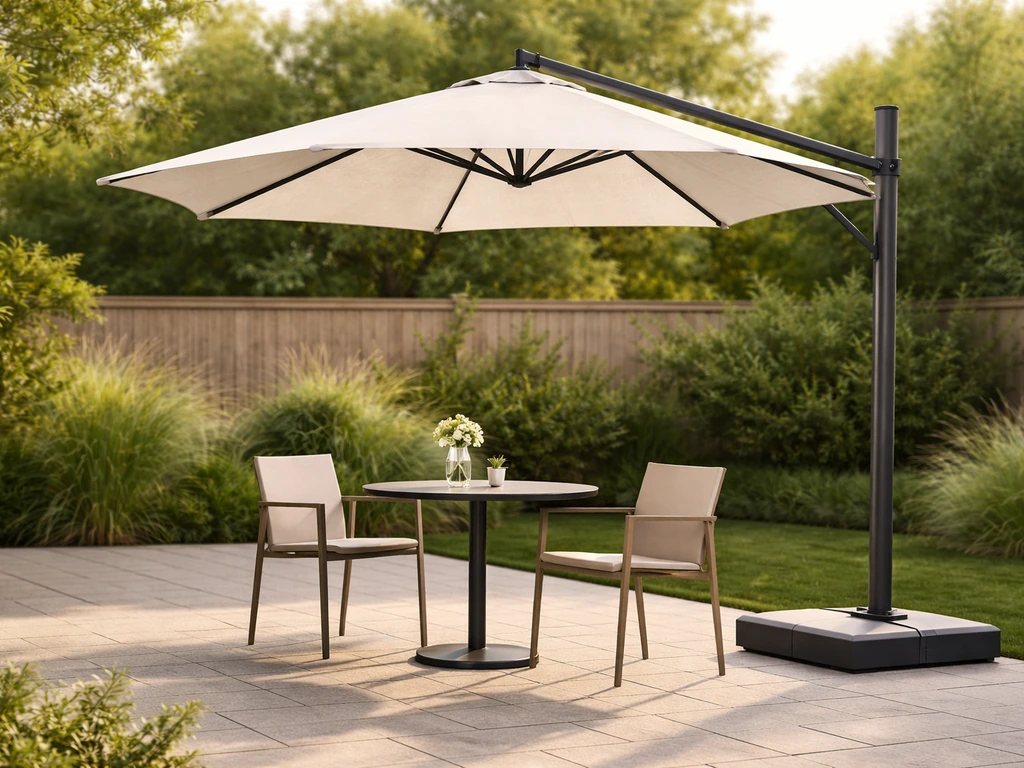
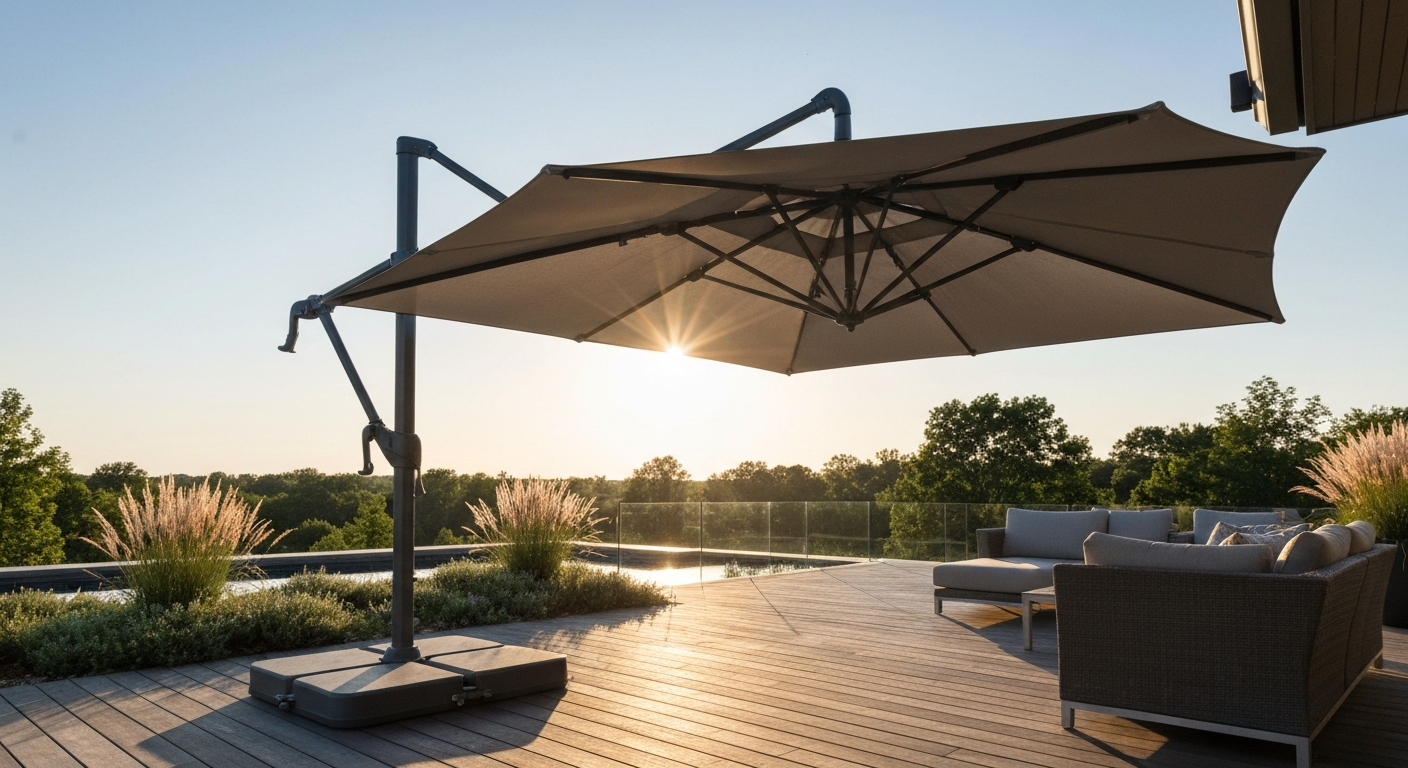
Cantilever umbrellas (also called offset umbrellas) have the pole off to one side and the canopy suspended over the seating area on an arm. This design eliminates the center pole obstruction and allows rotation and multi-position tilting, making it far more flexible for shade coverage throughout the day. The engineering is more complex: the lateral arm, counterweight or spring-tension system, and rotating hub all add components that have to withstand significant mechanical stress. Expect to pay $200 to $400 for an entry-level cantilever, $400 to $800 for a solid midrange model with quality fabric and 360-degree rotation, and $800 to $2,000 or more for commercial-grade offset umbrellas with true wind-resistance features and heavy bases. Base requirements are also higher: 100 to 250 lb is a reasonable range for a freestanding large cantilever.
Commercial and heavy-duty umbrellas
Commercial umbrellas are built for restaurant patios, pool decks, and hotel environments where they operate in full sun all day, every day, and need to survive without constant attention. They use heavy-gauge aluminum or steel frames, 8 oz/yd² Sunbrella or equivalent fabric, stainless hardware at critical joints, and are often in-ground mounted or anchored to structural bases. These are not really a consumer product category, but homeowners with exposed coastal patios, large entertainment spaces, or a genuine need for commercial durability sometimes buy them. Prices typically start around $800 and can exceed $3,000 for large, fully specified units. The lifespan expectation is 10 to 15 years with proper maintenance, which changes the cost math completely.
Realistic cost ranges by type and feature level
The table below summarizes typical retail price ranges and key features by umbrella type and tier. These are based on what is consistently available from established retailers and brands as of mid-2026. If you want a quick price summary, see our guide on how much does a patio umbrella cost. Prices exclude base unless noted.
| Type | Feature Level | Typical Price Range | Canopy Fabric | Frame | Mechanism | Warranty (typical) |
|---|---|---|---|---|---|---|
| Market / Center-Pole | Basic | $60 – $150 | Printed polyester | Steel or basic aluminum | Pulley or simple crank | 90 days – 1 year |
| Market / Center-Pole | Midrange | $200 – $450 | Solution-dyed polyester or entry Sunbrella | Extruded aluminum, powder-coat | Crank + collar tilt | 1 – 3 years frame, 2 – 3 years fabric |
| Market / Center-Pole | Premium | $450 – $900+ | Sunbrella or Tempotest acrylic | Heavy aluminum, fiberglass ribs | Auto-tilt crank or push-button | 3 – 5 years frame, 5 years fabric |
| Cantilever / Offset | Basic | $200 – $400 | Printed polyester | Basic aluminum arm | Manual lift, limited tilt | 1 year or less |
| Cantilever / Offset | Midrange | $400 – $800 | Solution-dyed polyester or entry Sunbrella | Extruded aluminum, crank arm | 360° rotation, multi-tilt | 1 – 3 years frame, 2 – 3 years fabric |
| Cantilever / Offset | Premium | $800 – $2,000+ | Sunbrella or equal acrylic | Heavy-gauge aluminum, fiberglass ribs, SS hardware | Auto-crank, rotation lock, wind vent | 3 – 5 years frame, 5 years fabric |
| Commercial / Heavy-Duty | Standard commercial | $800 – $3,000+ | 8 oz/yd² Sunbrella or equal | Heavy aluminum or steel, in-ground option | Commercial crank or manual | 5+ years frame, 5 years fabric |
Base costs are a real addition to these prices. Budget 35 to 50 lb bases for table-mount market umbrellas at $40 to $100. Freestanding market umbrella bases (50 to 100 lb) run $80 to $200. Large cantilever bases (100 to 250 lb) can cost $150 to $400. If you are shopping and wondering when prices drop, end-of-season sales in late August through October typically offer the deepest discounts, sometimes 30 to 50% off retail, though selection thins out as the season ends. For more on timing purchases, see our guide to the best time to buy patio umbrellas.
Where umbrellas are made and who sells them
The majority of patio umbrellas sold in the US are manufactured in China, including products from brands marketed under recognizable names. Abba Patio, for example, is a brand that sources production from Chinese manufacturers, which is typical for the price points they operate in. Domestic manufacturing of patio umbrellas is limited; most US-based operations focus on custom commercial work or canopy replacement fabric rather than full consumer umbrellas. European brands like Glatz (Switzerland) and Scolaro (Italy) manufacture domestically or regionally and command premium prices accordingly, often $600 to $2,000 or more for mid-to-large models.
As for where to buy: large home improvement retailers like Home Depot carry a broad range of market and offset umbrellas, both in-store seasonally and year-round online. For a quick overview of common sellers and retailer types, see who sells patio umbrellas. Big-box retailers, outdoor specialty stores, and direct-to-consumer brands all compete in this space. Specialty outdoor furniture retailers often carry higher-end brands with better post-sale support and parts availability. Online marketplaces offer the widest selection but require careful attention to canopy fabric specs and warranty terms, since listings do not always make those details prominent.
How long patio umbrellas last and how to extend that life
A well-made umbrella with a solution-dyed acrylic canopy, quality aluminum frame, and proper care realistically lasts 7 to 10 years. A budget polyester umbrella in full sun typically looks worn within 2 to 3 seasons and may fail structurally sooner in wind. The biggest lifespan killers are UV degradation of the canopy fabric, moisture-driven corrosion in the frame and hardware, and mechanical stress from wind events. All three are manageable. For a detailed breakdown of how long do patio umbrellas last under different materials, climates, and care routines, see our lifespan guide.
- Close the umbrella when not in use: Wind loading on an open canopy is the primary cause of rib and hub failures. Closing it during storms or extended high-wind periods is the single most effective protective habit.
- Store it properly off-season: Bring the umbrella inside or use a protective cover rated for outdoor storage. A quality umbrella cover ($30 to $80) pays for itself quickly in extended canopy life.
- Clean the canopy regularly: Mildew and dirt accelerate fabric breakdown. Most solution-dyed acrylic canopies can be cleaned with mild soap and water; avoid harsh bleach on acrylic unless the manufacturer specifies otherwise.
- Check and tighten hardware: Loose bolts and collar screws allow play that wears out mechanisms faster. A quick inspection at the start of each season catches small problems before they become big ones.
- Replace parts rather than the whole umbrella: If your crank breaks or a rib cracks, check whether your brand sells replacement parts before buying a new umbrella. Reputable brands maintain parts availability, and a $15 crank or a $60 replacement rib is far cheaper than a $400 umbrella.
Deciding what to buy: matching umbrella to budget, space, and climate
Here is a practical framework for making the decision without overthinking it. Start with what the umbrella actually needs to do, then work backward to budget.
- Identify your coverage need: Are you shading a table where a center pole is fine, or do you need pole-free coverage over a lounge area? Market umbrella for the first, cantilever for the second.
- Assess your exposure: Full sun all day in a hot climate with regular afternoon wind? Spend on Sunbrella fabric and fiberglass ribs. Covered porch with light use? A midrange polyester option is reasonable.
- Be honest about wind: If you live somewhere with regular gusts above 20 mph, a wind-tested umbrella with documented ratings is not a luxury. An umbrella that blows over once and breaks a rib or dents a railing has already cost more than the price premium.
- Budget for the base: Do not buy a $500 umbrella and pair it with a $30 base. The base is structural. Size it to the canopy using the recommended weights: 35 to 50 lb for small table umbrellas, 50 to 100 lb for large freestanding markets, 100 to 250 lb for cantilevers.
- Check the warranty terms before buying: Does the brand cover fabric fading? For how long? Is wind damage excluded (it almost always is)? Are replacement parts available? A brand that backs its product is less risky than one that does not, even at the same price point.
- Consider the best time to buy: If you are not in a hurry, late August through October is when seasonal clearance markdowns are deepest. Spring restocks in March and April offer the widest selection but full-price inventory.
- Think in cost-per-year: A $400 umbrella that lasts 8 years costs $50 per year. A $120 umbrella that lasts 2 years costs $60 per year and gives you two shopping and setup experiences instead of one.
The premium price on a well-made patio umbrella is not padding, it is the cumulative cost of better fabric, smarter engineering, documented performance, and a brand willing to back the product. That does not mean you always need the top tier. But knowing which features actually matter for your situation makes it a lot easier to spend confidently and avoid paying for a replacement sooner than you planned.
FAQ
Why are patio umbrellas so expensive — what drives the price?
Heading: Price drivers Patio umbrella cost reflects many components beyond the simple pole-and-cloth image. Major factors that raise price: - Canopy fabric and coatings: Solution-dyed acrylics (e.g., Sunbrella) and high‑weight woven fabrics resist fading, mildew and provide certified UPF; they cost substantially more per yard than commodity printed polyester. Premium coatings (water repellents, stain treatments, FR treatments) add cost. (Industry practice: acrylics typically 2–3× or more per-yard cost vs budget polyester.) - Frame material and engineering: Extruded aluminum alloys, stainless fasteners, die-cast hubs, or marine-grade hardware raise manufacturing cost vs thin steel or low-grade alloys. Surface finishes (anodize, high-grade powder coats) also add price and corrosion resistance. - Ribs and flex components: Fiberglass ribs or engineered hybrid ribs that flex and recover during gusts are more expensive than stamped steel ribs. - Mechanisms: Smooth, corrosion-resistant crank drives, worm-gear systems, gas-assist lifts, and multi-position tilts are more costly than basic push-up designs. - Size and coverage: Larger canopies use more fabric and heavier frames; cantilever/offset designs need more complex hubs and counterbalance engineering. - Wind ratings and testing: Wind-tunnel testing, reinforced frames, and certified ratings (or more robust engineering margins) increase cost. - Base and mounting needs: Heavy bases, wheeled bases, or permanent in-ground mounts (and associated anchor hardware) add to total system cost. - Brand, origin, and warranty: Established brands, documented warranties, and production in lower-volume or higher-regulation regions increase price. Long warranties often imply higher-quality components or insulated service costs. - Shipping/retail markups and accessories: Large awkward items cost more to ship; specialty retailers and showrooms add margin. Accessories (lights, valances, covers, weighted bases) add to the out-the-door price. Reasoning: These are commonly accepted industry drivers — better materials, more reliable mechanisms, validated testing, and stronger aftermarket support require higher-cost inputs and manufacturing steps, which naturally increase retail prices.
What realistic cost ranges should homeowners expect by umbrella type and feature level?
Heading: Typical cost ranges (retail, US market) — quick guide Broad ranges (approximate, include canopy + basic base when noted): - Budget table/market umbrellas (6–9 ft, printed polyester, push-up): $30–$100. Basic retail/backyard models, limited fabric life. - Midrange market umbrellas (7–11 ft, better polyester or olefin, crank/tilt): $100–$300. Better frames, smoother mechanisms, some replacement part support. - Premium market / small commercial (9–11 ft, Sunbrella or premium acrylic, anodized/powder-coated aluminum, fiberglass ribs, crank): $300–$700. - Entry cantilever/offset umbrellas (10–11 ft, basic offsets, lower-cost fabrics): $200–$600 (often require heavier bases sold separately). - Premium cantilever/offset (11–13+ ft, Sunbrella, engineered hubs, wind-tested frames): $700–$2,000+. Commercial-grade versions can be $1,500–$3,500 with heavy-duty hardware and warranties. - Commercial hospitality umbrellas (heavy-duty frames, 100% solution-dyed acrylic, tested components, in-ground options): $1,000–$4,000+ depending on size and marine-grade hardware. Comparative table (typical features vs cost): Type | Typical cost | Canopy material | Frame/ ribs | Wind/ Warranty Budget market | $30–$100 | Printed polyester | Thin steel/aluminum | Low wind tolerance; 30–90 day limited Midrange market | $100–$300 | Better polyester/olefin | Powder-coated aluminum | Moderate, 1–2 yr limited Premium market | $300–$700 | Solution-dyed acrylic (Sunbrella) | Anodized/powder-coated aluminum, fiberglass ribs | Higher wind tolerance, 3–5 yr fabric/1–3 yr frame Premium cantilever | $700–$2,000+ | Sunbrella / heavy acrylic | Engineered hubs, reinforced ribs | Wind-tested options; better warranty Commercial | $1,000–$4,000+ | 8 oz/yd² solution-dyed acrylic | 6061 extrusions, 316 stainless hardware | Lab-tested, spec-grade warranties Notes: Prices vary with brand, retailer, and included base. Base recommendations frequently require 35–50 lb for small market umbrellas, 100+ lb or permanent mounts for large or cantilever units.
How do materials (fabric, frame, ribs) affect performance and lifespan?
Heading: Materials → performance and expected life - Fabrics: Solution-dyed acrylic (Sunbrella and equivalents) resists fading, mildew and provides UPF ~50 — common in commercial specs and carries multi-year warranties. Budget printed polyester fades and breaks down faster under UV and moisture. Expect 5+ years useful life for high-end acrylic under normal use; 1–3 years for cheap polyester in sunny/wet climates. - Frames and finishes: Aluminum extrusions with anodize or high‑quality powder coat resist corrosion and last longer than bare steel. Stainless hardware (316) is crucial in coastal/marine exposure. Expect better corrosion resistance and longer structural life with higher-grade alloys and finishes. - Ribs: Fiberglass flexes and recovers in gusts better than stamped steel/aluminum ribs, reducing permanent damage. Well-designed hubs and reinforcements reduce stress concentrations and increase lifespan. Reasoning: Durability comes from both material inherent properties (UV resistance, corrosion resistance, flex fatigue) and engineering that puts materials where loads occur. Warranties and commercial specs reflect common industry lifespan expectations.
What practical performance considerations should buyers know (wind resistance, UV protection, base requirements)?
Heading: Performance considerations for real-world use - Wind resistance: Umbrellas are not windproof. Design, ribs, and testing matter. Fiberglass ribs and well-engineered hubs handle gusts better. Many warranties exclude wind damage — homeowners should follow base weight guidance. Typical base guidance: ~35–50 lb for 6–9 ft table umbrellas, 50–100 lb for freestanding 9–11 ft, and 100–250+ lb or permanent mount for 11–13 ft cantilevers depending on exposure. - UV protection: Fabric choice dictates UV protection. Solution-dyed acrylics commonly rate UPF 50 (≈98% UV blocked) in product specs; check for tested UPF or lab method cited (AATCC/UV Standard 801). Lighter or cheaper fabric will let more UV through and fade faster. - Base and mounting: Stability depends on proper base mass and correct mounting hardware. Cantilevers need larger, often outrigged bases or in-ground sleeves and may require base plates or buried anchors in windy climates. Why these affect price and long-term value: Better wind performance, higher UPF, and correct base solutions require stronger materials and often testing or larger accessory components — those add upfront cost but reduce replacement and injury risk over time.
How long will a patio umbrella last and what maintenance extends its life?
Heading: Lifespan and maintenance Expected life: With premium materials, proper use, and storage, 5–10+ years is reasonable for the canopy and frame; commercial-grade umbrellas used heavily may still need canopy replacement in 3–7 years. Lower-end umbrellas often fail or look worn in 1–3 years in harsh sun/rain. Maintenance checklist: - Storage: Close and cover when not in use, and store indoors during winter or extended storms. A fitted cover reduces UV and moisture exposure. - Cleaning: Brush off debris, rinse with fresh water; mild soap for oil/soiling. Avoid harsh bleaches that degrade fibers/finishes. Follow fabric maker guidance (Sunbrella recommends mild soap and water). - Repairs & parts: Keep spare cords, crank handles, and slip-in ribs where available. Many cranks/pulleys can be replaced cheaply ($6–$25 for handles, low two-digit for kits). Check brand parts pages — availability varies. - Replacement: Canopies are often replaceable; replacing fabric can extend umbrella life at lower cost than buying a new premium frame. Reasoning: Routine care reduces UV/moisture-driven degradation and mechanical stress; easy-to-source small parts mean low-cost repairs are often possible if the manufacturer supports parts.
Are any patio umbrellas made in the USA, and where are some brands manufactured? (including Abba)
Heading: Country of origin and brands - Made in USA: Some boutique and commercial umbrella makers produce at least portions of their umbrellas in the USA, especially custom or hospitality suppliers. However, much volume-level production is done overseas (Asia) because of scale and cost. If US manufacturing is a priority, check brand country-of-origin claims and ask for factory locations. - Specific brands (example 'Abba'): Brand sourcing varies. Many small brands import frames/canopies or assemble imported components domestically. For any named brand, verify: product labels, company disclosures, or ask customer service for the manufacturing origin. Retail and product pages often state "Made in…" when domestic. Reasoning: Global sourcing is common; claims are brand-specific, so verifying on the product page or contacting the seller is the pragmatic approach.