The best cantilever patio umbrella for most homeowners is a 10-foot to 11-foot aluminum-frame offset model with a solution-dyed acrylic canopy, a crank lift, infinite tilt, and at least 200 lbs of base weight. Models from Treasure Garden, PURPLE LEAF, and Tuuci consistently earn high marks across independent reviews, and if you want a single reliable pick at a mid-range price, the Treasure Garden AG25T 10-ft cantilever (available through dealers and Home Depot) hits the right balance of wind resistance, UV protection, and long-term durability. Wirecutter's published patio umbrella guide does not test cantilever umbrellas at all, which is a key gap this guide fills.
Best Cantilever Patio Umbrella Wirecutter-Style Guide

Kent Lang
24 Jul 2026
Quick picks at a glance
Below are the top cantilever umbrella picks organized by budget and use-case. Prices are approximate North American retail as of mid-2026 and will vary by retailer and region. Full model breakdowns appear further down.
| Use-Case | Recommended Model | Canopy Size | Frame | Approx. Price (USD) | Why It Wins |
|---|---|---|---|---|---|
| Best Overall | Treasure Garden AG25T | 10 ft | Powder-coated aluminum | $400–$550 | Proven OEM quality, wide dealer network, 360° rotation, strong warranty |
| Best Budget | PURPLE LEAF 10 ft Cantilever | 10 ft | Powder-coated steel/aluminum | $180–$280 | Wide availability, decent polyester canopy, solid value for occasional use |
| Best Premium | Tuuci Ocean Master MAX | 10–13 ft | Marine-grade aluminum | $1,200–$2,500+ | 15-yr structural warranty, commercial-grade wind resistance, exceptional longevity |
| Best Wind-Resistant | Treasure Garden AKZ PLUS 11.5 ft | 11.5 ft | Powder-coated aluminum | $700–$950 | Double-vented canopy, 360° rotation, min. 400 lb base, tested for high-wind zones |
| Best Small-Space | Crestlive 9 ft Cantilever | 9 ft | Powder-coated aluminum | $150–$230 | Compact footprint, suitable for small decks, 200 lb base requirement |
| Best Large-Area | Treasure Garden AKZ PLUS 13 ft | 13 ft | Powder-coated aluminum | $950–$1,300 | Covers up to 130 sq ft of shade, commercial-adjacent build quality |
| Best Commercial-Grade | Tuuci Ocean Master Classic | 10–13 ft | Marine-grade aluminum | $900–$1,800 | BS EN 13782-adjacent performance, used in hospitality settings worldwide |
What a cantilever umbrella actually is (and how it differs from a center-pole)
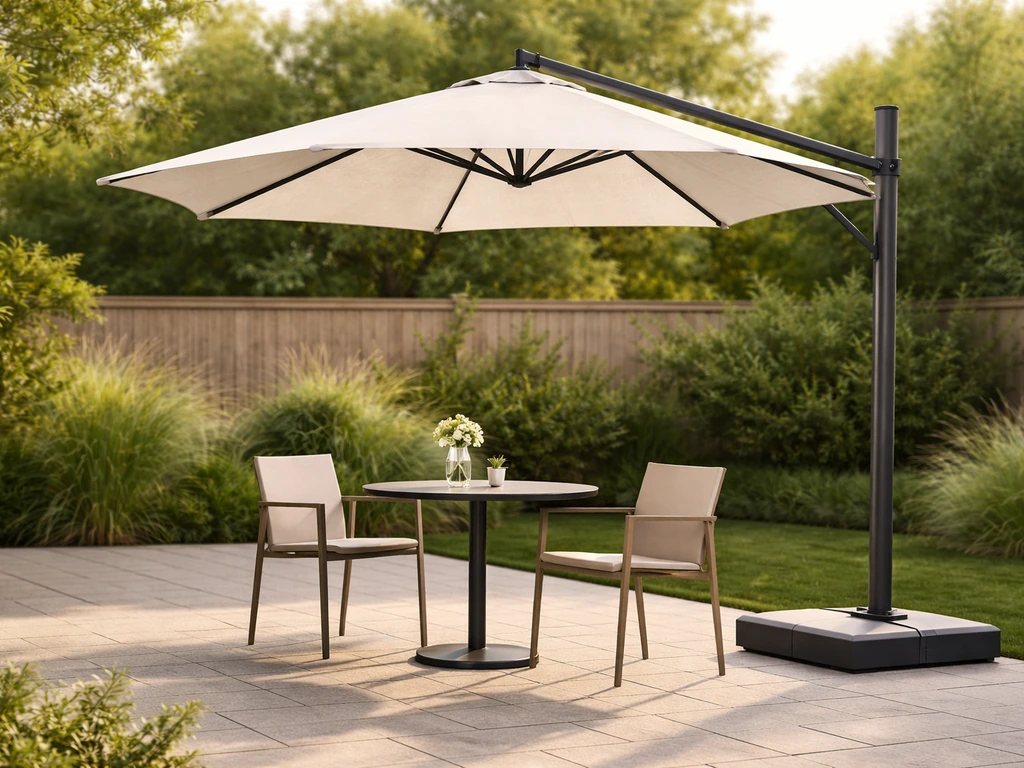
A cantilever umbrella, also called an offset or hanging umbrella, suspends its canopy from an arm that extends outward from a side post rather than supporting it with a pole that runs straight up through the center of a table or patio. The structural post sits to the side of your seating area, and the canopy hangs over the space you want to shade. That offset design is the entire point: you get full, unobstructed shade without a pole in the middle of your dining table, lounger setup, or pool deck.
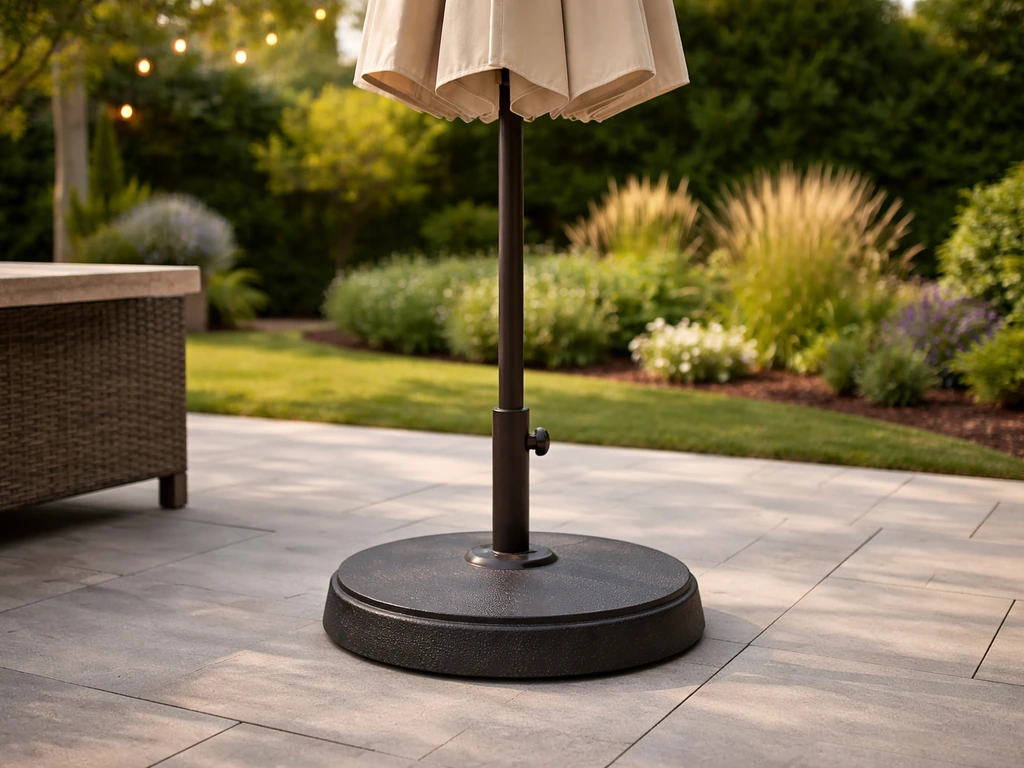
The term 'offset umbrella' refers to the same product. Some retailers use 'hanging umbrella' interchangeably, though that term occasionally describes smaller balcony-style parasols that hang from a wall bracket. If you see all three terms, they almost always mean the same cantilever-arm design. A center-pole umbrella (also called a market umbrella) does the opposite: the pole runs through a hole in your patio table, and the canopy opens symmetrically around it. Center-pole models are cheaper, lighter, and easier to move, but they block sightlines, require a table with the right hole diameter, and can't be repositioned to follow the sun without moving the whole table. A cantilever lets you rotate the canopy 360 degrees and tilt it toward the sun without touching your furniture.
| Feature | Cantilever/Offset | Center-Pole (Market) |
|---|---|---|
| Pole position | Side post, canopy extends on arm | Center of table or freestanding |
| Obstructs seating area? | No | Yes (pole in middle) |
| Rotation | 360° on most models | Usually fixed or limited |
| Tilt range | Infinite tilt or multi-position | Push-button or collar tilt only |
| Base weight required | 200–400+ lbs | 50–90 lbs |
| Typical price range | $150–$2,500+ | $50–$500 |
| Best for | Open lounging, pool decks, large patios | Table dining, tight budgets |
| Wind vulnerability | Higher (large lever arm) | Moderate |
How Wirecutter's approach compares to what cantilever buyers actually need
Wirecutter's patio umbrella guide, last substantially updated in 2023, explicitly limits its testing to 9-foot market (center-pole) umbrellas. Their team tested in Los Angeles, evaluated crank mechanisms, tilt systems, and base compatibility, and recommended 50 lb bases for table-mounted 9-ft models and 75 to 90 lb standalone bases as general minimums for freestanding 9-ft market umbrellas. Wirecutter’s guide explains their testing focus and methods, selection of common models, in‑field and lab observations (including Los Angeles testing), and emphasis on crank/tilt mechanisms and base compatibility rather than cantilever designs Wirecutter’s guide explains their testing focus and methods—selection of common models, in‑field and lab observations (including Los Angeles testing), and emphasis on crank/tilt mechanisms and base compatibility rather than cantilever designs.. Their methodology is sound for what it covers: real-world usage observation, mechanism durability, and ease of assembly. The problem for cantilever shoppers is that Wirecutter openly did not test cantilever or offset designs, which means their recommendations carry no direct weight for this category.
Consumer Reports fills part of this gap. Their 2026 patio umbrella coverage explicitly includes cantilever styles and evaluates assembly difficulty, adjustability, stability, and wind behavior in lab conditions. They also assess synthetic fabric performance and the benefit of double-vented canopies. That lab-tested approach is closer to what cantilever buyers need, since wind behavior on an offset umbrella is significantly different from a center-pole model: the side post creates a long lever arm, which multiplies the overturning force from wind and demands far heavier bases than Wirecutter's 75 to 90 lb guidance. For a 10-ft cantilever, 200 lbs is the floor, not the ceiling.
The practical takeaway: Wirecutter's testing standards (checking crank quality, rib-locking mechanisms, fabric colorfastness, and base stability) are the right criteria to apply, but you need to apply them to cantilever-specific models and account for the far greater base-weight and anchoring demands of offset designs. That is exactly what this guide does.
The buying criteria that actually matter
Wind ratings and structural testing
No universal consumer wind-rating standard exists for cantilever umbrellas sold in the US market. ASTM F3512-21 ('Standard Test Method for Evaluating Wind Safety and Durability of Market Umbrellas') provides a standardized test method, but it was written for market umbrellas, not cantilever designs. European and UK commercial parasols frequently reference BS EN 13782 (temporary structures) and some manufacturers claim tested resistance above 100 km/h under that standard. For US buyers, the honest guidance is: a double-vented canopy measurably reduces uplift, a heavier base reduces overturning risk, and any manufacturer claiming specific mph ratings without citing a test standard is using a marketing figure. ASCE 7 engineering methods can calculate overturning forces for anchor design, but that level of precision is for professional installation, not typical residential use. In practice, a well-vented canopy plus a correctly weighted base in the 200 to 400 lb range is your practical wind defense.
Fabric types and UV protection
Canopy fabric is where you will feel the quality difference most over time. There are two main options: solution-dyed acrylic (Sunbrella is the benchmark brand) and polyester. Solution-dyed acrylic is woven with pigment baked into the fiber before weaving, which means UV rays cannot bleach the color out the way they do with surface-dyed polyester. Sunbrella fabrics are rated UPF 50+ in canopy and marine applications and carry up to 10-year limited warranties against fading in their marine/awning lines. AATCC test methods TM-183 (UPF transmittance) and TM-16.x (colorfastness to light) are the lab standards that underpin these claims. Polyester canopies are lighter and cheaper, and they do the job for a season or two, but expect noticeable fading within two to three years of sun exposure. If you are spending more than $400 on an umbrella frame, it is worth the extra $80 to $150 to upgrade to an acrylic canopy, because the frame will outlast two or three polyester canopies.
| Fabric Type | UV Resistance | Fade Life (Typical) | Water Resistance | Price Premium | Best For |
|---|---|---|---|---|---|
| Solution-dyed acrylic (e.g., Sunbrella) | UPF 50+ | 5–10 years | Good (dries quickly) | High (+$80–$200) | Long-term investment, coastal/high-UV climates |
| Olefin/polyolefin | UPF 50+ on quality grades | 3–6 years | Very good | Medium | Mid-range value, humid climates |
| Coated polyester | UPF 30–50 on treated grades | 1–3 years | Moderate | Low | Budget use, seasonal or covered storage |
| HDPE mesh (ventilated) | Varies (50%+ open weave) | 3–5 years | N/A (open weave) | Medium | Hot, low-rain climates needing airflow |
Canopy size, shape, and coverage
Cantilever canopies come in round, square, and rectangular shapes. A 10-foot round canopy covers roughly 78 square feet of shade directly beneath it, though actual usable shade shifts with the sun angle and tilt position. A 10x10-foot square canopy covers 100 square feet and creates cleaner shade geometry over a square dining set. Rectangular canopies (common in 10x13 or 11x14 configurations) suit long chaise lounge setups along a pool. As a general sizing rule, add 2 feet to each side of your seating arrangement to capture full shade: a 6-foot round dining table needs at least a 10-foot canopy, and a 7-foot chaise lounge benefits from an 11-foot or larger canopy. Bigger canopies require heavier bases and create more wind load, so do not oversize unnecessarily.
Frame materials
Powder-coated aluminum is the right frame material for the vast majority of homeowners. It is lightweight enough to move when needed, corrosion-resistant in coastal and humid conditions, and strong enough for residential use. Premium brands like Tuuci use marine-grade aluminum alloy, which is the same specification used for boat hardware and justifies their price premium in coastal environments. Steel frames are heavier and cheaper but will rust if the powder coat chips, which is a meaningful risk on a product that lives outside year-round. Stainless steel hardware (bolts, screws, pivot points) is an important secondary detail: galvanic corrosion between dissimilar metals (aluminum frame, steel hardware) is a common long-term failure point on budget models.
Tilt, lean, and crank mechanisms
A good cantilever should offer both 360-degree horizontal rotation (to track the sun through the day without moving the base) and infinite or multi-position tilt (to angle the canopy toward low-sun angles in the morning and late afternoon). Cheap models offer push-button tilt locked at one or two fixed angles, which is a meaningful limitation. Look for a smooth crank-lift mechanism rather than a pull-cord: crank systems are easier on the fabric and more reliable over time. Auto-tilt (where tilting happens as part of the crank action) is convenient but adds mechanical complexity. For most residential use, a separate tilt lock and a reliable crank is the simpler, more durable choice.
Base weight and footprint requirements
This is where the most dangerous misinformation circulates. A 9-foot cantilever needs a minimum of 150 to 200 lbs of base weight. A 10 to 11-foot model needs 200 to 300 lbs. The large Treasure Garden AKZ PLUS models at 11.5 to 13 feet specify minimums of 300 to 400 lbs. Wirecutter's 75 to 90 lb guidance is for 9-foot market umbrellas and should not be applied to any cantilever design. Underweighted bases are the number-one cause of cantilever tip-overs and property or injury incidents. Lowe's product installation PDFs for cantilever umbrellas instruct users to fill all four base-weight plates completely before use for exactly this reason. If you buy a cantilever and skip the base plates, you are creating a hazard.
| Canopy Size | Minimum Base Weight (Portable) | Recommended Base Weight | Notes |
|---|---|---|---|
| 9 ft round/square | 150 lbs | 200 lbs | Minimum for calm-wind conditions; increase for exposed sites |
| 10 ft round/square | 200 lbs | 250–300 lbs | Treasure Garden AG25T spec range |
| 11–11.5 ft | 300 lbs | 350–400 lbs | AKZ/AKZ PLUS minimum per manufacturer |
| 13 ft | 400 lbs | 400–500 lbs | Permanent or semi-permanent anchoring strongly recommended |
| Commercial/hospitality | 400+ lbs or in-ground | In-ground mount preferred | BS EN 13782 / professional installation advised |
How to measure your space and pick the right size
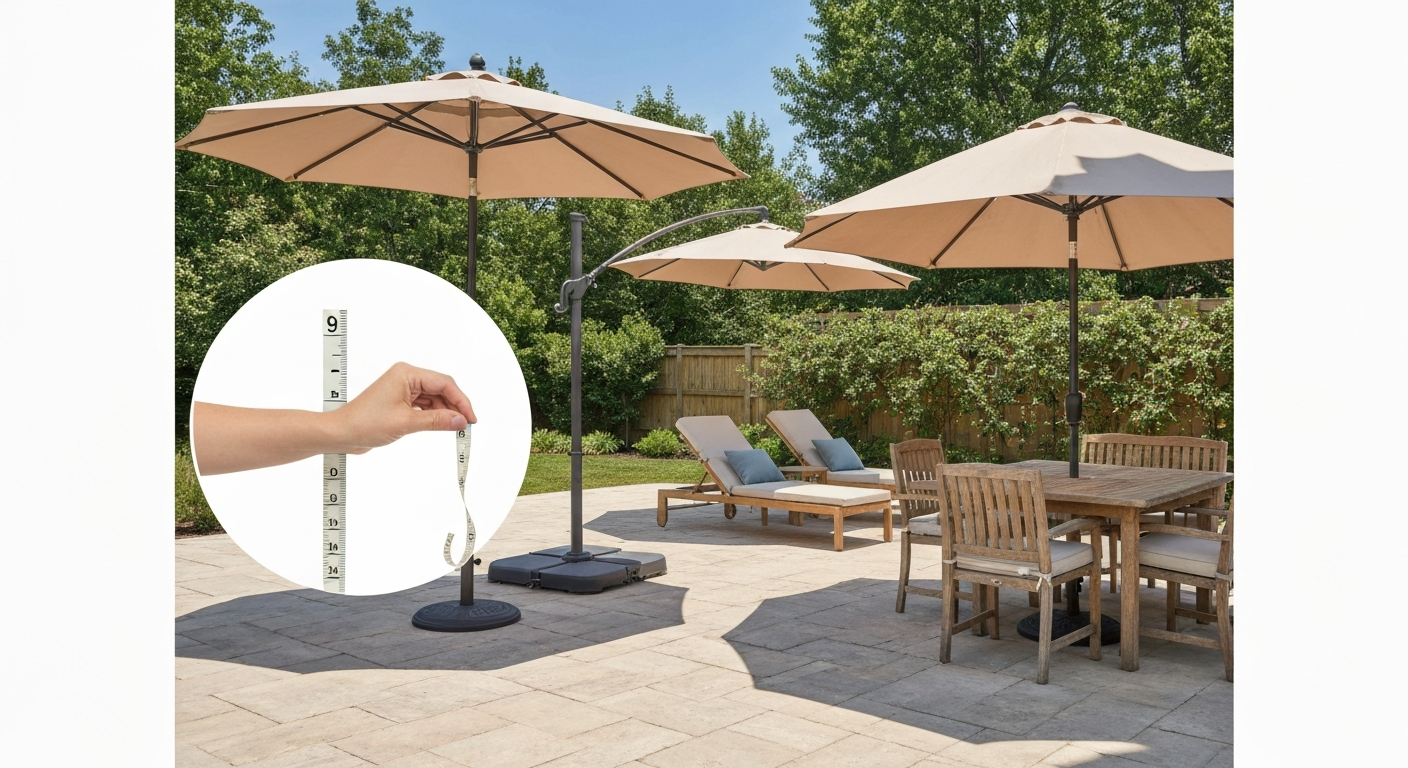
Before you buy, measure the seating or lounging area you want to shade at its widest and longest points. Add 2 feet on each side as a shade buffer (this accounts for sun angles less than 90 degrees). That gives you a minimum canopy diameter or width. Then measure where the base post will sit: a cantilever's arm typically extends 4 to 6 feet from the center of the post to the center of the canopy, so the post needs to stand at the edge of, or just outside, your patio area. Make sure that post location does not conflict with gates, fence lines, planters, or the edge of a deck that cannot support a 300 lb base.
For a standard 6-seat round patio table with a 60-inch diameter, a 10-foot round cantilever canopy positioned 4 feet off-center gives you complete overhead coverage plus a few feet of buffer. For a pool deck with two loungers side by side (roughly 8 feet wide), an 11-foot canopy with a good tilt range covers both chairs from mid-morning through late afternoon. Rectangular canopies suit linear arrangements: three chaise lounges in a row, a long outdoor sofa, or a rectangular dining table.
- Measure your seating area at its widest and longest points.
- Add 2 feet to each dimension to get your minimum canopy size.
- Identify a base location at least 4 feet from the edge of your seating area (where the post will stand).
- Check that the post location is on a flat, stable surface capable of supporting 200 to 400 lbs.
- Confirm the arm reach of your chosen model bridges the distance from post to canopy center.
- For decks, confirm joist spacing and deck-board load capacity before placing a 300 lb base on a single spot.
The best models for each type of homeowner
Best overall: Treasure Garden AG25T (10 ft)
Treasure Garden is one of the largest umbrella OEMs in North America, manufacturing canopies for dozens of retail brands, so buying a Treasure Garden-labeled product means you are getting the factory's own quality standard rather than a rebadged version of it. The AG25T 10-foot model has a powder-coated aluminum frame, a double-vented polyester canopy standard (upgradeable to Sunbrella acrylic), 360-degree rotation, infinite-tilt arm, and a crank lift. It requires a 200 to 250 lb base minimum. For a broader comparison of the best hanging patio umbrella options, see our best hanging patio umbrella guide. At $400 to $550 through authorized dealers and Home Depot, it sits in the mid-range but punches above it in build quality and available replacement parts.
Best budget: PURPLE LEAF 10 ft cantilever
PURPLE LEAF is widely available on Amazon and Wayfair and consistently appears in budget-category roundups. The 10-foot model comes with a powder-coated aluminum or steel frame (confirm the specific listing), a polyester canopy, 360-degree rotation, and a cross-base included. At $180 to $280, the weak points are the polyester canopy (plan for fading after two to three seasons) and the base weight: the included cross-base is often undersized for exposed sites. Fill it with every available weight plate and consider adding sandbags in high-wind areas. For a covered patio or sheltered backyard, this is a reasonable seasonal umbrella.
Best premium: Tuuci Ocean Master MAX
Tuuci builds marine-grade aluminum cantilever umbrellas used in hotels and resorts worldwide, and the Ocean Master MAX is their flagship residential-crossover line. The frame warranty runs up to 15 years structural, which is unmatched in the residential market. Canopy options include Sunbrella acrylic as standard. Assembly and operational manuals are published in full, and the mechanical limits are clearly documented. At $1,200 to $2,500 depending on size and canopy choice, this is a genuine long-term investment. If you live in a coastal or hurricane-adjacent climate and want an umbrella that survives serious weather events with a documented maintenance protocol, this is the product.
Best wind-resistant: Treasure Garden AKZ PLUS 11.5 ft
The AKZ PLUS series uses a heavier-gauge aluminum frame, a double-vented canopy, and a push-button tilt with 360-degree rotation. The 11.5-foot model explicitly requires a 300 to 400 lb base and is designed for sites with more wind exposure than a sheltered urban backyard. The double-vent design reduces uplift pressure on the canopy by allowing air to escape upward rather than building under the fabric. This is the cantilever to buy if you live in an open suburban lot, coastal area, or elevated deck where wind is a regular factor.
Best small-space: Crestlive 9 ft cantilever
For balconies, small urban patios, or areas where a 10-foot canopy arm would conflict with overhead structures, a 9-foot cantilever is the right call. Crestlive's 9-foot model is compact, reasonably built for the price, and available widely on Amazon and Wayfair. The base requirement of roughly 150 to 200 lbs is more manageable in tight spaces. Shade coverage is approximately 63 square feet, suitable for two to four people. Do not expect it to handle sustained winds above moderate breezes.
Best large-area and commercial-grade
For large patios, commercial setups, or hospitality use, the Treasure Garden AKZ PLUS 13-foot and the Tuuci Ocean Master Classic are the two benchmarks. The 13-foot AKZ PLUS covers up to 130 square feet of shade and requires a 400 lb minimum base, making permanent or semi-permanent anchoring a practical necessity. The Tuuci Ocean Master Classic is used in hotel and restaurant settings globally and can be specified with in-ground sleeve mounting. Both products have dealer networks rather than mass-retail availability, which also means actual after-sale support rather than a chat bot.
Region-specific guidance: Canada and the UK
Canada
Canadian buyers face a shorter outdoor season (typically May through September in most of the country), higher import and shipping costs, and a narrower retail network than US buyers. Home Depot Canada and Wayfair Canada both list cantilever umbrellas, but SKU availability is roughly 30 to 50 percent of the US catalog. Treasure Garden products are available through Canadian dealers, including some Home Depot Canada locations and independent patio retailers. For a Canadian-specific shortlist and buying tips, see our guide to the best cantilever patio umbrella Canada. PURPLE LEAF ships to Canada through Amazon.ca but at higher prices than the US equivalent. The key weatherproofing consideration in Canada is freeze-thaw cycles: any umbrella stored outdoors in winter in regions below freezing risks cracking of plastic components and corrosion of hardware. Plan to store the canopy indoors from October through April and bring the base plates inside or drain water-fill bases completely before freeze season. UV exposure is intense in Western Canada and the Prairie provinces from June through August, making solution-dyed acrylic canopies a better long-term investment than polyester even in a shorter season.
United Kingdom
UK buyers encounter a different product landscape: US brands like Treasure Garden and Tuuci are available but typically through specialist garden-furniture importers rather than high-street retailers. UK garden centres (B&Q, Dobbies, Hartman, and others) stock their own cantilever parasol ranges at competitive prices. Commercial vendors reference BS EN 13782 (temporary structures/parasol certification) for wind-resistance claims, and some higher-end commercial parasols sold in the UK claim tested wind resistance exceeding 100 km/h under that standard. For residential use, look for products with powder-coated aluminum frames, ventilated canopies, and base weights specified by the manufacturer. The UK climate creates a distinct challenge: overcast, damp conditions reduce the UV urgency but increase fabric mold risk, particularly with polyester canopies that hold moisture. Solution-dyed acrylic (Sunbrella or equivalent) resists mildew better than polyester and is worth the premium even in lower-sun climates. Post-Brexit import duties and VAT apply to US-shipped products, making direct import from US retailers significantly more expensive than buying UK-stocked product. For a curated list of UK-specific options and retailers, see our guide to the best patio umbrella uk. Returns on direct-import purchases are also complicated. Stick to UK-stocked brands unless you have a specific model that is not available domestically.
Installation and anchoring: step by step
The single most important installation decision is whether you will use a portable weighted base or a permanent in-ground anchor. Portable bases are the default for most homeowners and work well if you fill them completely and use the correct total weight. Permanent in-ground mounts (sleeve anchors set in concrete) are the right choice for 13-foot or larger canopies, commercial-grade use, or any site with frequent high winds. Here is how to approach each.
Portable weighted base: step-by-step
- Read the manufacturer's specified minimum base weight before purchasing weight plates. Do not estimate.
- Place the base on a flat, level hard surface (concrete, pavers, or compacted gravel). Avoid soft ground, grass, or decking that flexes.
- Fill all base-plate cavities completely with sand or the specified fill material. Do not partially fill.
- Assemble the vertical pole into the base socket and confirm it is plumb (use a level if needed).
- Attach the cantilever arm according to the manufacturer's assembly manual, confirming all locking pins and bolts are fully seated.
- Raise the canopy using the crank and test 360-degree rotation and tilt before placing furniture beneath it.
- In winds above 20 to 25 mph, close the canopy. Most residential cantilever umbrellas are not designed for sustained open operation in high winds.
- Inspect all hardware (pivot bolts, arm locks, crank mechanism) at the start of each season and tighten or replace as needed.
In-deck and in-ground permanent mounting
For large or commercial-grade cantilevers, a ground sleeve anchor set in concrete is the most secure option. The sleeve (typically a 3 to 4-inch diameter steel or aluminum tube) is embedded in a concrete footing sized to resist the umbrella's overturning moment. For a 10-foot cantilever in a 90 mph design wind zone (calculated using ASCE 7 wind-pressure methods), a conservative footing is roughly 12 inches in diameter by 24 inches deep, but any permanent structural installation should be confirmed with a local contractor familiar with your site's wind exposure and soil conditions. In-deck mounts thread through a drilled deck board into a structural blocking member below. Confirm the deck's joist spacing and load capacity before drilling: the umbrella load (base plus overturning wind force) will concentrate on a single deck penetration point.
Portable vs permanent: which is right for you?
| Factor | Portable Weighted Base | Permanent In-Ground/In-Deck Mount |
|---|---|---|
| Flexibility | High (moveable, storable) | None (fixed location) |
| Base weight required | 200–500 lbs of plates/fill | Concrete footing handles load |
| Cost | $50–$200 for base plates | $200–$800+ for professional installation |
| Wind stability | Good if correctly weighted | Excellent |
| Best for | Renters, flexible layouts, smaller umbrellas | Large canopies, high-wind sites, commercial use |
| Installation skill needed | DIY-friendly | Requires drilling, concrete, possibly a contractor |
Maintenance, troubleshooting, and parts
Cantilever umbrellas last significantly longer with basic seasonal maintenance. At the start of each season, clean the canopy with mild soap and water (never bleach on acrylic; dilute bleach solution is tolerated on polyester in small concentrations), rinse fully, and allow to dry open before closing and storing. Check all aluminum pivot joints and crank components for corrosion or binding. A drop of silicone spray lubricant on pivot points and the crank gear prevents the grinding and stiffness that develops after a season of use.
Common failures include broken crank handles (almost always a replaceable plastic or metal part available through the manufacturer or aftermarket), bent ribs from wind tip-overs (Treasure Garden and Tuuci both supply replacement ribs through their dealer networks), and faded or torn canopies. Canopy replacement is worth doing on a quality frame: replacing a $150 polyester canopy with a $200 to $300 Sunbrella replacement canopy on a good aluminum frame gives you years more service at a fraction of the cost of a new umbrella. At the end of each season, store the canopy in a dry location indoors. If you cannot bring the entire umbrella inside, at minimum remove and store the canopy fabric and apply a cover to the frame.
Warranty and where to buy
Warranty length is a proxy for manufacturer confidence in the product. Tuuci offers up to 15 years on Ocean Master frames (with specified exclusions for labor and cosmetic damage). Treasure Garden typically offers 2 to 5 years on frames and 1 to 3 years on canopy fabrics depending on the line. Budget brands from Amazon or Wayfair commonly offer 1-year warranties with limited support infrastructure. For any cantilever umbrella above $400, buy from a retailer or dealer that stocks replacement parts: Home Depot, specialist patio retailers, and authorized Treasure Garden or Tuuci dealers are better choices than marketplace third-party sellers. For Canada, check availability at patio specialist retailers and Home Depot Canada before ordering cross-border. For the UK, buy UK-stocked product to avoid post-Brexit import costs and complications on returns.
Decision checklist before you buy
Run through these questions before placing an order. They will catch most of the common mismatch errors that lead to returns or regrets.
- Have you measured your seating area and confirmed the canopy size will cover it (plus 2-foot buffer on each side)?
- Is there a flat, stable surface where the base post can stand, at least 4 feet from the edge of the seating area?
- Have you confirmed the manufacturer's minimum base weight and do you have (or plan to buy) enough plates to meet it?
- Does your chosen model have a double-vented canopy if you live in a windy or exposed location?
- Is the canopy fabric solution-dyed acrylic or quality olefin if you want more than three seasons of color retention?
- Does the model offer 360-degree rotation and infinite or multi-position tilt for sun-tracking?
- Have you confirmed warranty terms and that replacement parts (canopy, ribs, crank) are available for your chosen model?
- For Canada: have you planned seasonal storage to protect against freeze-thaw damage?
- For the UK: are you buying UK-stocked product to avoid import cost and returns complications?
- For 13-foot or larger canopies: have you considered a permanent or semi-permanent anchor rather than a portable base?
FAQ
What is a cantilever (aka hanging/offset) patio umbrella and how does it differ from a center‑pole (market) umbrella?
A cantilever (hanging/offset) umbrella has its support post off to the side and a boom arm that holds the canopy in a cantilevered position above the shaded area. A center‑pole (market) umbrella has a pole through the center of the canopy and typically mounts through a table or into a base beneath the pole. Key differences: cantilevers give unobstructed floor and table space and offer 360° rotation/offset coverage options, but they require much heavier bases or permanent anchoring to resist overturning; center‑pole umbrellas are simpler, lighter, usually cheaper, and need smaller bases for similar canopy sizes.
What are the evidence‑based top cantilever umbrella picks across budgets and use‑cases?
Summarized by use‑case: - Budget (patio/homeowner casual use): polyester canopy cantilevers from major big‑box brands (e.g., PURPLE LEAF / Crestlive style clones). Good for light, sheltered patios; expect limited wind tolerance and shorter fabric longevity. - Midrange (durability + good features): powder‑coated aluminum frames with solution‑dyed polyester or Sunbrella‑option canopies, crank tilt and 360° rotation—brands like Treasure Garden mid‑range lines. Balanced durability, available parts and dealer support. - Premium (high‑wind, long life, commercial‑grade): Sunbrella or acrylic canopies, stainless hardware, thicker extruded aluminum or stainless‑steel frames, robust mechanicals and manufacturer warranties—brands like Tuuci, Treasure Garden commercial lines. Choose premium for exposed sites and heavy seasonal use. Note: Wirecutter did not test cantilever umbrellas in their umbrella guide and therefore has no direct cantilever picks; Consumer Reports and manufacturers like Treasure Garden/Tuuci provide lab/field data for cantilevers.
How do Wirecutter’s recommendations compare with cantilever‑specific guidance?
Wirecutter focused on market/center‑pole umbrellas and limited testing to ~9‑ft market umbrellas; they explicitly did not test cantilever/offset umbrellas. Their base‑weight guidance (50 lb for table‑use 9‑ft, 75–90 lb for standalone 9‑ft) is aimed at center‑pole market umbrellas and underestimates the much larger base requirements manufacturers list for cantilevers. For cantilevers follow cantilever‑specific specs from manufacturers and testing organizations (Consumer Reports, Treasure Garden, Tuuci, ASTM guidance) rather than Wirecutter’s center‑pole numbers.
What practical buying criteria should I use (wind ratings, fabric, canopy size/shape, frame, mechanisms, base)?
Actionable checklist: - Wind tolerance: Look for lab testing or manufacturer wind rating; commercial lines often list tested speeds. For exposed sites prefer models with vented canopies and commercial testing (BS EN or ASTM references). - Fabric type & UV: Solution‑dyed acrylics (Sunbrella) generally give best UV stability and colorfastness (UPF 50+); high‑quality polyester is cheaper but fades faster. Check warranty for fading/UV. - Canopy size & shape: Match canopy projected area to desired shaded area. Example: a 10‑ft round canopy covers ~78 sq ft; give ~10–20% oversize to allow movement/angle. Rectangular/oval canopies provide more usable shade over tables/decks. - Frame materials: Powder‑coated aluminum is common and corrosion‑resistant; stainless or marine‑grade hardware for coastal zones. Avoid thin steel without good coating. - Tilt/crank mechanisms: Look for smooth gear cranks and positive‑lock tilt; test for creep (sags under load) in reviews or in‑store. - Base weight & footprint: Follow manufacturer minimums; many 10'–13' cantilevers require 200–400 lb minimum base weight or bolted permanent anchors. Consider base footprint and ability to move. - Parts/support: Prefer brands with spare‑parts availability and clear manuals (Tuuci, Treasure Garden, big‑box brands with replacement parts).
How should homeowners interpret wind ratings and standards (ASTM, BS EN, ASCE) for cantilever umbrellas?
Use standards as follows: - ASTM F3512‑21 describes lab wind testing for market umbrellas (useful background). - BS EN 13782 (used in UK/EU) covers parasols/temporary structures and is used by commercial parasol makers to claim higher wind resistance. - ASCE 7 provides wind‑pressure/force calculation methodology for anchor sizing. Practical approach: don’t rely on vague 'wind‑resistant' marketing—look for a stated tested wind speed or compliance (manufacturer lab report or standard). For exposed sites, choose models with commercial testing or plan to take umbrellas down at gusts commonly above 25–30 mph (40–50 km/h) unless manufacturer/engineer guidance allows otherwise.
Region‑specific notes: What should buyers in Canada and the UK consider about availability, brands, weatherproofing, and returns?
Canada: - Availability: Big‑box retailers (Home Depot, Lowe’s) and Canadian dealers carry many cantilevers; check seasonal stock and cross‑border shipping fees if importing. - Weatherproofing: Choose powder‑coated aluminum and Sunbrella or solution‑dyed acrylic for snow/sun cycles; expect accelerated fading in strong UV provinces. - Shipping/returns: Seasonal products may have return windows; large base shipping costs and freight return fees can apply. UK: - Availability: UK/EU brands and commercial parasol vendors are common; look for BS EN 13782 compliance if you need documented wind resistance. - Weatherproofing: Prioritize corrosion resistance (stainless fittings) in coastal areas and consider winter storage—many UK owners use removable canopies or off‑season storage. - Returns: Check EU/UK distance‑selling rules for returns; large, bulky items sometimes have different return policies and restocking/freight charges.