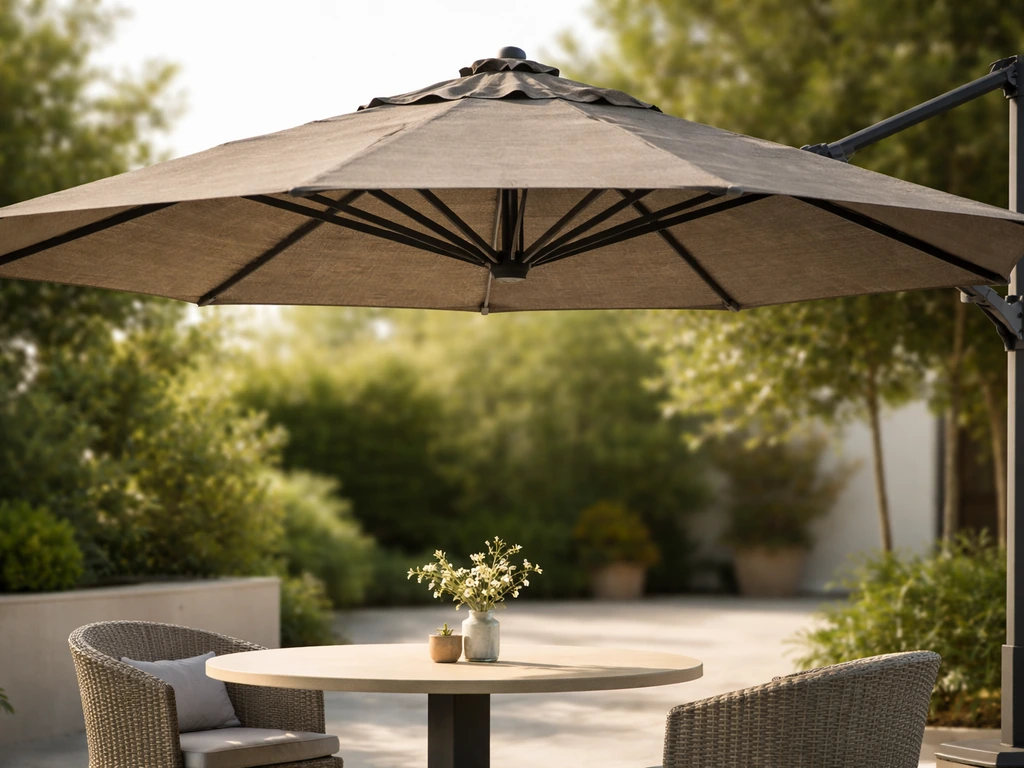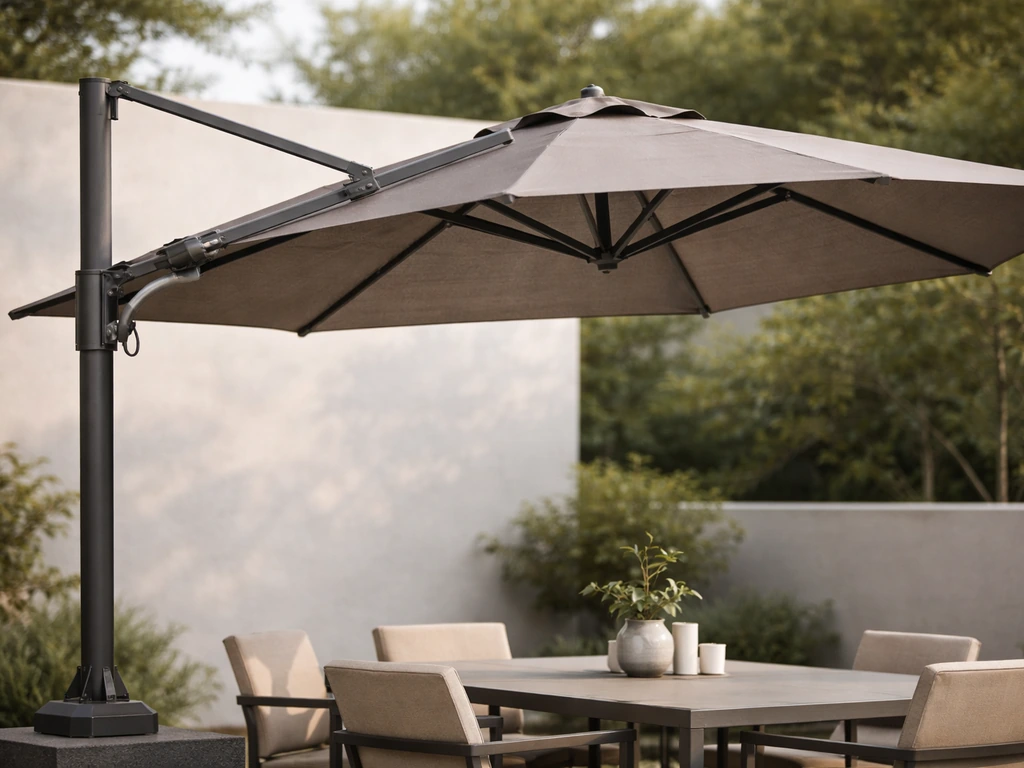
The best offset patio umbrella for most backyards is a 10- to 13-foot cantilever with an aluminum or fiberglass-reinforced frame, a solution-dyed acrylic canopy rated UPF 50+, a 360-degree rotation mechanism, and a weighted base of at least 100 lbs. That combination gives you genuine shade coverage, decent wind resistance, and enough durability to last five or more seasons without constant babying. What separates a great offset umbrella from a frustrating one isn't brand name, it's whether the specs match your actual space, wind exposure, and how you plan to use it day to day.
Best Offset Patio Umbrellas: Cantilever Buying Guide

Kent Lang
13 May 2026
What makes an offset umbrella different from a regular one
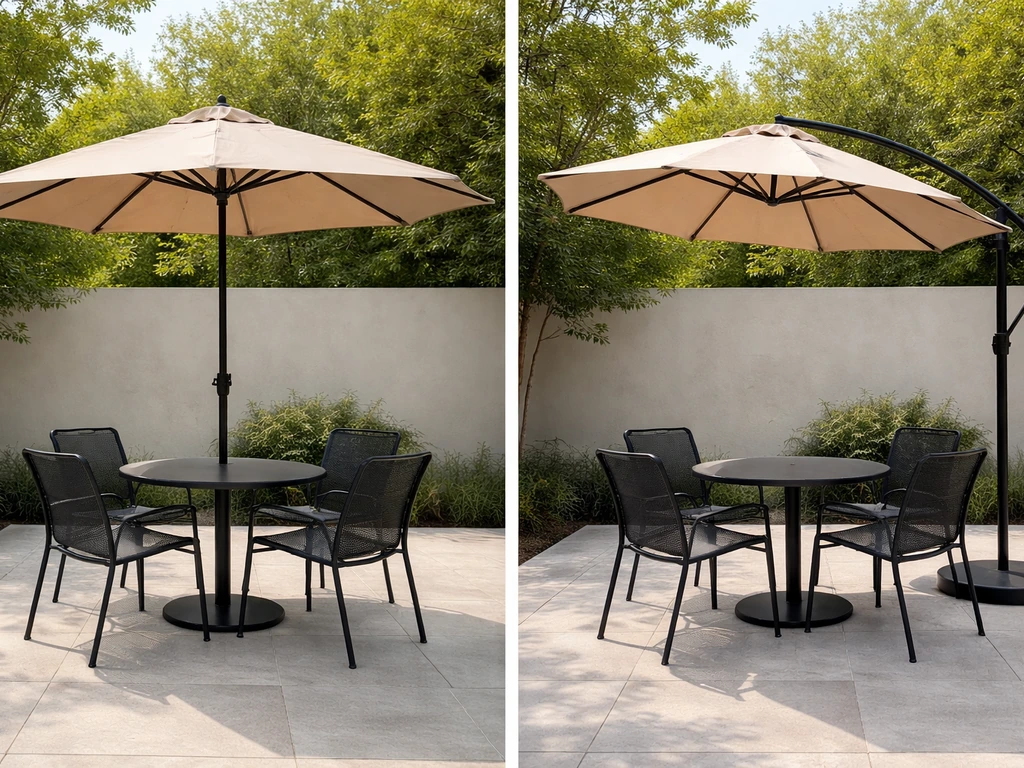
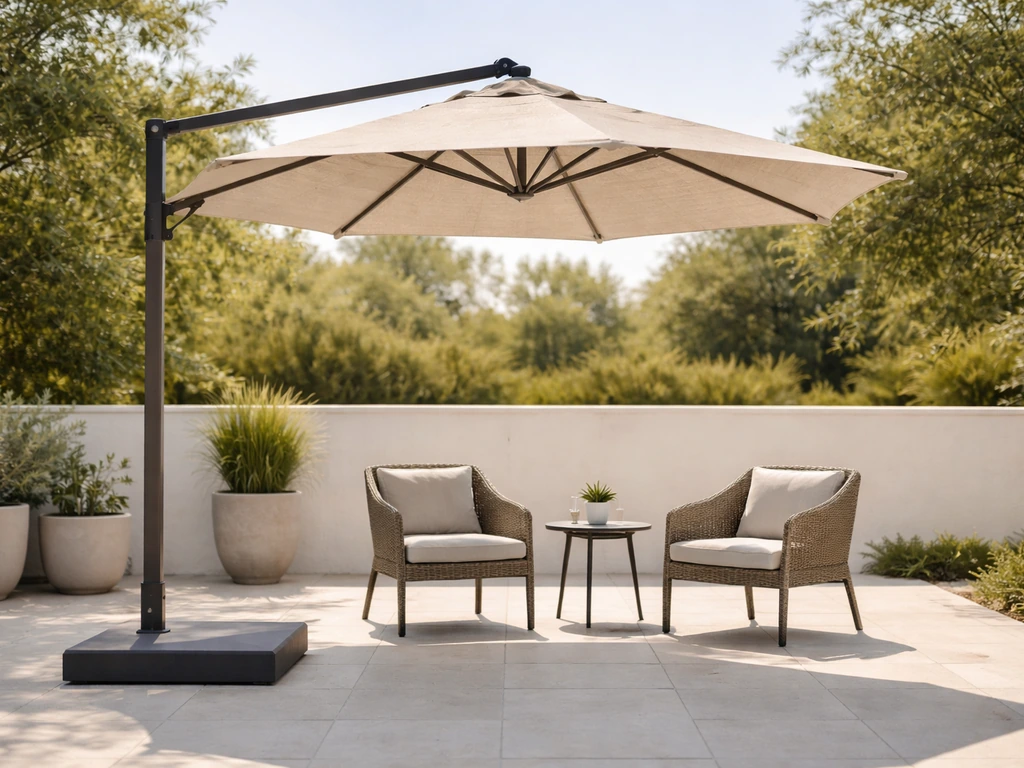
A standard center-post (or market-style) umbrella runs a pole straight through the middle of your table. It works fine, but it forces the umbrella through a hole in the table and limits where the shade falls. An offset or cantilever umbrella moves the support pole entirely to the side, so the canopy hangs out over your seating area with nothing in the middle. You get full use of your table surface, you can position the shade wherever the sun is hitting, and you don't need a table with a center hole at all.
The terms 'offset' and 'cantilever' are used interchangeably in most product listings, and they mean the same thing for practical purposes. The canopy is suspended from an arm that extends out from a side post. This design gives you more flexibility in placement, but it also creates more mechanical stress on the frame, which is why build quality matters more in this category than with simpler center-post models. It also means the base doing the anchoring work is under a lot of leverage, not just vertical load.
People choose offset umbrellas over center-post ones for a few clear reasons: no pole in the middle of the dining table, the ability to shade a lounge chair or sectional that has no table at all, easier repositioning as the sun moves, and a cleaner look when guests are around. The trade-off is that they cost more, need a heavier base, and require more clearance around the perimeter for the arm and canopy to swing without hitting a wall or fence.
Measure your patio before you look at a single product
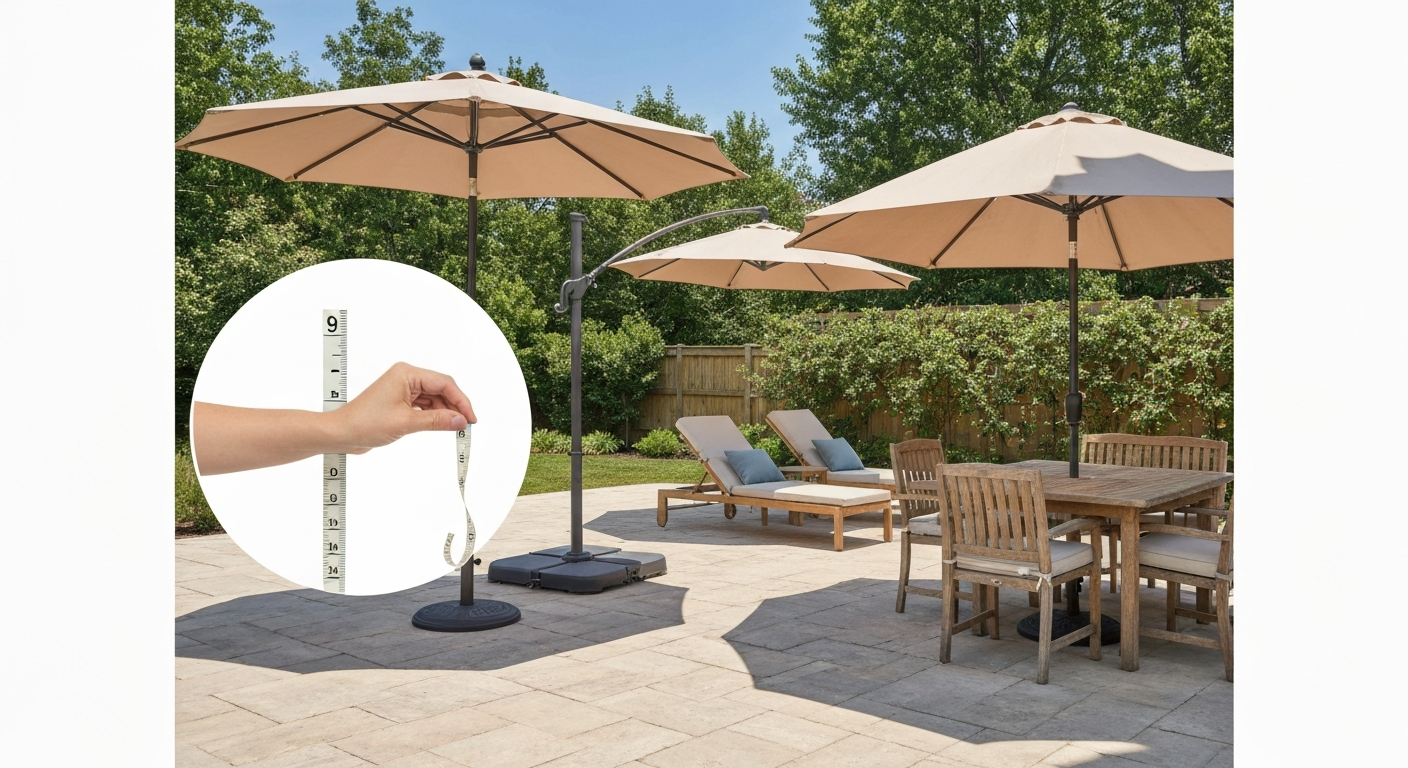
This step gets skipped constantly, and it's the main reason people end up with an umbrella that either blocks their back door or leaves half their seating in full sun. Before you open a browser tab, grab a tape measure and note three things: the width and depth of the area you want to shade, the clearance height from the ground to any overhead obstruction (pergola beam, eave, power line), and the distance from your intended base position to the edge of the seating area.
Offset canopies typically run from 9 feet to 13 feet across. A 9-foot canopy shades roughly 60 to 65 square feet, which covers a small bistro set or two lounge chairs. A 10- to 11-foot canopy gets you around 80 to 95 square feet, ideal for a 4- to 6-person dining set. A 13-foot model pushes past 130 square feet and can cover a full sectional or a large rectangular table. The rule of thumb is to add 2 feet of canopy diameter beyond the outer edge of whatever you're shading, so the sun doesn't creep in from the sides as it moves.
Height clearance is where offset umbrellas surprise people. The arm and the hanging canopy need room to tilt and rotate. Most models require at least 7.5 to 8 feet of ground clearance under the canopy when it's in use, and the top of the pole can reach 8.5 to 10 feet depending on model. If you're putting this under a pergola or near a roof overhang, measure the opening carefully. Also measure the swing radius of the arm: when you rotate the canopy 360 degrees, does it clear your fence, outdoor kitchen, or wall? Leave at least 18 to 24 inches of buffer on all sides.
| Canopy Size | Approx. Shade Coverage | Best For | Typical Base Weight Needed |
|---|---|---|---|
| 9 ft | 60–65 sq ft | Bistro set, 2 lounge chairs | 75–100 lbs |
| 10–11 ft | 80–95 sq ft | 4–6 person dining set | 100–125 lbs |
| 11–12 ft | 95–115 sq ft | Large dining or small sectional | 125–150 lbs |
| 13 ft | 130+ sq ft | Full sectional, 6–8 person table | 150–200 lbs |
Stability and wind: the base is the whole ballgame
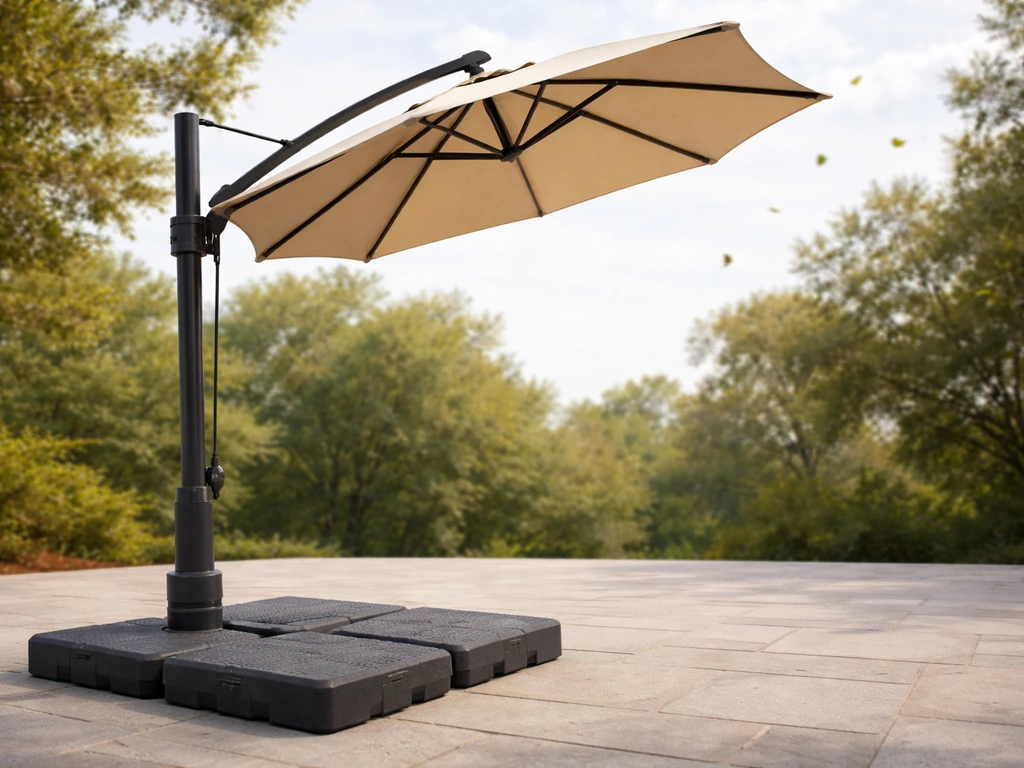
If there's one thing that separates a safe, long-lasting offset umbrella from a hazardous one, it's the base. Because the canopy is offset from the pole, the wind load creates a strong rotational force (torque) that a lightweight base simply can't resist. The base is legitimately the most safety-critical component of any cantilever umbrella setup, and it's where budget products consistently cut corners.
For a 9- to 10-foot canopy in moderate wind conditions (up to about 20 mph), a 100-pound filled base is the minimum. Step up to an 11- to 13-foot canopy or a windier climate, and you want 150 to 200 pounds. Some high-quality systems allow you to anchor the base directly to a concrete pad using bolts, which is the most secure option if you have a poured patio. High quality patio umbrellas are also easier to stabilize when you can anchor them securely to a concrete pad. In-ground post anchor systems are another option for permanent installs. For freestanding setups, the most common choice is a cross-base or wheeled base that you fill with sand or water, but sand is always preferred since it's heavier and doesn't freeze or evaporate.
Wind performance also depends on the canopy ventilation. A double-vent canopy (two layers at the top with a gap between them) lets wind pass through rather than catching it like a sail, which dramatically reduces uplift force. Single-vent canopies are acceptable in sheltered yards; double-vent is worth paying for if you're in a coastal, open, or gusty area. No offset umbrella is truly safe in sustained winds above 30 to 35 mph, and most manufacturers will tell you to close and secure yours any time a storm is approaching.
Base types compared
| Base Type | Best Use Case | Stability Level | Notes |
|---|---|---|---|
| Fillable cross-base (sand) | Freestanding on any patio surface | Good | Fill with sand, not water; most versatile |
| Wheeled fillable base | Patios where you reposition often | Moderate | Lock wheels when in use; less stable than fixed |
| Concrete bolt-down anchor | Permanent install on poured patio | Excellent | Highest stability, not movable |
| In-ground post sleeve | Permanent installs in soil or turf | Excellent | Requires professional install for best results |
| Paver/deck mount plate | Wood decks or tile patios | Good–Excellent | Hardware must match deck material |
Frame, ribs, and fabric: what the best offset umbrellas are actually made of
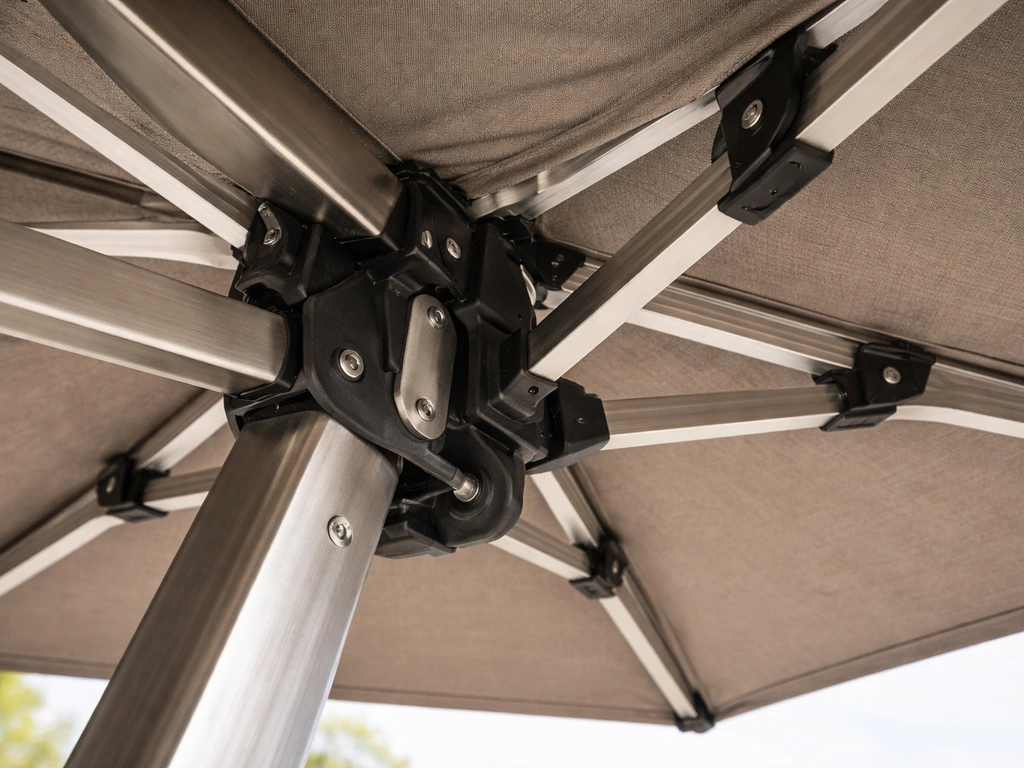
The frame material determines how much the umbrella weighs, how it holds up to moisture and UV exposure, and how long it lasts before joints and hardware start failing. Aluminum is the standard for good reason: it's lightweight, corrosion-resistant, and strong enough for most residential use. Look for powder-coated aluminum poles with a diameter of at least 2 inches (preferably 2.5 inches or more for larger canopies), since thinner poles flex and fatigue over time. Cast aluminum joints and hardware are significantly more durable than stamped or pressed steel fittings.
Steel frames are heavier but more affordable at the entry level. The problem is that even galvanized or painted steel will eventually rust at connection points if you're in a humid or coastal climate. Stainless steel hardware (bolts, pins, pivots) is worth seeking out even on aluminum-frame models, since it won't seize or corrode the way zinc or basic steel hardware does after a couple of wet seasons.
Ribs are what the canopy fabric stretches over. Fiberglass ribs are the clear winner here: they flex under wind load instead of snapping, which is why they're standard on better-quality offset umbrellas. Aluminum ribs are lighter and cheaper but crack or crease under stress. If you've ever had an umbrella come home from a windstorm with a bent rib, that was almost certainly aluminum. A good 11-foot offset umbrella should have at least 8 fiberglass ribs; 12-rib designs are noticeably more stable and hold the canopy shape better.
For fabric, solution-dyed acrylic is the gold standard. The color is woven into the fiber before it's spun, not printed on top, so it doesn't fade the way screen-printed polyester does after one or two summers. Sunbrella is the most recognized brand in this category and genuinely performs better over time, though there are comparable fabrics from other manufacturers. Look for a canopy rated UPF 50+ (blocks 98% or more of UV rays) and a fabric weight of at least 160 grams per square meter for durability. Water resistance matters too: solution-dyed acrylic is naturally water-repellent and dries quickly, which prevents mold and mildew from setting in.
The hardware and features you'll actually use every day
Opening and closing an offset umbrella shouldn't require two people and a manual. The best systems use an easy-crank pulley mechanism that you can operate with one hand, combined with a locking lever or pin that holds the canopy position firmly once it's open. Avoid any model that relies entirely on a rope-and-pulley system without a positive lock, since those tend to slip over time and can let the canopy drop unexpectedly.
Tilt adjustment is what lets you angle the canopy toward low morning or afternoon sun rather than just straight overhead. A multi-position tilt with at least three or four stops gives you much more usable shade across the day than a fixed canopy. Some premium models offer infinite tilt adjustment, which is genuinely useful if you have loungers that you move around. Rotation, ideally 360 degrees, lets you reposition the shade without moving the base, which is a feature you'll appreciate every single day once you have it.
Ground clearance under the canopy is worth checking in the product specs. Most offset umbrellas sit 7.5 to 8.5 feet above ground at the lowest canopy point when fully extended and horizontal. If you're tall, or if you have guests who are, look for models that advertise 8-foot minimum clearance rather than the 7.5-foot minimum. Some arms are adjustable in height, which solves this completely.
- Easy-crank opening mechanism with a positive locking system
- Multi-position or infinite tilt (at least 3 stops, ideally 5+)
- 360-degree canopy rotation without moving the base
- Adjustable arm height for clearance flexibility
- Double-vent canopy for wind resistance
- UV-resistant hardware (stainless steel or marine-grade aluminum)
- Integrated LED lighting (optional but useful for evening use)
Matching budget and climate to the right pick
Under $200 gets you a functional umbrella for occasional use in sheltered yards. Frames will be thinner-wall aluminum or steel, fabric will be polyester, and the base will need supplementing or upgrading. These are fine for a rental property or a low-use patio where the umbrella mostly sits furled, but they won't hold up to daily use across multiple seasons.
The $200 to $500 range is where the quality jump is most significant. You start getting powder-coated aluminum frames with 2-inch or larger poles, fiberglass ribs, and acrylic or acrylic-blend canopies. Base quality improves noticeably here too. For most homeowners with a standard backyard, a solidly built umbrella in this range paired with a good base will last 4 to 7 years with normal care. This is the sweet spot for value.
Above $500, and especially in the $800 to $1,500-plus range, you're getting commercial-grade components: heavy-wall aluminum or stainless steel frames, genuine Sunbrella or equivalent solution-dyed acrylic, precision machined rotation and tilt hardware, and bases designed for long-term outdoor exposure. If you live in a coastal area with salt air, a high-UV climate like the Southwest, or a region with regular afternoon thunderstorms, spending more upfront is the better financial decision because mid-range umbrellas deteriorate fast in those conditions. The best quality offset patio umbrellas at this tier are genuinely built to last a decade with minimal maintenance.
| Budget Range | What You Get | Best Climate Fit | Watch Out For |
|---|---|---|---|
| Under $200 | Steel or thin aluminum frame, polyester fabric, basic base | Mild, sheltered, low-wind | Rust, fading fabric, weak joints |
| $200–$500 | Powder-coated aluminum, fiberglass ribs, acrylic blend fabric | Most residential climates | Base often sold separately; verify weight |
| $500–$1,000 | Heavy-wall aluminum, solution-dyed acrylic, quality tilt/rotation | Higher UV, moderate coastal, windier areas | Higher price doesn't always mean better base included |
| $1,000+ | Commercial-grade, stainless hardware, premium canopy, robust base | Harsh coastal, high-UV, storm-prone regions | Overkill for mild climates; verify warranty terms |
Climate matters more than most buyers realize. A $350 umbrella that performs well in a mild Pacific Northwest patio will last two seasons in a South Florida backyard with daily afternoon thunderstorms and intense UV. If you're somewhere hot, humid, or frequently windy, treat the climate rating as seriously as you treat the canopy size.
Your shopping checklist before you click 'buy'
Run through this list before committing to any specific model. It sounds like extra work, but it takes about ten minutes and prevents the most common buyer regrets in this category.
- Measure your shade zone: note the width, depth, and height clearance of the area you want to cover, then add 2 feet to each dimension to find your minimum canopy size.
- Check your base situation: decide whether you want freestanding, deck-mounted, or concrete-anchored, and verify the base weight matches the canopy size and your wind exposure.
- Confirm canopy-to-ground clearance: look for the spec labeled 'minimum clearance height' or 'height under canopy' in the product details, not just the total pole height.
- Verify rotation and tilt: confirm the model has 360-degree rotation and at least 3-position tilt if shade tracking matters to you.
- Check the rib material: look for fiberglass ribs explicitly stated; if the listing only says 'aluminum frame' without specifying ribs, assume they're aluminum too.
- Look at the fabric spec: confirm solution-dyed acrylic or a UV-rated equivalent; check for UPF 50+ rating and ask about the fabric weight if it's not listed.
- Read the wind rating: most good offset umbrellas are rated for 20 to 35 mph winds when properly anchored; anything without a stated wind rating is a red flag.
- Check what's included: many offset umbrellas are sold without a base, and a quality base adds $80 to $200 to the total cost. Factor that in before comparing prices.
- Read the warranty terms: look for at least a 1-year frame warranty and a separate fabric warranty; better brands offer 3- to 5-year coverage on the frame.
- Plan for storage: offset umbrellas need to be closed and secured or stored during high winds and off-season; confirm you have space for the closed umbrella or a cover that fits it.
Once you've done that groundwork, you'll be comparing apples to apples instead of getting distracted by canopy colors or product photos. The umbrella that checks all ten boxes for your specific patio is a better buy than a prettier one that fails on base weight or rib material. If you're also weighing whether a premium offset umbrella is worth the jump over a quality center-post model, or how offset umbrellas stack up against the best high-end patio umbrella options in general, those are worth exploring once you've confirmed the offset format fits your layout. The offset style earns its price premium when the pole-free coverage genuinely changes how you use your outdoor space, and with the right specs dialed in, it usually does.
FAQ
What size base do I actually need for the best offset patio umbrellas in windy areas?
Use the canopy diameter and your typical gusts as the starting point, then add a safety margin. If you often see gusts above about 20 mph, plan on 150 to 200+ lb of base capacity even for a mid-size canopy, and choose a model that allows bolt-down or an anchor kit for your patio surface. If you can only use a wheeled or cross-base setup, avoid sand-light base volumes and consider topping off with additional fill to reduce wobble when you rotate the canopy.
Do I need to buy a matching base, or can I use any weighted base for an offset umbrella?
Most offset umbrellas are not “universal” because the arm torque and pole geometry require a specific mounting footprint and height. Check the umbrella’s manual for the base model or the required post diameter, base plate dimensions, and whether it expects a center-hole, bolt pattern, or sleeve fit. If the listing only says “works with most bases,” treat it as a red flag and confirm compatibility before buying.
How much clearance do I need for the arm to rotate without hitting my fence, wall, or outdoor kitchen?
Measure the full swing path, not just the open canopy width. When the canopy rotates, the underside of the fabric and the arm will trace a curved zone that can be wider than the canopy itself, especially with tilt engaged. Leave at least 18 to 24 inches of buffer on the side closest to obstacles, and test at the highest tilt you plan to use.
Will a double-vent canopy really matter, or is single-vent fine?
Double-vent canopies are most noticeable in gusty conditions because the gap reduces uplift, which lowers how hard the base and ribs get pushed. If your yard is sheltered and you rarely get strong gusts, single-vent is often acceptable, but you should still prioritize a heavier base and sturdy rib material. In coastal or open locations, double-vent is usually the difference between “steady” and “constantly fighting the umbrella.”
What is the best way to reduce rust or corrosion on the frame and hardware?
Even with aluminum frames, corrosion often starts at connection points where water traps against hardware. Look for stainless hardware (pins, bolts, pivots) and sealed hardware channels, then rinse the umbrella after salt air or heavy rain if you are in a coastal area. If the umbrella is stored outdoors uncovered, use a breathable cover that keeps airflow going, to prevent moisture from staying trapped around joints.
How should I measure height clearance for an offset umbrella under a pergola or eave?
Measure three things: the lowest canopy point when it is fully extended, the height of the arm/pole section as it tilts, and the clearance needed for rotation. Many buyers only check the canopy height at a “straight overhead” position, but the tilt can bring the underside closer to beams. If your opening is tight, prioritize models with adjustable arm height and confirm the minimum clearance in the product spec for the exact canopy position.
Can I leave my offset umbrella outdoors during light rain and still expect long life?
Light rain is usually fine if the canopy can drain and dry quickly, but you should close and lock it after the rain starts so water does not pool under the fabric. Solution-dyed acrylic generally resists mildew because it dries faster than printed polyester. Avoid leaving it open overnight in humid climates, and use a breathable cover if you must leave it outside for extended periods.
What’s the most common mistake that makes offset umbrellas fail early?
Under-sizing the base and not accounting for torque during rotation. A heavy canopy on a too-light base might feel stable when it is closed or barely moved, then wobble once you tilt and spin it to follow the sun. Another frequent mistake is ignoring rib material, aluminum ribs can crease or bend after wind events, while fiberglass ribs are built to flex and recover.
Should I choose fiberglass ribs or aluminum ribs if I want maximum durability?
For longevity, fiberglass ribs are the safer default because they flex under wind load instead of cracking or taking permanent bends. Choose fiberglass if you are in a windy or coastal area, or if you plan to use the umbrella frequently. Aluminum ribs can be acceptable for very sheltered patios and occasional use, but they are more likely to show damage after a few gusty days.
Is UPF 50+ enough, or should I look for something else when choosing the best offset patio umbrellas?
UPF 50+ is a strong baseline for UV blockage, but shade coverage still depends on canopy size, tilt range, and how far the canopy sits beyond your seating. If you are trying to protect a dining area that stays in direct sun, oversize the canopy by about 2 feet beyond the outer edge of your seating and prioritize multi-position tilt so you can keep the fabric angled correctly through the day.
What’s the right storage routine to maximize lifespan?
Close and secure the umbrella before storms, then allow it to dry fully before covering for storage. In off-season storage, store in a dry, ventilated area if possible, or use a breathable cover that does not trap moisture. If you live in a freezing climate, avoid leaving sand-filled bases outdoors without protecting from freeze damage and check fill stability after thawing.