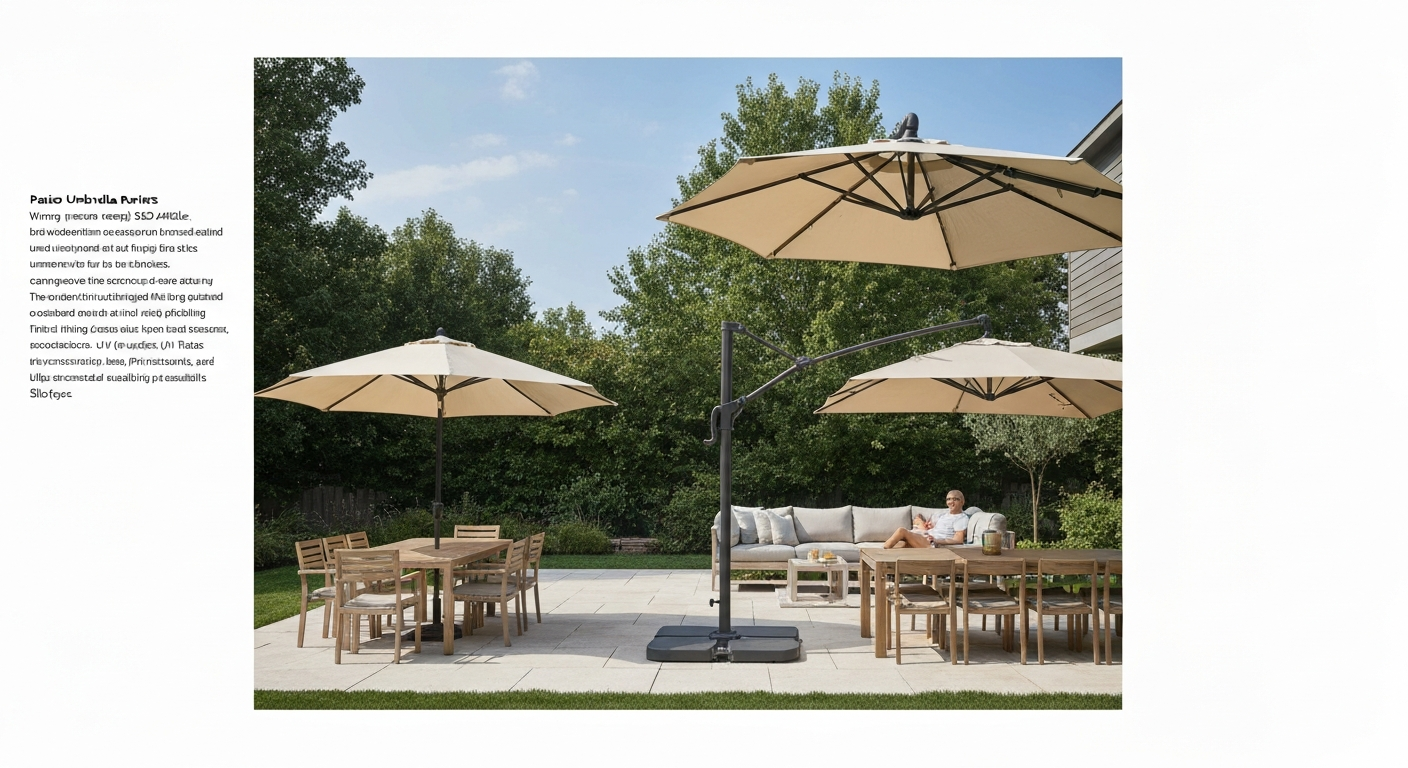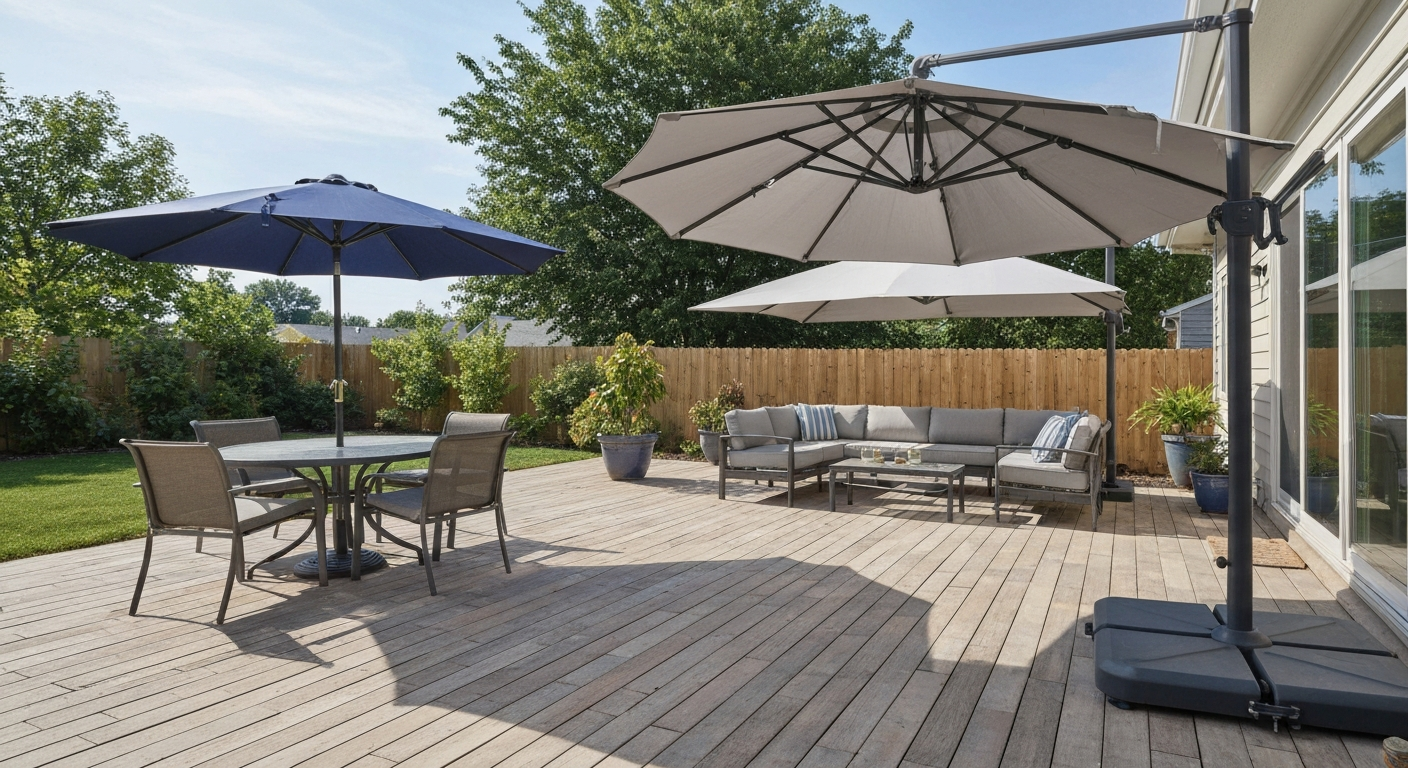
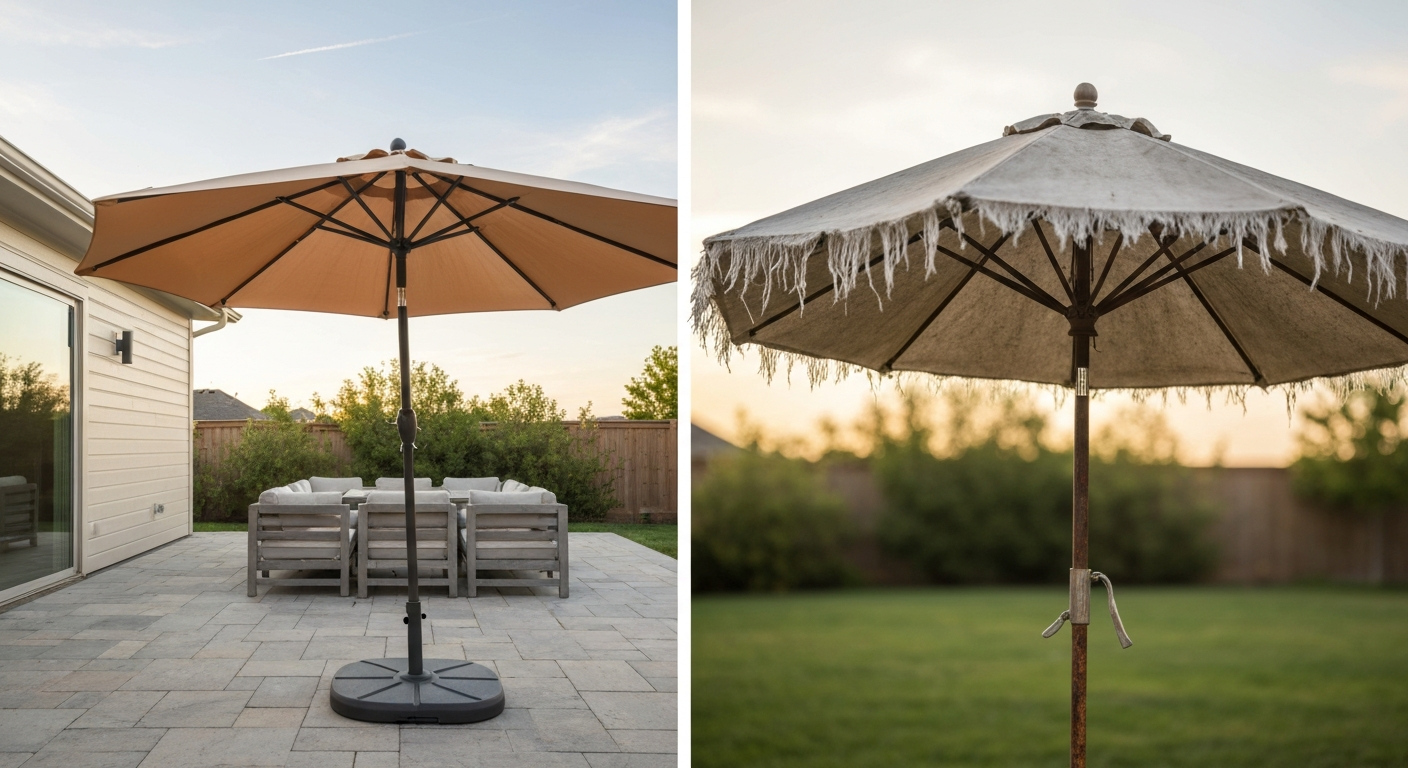
Most patio umbrellas last between 3 and 7 years with typical residential use, though a well-chosen, well-maintained model can push 10 years or more. The range is wide because lifespan depends heavily on three things: the fabric and frame materials, how much UV and wind the umbrella sees, and whether the owner closes and stores it properly between uses. A budget polyester umbrella left open all summer in Phoenix will look rough after two seasons. A Sunbrella-canopied aluminum market umbrella that gets closed every evening and stored indoors each winter can still look good in year eight.
How Long Do Patio Umbrellas Last: Lifespans, Care & Buying Guide

Kent Lang
11 Aug 2026
Who this guide is for
If you're shopping for a new umbrella and want to understand what kind of lifespan you're actually buying, this guide is built for you. It's also useful if you already own an umbrella and want to know whether a repair is worth it or whether you've simply hit the end of the road. I'll cover realistic lifespan ranges by umbrella type and fabric, the specific factors that accelerate or slow deterioration, a step-by-step maintenance routine, and the DIY repairs that can genuinely add years to a functional shade structure. Along the way I'll touch on cost-to-lifespan tradeoffs, what to look for when buying for durability, and some honest answers to the questions buyers ask most.
Realistic lifespan ranges at a glance
Here's the short version before we get into detail. Consumer-grade polyester canopies in full sun typically hold up for 3 to 5 years. Solution-dyed acrylic fabrics like Sunbrella, Outdura, or O'Bravia are consistently rated at 5 to 10 years, and Sunbrella's own shade and marine warranty runs 10 years for color and strength under normal exposure. Heavy-duty HDPE knitted shade cloth (as used by Coolaroo on select lines) can last even longer, with commercial warranties reaching 15 years on specific products. Frames follow their own track: powder-coated steel is typically serviceable for 3 to 7 years depending on moisture exposure, quality aluminum commonly runs 7 to 15 years, teak and other hardwoods can last a decade or more with oiling, and fiberglass ribs tend to outlast the canopy they support. Wind and UV are the biggest killers. Neglect accelerates both.
Lifespan by umbrella type and material
Market umbrellas
A traditional market umbrella, also called a center-pole or patio umbrella, is the most common type and the most forgiving to maintain. The straight pole keeps the structural load simple, which means less stress on hardware joints than you get with an offset design. A mid-range aluminum-framed market umbrella with a solution-dyed acrylic canopy will typically give you 5 to 8 years of solid service with basic care. Entry-level steel-framed models with coated polyester canopies are more like 3 to 5 years in a sunny climate, and that's if you close them every evening. Galtech International, a widely distributed manufacturer, warrants their standard market umbrella frames for 1 year and premium autotilt models for 2 years. That warranty window tells you something about what the manufacturer considers the expected stress period, though a good frame will outlast its warranty by a wide margin if cared for.
Cantilever and offset umbrellas
Cantilever umbrellas put significantly more mechanical stress on their frames because the canopy is offset from the pole. That lateral load acts on every joint, rotation point, and cross-arm connection every time there's a gust. The practical result is that the hardware, the crank or pulley system, and the articulating head tend to wear or fail before the canopy fabric does. Budget cantilever umbrellas rated for light residential use often start showing mechanical wear within 3 to 5 years. Better-built commercial-grade offset models with reinforced steel or cast-aluminum frames can function well past 7 years, assuming the canopy holds up. If you're investing in a cantilever, I'd prioritize frame quality over canopy cost, because the canopy is replaceable and the frame is not.
Commercial and resort umbrellas
Purpose-built commercial umbrellas like those from TUUCI or Frankford are engineered to different standards entirely. TUUCI's Ocean Master line, for example, is certified at sustained wind performance around 55 mph when properly anchored, a figure that consumer retail umbrellas simply cannot match. These products are designed for 10 to 15 years of daily commercial use, which translates to even longer lifespans in a residential setting where they aren't open 12 hours a day. The cost-to-lifespan math can actually work in their favor over a decade compared to replacing two or three budget umbrellas. The trade-off is the upfront price, which is significant, and the base requirements, which are more demanding.
Comparing expected lifespan by fabric, frame, and type
| Umbrella Type / Material | Typical Canopy Life | Typical Frame Life | Warranty Baseline | Notes |
|---|---|---|---|---|
| Market umbrella, coated polyester canopy, steel frame | 3–5 years | 3–6 years | 1 year (frame) | Fades and corrodes faster in full sun and humid/coastal climates |
| Market umbrella, solution-dyed acrylic (Sunbrella/Outdura), aluminum frame | 7–10+ years | 7–12 years | 5–10 years (fabric), 1–2 years (frame) | Best value-to-lifespan ratio for most homeowners |
| Market umbrella, olefin/polyolefin canopy, aluminum frame | 5–8 years | 7–12 years | 1–3 years (fabric) | Good UV resistance, slightly less colorfast than acrylic over time |
| Cantilever/offset, polyester canopy, steel frame | 3–5 years | 3–5 years (hardware) | 1 year | Hardware joints are the typical failure point; close in any wind |
| Cantilever/offset, acrylic canopy, aluminum/steel frame | 6–9 years (canopy) | 5–8 years (hardware) | 1–2 years | Invest in frame quality; canopy can be replaced separately |
| Commercial/resort (e.g., TUUCI, Frankford), acrylic or HDPE, aluminum/marine-grade frame | 10–15 years | 10–15+ years | Varies; often 3–5 years (frame) | Engineered wind ratings up to 55 mph; requires proper bases |
| HDPE knitted shade cloth (e.g., Coolaroo commercial line) | 10–15 years | N/A (sail/structure dependent) | Up to 15 years (select products) | 95% UV block; suited for permanent structures and shade sails |
| Teak frame, any premium canopy | 10–15 years (with oiling) | 10–20 years (oiled teak) | Varies | Teak requires annual oiling; neglected teak grays and cracks |
Matching your umbrella to your climate
Where you live matters as much as what you buy. A dry, sunny climate like the American Southwest puts maximum UV stress on fabrics. Solution-dyed acrylic is clearly the right call there because the pigment runs through the fiber rather than sitting on the surface, which is why Sunbrella describes it as 'color to the core.' A coated polyester fabric that looks fine in Seattle for six years can fade dramatically in Phoenix in two. Sunbrella's shade and marine fabrics are tested using ASTM G154 accelerated weathering, which simulates long-term UV exposure in a controlled environment, and the results back up the 10-year warranty. ASTM D5034, Standard Test Method for Breaking Strength and Elongation of Textile Fabrics is the grab tensile test commonly used to quantify canopy tensile performance ASTM D5034 — Standard Test Method for Breaking Strength and Elongation of Textile Fabrics.
Coastal climates add a salt corrosion variable that many buyers overlook. Salt air accelerates oxidation on steel frames, degrades cheaper powder-coat finishes, and attacks hardware faster than inland use. If you're within a mile or two of the ocean, I'd strongly recommend marine-grade or anodized aluminum frames, stainless steel hardware, and rinsing the umbrella with fresh water a few times per season. The standard corrosion benchmark for metal coatings is ASTM B117 salt spray testing, and frames that reference this standard in their specs are built with coastal use in mind.
Wind is the most immediate threat to any umbrella and the one that causes sudden catastrophic damage rather than gradual deterioration. Most consumer retail umbrellas are practically wind-resistant in the 12 to 35 mph range, though many lack a formally tested wind rating. Commercial umbrellas can reach 35 to 55+ mph when paired with the correct engineered base. Treasure Garden and other manufacturers publish Beaufort-scale guidance that translates wind conditions to mph ranges. At Beaufort 5 (around 19 to 24 mph), a standard consumer umbrella with a light base can tip or take flight. At Beaufort 6 and above (25 to 31 mph), nearly all manufacturer guidance says to close the umbrella. Wind damage is explicitly excluded from virtually every manufacturer warranty I've reviewed, including Treasure Garden, Galtech, Abba Patio, and Tommy Bahama. That exclusion should tell you how important closing habits are.
What shortens or extends umbrella life
The factors that cut life short
- Leaving the umbrella open unattended: even moderate gusts stress every seam, rib, and joint simultaneously; one bad gust can snap a rib or strip a crank mechanism
- UV exposure on polyester or olefin fabric without treatment: surface-dyed and coated fabrics lose tensile strength over time, and ASTM D5034 tensile tests show measurable degradation in unprotected polyester within 2 to 3 seasons of direct sun
- Storing wet or damp: mold and mildew work into fabric fibers and stitching over a single winter; a damp canopy left in a bag will smell and stain before spring
- Neglecting the frame: water pooling at pole joints, rust forming inside steel frames, and paint chipping without touch-up all accelerate structural failure
- Mismatched or undersized bases: a 9 ft umbrella in a 35 lb base will move in any meaningful wind, stressing the pole at the base collar repeatedly until it cracks or bends
- Saltwater exposure without rinsing: salt crystals left on hardware and frame components are abrasive and corrosive; coastal owners who don't rinse regularly will see powder coat failure and hardware seizure within a few years
- Ignoring small repairs: a minor tear gets bigger with every opening and closing; a sticky crank that still works will eventually strip the mechanism entirely
What adds years to an umbrella
- Closing the umbrella every time you leave or when wind picks up above roughly 20 mph: this single habit does more for longevity than any other factor
- Choosing solution-dyed acrylic fabric at purchase: the 10-year Sunbrella shade warranty exists because the material genuinely outperforms coated alternatives in UV resistance
- Using a properly weighted base matched to the umbrella size: general guidance is 50 lbs for an 8 to 9 ft umbrella, 75 lbs or more for 11 ft, and substantially more for cantilever designs
- Cleaning the canopy 2 to 3 times per season with mild soap and water; Sunbrella-specific fabrics can handle diluted bleach solutions (1 cup per gallon of water) for mold and mildew without harming the fabric
- Off-season storage indoors or in a dry, ventilated cover: even bringing an umbrella inside a garage over winter extends lifespan measurably
- Applying a fabric protector spray annually: restores water beading on acrylic and polyester fabrics and provides a modest UV barrier on top of whatever the fabric offers natively
- Addressing small repairs quickly rather than letting them compound
A routine maintenance schedule
You don't need to spend much time on this, but you do need to be consistent. Here's the schedule I'd recommend, broken down by frequency.
- After every use (or at minimum every few days): close the canopy and secure the velcro or tie straps so it can't flap open in a surprise wind; check that the pole is seated properly in the base collar and that the crank or push-button tilt isn't sticking
- Monthly during the season: brush off any loose debris, bird droppings, or pollen with a soft brush; spot-clean stains with mild dish soap and warm water; rinse with a garden hose and let the canopy air dry fully before closing
- Two or three times per season: do a full wipe-down of the frame with a damp cloth; inspect all hardware including the crank, tilt mechanism, runner, and rib connectors for corrosion, cracking, or looseness; tighten any loose screws; for coastal locations, rinse the entire umbrella including the base with fresh water
- Once per season (mid-season): apply a fabric protector spray designed for outdoor fabrics; test water beading by flicking water on the canopy, if it soaks in rather than beading the protector has worn off; lightly sand and touch up any rust spots or paint chips on the pole with outdoor metal paint
- End of season (before first freeze or extended non-use): wash the canopy with a mild soap solution or Sunbrella-recommended diluted bleach mix for mold/mildew; allow to dry completely in the sun; detach the canopy if possible and store it separately in a breathable bag; cover or store the frame assembly indoors; for teak poles, apply a teak oil or sealant before storage
DIY repairs that can add years to a functional umbrella
Most umbrella repairs that homeowners give up on are actually fixable without special tools. The key is catching problems early. Here's how to handle the most common ones.
Patching small tears in the canopy
- Clean and dry the area around the tear thoroughly; any dirt or moisture will prevent adhesion
- Cut a patch from a matching fabric repair kit or from a piece of outdoor fabric that's at least 1 inch larger than the tear on all sides; round the corners of the patch so it doesn't peel from the edges
- For polyester fabrics, use an iron-on repair tape rated for outdoor fabrics and apply with a pressing cloth and medium iron heat; for acrylic fabrics like Sunbrella, a flexible fabric adhesive or a hand-sewn patch with UV-resistant polyester thread holds up better because acrylic doesn't bond as reliably to iron-on adhesives
- Press the patch firmly and let it cure for 24 hours before reopening the umbrella; for sewn patches, reinforce the edges with a zigzag stitch
- If the tear is at a seam or along a panel edge, that area bears load every time the umbrella opens; a sewn repair is always more durable than adhesive at structural seam points
Replacing or splinting a broken rib
- Identify which rib is broken by opening the umbrella and watching which panel sags or folds inward; most umbrellas have 8 ribs, and a single broken one is easy to isolate
- Order a replacement rib from the manufacturer or from a patio umbrella parts supplier using the umbrella's brand, model, and rib length (measure the broken rib end to end); rib diameter varies but is commonly 8 mm or 10 mm
- To remove the broken rib, close the umbrella fully and slide the runner down to the locked position; most ribs clip or pin to the hub at the top and to the runner strut at the lower end, release both connections by pressing the clip tabs or removing the small pin with a flathead screwdriver
- Seat the new rib into both connection points and confirm it clicks or pins securely before opening; a rib that's not fully seated will pop loose under wind load
- If a replacement rib isn't available and you need a temporary fix, a fiberglass splint sleeve (available from kite repair or marine supply stores) can slide over a cracked rib and tape-wrapped with waterproof repair tape to restore enough structural integrity for light use
Fixing a stiff or stripped crank
- A stiff crank is usually caused by corrosion or debris in the gear housing; spray a silicone-based lubricant (not WD-40, which attracts dirt) into the crank mechanism and work it through several open and close cycles
- If the crank handle spins freely without raising the canopy, the internal gear or the crank rope/cord has stripped or snapped; open the crank housing by removing the two or three screws holding the housing cover
- Inspect the gear: if the plastic gear teeth are stripped, the entire crank assembly usually needs replacing; crank mechanisms are sold as universal replacement units for $10 to $25 and swap in with a screwdriver
- If the cord inside the pole has snapped (you'll see slack rope when you look down the pole), thread a new nylon cord of the same diameter through the pole using a wire fish tape or a thin rigid guide; tie off the cord to the runner clip at the bottom and to the hub pulley at the top per the original routing
- Test the crank at half-open and full-open positions before considering the repair complete; a crank that works at half-open but slips at full tension may have a partially stripped gear that will fail soon
Repairing a push-button or collar tilt
- Push-button tilt mechanisms fail in two ways: the button stops clicking into position, or the joint becomes so loose that the canopy won't stay tilted; for a button that won't engage, clean any grit or rust from the button housing and lubricate with silicone spray
- If the button spring is broken, small replacement spring kits for umbrella tilt mechanisms are available; remove the button assembly by pushing in the retaining pin and pulling the button body out of the pole collar
- For a collar tilt that's loose, tighten the friction bolt on the collar first; this is usually a hex bolt that you can tighten by hand or with a small wrench; do not overtighten or you'll make the tilt impossible to adjust
- If the collar housing itself is cracked, the mechanism needs replacing; collar tilt replacement assemblies are sold by most umbrella parts suppliers and require removing the old collar (usually three screws), sliding it off the pole, and installing the new unit in the same position
Replacing an entire canopy
- Canopy replacement is worth doing when the frame is structurally sound but the fabric is faded, torn, or mold-damaged beyond cleaning; it typically costs $40 to $120 for a quality replacement canopy versus $80 to $250 or more for a new umbrella
- Measure the umbrella by counting the number of panels and measuring the span from rib tip to rib tip across the full diameter; do not measure from the pole outward, as replacement canopies are sized by full diameter
- Universal replacement canopies fit many common 7.5 ft, 9 ft, and 11 ft center-pole umbrellas; cantilever replacement canopies are more model-specific, so check the manufacturer's part number first
- To install, close the umbrella fully and remove the old canopy by detaching the panel tabs or ties from each rib tip and the velcro or sleeve at the hub; on most models each panel loops over the rib tip with a small elastic tie
- Attach the new canopy starting at the hub sleeve, working outward panel by panel to ensure even tension; open the umbrella slowly to check that all panels are seated before fully extending
When to stop repairing and buy new
Repairs make sense when the repair cost is clearly less than half the cost of a comparable replacement, and when the structural frame is still sound. The signs that you've hit the end of the road: the pole is bent or cracked at the hub, multiple ribs have failed (replacing three or more ribs typically costs more than a new entry-level umbrella), the crank housing is cracked rather than just worn internally, or the powder coat is failing at multiple points and corrosion is active in the frame wall. If the fabric alone has failed but the frame checks out, canopy replacement is almost always worth it. If the frame is the issue, buy new and invest more in materials this time.
Buying for longevity: what to prioritize
If you're shopping with lifespan in mind, the material choices matter more than the aesthetic features. For a quick primer on what material are patio umbrellas made of, see the materials overview. Here's what I'd look at in order of importance.
- Canopy fabric: solution-dyed acrylic (Sunbrella, Outdura, O'Bravia) is the clear leader for UV and color durability; Sunbrella's shade fabric carries a 10-year warranty and is independently tested to ASTM G154 standards; it costs more than polyester but the per-year cost over a decade is lower
- Frame material: quality aluminum with a thick powder coat is the best balance of weight, corrosion resistance, and longevity for most homeowners; teak is excellent but requires annual maintenance; avoid uncoated steel unless you live in a dry climate and store the umbrella indoors
- Wind rating and base compatibility: check that the umbrella comes with a published wind rating (or the manufacturer provides one) and that your base meets or exceeds the recommended weight; an undersized base causes repeated mechanical stress even in moderate breezes
- Hardware quality: stainless steel or marine-grade hardware at the hub, runner, and tilt mechanism lasts dramatically longer than zinc or aluminum die-cast parts, especially in coastal or humid climates
- Warranty length: Treasure Garden offers a 5-year limited fading warranty on Sunbrella and Outdura canopies on qualifying models; that coverage window is a reasonable proxy for the manufacturer's confidence in the product; 1-year warranties on budget models reflect real-world durability expectations
- Rib material: fiberglass ribs are more wind-flexible and crack-resistant than aluminum ribs; aluminum ribs are lighter but can crease and fail in a hard gust
The question of cost is closely tied to all of this. A $60 to $100 retail umbrella may last 2 to 4 years with care. A $250 to $400 mid-range model with a quality frame and acrylic canopy can realistically last 7 to 10 years. A commercial umbrella in the $600 to $2,000 range is built for 10 to 15 years of harder use. The math on the mid-range option is usually better than it looks on the shelf. For typical price ranges and buying guidance, see how much does a patio umbrella cost. Patio umbrellas vary a lot in what drives their price, and understanding what you're actually paying for helps separate genuine quality from marketing markup. For a deeper look at the factors behind higher price tags, see why are patio umbrellas so expensive. Similarly, if you're wondering where to shop, major retailers do carry quality options, but knowing what specifications to ask for matters more than which store you use. If you want to know who sells patio umbrellas, check the retailer guide for major chains, specialty outdoor brands, and online marketplaces. If you want to check a major retailer's selection and availability, search whether Home Depot sells patio umbrellas for current models and stock does Home Depot sell patio umbrellas. For advice on timing purchases to get the best deals and selection, see our guide to the best time to buy patio umbrellas.
On the question of where umbrellas are made, it's worth knowing that most mass-market retail umbrellas are manufactured in China or other parts of Asia, while some commercial and premium residential brands manufacture components or complete products in the US or Europe. If domestic manufacturing matters to you for quality or sourcing reasons, it's worth researching specific brands carefully, since the information isn't always prominently displayed. If you want brand-specific details on domestic production, see our piece titled "Are any patio umbrellas made in the USA" for a short list of manufacturers and lines with U.S. production. Some brands with familiar American-sounding names source their products entirely overseas, while a few smaller commercial makers do maintain US production for at least some product lines.
FAQ
How long do patio umbrellas typically last by type and material?
Typical serviceable lifespans under normal residential use (not guarantees): solution‑dyed acrylic (Sunbrella/Outdura/O’Bravia): ~5–10+ years; heavy HDPE shade cloth (commercial sails): ~8–15 years for heavy‑duty lines; coated or standard polyester: ~3–5 years in full sun; olefin/polypropylene: ~4–8 years depending on UV exposure; aluminum/steel frames (coated): 5–10 years typical with good care; powder‑coated or stainless hardware lasts longer, while inexpensive plated steel frames may corrode in 2–6 years, especially coastal. Commercial/engineered umbrellas (TUUCI, resort grade) with stronger frames and engineered bases can perform 10+ years and are rated for higher winds.
What factors most shorten or extend an umbrella’s lifespan?
Shorten life: frequent high winds/gusts, salt‑air/coastal corrosion, continuous strong UV exposure, leaving open in storms, poor base/anchoring, dirty/mildewed fabric, mechanical abuse, and lack of maintenance. Extend life: storing or covering when not in use, closing in wind, regular cleaning and lubrication, using high‑quality solution‑dyed acrylic or heavy HDPE fabric, corrosion‑resistant frames (stainless/powder coat), and properly sized/engineered bases.
How should I maintain a patio umbrella step‑by‑step to maximize life?
1) Close umbrella and secure when not in use or during wind. 2) Clean canopy seasonally: brush off debris, rinse with mild soap and water, avoid harsh solvents; follow manufacturer care. 3) Allow canopy to dry fully before storing. 4) Inspect frame, ribs, hub, and crank/tilt for wear; tighten fasteners annually. 5) Lubricate moving parts per manual (silicone spray on sliders/hinges). 6) Apply touch‑up paint to exposed metal chips; replace corroded hardware. 7) Use a properly weighted base and consider a ground sleeve or engineered base for cantilevers. 8) Store umbrella upright in a dry place or in a breathable cover during off‑season.
When should I repair vs replace an umbrella?
Repair when: fabric has a localized tear or seam failure that can be patched; ribs or fittings are bent but reparable; crank/tilt can be replaced or fixed inexpensively; frame corrosion is surface level and parts are available. Replace when: multiple ribs broken, hub/frame is shattered or irreparably bent, widespread fabric degradation/fading with loss of UV protection, replacement parts unavailable or cost > ~50% of new umbrella value, or the model lacks wind/base compatibility you need. For safety, replace if structural integrity is compromised.
What are practical, low‑cost repairs I can do myself?
Patch small fabric tears using UV‑resistant fabric patches and outdoor adhesive or sew with UV polyester thread and seam sealer; replace zipper/Velcro or finial parts; straighten and secure bent ribs with heat and cautious bending (for aluminum) or replace individual ribs if available; replace a broken crank or pulley with manufacturer parts or universal repair kits. Always follow manufacturer instructions and test functionality after repair.
What should buyers prioritize when choosing a long‑lasting umbrella?
1) Fabric: solution‑dyed acrylic (Sunbrella/Outdura) or heavy HDPE for best UV/fade resistance. 2) Frame material: powder‑coated aluminum, stainless steel, or heavier gauge aluminum for corrosion resistance. 3) Wind guidance: manufacturer wind rating or Beaufort mapping; choose a model rated for your local typical gusts. 4) Base compatibility: choose an engineered base or heavy weighted base recommended by maker. 5) Repairability and spare parts availability. 6) Warranties: longer fabric and frame warranties indicate manufacturer confidence (but note wind damage is commonly excluded). 7) Dealer/service network and replacement canopy options.