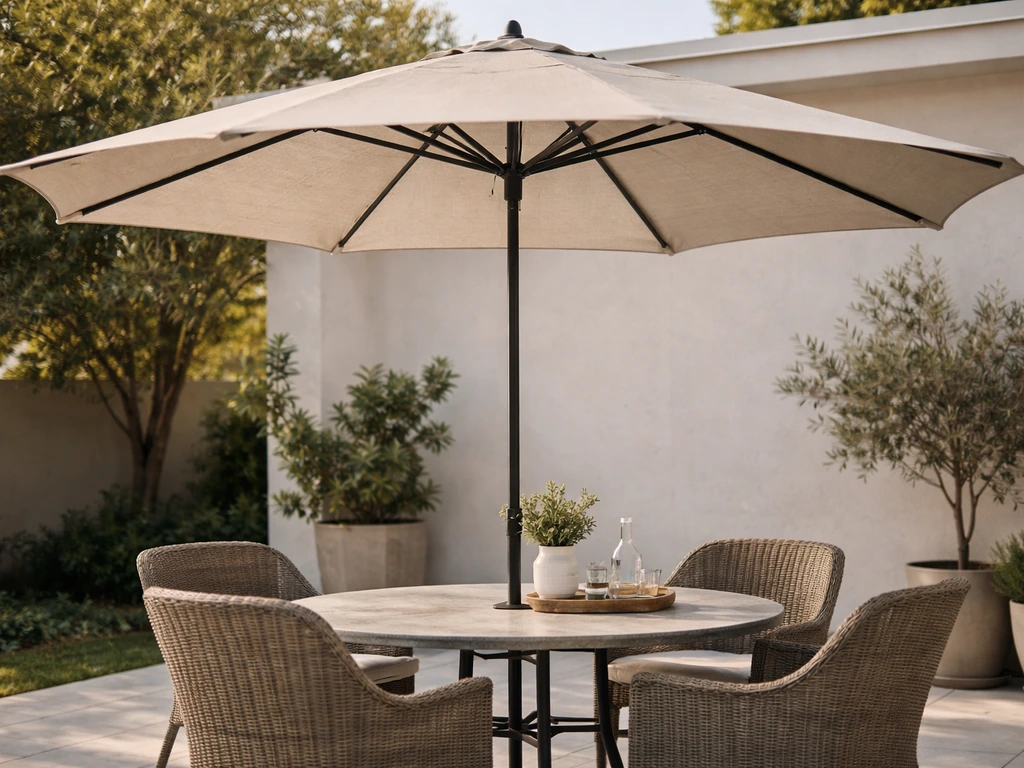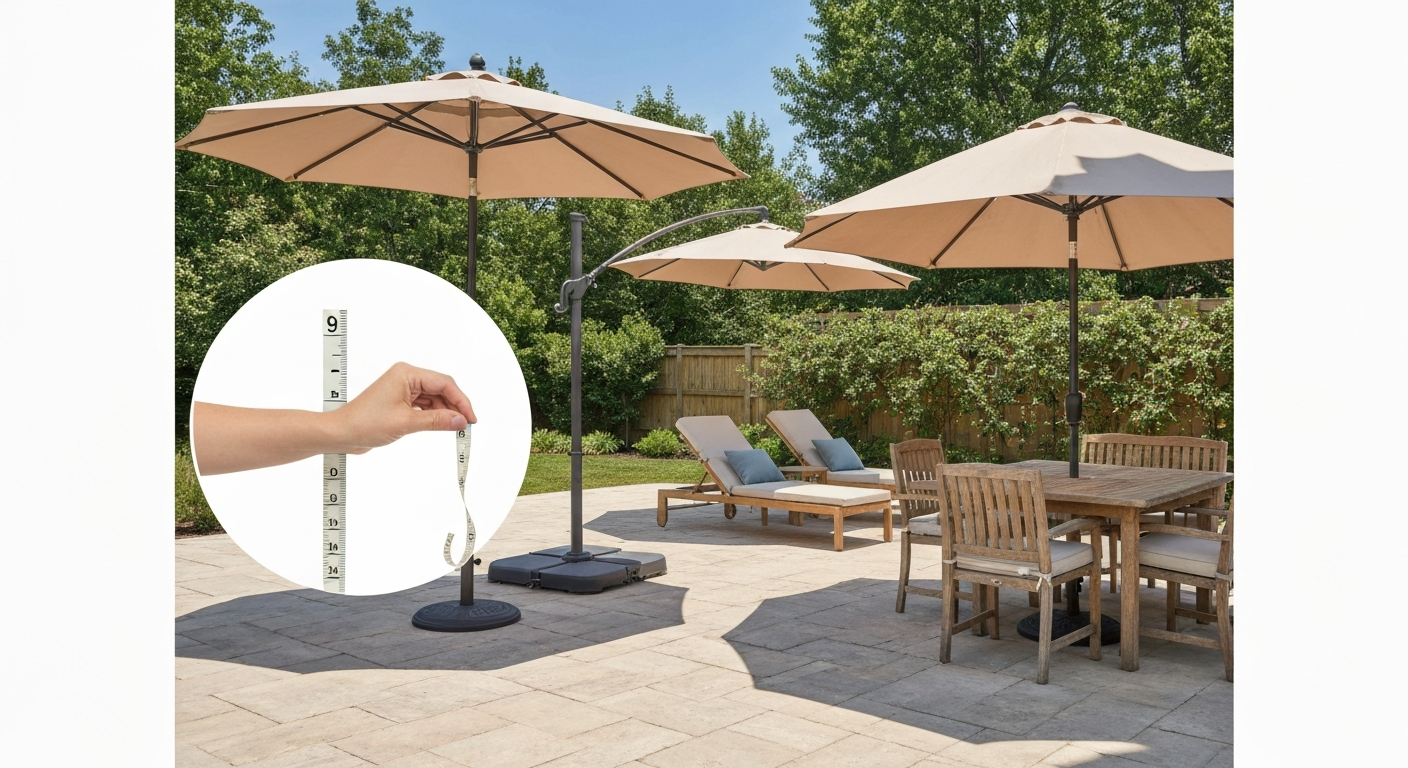
A 9 ft patio umbrella covers roughly 57 to 64 square feet of shade, while a 10 ft model covers about 79 square feet. PatioProductions: Ultimate Patio Umbrella Buyers Guide, table ↔ umbrella size rules notes that Table‑to‑umbrella quick chart (published guides): 30–36" table → 6–8 ft umbrella; 38–48" → 9–11 ft umbrella; 54–60" round table → 11 ft+ recommended for full coverage (multiple industry buying guides and patio retailer charts repeat similar sizing rules) PatioProductions: Ultimate Patio Umbrella Buyers Guide — table ↔ umbrella size rules. That 15-square-foot difference sounds modest on paper, but it translates directly into whether your chairs sit in full shade or your guests are squinting. For most 4-person dining sets built around a 48-inch table, a 9 ft umbrella does the job. If you have a 54- to 60-inch round table, 6 or more seats, or a lounge arrangement where you want shade to reach the armrests, the 10 ft is the safer pick.
9 ft vs 10 ft patio umbrella: choose the right canopy size

Why umbrella size actually matters for your patio
An umbrella that is too small leaves chair backs and shoulders exposed to direct sun even at midday. One that is too large can overwhelm a compact deck, create awkward pole placement at the table center, or demand a base so heavy it becomes a trip hazard. Getting the size right means shade lands where people actually sit, the pole does not interfere with how you use the space, and the base weight stays manageable. It also affects cost, wind resistance, and how difficult the whole thing is to set up and store at the end of the season.
Quick at-a-glance: diameters and shaded square footage
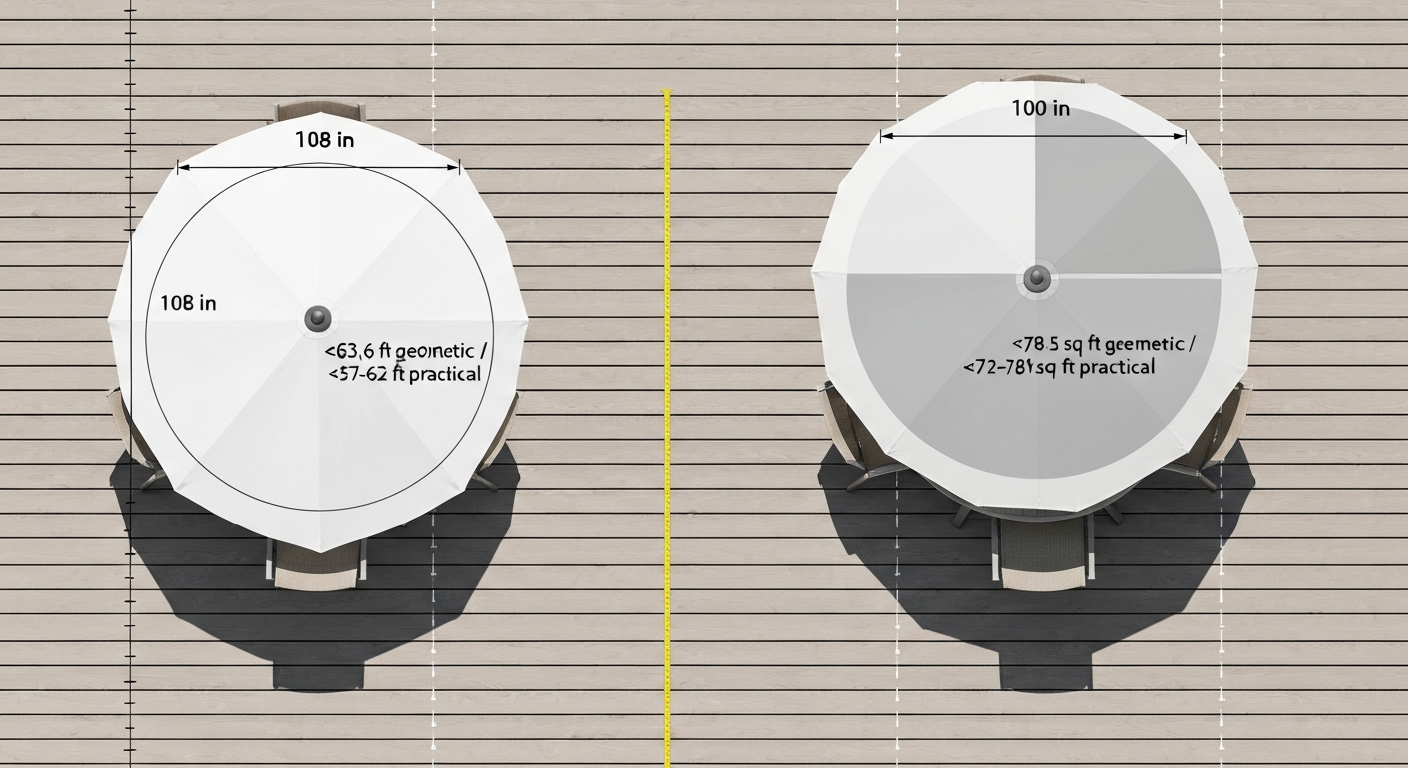
The shade area for a circular canopy is calculated as: Area = π × (diameter ÷ 2)². So a 9 ft canopy gives π × 4.5² = approximately 63.6 sq ft of geometric coverage. A 10 ft canopy gives π × 5² = approximately 78.5 sq ft. An 11 ft canopy gives π × 5.5² = approximately 95 sq ft. Keep in mind that most market umbrellas have octagonal panels rather than a true circle, and vents or valances trim the actual shaded footprint. Treasure Garden, for example, lists their 9 ft octagonal model at 57 sq ft of effective coverage despite the geometric circle being about 63.6 sq ft. Use the table below as your starting reference.
| Nominal Size | Canopy Diameter (inches) | Geometric Area (sq ft) | Practical Shade (approx.) | Typical Base Weight |
|---|---|---|---|---|
| 9 ft | 108 in | ~63.6 sq ft | ~57–62 sq ft | 50–80 lb |
| 10 ft | 120 in | ~78.5 sq ft | ~72–78 sq ft | 50–100 lb |
| 11 ft | 132 in | ~95 sq ft | ~85–92 sq ft | 80–100+ lb |
One important note on specs: manufacturers measure canopy size in different ways. Some quote the open diameter tip-to-tip, others quote the rib length or arc length. A '10 ft' label from one brand might actually measure out to 118 or 122 inches when you lay a tape measure across it. Always check the inch dimension on the spec sheet rather than relying on the round-number label alone.
9 ft vs 10 ft side by side: pros, cons, and honest trade-offs
| Factor | 9 ft Umbrella | 10 ft Umbrella |
|---|---|---|
| Canopy diameter | 108 in (approx.) | 120 in (approx.) |
| Effective shade area | ~57–63 sq ft | ~72–78 sq ft |
| Best table size | Up to 48-inch round or 36×60-inch rect. | 48–60-inch round or 36×72-inch rect. |
| Seating capacity covered | 4 seats comfortably | 4–6 seats comfortably |
| Base weight needed | 50–80 lb (freestanding) | 50–100 lb (freestanding) |
| Portability | Easier to move and store | Heavier, slightly more storage space |
| Wind exposure risk | Lower surface area, less sail effect | Larger canopy catches more wind |
| Price range (typical) | Lower entry cost | Moderate step up |
| Compact patio fit (10×10 ft) | Easy fit with room to spare | Fits, but tighter clearance |
| Large dining area fit (12×14 ft) | May leave outer seats in sun | Good coverage for full table |
Where the 9 ft wins
The 9 ft is the sweet spot for smaller patios, balconies, and 4-person bistro or dining sets. It is lighter, cheaper, easier to open and close solo, and the smaller canopy catches less wind on an exposed deck. If your outdoor space is roughly 10×10 feet or you are working with a 36- to 48-inch table, a 9 ft covers the seating zone without the canopy edge hanging over furniture or pathways in an awkward way.
Where the 10 ft earns its keep
The 10 ft makes sense when you have a larger dining table (54 to 60 inches round, or a 6-person rectangular set), a lounge arrangement with a coffee table flanked by two chairs, or a 12×12 ft or larger patio space. That extra foot of radius (6 additional inches per side compared to a 9 ft) means chairs at the table edge actually sit inside the shade cone rather than just barely outside it. The trade-off is a heavier base, a bigger storage footprint, and more wind surface area to manage in a storm.
What each size actually covers: table sizes, seating, and layout
The rule of thumb used consistently across retailer guides and manufacturer sizing charts is this: add 4 to 5 feet to your table diameter to find the minimum umbrella size that gives comfortable overhang on all sides. That 2 to 2.5 feet of overhang per side is what keeps seated guests in the shade rather than right at the canopy edge.
| Table Size | Seats | Recommended Umbrella | Notes |
|---|---|---|---|
| 30–36 in round | 2–3 | 7–8 ft | 9 ft works but may be oversized |
| 48 in round | 4 | 9 ft | ~24 in overhang per side |
| 54 in round | 6 | 9–10 ft | 10 ft preferred for full seat coverage |
| 60 in round | 6–8 | 10–11 ft | 9 ft will leave outer seats in sun |
| 36×60 in rect. | 4–6 | 9–10 ft | Size to the longer dimension |
| 36×72 in rect. | 6–8 | 10–11 ft | 10 ft minimum for good coverage |
| Lounge set / chaises | 2–4 | 10–11 ft (or cantilever) | Offset/cantilever avoids center pole conflict |
For layout, think in zones. A center-pole umbrella works best when it threads through a table's center hole, placing the pole away from foot traffic. For a lounge area without a table center hole, an offset cantilever at 10 ft is often the cleaner solution because there is no pole cutting through the seating zone. On a 10×10 ft patio, a 9 ft center-pole over a 4-person set is the classic arrangement: the canopy clears the furniture by about a foot on each side and leaves a walking lane around the edges. On a 12×14 ft space with a 6-person table, a 10 ft center-pole or 11 ft cantilever is more appropriate.
How to measure your space and position the umbrella
Follow this step-by-step before buying anything. Skipping the measurement is the number one reason people return umbrellas or end up with a canopy that crowds a wall or fence.
- Measure your table diameter (or length and width for rectangular). Write it down in inches.
- Add 48 to 60 inches (4 to 5 feet) to your table's longest dimension. This is your minimum canopy diameter.
- Measure the patio or deck area. Mark out the umbrella's radius from the intended center point with a tape measure or string. Check that the canopy edge clears walls, fences, and railings by at least 12 inches.
- Check overhead clearance. The canopy top typically sits 7 to 9 feet off the ground when the pole is mounted in a table hole or base at grade. Confirm there are no overhanging branches, roof eaves, or pergola beams in that arc.
- Mark the pole position. For center-pole over a table, the pole goes through the center hole. For a freestanding base, the pole center should be offset from the furniture edge so the canopy fully covers the seating area without tilting too far.
- Confirm walking clearance. Leave at least 24 to 30 inches between the outermost furniture and the canopy edge or any wall to allow for comfortable movement.
- Note wind exposure. If the site is on a rooftop, elevated deck, or open yard with no wind buffer, factor in a heavier base and a vented canopy (see the wind section below).
Base, anchoring, and installation: what you actually need
This is the part people underestimate. A 9 ft or 10 ft umbrella in freestanding mode needs a heavier base than most packaging makes obvious. The general rule floating around retailer guides is roughly 10 lb of base weight per foot of canopy diameter for freestanding use in moderate wind conditions. That puts a freestanding 9 ft at 80 to 90 lb and a freestanding 10 ft at 90 to 100 lb minimum. Treasure Garden's published guidance recommends 50 to 80 lb for a 9 ft model and a minimum of 80 lb for their 11 ft market umbrella.
The situation changes if the umbrella pole threads through a table's center hole. The table itself adds friction and lateral resistance, which is why manufacturers often allow slightly lower base weights for table-through installations versus freestanding. Even so, do not rely on the table alone: pair it with a weighted base underneath for anything larger than an 8 ft canopy.
Base and mount options
- Fillable resin bases: affordable and portable, but actual fill weight matters. Sand fills to about 90% of rated weight; water fills to about 60–70%. Use sand for better stability.
- Cast iron or steel bases: heavy right out of the box, more stable, but harder to move. Good for permanent or semi-permanent setups.
- In-ground anchor sleeves: a sleeve is cemented into the ground, and the umbrella pole slides in. Extremely stable for large or commercial-grade umbrellas, but commits you to a fixed location.
- Through-deck mounts: the pole passes through a hole in a wooden or composite deck into a below-deck flange or footing. Common for built-in umbrella installations and very secure.
- Cantilever/offset bases: these are almost always extra-heavy (100 to 200 lb) because the arm extends the canopy laterally, creating significant lever torque at the base. Never underweight a cantilever.
Fabrics, frames, and opening mechanisms explained
Canopy fabrics
The two fabrics you will encounter on almost every umbrella at every price point are polyester and solution-dyed acrylic. Polyester is cheaper, widely available, and fine for occasional use or covered patios. It fades faster because the dye sits on top of the fibers rather than being baked in. Solution-dyed acrylic (Sunbrella being the best-known brand) has the pigment dyed into the fiber itself during manufacturing, so UV degradation affects color far more slowly. Expect solution-dyed acrylic to hold color for 5 to 7 years of daily outdoor exposure versus 2 to 3 years for standard polyester. For an umbrella that lives outside through the warmer months every year, the acrylic upgrade is worth the price difference.
Frame materials
| Frame Material | Weight | Rust/Corrosion Resistance | Durability | Best For |
|---|---|---|---|---|
| Aluminum | Light | Excellent (powder-coated) | High | Most patios; coastal areas |
| Steel | Heavy | Moderate (rusts if coating chips) | High (when maintained) | Budget market umbrellas |
| Wood (hardwood/teak) | Medium-heavy | Good with oiling | High if maintained | Traditional/aesthetic-focused setups |
| Fiberglass ribs | Light | Excellent | Flexible, wind-resistant | Hurricane-prone or windy sites |
For most homeowners, a powder-coated aluminum pole with fiberglass ribs is the best combination: it resists rust, flexes slightly in wind instead of snapping, and is light enough to handle solo. Wood poles look great but need seasonal oiling and are heavier to operate. Steel is common in budget umbrellas and fine for inland areas with light use, but the coating needs attention if it chips.
Opening mechanisms
- Crank lift: a handle at the pole mid-section winds the canopy open. The most common and convenient mechanism for 9 ft and larger canopies. Look for a metal gear housing rather than plastic.
- Push-up: you physically slide the runner up the pole by hand. Simpler mechanics, fewer failure points, but more physical effort for larger canopies.
- Auto-tilt: built into the crank, allowing you to tilt the canopy at an angle once fully open. Very useful for afternoon or low-sun angles. Common on 9 ft and 10 ft market umbrellas.
- Collar tilt: a twist collar below the runner allows manual tilting without a separate mechanism. Simpler than auto-tilt and reliable.
- Cantilever/offset rotation: the canopy rotates 360 degrees around the offset arm, letting you reposition shade without moving the base. Standard on offset umbrellas and genuinely useful.
Wind, durability, and when to close it down
No residential patio umbrella is designed to stay open in high winds. The general consensus from manufacturers and safety guidelines is to close and secure any umbrella when sustained winds exceed 20 to 25 mph, and absolutely before any storm. A 10 ft open canopy in a 30 mph gust acts as a sail with roughly 78 square feet of surface area and can tip a 50 lb base, become a projectile, or damage furniture and fencing.
Features that improve wind performance
- Vented canopy: a double-layer vent at the top allows wind to escape upward instead of lifting the entire canopy. Look for at least one vent on any umbrella larger than 9 ft in an exposed location.
- Fiberglass ribs: flex under wind load instead of snapping. Worth the premium over plain steel ribs in windy climates.
- Weighted base with tie-down straps: some manufacturers sell umbrella stake kits that anchor the base directly to a deck or ground. These are especially important for freestanding cantilevers.
- Lower the canopy: if your umbrella has a tilt feature, leveling it to a more horizontal angle reduces wind loading compared to a fully angled position.
- Closed and stored or tied: a velcro wrap or zippered cover keeps the furled canopy from catching wind. Never leave a large umbrella open unattended in unpredictable weather.
When an 11 ft umbrella makes more sense
If you are looking at this comparison and your table is 60 inches round with 6 to 8 chairs, or you have a rectangular 6 to 8 person dining set, the honest answer is that a 10 ft umbrella will leave the outer seats partially in the sun. An 11 ft model at roughly 95 square feet of geometric coverage (about 85 to 92 sq ft effective) is the better fit for those scenarios. Treasure Garden's 11 ft market umbrella, for example, is listed at approximately 85 sq ft of actual shade coverage, and they recommend at minimum an 80 lb base for it.
The trade-offs are real though. An 11 ft umbrella costs more, needs a heavier base, is harder to move once set up, and puts a larger sail area up in the wind. It also needs more patio clearance from walls and overhangs. If your space is smaller than about 12×12 ft, an 11 ft canopy may clip a wall or fence line when open. For large or permanent outdoor dining rooms and commercial café patios, they are excellent. For a typical suburban deck, the 9 or 10 ft is usually the practical limit. More detail on 11 ft models is covered in the dedicated best 11 ft patio umbrella guide.
Best umbrella types and styles by use case
Best 9 ft options
For a 9 ft umbrella, a center-pole market umbrella with crank-and-tilt is the most versatile and well-supported style. Look for an aluminum pole, solution-dyed acrylic canopy if budget allows, and a base in the 50 to 80 lb range. A push-up mechanism is fine for 9 ft if you prefer simplicity over convenience. The 9 ft size is also the easiest to find in a wide range of colors and frame finishes. For in-depth picks, the dedicated best 9 ft patio umbrella guide covers specific models worth considering. For broader model comparisons and picks, see our top 10 patio umbrellas guide.
Best 10 ft options
At 10 ft, both center-pole and cantilever (offset) styles are common and practical. A 10 ft center-pole market umbrella with crank-and-auto-tilt handles most dining tables in the 48 to 60-inch range. A 10 ft offset cantilever is the better choice for lounge areas or when you want shade over a space without a table center hole. The Abba Patio 10 ft offset cantilever umbrella, Walmart product page lists the canopy diameter as 10 ft (120 in) blank" rel="noopener noreferrer">Abba Patio 10 ft offset cantilever umbrella — Walmart product page. For cantilevers, always buy the heaviest base the manufacturer offers, or plan for a ground anchor. Commercial-grade 10 ft options with Sunbrella fabric and welded aluminum frames are available if the umbrella will see heavy daily use. More model-specific recommendations are in the best 10 ft patio umbrella guide. See our best 10 ft patio umbrella guide for model-specific recommendations and detailed picks.
Where 11 ft fits into the picture
The 11 ft slot is mostly for large dining sets, pool decks, and commercial or restaurant use. Center-pole 11 ft models are available and work well over large round tables. Cantilever 11 ft models are large enough to shade a full chaise lounge arrangement or a 6-seat outdoor sofa grouping. If you are shopping this size, the best 11 ft patio umbrella guide has targeted recommendations for both residential and light commercial applications.
Decision checklist: 9 ft, 10 ft, or larger
Run through these questions before you commit to a size. If you answer yes to multiple items in a row, move to the next size up.
- Is your table 48 inches round or smaller, or your seating area under 50 sq ft? Start with a 9 ft.
- Do you have 5 or 6 seats, a 54-inch or larger table, or a rectangular set longer than 60 inches? Step up to 10 ft.
- Is your table 60 inches round, do you have 6 to 8 seats, or does your patio layout span more than 10×12 ft? Consider 11 ft or a cantilever.
- Is your patio 10×10 ft or smaller? Stay at 9 ft — a 10 ft canopy edge may brush walls or railings.
- Are you covering a lounge area without a table center hole? Choose an offset cantilever at whatever diameter fits the zone.
- Is the site exposed to regular wind above 15 mph? Prioritize a vented canopy and a heavier-than-minimum base at any size.
- Is portability and solo setup important? A 9 ft is significantly easier to manage than a 10 or 11 ft.
Seasonal care, cleaning, and keeping it safe
Umbrellas last longer than most people expect if they get basic care. The biggest killers are mold from closed-while-wet storage, UV degradation from never being brought in, and pole/joint corrosion from saltwater or standing water in the base. Here is what actually makes a difference.
Routine and seasonal maintenance
- Clean the canopy every 4 to 6 weeks during the outdoor season. Use mild soap and lukewarm water; a soft brush handles most dirt and mildew. Rinse thoroughly and allow to dry fully before closing.
- Never store the canopy folded while wet or damp. Mold and mildew set in within 24 to 48 hours on polyester fabric in warm conditions. Let it dry fully open, then close and cover.
- At the end of the season, clean, dry, and store the canopy in a breathable fabric cover (not plastic, which traps moisture). Store the pole indoors or in a dry shed if possible.
- Inspect the crank mechanism and tilt joint at the start of each season. A drop of silicone lubricant on the crank shaft and a little paste wax on the pole keeps the runner sliding smoothly.
- Check the base annually for cracks (resin bases) or rust (metal bases). A cracked base that has been filled with sand or water will leak and lose ballast over time.
- For wood poles: apply a teak or hardwood oil once a season to prevent drying and cracking. Do not use linseed oil, which can go rancid.
- Patch small canopy tears immediately with a UV-resistant repair tape or patch kit to prevent them from growing into larger tears.
Safe operation habits
- Close the umbrella any time you leave the patio unattended for an extended period, even on calm days.
- Check that the crank or push-up locking mechanism is fully engaged before walking away from an open umbrella.
- Never tilt the canopy to an extreme angle in anything above a light breeze — a heavily tilted 10 ft canopy has a significant sail surface off to one side.
- Keep children from pulling on the canopy edge or hanging on the tilt collar — the mechanisms are not rated for lateral stress loads.
- If you smell a burning or grinding sensation from the crank, stop using it and inspect the gear before continuing.
Buying checklist and recommended accessories
Beyond the umbrella itself, a few accessories make a real difference in stability, longevity, and convenience. Here is what is worth budgeting for alongside your purchase.
- Base: buy the heaviest base rated for your umbrella size. For a freestanding 9 ft, target 50 to 80 lb filled weight. For a freestanding 10 ft, target 80 to 100 lb. Do not cut corners here.
- Protective cover: a zippered, UV-resistant polyester cover for when the umbrella is closed. Keeps mold, bird droppings, and UV off the fabric between uses.
- Tie-down straps or stake kit: essential for exposed decks or any cantilever setup. Many manufacturers offer these as accessories for their umbrella lines.
- Canopy replacement: if you buy a quality aluminum frame, check whether the manufacturer sells replacement canopies. It is far cheaper to replace just the fabric than the whole umbrella.
- Sand (not water) for fillable bases: sand weighs about 100 lb per cubic foot versus water at about 62 lb per cubic foot. Sand-filled bases provide meaningfully more ballast.
- Cross base weight rings: supplemental iron rings that stack on top of an existing base for extra ballast. Useful if your current base is slightly undersized.
- Pole adapter/reducer: if you own a table with a center hole in a size that does not match your new umbrella's pole diameter (commonly 1.5 in or 1.75 in), a rubber or plastic adapter closes the gap and prevents wobble.
Making the call: measure once, buy right
The choice between a 9 ft and a 10 ft patio umbrella almost always comes down to your table size and how many seats you need to shade. If your table is 48 inches or smaller and you have 4 chairs, the 9 ft is the right tool: lighter, cheaper, easier to live with. If you have a 54- to 60-inch table or 5 to 6 seats, spend the extra on the 10 ft and pair it with an adequately weighted base. If you find yourself looking at an 8-person dining set or a large lounge area that neither size covers cleanly, that is when it is worth checking out the 11 ft options before deciding. The most expensive mistake is buying a size that almost works, because almost always means someone is sitting in the sun. For another relevant comparison, see best 9 patio umbrella.
FAQ
What is the real canopy diameter and shaded area for 9 ft, 10 ft and 11 ft patio umbrellas?
Manufacturers usually quote tip‑to‑tip canopy diameter. Using that nominal diameter and the circle area formula: 9 ft (108 in) → geometric area ≈ 63.6 sq ft; 10 ft (120 in) → ≈ 78.5 sq ft; 11 ft (132 in) → ≈ 95.0 sq ft. Note: many market/ octagonal canopies (vented tops, panel cuts) reduce continuous practical shade — manufacturers sometimes report lower usable coverage (e.g., a Treasure Garden 9 ft octagon is listed ≈57 sq ft). Always confirm the listed open‑diameter (in inches) on the spec sheet rather than just the rounded foot size.
How does canopy shape (round, octagon, square) affect actual shaded area?
Square or full circular canopies give near the geometric area. Octagonal panels and valances remove small edge portions; vents and panel seams create gaps or airflow that can reduce continuous shade. Manufacturer coverage figures often reflect these reductions — expect practical shaded area up to ~5–15% smaller than the pure circle area depending on shape and venting.
How do I match umbrella size to common round table diameters?
Rule of thumb: allow ~24–30 in of canopy overhang beyond the table edge for comfortable coverage. Typical matches: 30–36 in table → 6–8 ft umbrella; 38–48 in table → 9 ft umbrella; 54–60 in table → 10–11 ft umbrella. For a 60 in (5 ft) round table, plan a 10–11 ft umbrella for full seated coverage.
What about rectangular tables and patios—how to choose between 9 ft and 10 ft?
For rectangles, size to the longer dimension plus ~18–24 in of overhang each end. Examples: 36×60 in (6 ft) table → 9–10 ft umbrella; 36×72 in → 10–11 ft umbrella. If you use a center‑pole umbrella on a long table, a 10 ft is a safer choice; for offset/cantilever designs you can place the canopy to cover one end or the whole table depending on reach and base placement.
When should I choose a 9 ft umbrella instead of a 10 ft?
Choose 9 ft when: your dining table is up to ~48 in, patio dimension is tight (≤10 ft across), you want a lighter, easier‑to‑store option, or you’ll use the umbrella mostly for a 4‑person set or lounge chair area. It’s more compact, easier to lift/operate, and usually needs a lighter base if used with a table.
When is a 10 ft or 11 ft umbrella preferable?
Choose 10 ft when you need broader coverage for a 5–6 person table, want better edge coverage for lounge groups, or have a 10–12 ft patio zone. Choose 11 ft when you want near‑full coverage for a 60 in+ table, a large 6–8 seat dining area, or one canopy to shade multiple seating zones. Larger canopies improve coverage but require heavier bases and more wind caution.