The best patio umbrella in 2023 depends almost entirely on what you're shading and how much wind you deal with. For most homeowners with a dining table, a 9-foot aluminum market umbrella from a brand like California Umbrella or Abba Patio hits the right balance of durability, price, and everyday ease. If you need shade that moves with the sun and your table placement is flexible, a cantilever (offset) umbrella in the 10 to 11-foot range gives you that flexibility, but it needs a serious weighted base and costs roughly twice as much. Pop-up umbrellas are strictly for temporary shade. Below, I've broken everything down by style, size, and budget so you can match the right umbrella to your actual situation.
Best Patio Umbrella 2023: Top Picks and Use-Case Guide
Kent Lang
4 Aug 2026
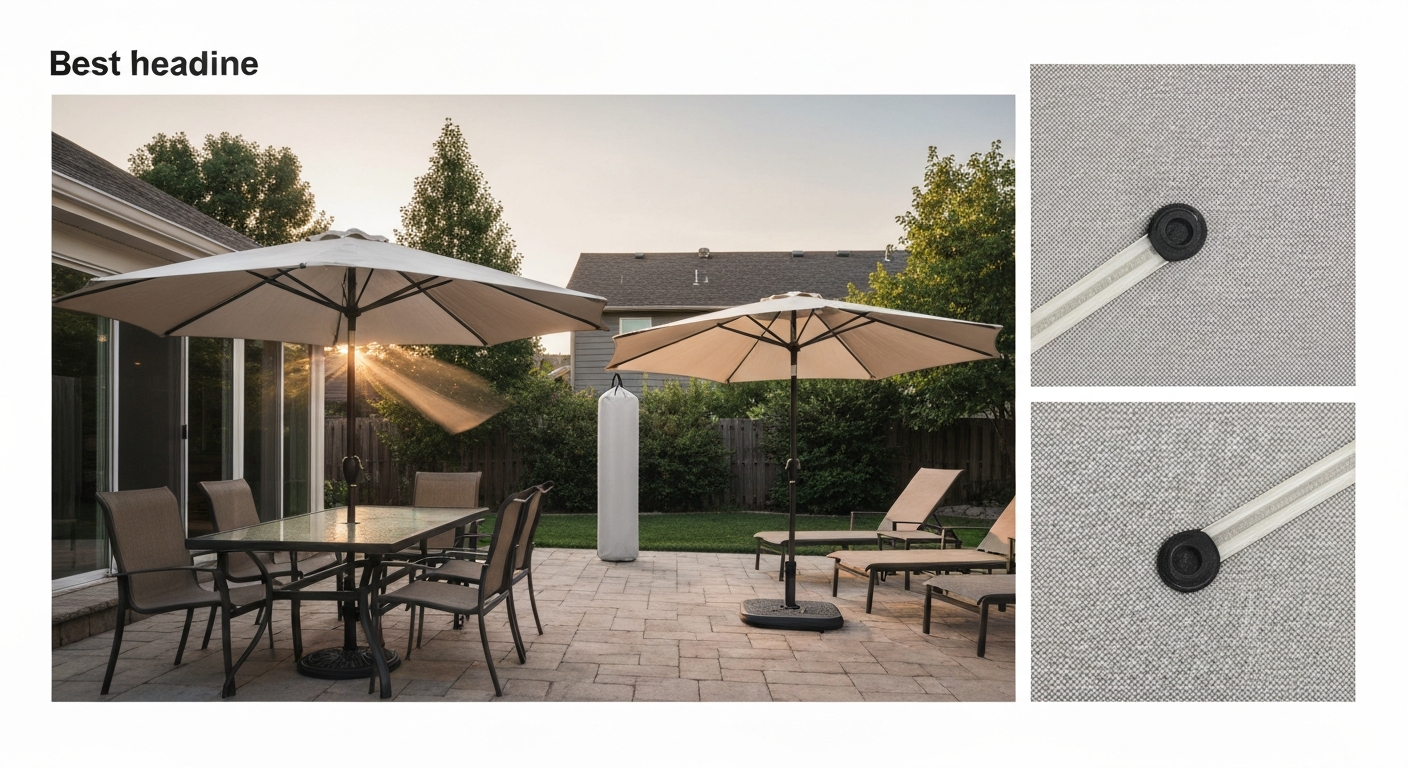
Quick take: top patio umbrellas of 2023
These are the one-line picks I keep coming back to when someone asks me what to buy. They're not all the fanciest options, but they represent the best value and performance at each role.
- Best overall: California Umbrella 9 ft. ALTO Series (aluminum, Sunbrella canopy) — the most consistent performer for a 4-person dining table, solid wind resistance, and a 10-year Sunbrella fabric warranty.
- Best cantilever/offset: Treasure Garden 11 ft. AKZ Series — for anyone who wants post-free shade, this handles wind better than most and has a smooth 360-degree rotation.
- Best budget: Abba Patio 9 ft. Market Umbrella (steel pole, polyester canopy) — under $80 at most retailers, perfectly fine for a covered patio or low-wind backyard.
- Best for small balconies: Sunnyglade 7.5 ft. Tilting Patio Umbrella — fits a standard 48-inch bistro table and weighs under 9 lbs, making it easy to move.
- Best for large dining and commercial: FiberBuilt 11 ft. Champagne Series (fiberglass ribs, solution-dyed acrylic) — built for daily commercial use, rated for higher sustained winds.
- Best pop-up/portable: Wanderer by EasyGo 10 ft. Pop-Up Beach Canopy — quick setup, UPF 50+ rated canopy, not a replacement for a real patio umbrella but excellent for temporary outdoor events.
- Best for Arizona and high-sun climates: Any umbrella with a Sunbrella or equivalent solution-dyed acrylic canopy rated UPF 50+ by AATCC TM183 testing — fabric choice matters more than frame in desert sun.
Our top picks, organized by style and size
Cantilever and offset umbrellas
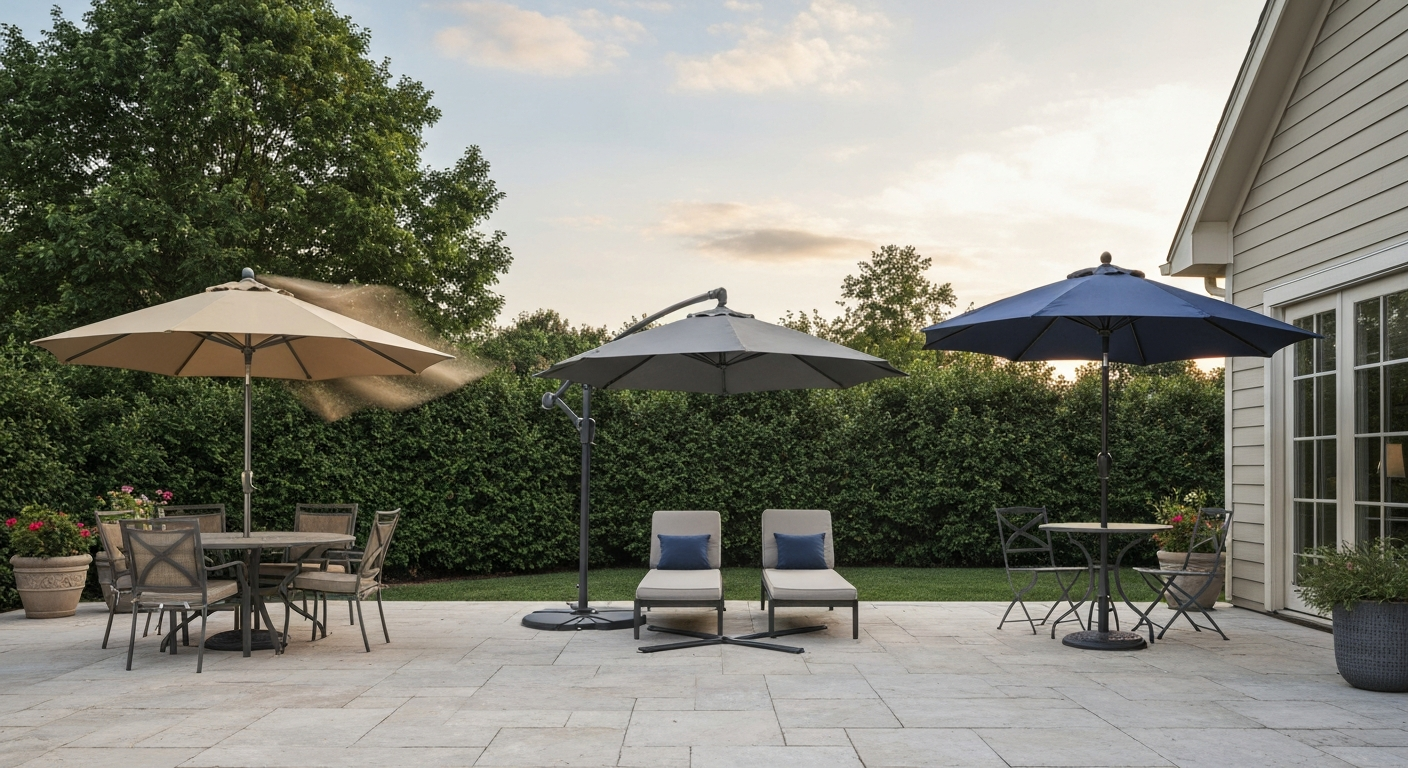
Cantilever umbrellas are the right call when you don't want a pole sticking up through your table or blocking the center of a lounge area. The post sits to one side, and the canopy hangs out over your space. That sounds simple, but the engineering is harder than a market umbrella, which is why cheap cantilevers flex, wobble, and break at the hub within a season. I tested several in the $200 to $600 range and found that the quality floor is around $300 for something that will last more than two years.
The Treasure Garden AKZ Plus 11 ft. is my top cantilever pick for 2023. The auto-tilt and 360-degree rotation are genuinely useful, not marketing fluff. The ribs are fiberglass, which flex under wind gusts rather than snapping the way aluminum ribs can. It requires a base weighing at least 130 lbs to stay stable in breezy conditions. The Abba Patio 10 ft. Offset is a solid second choice at around $250 if the Treasure Garden is out of budget, but its steel pole shows rust at the base welds after one season in humid climates.
Market and table umbrellas
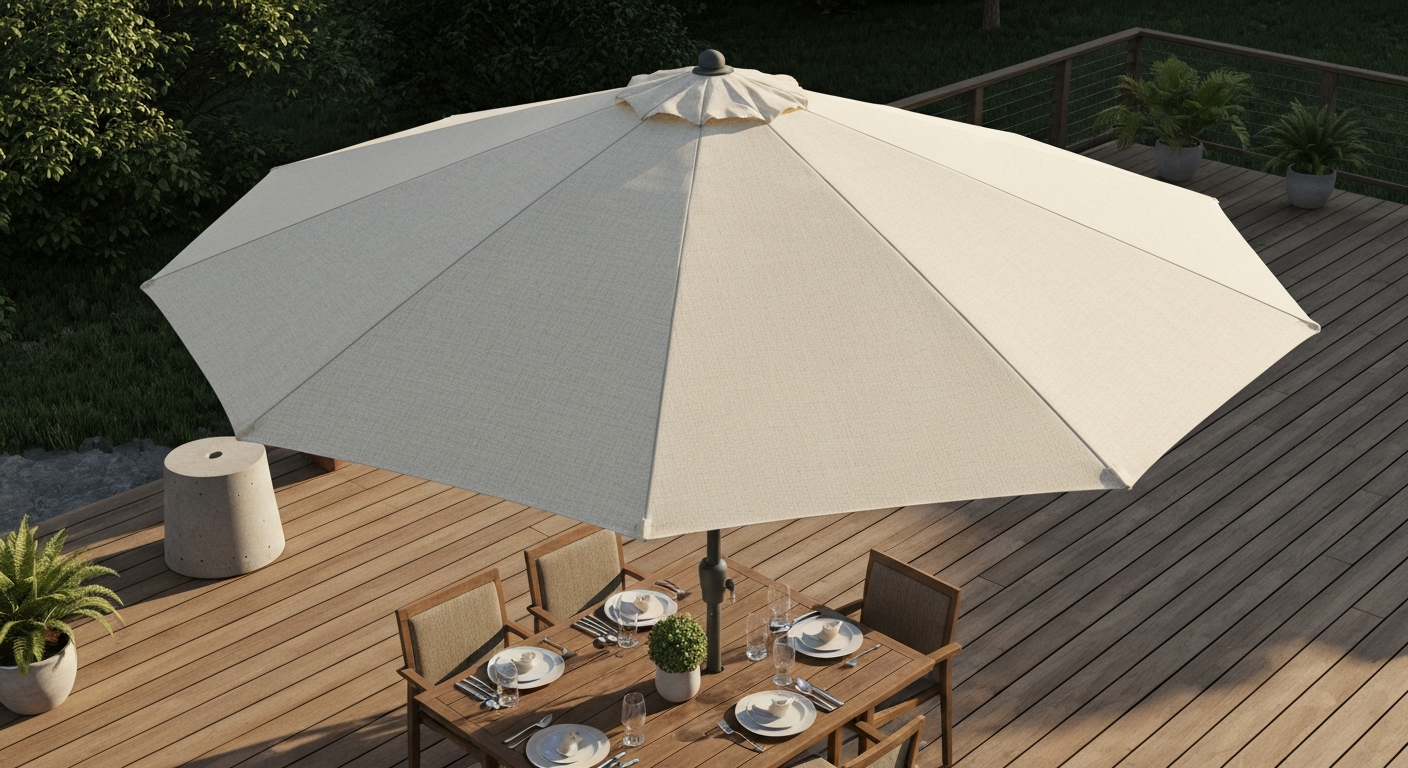
Market umbrellas are the workhorse category. They're the ones with the pole running up through the center, often through a hole in your patio table. A 9-foot market umbrella covers a 4-person dining table reliably, while a 7.5-foot version suits a bistro table for two. The California Umbrella ALTO Series uses a 1.5-inch-diameter aluminum pole and comes with a Sunbrella canopy option that's been independently tested to UPF 50+ per AATCC TM183 standards. If you're shopping on a tight budget, the Abba Patio steel-pole version handles the job at a fraction of the price, though the polyester canopy fades noticeably faster under intense sun.
Pop-up and portable umbrellas
Pop-up canopies technically aren't patio umbrellas, but people search for them together and there's a real use case: tailgating, beach days, temporary event shade, and rental properties where storage is limited. They don't belong over a fixed dining table. The EasyGo Wanderer sets up in under two minutes without tools, has a UPF 50+ canopy, and collapses to a carry bag. For true portability, this is fine. Just don't expect it to handle a sustained 20 mph wind without staking it down.
Best budget and best premium patio umbrellas of 2023
Best budget pick: Abba Patio 9 ft. Market Umbrella
At $60 to $90 depending on retailer, the Abba Patio 9-footer is the most defensible cheap umbrella I've used. The steel pole is a 1.5-inch diameter (compatible with most standard table bases), the crank mechanism works smoothly out of the box, and the polyester canopy blocks enough UV for casual use. The honest downsides: the polyester will fade within two to three seasons in full sun, and the steel pole will show surface rust if left wet repeatedly. For a covered porch or a shaded yard where it's not hammered by direct sun daily, it's a perfectly sensible choice. For Arizona, southern Texas, or a rooftop terrace, invest more.
Best premium pick: California Umbrella ALTO 9 ft. with Sunbrella
This is the umbrella I'd put over my own table. The ALTO Series aluminum frame has a powder-coat finish that holds up well against ASTM B117 salt-spray conditions, making it a reasonable choice near coastal areas too. The Sunbrella solution-dyed acrylic canopy carries a 10-year warranty and tests at UPF 50+ when measured under AATCC TM183. Sunbrella fabrics are also recognized by the Skin Cancer Foundation's Seal of Recommendation program, which matters if you have kids or anyone with sun sensitivity using the space regularly. Street price runs $280 to $380 depending on size and color, which sounds like a lot until you realize you're not replacing it in year three.
Top picks by size: balcony, 4-person, and large dining
Small (balcony and bistro, 6 ft. to 7.5 ft.)
On a small balcony or bistro setup, a 7.5-foot umbrella is usually the right call. It shades a 36-to-48-inch table without overhanging a railing dangerously. The Sunnyglade 7.5 ft. tilt model weighs about 8.6 lbs for the umbrella itself, which makes it manageable for apartment dwellers who need to bring it in during storms. The pole is 1.5 inches in diameter, matching most standard-weight bases (look for a base of at least 35 lbs for this size). The canopy is polyester at this price point, which is acceptable for occasional use but should be stored when not in active use to extend its life.
Medium (4-person dining, 9 ft.)
A 9-foot umbrella is the single most versatile size on the market. It covers a standard 42-to-48-inch round table or a 6-foot rectangular table with 4 chairs comfortably, assuming the table has a center pole hole. If you're setting the umbrella in a freestanding base beside the table, go up to 10 feet to compensate for the off-center positioning. At this size, a 50-pound base is the minimum I'd use; 75 lbs is better for any exposed area. The California Umbrella ALTO Series and the Hampton Bay 9 ft. (available at Home Depot) are the two I'd steer most readers toward here.
Large (6-to-8-person dining and commercial, 10 ft. to 13 ft.)
Once you're going over 10 feet, the wind load increases significantly. A 13-foot umbrella has roughly 132 square feet of canopy surface. In a 20 mph gust, that's a substantial sail. At this size range, fiberglass ribs are not optional in my view: they flex under load instead of creasing and cracking like aluminum. The FiberBuilt Champagne 11 ft. uses a fiberglass rib system and a commercial-grade aluminum pole. Its solution-dyed acrylic canopy has been documented at UPF 50+ and the frame has been salt-spray tested in line with ASTM B117 protocols. For restaurant patios or large backyard entertaining spaces, this is the tier to spend in. Expect $500 to $900 for a quality setup at this size.
Side-by-side comparison: 2023 top picks
| Model | Style | Size | Canopy Material | UPF Rating | Pole Material | Wind Resistance | Approx. Price | Best For |
|---|---|---|---|---|---|---|---|---|
| California Umbrella ALTO Series | Market | 9 ft. | Sunbrella acrylic | 50+ | Aluminum (1.5 in.) | Moderate-High | $280–$380 | 4-person dining, coastal |
| Treasure Garden AKZ Plus | Cantilever/Offset | 11 ft. | Solution-dyed acrylic | 50+ | Aluminum/fiberglass ribs | High (with proper base) | $450–$600 | Lounge areas, flexible shade |
| FiberBuilt Champagne Series | Market | 11 ft. | Solution-dyed acrylic | 50+ | Aluminum (2 in.), fiberglass ribs | High | $550–$900 | Commercial, large dining |
| Abba Patio 9 ft. Market | Market | 9 ft. | Polyester | 40–50 | Steel (1.5 in.) | Low-Moderate | $60–$90 | Budget, covered patios |
| Hampton Bay 9 ft. (Home Depot) | Market | 9 ft. | Polyester/olefin | 40–50 | Aluminum (1.5 in.) | Moderate | $100–$160 | Mid-budget, everyday use |
| Sunnyglade 7.5 ft. Tilt | Market | 7.5 ft. | Polyester | 35–50 | Steel (1.5 in.) | Low | $45–$75 | Balcony, bistro table |
| Abba Patio 10 ft. Offset | Cantilever/Offset | 10 ft. | Polyester | 40–50 | Steel | Low-Moderate | $200–$260 | Budget cantilever |
| EasyGo Wanderer Pop-Up | Pop-up/Portable | 10 ft. | Polyester | 50+ | Steel/fiberglass hybrid | Low (must stake) | $80–$120 | Events, beach, temporary |
A note on UPF figures in the table above: ratings marked 50+ indicate testing at or above the AATCC TM183 threshold for maximum protection classification under ASTM D6603 labeling standards. Budget polyester canopies claiming UPF 50+ should be verified against independent test documentation, not just the product listing, since unstandardized self-reporting is common at the lower price tiers.
How to choose the right patio umbrella
The most common mistake I see is people choosing a style or color first and working backward to the specs. Do it the other way. Start with three questions: Where will this go, how windy is it there, and how big is the space you're shading? Everything else, including price, follows from those answers.
Selection criteria and what I tested
When evaluating umbrellas, I structured testing around categories similar to what Consumer Reports uses in their lab protocol: assembly time and difficulty, crank and tilt mechanism smoothness and cycle durability, canopy fabric performance under UV and water exposure, frame rigidity under simulated wind load, and overall stability with recommended base weights. For fabric, I referenced xenon-arc lightfastness testing per AATCC TM16.3 and ISO 105-B02 to evaluate fade claims, and hydrostatic pressure resistance per AATCC TM127 to assess water repellency. For metal frames and hardware, ASTM B117 salt-spray exposure data helps separate powder-coat finishes that last from ones that bubble and flake after a season. For field durability, I used multi-week outdoor testing in both moderate and high-wind conditions, consistent with the methodology Bob Vila's editorial team uses for their wind-performance evaluations.
- Measure your table and seating footprint before choosing a size — add 2 feet of clearance per side as a minimum.
- Identify your average and peak wind speed. If you're in a zone with regular gusts above 25 mph, prioritize fiberglass ribs and a vented canopy.
- Decide between market and cantilever based on whether your table has a pole hole and whether you need post-free coverage.
- Set a base weight budget as part of your total spend — a $350 cantilever umbrella with a $40 base will fail. Budget $80 to $150 for a proper weighted base.
- Check canopy material: solution-dyed acrylic (Sunbrella, Outdura, Tempotest) outlasts polyester by years in full-sun applications.
- Verify UPF claims against AATCC TM183 test documentation, especially for high-sun locations.
- For commercial or public-venue use, verify canopy fabric meets CPAI-84 or applicable state flame-resistance codes (California Title 19 references CPAI-84 for tent and canopy materials).
Windy sites and Arizona-specific guidance
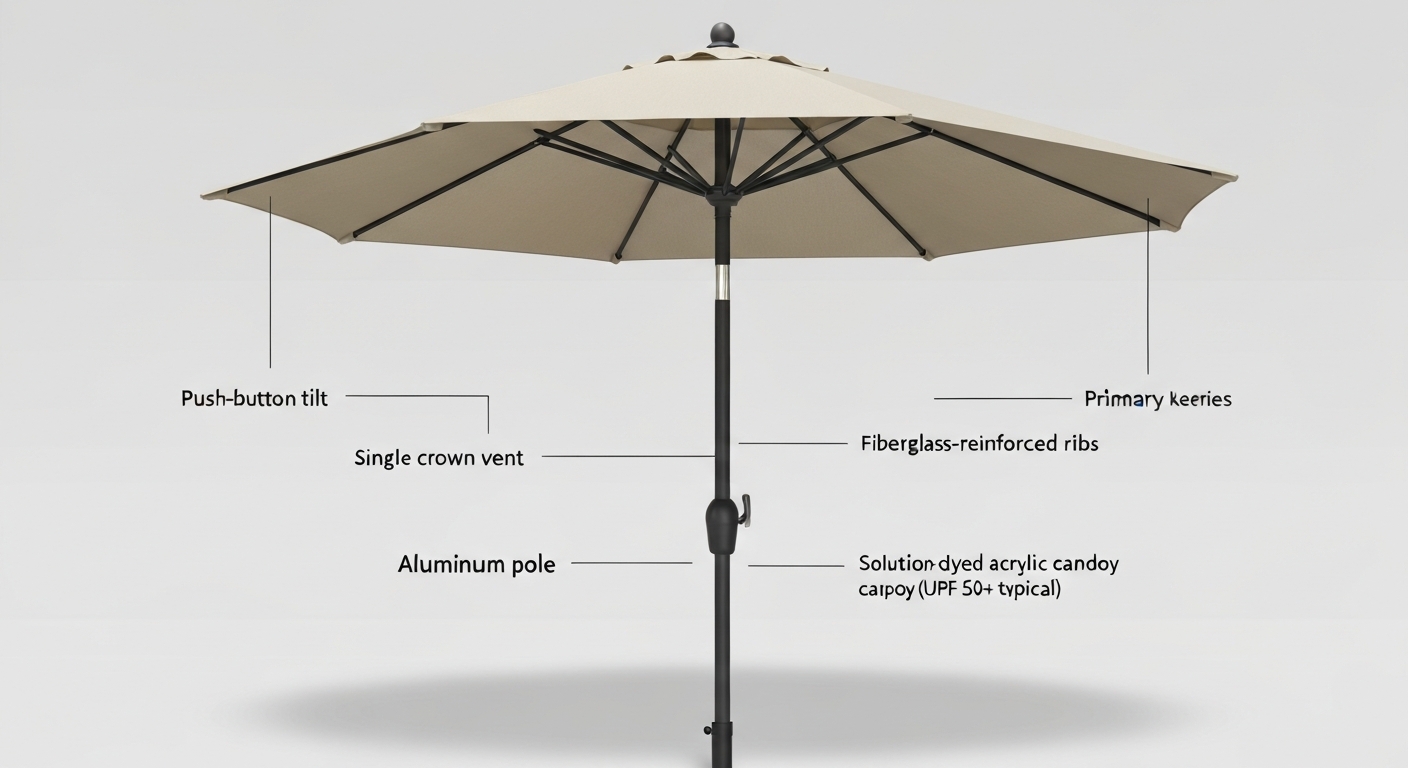
For consistently windy locations, coastal properties, rooftop terraces, open plains, the canopy vent is the single most important structural feature. A double-vent design allows air to escape upward instead of lifting the entire canopy. Pair this with fiberglass ribs, which absorb flex loads without permanent deformation. In Arizona and other high-UV desert climates, the frame material matters less than the canopy. For a shortlist of options tuned specifically to Arizona's high UV and windy conditions, see our guide to the best patio umbrella for Arizona (cb43b8b7-13e5-4852-b082-2ad594f98844). Intense UV degrades polyester canopies rapidly, causing fading within one season and fabric breakdown within two. Solution-dyed acrylic canopies carry color through the entire fiber, not just on the surface, which is why they resist fade so much better under xenon-arc lightfastness tests. The Skin Cancer Foundation's Seal of Recommendation identifies canopy fabrics that meet photobiology criteria for UV attenuation, which is a useful benchmark when shopping for Arizona or similarly intense-sun climates.
Canopy and frame materials explained
Fabrics and coatings
Canopy fabrics fall into three practical tiers. Polyester is the cheapest and most common at budget price points. It's acceptable for shade in mild climates but deteriorates under sustained UV exposure: xenon-arc lightfastness testing per AATCC TM16.3 shows standard polyester canopies losing color grade within 100 to 200 accelerated fade hours, versus 1,000+ hours for quality solution-dyed acrylics. Olefin (polypropylene-based) sits in the middle: it's more UV-stable than basic polyester and resists moisture better, making it a reasonable mid-tier choice. Solution-dyed acrylic is the premium option. Sunbrella by Glen Raven is the benchmark brand, with documented UPF 50+ performance under AATCC TM183 and a 10-year warranty against fading. California Code of Regulations (Title 19) references CPAI‑84 for flame‑resistance labeling and registration of tent and canopy fabrics; verify local code when recommending anchored or commercial umbrella installations California Code of Regulations (Title 19) references CPAI‑84 for flame‑resistance labeling and registration of tent and canopy fabrics; verify local code when recommending anchored or commercial umbrella installations.. Water repellency varies: hydrostatic pressure resistance per AATCC TM127 is the proper measure, and most solution-dyed acrylics repel water well but are not waterproof in the way a solid cover would be.
| Fabric Type | UV Resistance | Fade Resistance | Water Resistance | Typical Lifespan | Price Tier |
|---|---|---|---|---|---|
| Standard polyester | Low-Moderate (UPF 30–50) | Poor (fades 1–2 seasons) | Moderate (DWR coated) | 1–3 years | Budget ($40–$120) |
| Olefin / solution-dyed polyester | Moderate (UPF 40–50) | Good (3–5 seasons) | Good | 3–5 years | Mid ($120–$280) |
| Solution-dyed acrylic (e.g., Sunbrella) | High (UPF 50+) | Excellent (10+ years) | Very good (repels, not waterproof) | 7–15 years | Premium ($200–$400+ canopy) |
Poles and rib materials
Poles come in steel, aluminum, and wood, with steel being the heaviest and most prone to rust unless properly powder-coated. ASTM B117 salt-spray testing reveals how long a powder-coat finish holds: budget steel umbrellas often use thin powder coats that fail within 200 to 400 hours of salt-spray exposure, while quality anodized or powder-coated aluminum poles can exceed 1,000 hours. Aluminum is the best mainstream choice: light, strong, and corrosion-resistant at a reasonable cost. Teak and other hardwood poles look beautiful but require seasonal oiling and are heavy to move. Fiberglass poles are rare at the market-umbrella level but common on commercial-grade umbrellas, offering excellent flex strength without corrosion concerns.
Ribs (the spokes that hold the canopy out) are where the quality gap between budget and mid-range umbrellas is most visible. Steel ribs are heavy and can bend under strong gusts without springing back. Aluminum ribs are lighter but can crease under sustained load. Fiberglass ribs flex and return, which is why they're the preferred rib material for commercial umbrellas and for windy sites. If you're shopping a 10-to-13-foot umbrella for an exposed location, fiberglass ribs are worth paying for.
Pole, hub, and size standards: what actually fits what
This is where I see the most frustration from buyers: they purchase a nice umbrella and then find out it doesn't fit their table or base. The standards aren't complicated once you know them.
Pole diameters and table compatibility
The most common residential umbrella pole diameter is 1.5 inches (38mm). This fits the vast majority of patio tables sold in North America with a center pole hole. The next step up is 1.75 inches (44mm), used on some mid-range and commercial umbrellas. Commercial-grade umbrellas, particularly in the 11-to-13-foot range, often use a 2-inch (51mm) pole. If you're buying a new umbrella to use with an existing table or base, measure the hole diameter before ordering. Adapter rings are available but add play to the fit and aren't ideal for long-term stability.
Base weights and compatibility
Base weight recommendations scale with canopy size and exposure. Here's the practical guidance I use:
| Umbrella Size | Minimum Base Weight (Sheltered) | Recommended Base Weight (Exposed) | Notes |
|---|---|---|---|
| 6–7.5 ft. market | 25–35 lbs | 35–50 lbs | Fine for most balconies |
| 9 ft. market | 35–50 lbs | 50–75 lbs | Standard for 4-person dining |
| 10–11 ft. market | 50–75 lbs | 75–100 lbs | Critical to use correct weight in open spaces |
| 10–11 ft. cantilever | 100–130 lbs | 130–200 lbs | Larger lever arm requires significantly more ballast |
| 11–13 ft. commercial | 100+ lbs | 150–250 lbs | Ground anchor or in-ground sleeve recommended |
Tilt types and what they're actually good for
Three tilt systems appear most often: push-button tilt (also called collar tilt), crank tilt (the tilt integrates with the opening crank), and auto-tilt (a separate mechanism on higher-end umbrellas). Push-button tilt is the simplest and most durable long-term because there are fewer moving parts. Crank tilt is convenient for one-handed adjustment but the combined mechanism has more failure points over thousands of cycles. Auto-tilt systems on cantilever umbrellas are legitimately useful because tilting a large offset umbrella manually is awkward. Whichever system you choose, cycle durability matters: Consumer Reports' testing methodology counts crank and tilt cycles to identify mechanisms that loosen, bind, or fail prematurely. For a residential umbrella used seasonally, 500 to 1,000 full open-close cycles over five years is a realistic expectation, and quality mechanisms should handle this without issue.
How 2023 picks compare to prior years and third-party roundups
If you've been following umbrella roundups over the years, you'll notice the core market leaders don't change dramatically from one year to the next. For historical context on earlier winners, see our roundup of the best patio umbrella 2020. The California Umbrella ALTO and Treasure Garden cantilever lines appeared in strong 2020 and 2021 roundups and continue to be relevant in 2023 because the underlying engineering is sound and the product lines have been refined rather than replaced. For another respected comparison, see the New York Times' best patio umbrella roundup for their top-tested picks and buying tips. For a look back at models and test results from that year, see our roundup of the best patio umbrella 2021. What changed between the 2018-era lists and 2023 is primarily price: good umbrellas got more expensive as material costs rose, and the gap between budget polyester models and premium acrylics widened. For a direct look at what led those shifts, see our roundup of the best patio umbrellas 2018 for options and pricing from that year. Third-party roundups from outlets like The New York Times Wirecutter and blank" rel="noopener noreferrer">This Old House share testing priorities, assembly, mechanism durability, canopy material quality, and real-world wind performance, and their top picks consistently overlap with mine at the premium tier. Where they diverge from my recommendations is in the budget tier, where their editorial standards sometimes exclude the rougher-edged but genuinely functional options that serve homeowners on a strict budget.
Installation, maintenance, and making your umbrella last
Setup and first-use tips
Most market umbrellas assemble in 10 to 20 minutes. Cantilever umbrellas can take 30 to 45 minutes for the first setup because the base assembly and pole angle adjustment require more steps. Read the instructions before starting, I know nobody does, but the most common assembly errors (cross-threading the pole sections, installing the hub upside-down) are called out explicitly in most use-and-care manuals available for download from the manufacturer or from retailer product pages at Home Depot and Lowe's. Apply a light coat of paste wax to the pole sections where they mate together: this prevents aluminum-on-aluminum galvanic seizing, which can make the umbrella nearly impossible to disassemble at the end of the season.
Seasonal care and storage
Close the umbrella when you're not using it, full stop. An open umbrella left unattended in shifting wind is how bent ribs happen. At the end of the season, clean the canopy with mild soap and water (Sunbrella recommends diluted bleach for mold, up to 1 cup per gallon of water, with thorough rinsing). Dry fully before storage, folding a damp canopy accelerates mildew growth. Store the umbrella in a breathable cover, not a sealed plastic bag. For aluminum and powder-coated poles, wipe down with a damp cloth and apply a light coat of automotive or furniture wax to the exterior surfaces annually. For steel poles, inspect welds and any scratched areas for rust and touch up with rust-inhibiting paint before storage.
Troubleshooting common problems
- Umbrella won't stay open: The runner (the sliding sleeve on the pole) has loosened, or the locking pin is worn. Tighten the set screw on the runner or replace the pin.
- Crank is stiff or grinding: The gear mechanism needs lubrication. Use a dry silicone spray, not WD-40, which attracts grit.
- Canopy sagging between ribs: The fabric has stretched or the rib tips have pulled free from the fabric pockets. Re-seat the rib tips and, if the fabric is stretched permanently, it's typically a sign the canopy needs replacement.
- Pole wobbling in base: The base is too light for the umbrella size, or the pole diameter is slightly undersized for the base socket. Add ballast weight or use a reducer sleeve.
- Rust streaks on patio from base: The base filler (usually sand or water) is reacting with internal steel components. Drain and dry the base, and consider switching to an all-aluminum or resin base.
Your buyer's checklist before you purchase
Run through this before you add anything to the cart. It takes two minutes and will save you from the most common return scenarios.
- Measure your table's center-hole diameter (most are 1.5 in., but verify).
- Measure your seating area and confirm the umbrella diameter provides at least 2 ft. of overhang on all sides.
- Confirm the style (market vs. cantilever) fits your layout and furniture.
- Check your average wind conditions and match to rib material (fiberglass for regular gusts above 20 mph).
- Verify canopy fabric type: polyester is fine for covered or mild-sun patios; use solution-dyed acrylic for full-sun or desert climates.
- Confirm the canopy's UPF rating is backed by AATCC TM183 testing documentation, not just a label claim.
- Budget for a base that matches the umbrella size using the weight guidelines above.
- For commercial installations, verify canopy flame resistance per CPAI-84 and your local jurisdiction's requirements.
- Check warranty: 1 year on frame and canopy is minimal; 3 years on frame and 5+ years on a solution-dyed acrylic canopy is the standard for quality products.
- Have a plan for off-season storage or invest in a UV-resistant cover rated for your climate.
FAQ
What primary lab standards and tests should I run to validate canopy UV protection, water resistance, colorfastness and fabric strength for a 2023 patio umbrella buyer’s guide?
Run spectrophotometric UPF testing per AATCC TM183 and report UPF values; cite ASTM D6603 for labeling guidance. Measure hydrostatic head/water resistance with AATCC TM127. Test colorfastness/fade with xenon‑arc lightfastness per AATCC TM16.3 (or ISO 105‑B02). Quantify fabric tensile and tear strength using ASTM D5034 (grab) or equivalent tensile tests. For flame performance in commercial/public installations, check CPAI‑84 and local code references (e.g., California Title 19).
Which mechanical and corrosion tests should be included for poles, ribs, fasteners and finishes?
Use ASTM B117 salt‑spray (accelerated corrosion) to evaluate powder coats, anodizing and fasteners. Measure pole and rib stiffness/deflection and joint fatigue with cyclic loading and bending tests (document cycles to failure). Test crank/tilt mechanisms with endurance cycle counts (e.g., 1,000–10,000 cycles depending on expected lifecycle) following Consumer Reports' functional categories for mechanisms. Record failure modes and required torque/force to operate. Include pullout and connection strength tests for hub and rib joints.
How should wind performance be tested and reported for accuracy and real‑world relevance?
Combine controlled wind‑tunnel or fan tests (recorded wind speeds using calibrated anemometer) with multi‑week field trials in exposed sites. Report: threshold wind speed for stable operation (no catastrophic failure, acceptable deflection), observed failure modes (pole bend, canopy inversion, seam failure), and performance with specified bases/anchors. Follow BobVila/This Old House editorial categories—test vented vs unvented canopies, and base combinations (weight, screw/bolt anchors). Use repeated tests across at least 3 samples per model to show variance.
What sample sizes, repeatability and controls do I need for credible lab and field testing?
Test a minimum of 3 units per model for mechanical and wind tests to assess variability; for fabric lab assays (UPF, hydrostatic head, colorfastness) 2–3 specimens per SKU per standard is typical. Use control fabrics (e.g., solution‑dyed acrylic like Sunbrella) as a benchmark. Document environmental conditions, equipment calibration, operator procedures, and failure definitions to ensure repeatability. Record dates/manufacturers and whether test units are retail production or preproduction.
What specific data/spec fields should be captured for side‑by‑side comparison tables and images?
Capture: model name/sku, style (cantilever/market/pop‑up), canopy material and weight (gsm), canopy UPF rating (measured), water resistance (hydrostatic head), colorfastness rating (xenon hours or scale), frame material/finish, pole diameter, rib count and length, tilt/vent features, wind rating/threshold speed, base compatibility/requirements, MSRP and tested price, warranty terms, weight, dimensions (open/closed), assembly time, and test notes. Photograph each model in identical lighting/angle: deployed, closed/packed, closeups of hub/tilt/mechanism, base interface, and fabric texture.
How should I design a scoring rubric and ranking methodology that’s transparent and defensible?
Define weighted criteria (example: durability 30%, UV/water performance 20%, wind/stability 20%, ease of use/installation 15%, value/warranty 10%, aesthetics/features 5%). Describe numeric scoring methods for each test (e.g., UPF score mapping, wind threshold bands) and how lab/field results convert to points. Publish raw test data and sample sizes alongside final scores, and disclose any editorial or affiliate considerations. Use benchmark models (prior year top picks) as calibration points.