Wirecutter, which is owned and operated by The New York Times Company, currently names the Treasure Garden 9-Foot Single Vent Push Button Tilt Market Umbrella (model UM920) as its top overall patio umbrella pick. It earns that spot because it hits a rare combination of solid construction, a reliable tilt mechanism, a well-priced canopy, and wide parts availability. For most homeowners shopping for a dependable umbrella that will last more than a couple of seasons, it is a strong starting point. That said, it is not the right answer for every outdoor space, and understanding why it won, and where its limits are, will help you decide whether to buy it or look at alternatives.
New York Times Best Patio Umbrella: Pick, Compare, Buy Guide

Kent Lang
22 Jul 2026
What this guide is for and who should read it
This guide is written for homeowners and renters who are doing serious research before spending real money on a patio umbrella. If you have ever landed on a major outlet's 'best of' list, bought the top pick, and found it flipped in the first summer storm or faded to a washed-out gray by Labor Day, you know that a single-pick recommendation only tells part of the story. Here we use The New York Times and Wirecutter's current pick as an anchor, then widen the lens to cover how recommendations have shifted from 2018 through 2026, what the testing behind those picks actually measured, how different umbrella styles compare, and what specific considerations apply if you live somewhere like Arizona where the sun is genuinely punishing. By the end, you should have enough to choose the right umbrella for your specific space, budget, and climate.
The NYT/Wirecutter pick: what they recommended and why
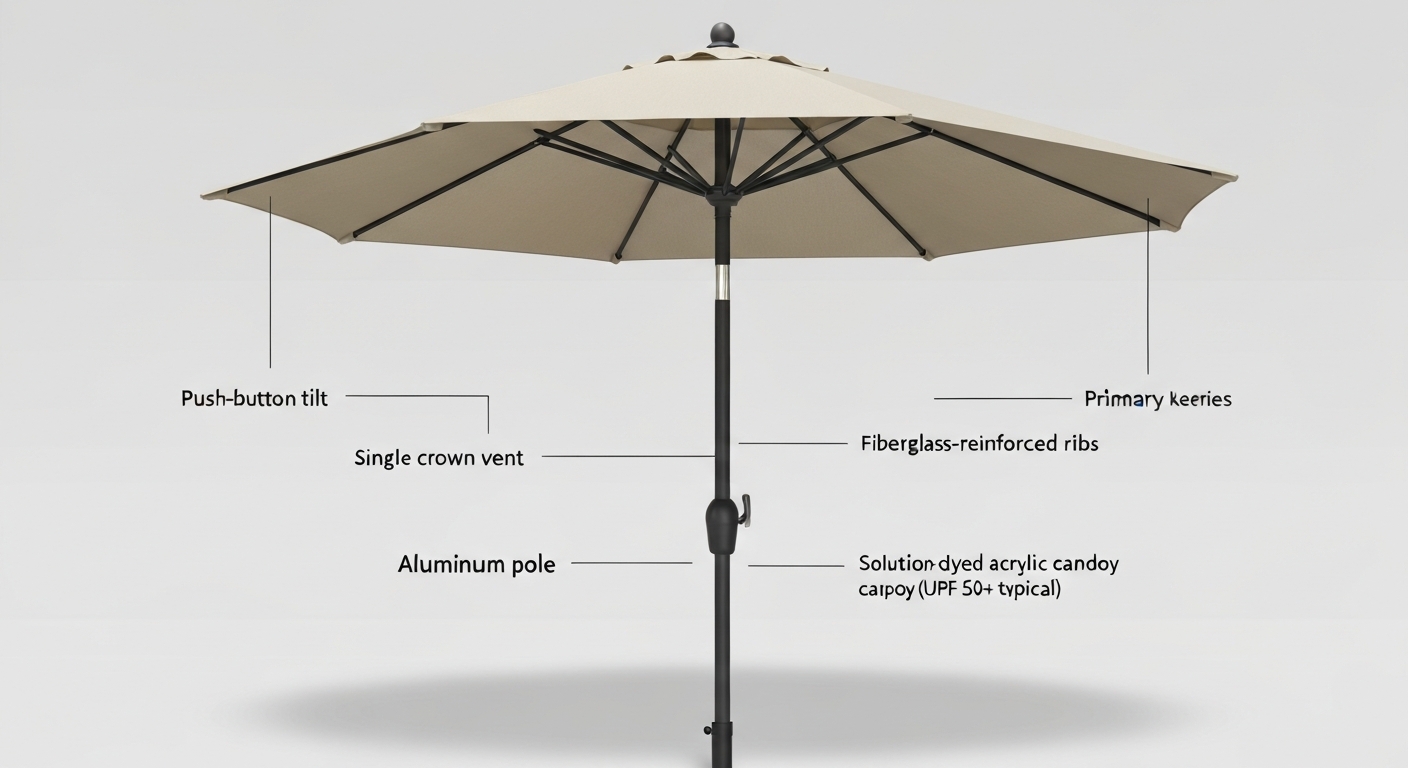
Wirecutter's current top pick is the Treasure Garden UM920 9-foot single-vent push-button tilt round market umbrella. Treasure Garden is a well-established manufacturer with a reputation for consistent quality control and broad availability of replacement parts and canopies, which matters more than most buyers realize at the point of purchase. The UM920 features an aluminum pole, fiberglass-reinforced ribs, a single wind vent at the crown to reduce uplift, and a push-button tilt mechanism that lets you adjust the canopy angle without a separate crank collar. The canopy is offered in solution-dyed acrylic fabric options, which resist fading better than polyester or printed fabrics. At a typical retail price in the $130 to $180 range for the umbrella alone (base sold separately), it sits in the accessible mid-tier.
Wirecutter recommended it primarily because of the tilt mechanism reliability, the manufacturer's track record for parts support, and the canopy fabric quality relative to price. Reviewers noted that the push-button tilt is more durable over repeated use than collar-tilt systems, which can loosen and slip. The fiberglass ribs offer more flex before breaking compared to cheaper aluminum-rib alternatives, which is meaningful if you occasionally forget to close it before a storm. The single vent helps equalize pressure across the canopy in moderate wind rather than creating a parachute effect. These are practical, durability-focused reasons, not marketing points.
What Wirecutter actually tested and where the limits are
Wirecutter's patio-umbrella testing is primarily field and hands-on evaluation rather than controlled lab testing. Testers assess ease of assembly, mechanism smoothness, canopy tension and fit, tilt range and hold, and overall build feel. They compare models side by side and track long-term use over multiple seasons where possible. For wind performance specifically, Wirecutter does not typically conduct instrumented wind-tunnel testing. They note wind resistance qualitatively based on rib construction, canopy venting, and manufacturer claims rather than measured wind-speed thresholds.
Consumer Reports takes a different approach and does conduct more formalized lab-style testing on patio umbrellas, measuring metrics like canopy stability, UV protection, and resistance to simulated rain and fade. BobVila's reviews combine hands-on use with spec analysis and tend to weight user feedback heavily. Neither Consumer Reports nor BobVila currently overturn the general consensus around Treasure Garden, though Consumer Reports often highlights additional models in the premium tier with higher measured UPF values. The practical limitation to know: no widely published consumer review as of mid-2026 includes instrumented wind-tunnel tests conducted to a formal standard. The ASTM F15.79 subcommittee on market umbrellas has been working toward a formal wind-resistance standard for patio umbrellas, with CPSC staff presentations as recently as November 2024 covering durability and wind-load testing protocols. That standard is not yet finalized and published, meaning manufacturer wind-resistance claims are largely self-certified at this point.
The CPSC recall history for patio umbrellas is also worth knowing. A notable example is the 2021 recall of Umbrosa pool and patio umbrellas due to injury hazard from arm or pole failure under load. The U.S. Consumer Product Safety Commission recalled Umbrosa pool and patio umbrellas on May 27, 2021, citing injury hazards from arm or pole failure under load CPSC recall (May 27, 2021): Umbrosa pool and patio umbrellas were recalled due to arm or pole failures.. These recalls typically involve structural failure modes, arm-to-pole joint failures, or collar problems rather than canopy fabric issues. When shopping, it is worth checking the CPSC recall database for any model you are seriously considering.
How the NYT pick stacks up against current top contenders
The Treasure Garden UM920 is not the only credible option at its price point, and several competing models score higher on specific criteria. Here is a direct comparison across the models most frequently named by major review outlets in 2026.
| Model | Type | Canopy Size | Fabric | Rib Material | Tilt Mechanism | Approx. Price (umbrella only) | Base Included |
|---|---|---|---|---|---|---|---|
| Treasure Garden UM920 | Market/Pole | 9 ft round | Solution-dyed acrylic | Fiberglass-reinforced | Push-button tilt | $130–$180 | No |
| Treasure Garden Auto-Tilt 9ft | Market/Pole | 9 ft octagon | Solution-dyed acrylic | Fiberglass-reinforced | Auto-tilt (crank) | $160–$220 | No |
| GrandPatio 12 ft Napoli (Sunbrella) | Cantilever/Offset | 12 ft round | Sunbrella acrylic | Aluminum | 360° rotation + tilt | $350–$500 | No (base fill req.) |
| Abba Patio 9 ft Market | Market/Pole | 9 ft octagon | Polyester | Steel | Push-button tilt | $70–$100 | No |
| California Umbrella 9 ft Sunbrella | Market/Pole | 9 ft round | Sunbrella acrylic | Fiberglass | Push-button tilt | $250–$320 | No |
| Frankford Umbrellas 9 ft | Market/Pole | 9 ft octagon | Sunbrella or pacifica acrylic | Aluminum | Collar tilt | $200–$280 | No |
The main takeaway from this comparison is the three-tier structure of the market. Budget models under $100, like Abba Patio, use polyester canopies and steel ribs. Polyester fades noticeably faster than solution-dyed acrylic and steel ribs corrode and are more brittle in cold weather. They are fine for occasional use but not built for multi-season durability. The Treasure Garden UM920 sits in the mid-tier with genuinely better materials at a reasonable price. Premium options like the California Umbrella with Sunbrella fabric cost more but offer measured UPF 50+ protection, a 5-year fade warranty from the fabric manufacturer, and a brand-name fabric guarantee. If you are in a high-UV climate or want the canopy to look good for a decade, the upgrade to Sunbrella is worth it. The cantilever option from GrandPatio is a different category entirely, addressed in the style section below.
How 'best' picks have changed from 2018 to 2026
If you have been following patio umbrella recommendations for several years, one thing stands out: Treasure Garden has appeared consistently near the top of Wirecutter's list for most of the period from 2018 through 2026, with the specific model designation updating as the product line evolved. For historical context, see our roundup of best patio umbrellas 2018 for the earlier recommendations and testing approach. For historical context, see our roundup of the best patio umbrella 2020. Early recommendations in 2018 and prior focused heavily on simple crank-lift market umbrellas in the 7.5- to 9-foot range, and the emphasis was almost entirely on ease of use and price. Wind resistance and fabric longevity were discussed but rarely measured.
By 2020 and 2021, recommendations from outlets including Wirecutter and Good Housekeeping began giving more weight to tilt mechanisms and canopy venting, reflecting a shift in what consumers were reporting as failure points. The 2020 and 2021 best-of lists also saw cantilever umbrellas appear as a distinct 'best for large spaces' category rather than a footnote, with options from Treasure Garden and Abba Patio appearing more frequently. Consumer Reports' 2021 testing placed stronger emphasis on UPF ratings and measured sun protection, pushing solution-dyed acrylic and Sunbrella fabrics further up the recommendation hierarchy. For historical context, see our roundup of the best patio umbrella 2021 to compare choices and testing focus that year.
By 2023 the market had matured noticeably. More mid-tier models offered Sunbrella canopy options, base weight recommendations became more specific (50 lbs minimum stated explicitly in more reviews), and solar-powered LED umbrellas became a testable subcategory rather than a novelty. For readers comparing past recommendations, our roundup of the best patio umbrella 2023 highlights the models and evaluation criteria that shaped the market that year. The 2023 lists from Forbes Vetted and BobVila both flagged the importance of base compatibility and noted that a heavy umbrella paired with an inadequate base was a leading cause of tip-over incidents and property damage. The CPSC's work with the ASTM F15.79 subcommittee during 2023 and 2024 reflects that concern at a regulatory level. Through all of this, Treasure Garden's core market umbrella line remained a consensus recommendation because the product did not regress in quality even as competitors entered the space.
What this actually means if you're a typical homeowner or renter
The NYT/Wirecutter pick is a reliable, evidence-backed choice for a standard 4- to 6-person patio dining or seating setup with a table that has a center pole hole. A 9-foot market umbrella covers roughly a 6-foot table with about 18 inches of overhang on each side, which is the practical minimum for actual shade coverage while seated. You will need to purchase a base separately, and the base matters as much as the umbrella. Treasure Garden recommends a minimum 50-pound base for their 9-foot models. For renters with a small balcony or paved patio, the UM920 is manageable to assemble, carry, and store. It is not a heavy-wind solution and should be closed during storms regardless of the vent design. For homeowners wanting something they can leave assembled through a full season with minimal intervention, stepping up to a Sunbrella canopy version, or a model with a more robust base system, is worth the extra $100 to $150.
Choosing your umbrella style: market, cantilever, and compact options
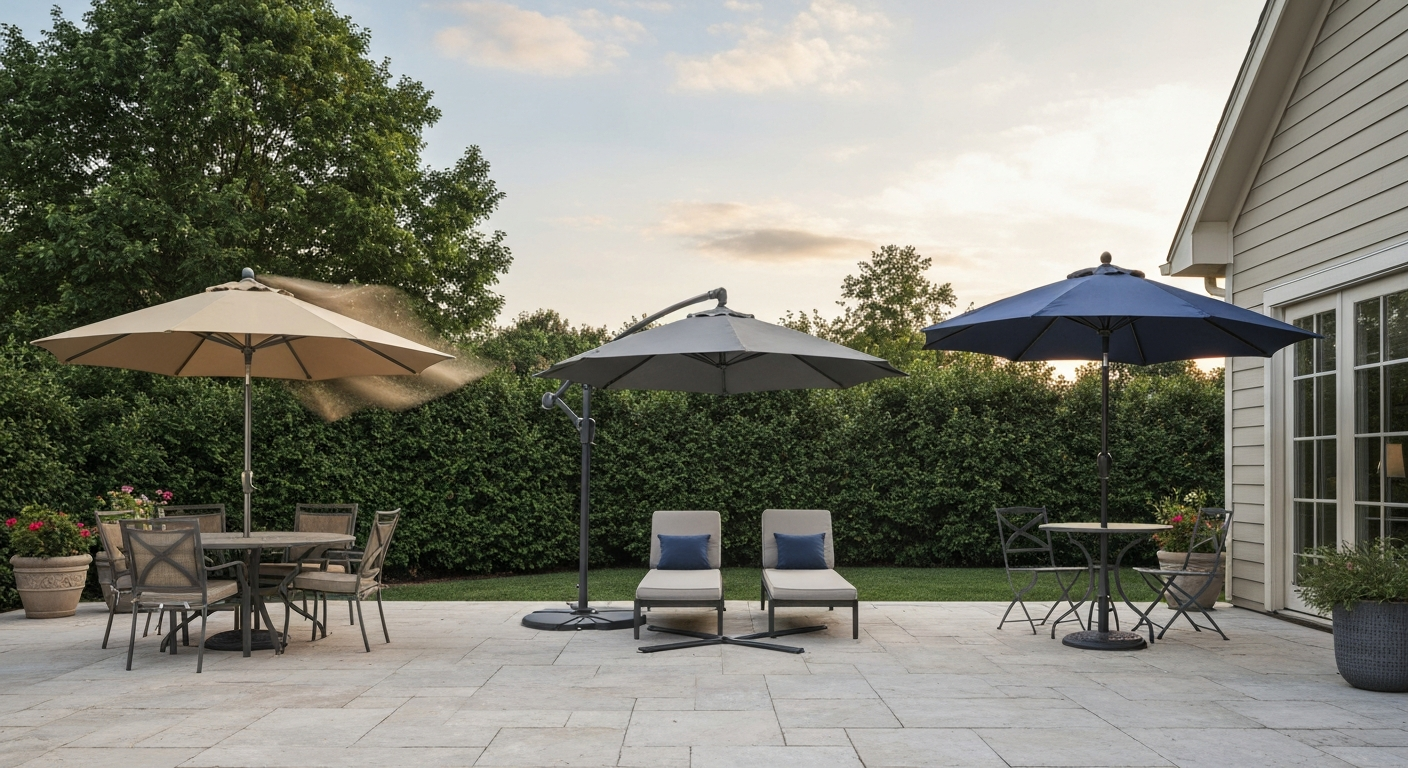
The style of umbrella you choose has more impact on your daily experience than almost any other single spec. The three main types serve genuinely different situations, and picking the wrong one for your space is a common and frustrating mistake.
Market and pole umbrellas
A market umbrella (also called a pole umbrella) has a center pole that runs straight through the canopy with the canopy ribs extending from the top. It is the most common type, the most affordable, and the easiest to find parts and replacement canopies for. The center pole typically fits through a hole in a dining table or drops into a freestanding base. These umbrellas are stable, straightforward, and well-suited to rectangular or round dining setups where a table is the centerpiece. The main limitation is that the pole goes directly through your table or seating area, which restricts placement flexibility and can be awkward with sectional seating where there is no central table. The 9-foot size is the most common and versatile. A 7.5-foot version works for smaller bistro setups; 11-foot and 13-foot versions exist for larger tables but require proportionally heavier bases and sturdier frames.
Cantilever and offset umbrellas
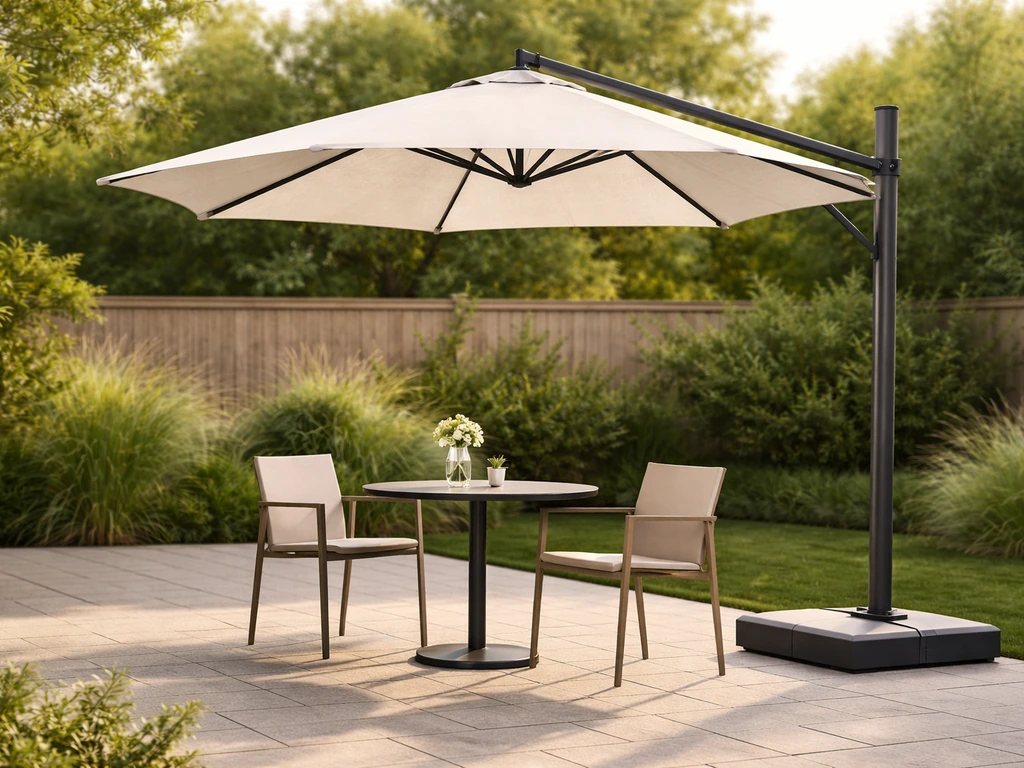
A cantilever or offset umbrella mounts the pole to the side and extends the canopy out over the seating area, leaving the space underneath completely clear. This design is ideal for lounge seating, hot tubs, sectional sofas, or any layout where a center pole would be intrusive or where you want to shade an area without a table. Cantilevers typically range from 10 to 13 feet in canopy diameter and can rotate 360 degrees, allowing you to track the sun across the day without moving the base. The trade-offs are significant: they cost considerably more (a quality cantilever starts around $300 and goes well past $600 for premium Sunbrella options), they require much heavier or more elaborate bases (often 200-plus pounds of ballast or a ground anchor), and the offset arm creates more mechanical complexity and more potential failure points. They are also more susceptible to wind uplift because the canopy is not centered over the base. For spaces where a cantilever genuinely fits the use case, it is worth every dollar. For a standard dining table setup, a market umbrella is almost always the better choice.
Compact and balcony umbrellas
Compact umbrellas in the 6- to 7.5-foot range are designed for small balconies, bistro tables, or tight spaces where a 9-foot umbrella would overhang a railing or neighboring unit. Some are designed to mount to a balcony railing rather than a table or ground base, which removes the floor space penalty entirely. These are niche products but genuinely useful in high-rise or urban environments. They are not meant for full-afternoon shade coverage; they are a comfort upgrade for morning coffee or late-afternoon reading on a small outdoor footprint.
| Style | Best For | Typical Canopy Size | Approx. Price Range | Base Requirement | Key Trade-off |
|---|---|---|---|---|---|
| Market/Pole | Dining tables, standard patios | 7.5–13 ft | $70–$350+ | 50–75 lbs for 9 ft | Pole runs through table center |
| Cantilever/Offset | Lounge seating, sectionals, hot tubs | 10–13 ft | $250–$700+ | 150–250+ lbs or ground anchor | Higher cost, more wind exposure |
| Compact/Balcony | Small balconies, bistro setups | 6–7.5 ft | $50–$150 | Railing mount or 30–40 lbs | Limited coverage area |
Getting the size and placement right
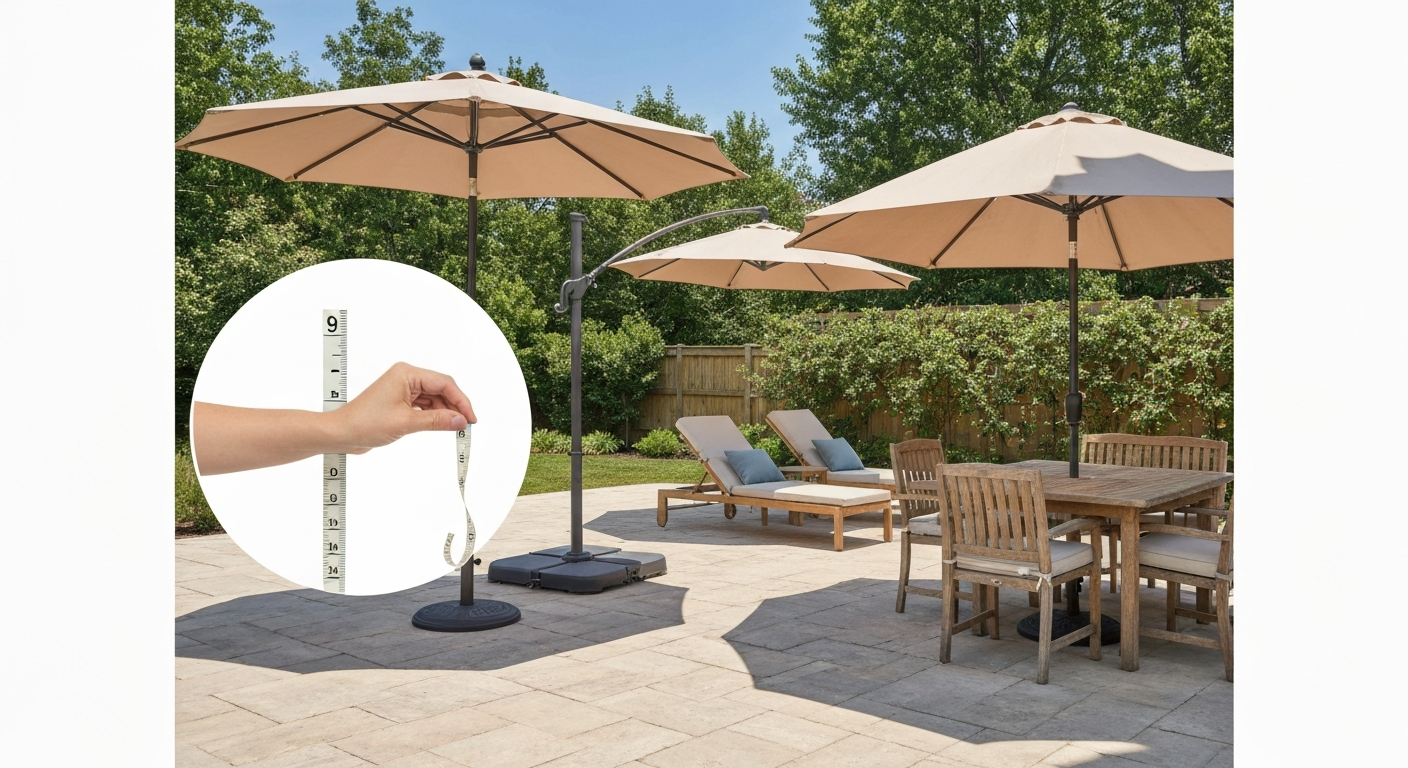
Umbrella size is the most commonly misjudged spec. The general rule is to add 2 feet to each side of your seating footprint. A standard 4-person round table is about 48 inches (4 feet) in diameter, meaning you need a canopy that extends at least 2 feet beyond each side, putting you at 8 feet minimum. A 9-foot (108-inch) umbrella is the practical sweet spot for most 4-person dining tables. For a 6-person rectangular table at 72 inches long, a 9-foot umbrella provides acceptable coverage along the sides but will leave the ends partially exposed during midday sun. An 11-foot umbrella solves that problem, but requires a 65-pound or heavier base and a sturdier pole.
Canopy shape also matters more than most buyers consider. Round canopies are symmetric and shade evenly from all sides, making them ideal for round or square tables. Rectangular canopies (often called market square or oblong) mirror the shape of a rectangular table and provide better coverage at the ends. Octagon canopies are a visual and functional middle ground that work well with either table shape. For a cantilever over a sectional sofa, a round or square canopy works depending on the sofa configuration.
Placement relative to the sun's path is the other underappreciated factor. In the northern hemisphere, the sun tracks roughly from east to west and sits to the south at its peak. If your seating area faces south or southwest and you are primarily shading afternoon use, you can position a fixed-tilt umbrella accordingly. If you use the space throughout the day, a tilt mechanism (push-button or crank) or a full-rotation cantilever is worth the extra investment because a fixed canopy that is perfectly positioned at noon is useless by 4 PM when the sun has shifted 60 to 90 degrees.
Fabric, UV protection, and what UPF actually means
UPF (Ultraviolet Protection Factor) on umbrella canopies is not the same as on clothing, but the rating system works similarly. A UPF 50+ canopy blocks more than 98% of UV-B radiation passing through the fabric. Solution-dyed acrylic fabrics like Sunbrella and Treasure Garden's branded options achieve UPF 50+ because the color pigment is embedded throughout the fiber rather than printed on the surface, which also means the UV protection does not fade as the color fades. Polyester canopies vary widely: some achieve UPF 50 when new but degrade toward UPF 15 to 25 after one or two seasons of full-sun exposure.
For everyday residential use in the Mid-Atlantic or Pacific Northwest, a mid-tier solution-dyed acrylic canopy is adequate. For Arizona, Southern California, Florida, or any high-UV climate, Sunbrella or equivalent solution-dyed acrylic with a confirmed UPF 50+ rating is not optional if you want the canopy to hold its rating and its appearance past year two. Darker colors and tighter weave constructions generally provide better UV blocking than light colors and open weave, though solution-dyed acrylic at any shade typically outperforms polyester regardless of color.
Frame materials and wind performance: what to know before you buy
Pole and rib material choices are a direct proxy for durability. Here is what the options actually mean in practice.
- Aluminum poles: Lightweight, corrosion-resistant, and the most common choice for quality market umbrellas. A 1.5-inch diameter aluminum pole is adequate for a 9-foot canopy in typical residential conditions.
- Steel poles: Heavier and less expensive. Fine for short-term use but prone to surface rust if the coating chips, which it will over time, especially in coastal or humid environments.
- Fiberglass ribs: Flex before breaking and perform best in wind events. Significantly better than aluminum or steel ribs for durability. Heavier and pricier but worth it if you are in a breezy location.
- Aluminum ribs: Common on mid and budget models. Functional in calm to moderate wind but can crease or snap in strong gusts rather than flexing.
- Wood poles (teak or hardwood): Traditional and attractive, commonly used on commercial-grade market umbrellas. Heavy, expensive, require periodic sealing or oiling, and not ideal for high-humidity environments unless properly maintained.
- Wind vents: A single vent at the crown allows air to escape upward rather than building pressure under the canopy. Double vents improve this further. Neither vent design makes an umbrella storm-proof; they reduce, not eliminate, wind uplift risk. The umbrella should still be closed and secured in sustained winds above 20 to 25 mph regardless of venting.
As of mid-2026, there is no finalized ASTM voluntary standard that mandates specific wind-resistance testing for residential patio umbrellas. CPSC staff and the ASTM F15.79 subcommittee have been developing testing protocols, but formal published standards have not yet been adopted. This means manufacturer wind-speed claims on packaging and product pages are based on internal testing, not a common third-party benchmark. Treat wind-resistance specs as directional guidance rather than guaranteed performance.
Bases: the most neglected part of the purchase
The base is consistently the most underinvested part of a patio umbrella setup, and it is responsible for most tip-over incidents and property damage. Treasure Garden's own catalog specifies a minimum 50-pound base for their 9-foot umbrellas and recommends 75 pounds or more in any area with regular wind exposure. See the manufacturer's product page for the 9 Foot Double Vent Crank Lift Round Market Umbrella by Treasure Garden, product page (images & diagrams) for high-resolution product photos, in-use lifestyle images, and line drawings/diagrams useful for close-ups of ribs, tilt mechanisms, canopy venting, base options, and installation guidance 9 Foot Double Vent Crank Lift Round Market Umbrella by Treasure Garden — product page (images & diagrams). For 11-foot umbrellas, 75 to 100 pounds is the practical minimum. Cantilever umbrellas with offset arms require far more ballast, typically 150 to 250 pounds, because the canopy's center of gravity is not over the base. Many cantilever bases are designed to be filled with sand or water on-site to reach the required weight.
Base material matters too. Cast iron and steel bases filled with sand or water are the most common residential options. Cross-base designs provide a wider footprint than round or single-post bases and improve stability without requiring as much weight. If you have a table with a center hole, you can use a table base or a freestanding umbrella base depending on the table construction. Resin bases that are not filled are generally not heavy enough for anything larger than a 7.5-foot umbrella.
What Arizona homeowners specifically need to consider
If you are in Phoenix, Tucson, or anywhere in the Sonoran Desert corridor, your umbrella faces conditions that are genuinely more demanding than the average suburban patio in the Midwest or Northeast. See our guide to the best patio umbrella for Arizona for specific model and fabric recommendations tailored to Sonoran Desert conditions. The UV index in Phoenix routinely reaches 10 to 11 during summer, placing it in the 'very high' to 'extreme' range on the NOAA/NWS scale for most of June, July, and August. UV index levels above 8 can cause accelerated fabric degradation on canopies rated for typical residential use, and a polyester canopy in full Phoenix sun can lose meaningful UV protection within a single season.
Arizona also brings haboobs and summer monsoon wind events, which arrive fast and can reach 40 to 60 mph in a haboob front. No residential patio umbrella is designed to survive a haboob open. The practical guidance is to close and secure your umbrella whenever there is any indication of a storm system approaching, and to use a storage cover and a weighted base year-round rather than treating wind as a once-a-season concern. For Arizona specifically, the following specifications are effectively non-negotiable rather than optional upgrades.
- Sunbrella or confirmed solution-dyed acrylic canopy with UPF 50+ rating and a manufacturer fade warranty of at least 5 years
- Aluminum or powder-coated steel frame, not raw steel, to handle daily thermal cycling and occasional moisture from monsoon rain
- Fiberglass ribs if you can get them, for resilience after the occasional wind catch before you get the umbrella closed
- A base of at least 75 pounds for a 9-foot umbrella, anchored to a paved surface if possible
- A storage cover for overnight or multi-day absences, since UV degradation and heat build-up under a closed-but-uncovered canopy can accelerate fabric stress
- Lighter canopy colors (sand, beige, white) which reflect more solar heat than dark colors and keep the shaded area cooler, though they show dust from haboobs more visibly
For Arizona buyers, the California Umbrella 9-foot with Sunbrella fabric or the Treasure Garden equivalent with a Sunbrella canopy upgrade is a better long-term investment than the base UM920 with standard acrylic. The price difference over a 5-year horizon is usually smaller than buying and replacing a cheaper umbrella twice.
Category picks by use case and budget
Rather than one-size-fits-all, here is a breakdown by the scenarios readers most commonly describe when choosing an umbrella.
| Use Case | Recommended Category | Representative Model | Approx. Budget |
|---|---|---|---|
| Best overall for most homeowners | Mid-tier market, solution-dyed acrylic | Treasure Garden UM920 (9 ft) | $130–$180 + base |
| Best for high-UV climates (Arizona, FL, SoCal) | Mid-premium market, Sunbrella fabric | California Umbrella 9 ft Sunbrella | $250–$320 + base |
| Best budget pick for occasional use | Budget market, polyester | Abba Patio 9 ft | $70–$100 + base |
| Best for lounge/sectional seating | Cantilever/offset, Sunbrella | GrandPatio 12 ft Napoli Sunbrella | $350–$500 + ballast base |
| Best for small balconies/renters | Compact market or railing-mount | Various 6–7.5 ft options | $50–$150 |
| Best for heavy wind exposure | Market with fiberglass ribs, double vent | Treasure Garden auto-tilt with fiberglass ribs | $160–$220 + heavy base |
Setup, maintenance, and making your umbrella last
Assembly on most market umbrellas takes 15 to 30 minutes and requires no special tools. The most common assembly mistake is overtightening the collar or tilt mechanism hardware, which causes the mechanism to bind after a few uses. Finger-tight plus a quarter turn is the right approach on most plastic-and-aluminum collar mechanisms. Ribs should click or seat fully into the hub before you raise the canopy for the first time; check each one individually.
For cleaning, Treasure Garden's own care documentation recommends a mild soap and lukewarm water solution applied with a soft brush, then rinsed thoroughly. Sunbrella's official guidance is similar: a diluted bleach solution (1 cup bleach to 1 gallon water) is permitted for mold and mildew on Sunbrella fabric, something most acrylic canopy brands do not allow. Do not use a pressure washer on any canopy fabric, as the high-pressure stream degrades the weave and can compromise UV-blocking capacity. After washing, allow the canopy to air dry fully before closing it; closing a damp canopy is the most common cause of mildew growth.
At the end of the season, remove the canopy from the frame if possible and store it flat or loosely rolled in a breathable storage bag in a dry space. Storing it compressed in its original box for months at a time can set creases into the fabric. Spray moving parts (tilt mechanism, crank gears, rib hub pins) lightly with a silicone-based lubricant before storage and again at the start of the season. Avoid WD-40 on plastic components; it can degrade certain plastics over time. Checking rib tips and hub connections at the start of each season and replacing worn end caps prevents small issues from turning into rib failures during use.
Windproofing your setup: practical steps
Wind damage is the single most common cause of umbrella replacement, and most of it is preventable. A few straightforward steps significantly reduce your risk.
- Use a base that meets or exceeds the manufacturer's minimum weight recommendation for your canopy size. Most tip-overs happen with bases that are technically designed for a 9-foot umbrella but are at the light end of the acceptable range.
- Close the umbrella whenever winds are forecast above 20 mph, even if the sky looks clear. Wind gusts, not sustained wind, cause most umbrella failures.
- Use a velcro or snap closure strap on the closed canopy to prevent it from catching wind even when 'closed.' Most quality umbrellas include one; if yours did not, add one.
- Consider a weighted base anchor or umbrella base anchor strap to secure a freestanding base to the patio deck surface, especially for composite or pavers that allow strapping.
- Position the base on a level surface. An unlevel base reduces effective ballast contact area and introduces a lean that compounds tipping risk.
- If you have a cantilever umbrella, position the base weight on the same side as the canopy extends toward, so the ballast counteracts the canopy's moment arm rather than sitting to the opposite side.
The bottom line on the NYT/Wirecutter pick and what to do with it
The Treasure Garden UM920 is a genuinely good umbrella and a well-reasoned recommendation from Wirecutter. It earns its place at the top of the list through consistent build quality, a reliable tilt mechanism, and better fabric than what you get in the budget tier. It is not the last word for every situation. High-UV climates like Arizona justify spending more on Sunbrella fabric. Large or freeform seating areas justify a cantilever. Small balconies are better served by a compact or railing-mount option. And whatever you choose, the base, maintenance habits, and willingness to close the umbrella before a storm will do more for long-term satisfaction than any single spec on the product page.
FAQ
What primary source must I read to summarize the New York Times’ (Wirecutter) “best patio umbrella” pick accurately?
Locate and read the specific NYT/Wirecutter review page that names the current “best patio umbrella” pick. Capture the exact model name, model year, quoted short verdict, full rationale, and the review’s 'How we tested' section. Save the page URL and publication date for citation.
How should I treat Wirecutter as a New York Times–associated source?
Confirm Wirecutter’s ownership/relationship to The New York Times (e.g., via Wikipedia or NYT corporate pages). Note this when citing the pick as 'NYT/Wirecutter' and state any editorial separation if described in primary documentation.
What testing-methodology details must I extract from the NYT/Wirecutter review?
Pull the review’s testing scope: number of models tested, wind/sun/rain test conditions, lab vs. field tests, performance metrics (UV protection, wind resistance, durability), tester expertise, duration of testing, and stated limitations or disclaimers.
Which independent testing sources should I consult to cross-check the review’s claims?
Use at least one independent lab-tested resource—ideally Consumer Reports’ lab-tested patio-umbrella guide—to compare measurement methods, sample sizes, and objective metrics. Also consult other long-form testers (BobVila, Good Housekeeping) for methodological contrast.
What manufacturer-level technical details do I need to collect for the NYT pick and competing models?
Gather product specs from manufacturer pages and technical sheets: canopy dimensions/shape, fabric type and UPF/UV claims, pole and rib materials, venting, tilt/rotation/raise mechanisms, advertised wind ratings, minimum base/anchor requirements, and warranty terms.
Why should I consult manufacturer catalogs and technical PDFs?
Catalogs/PDFs often list authoritative specs and minimum base/anchor recommendations, installation diagrams, and official disclaimers (e.g., 'base sold separately'). Use these to verify retailer claims and to give accurate base-weight guidance.