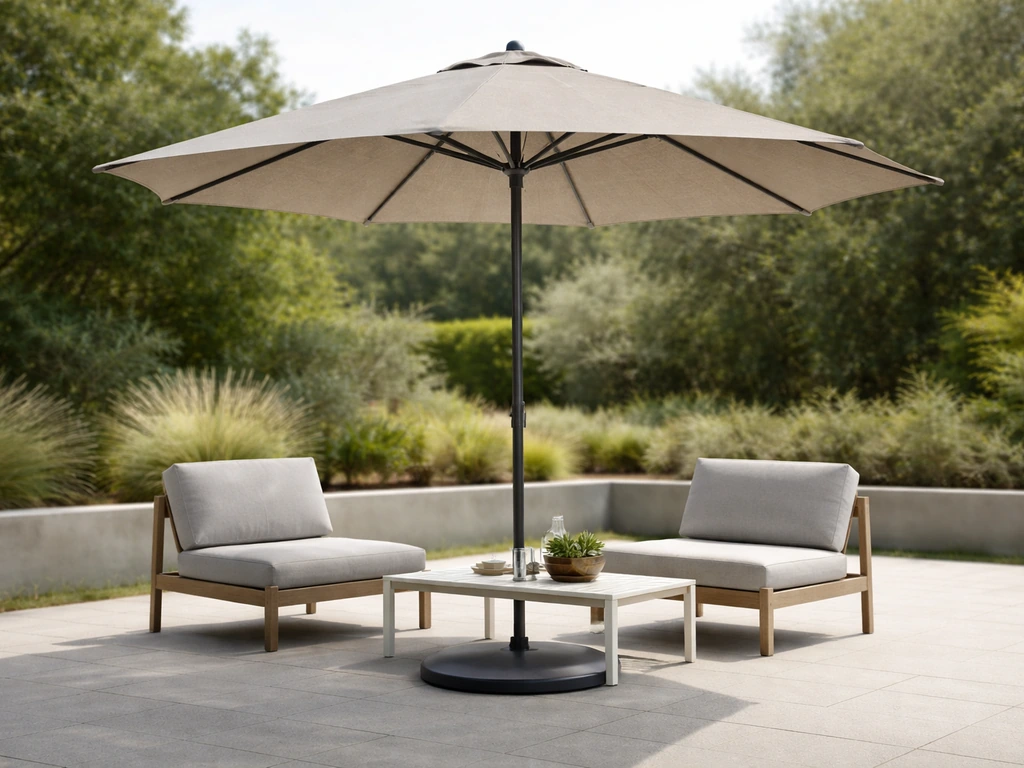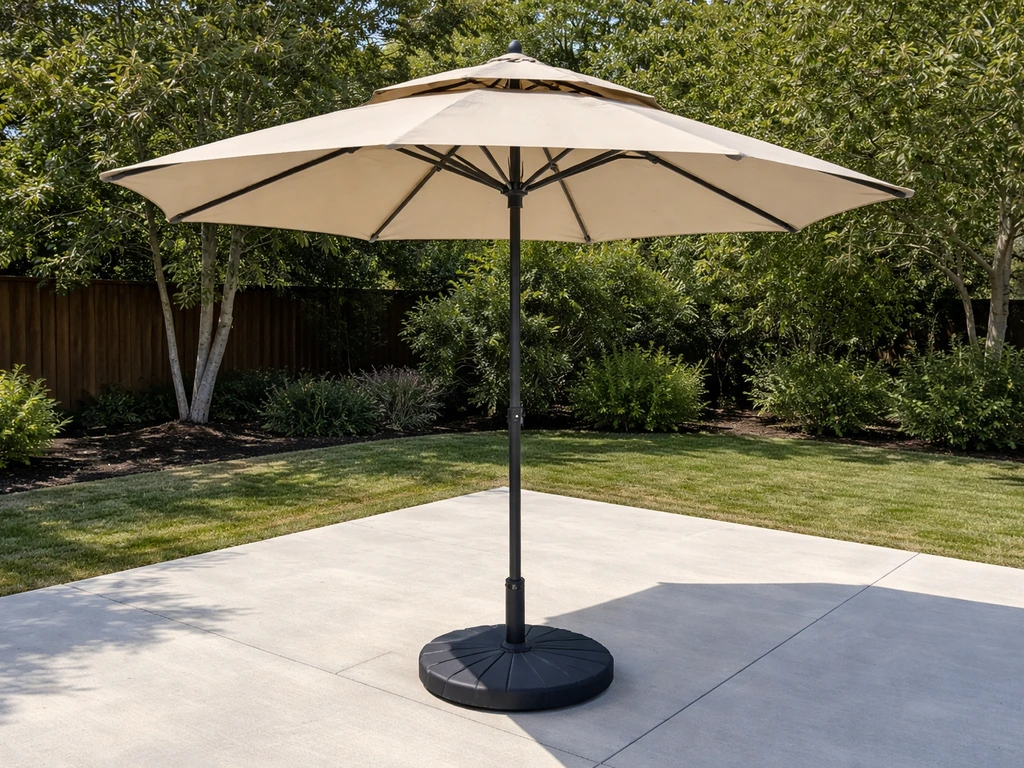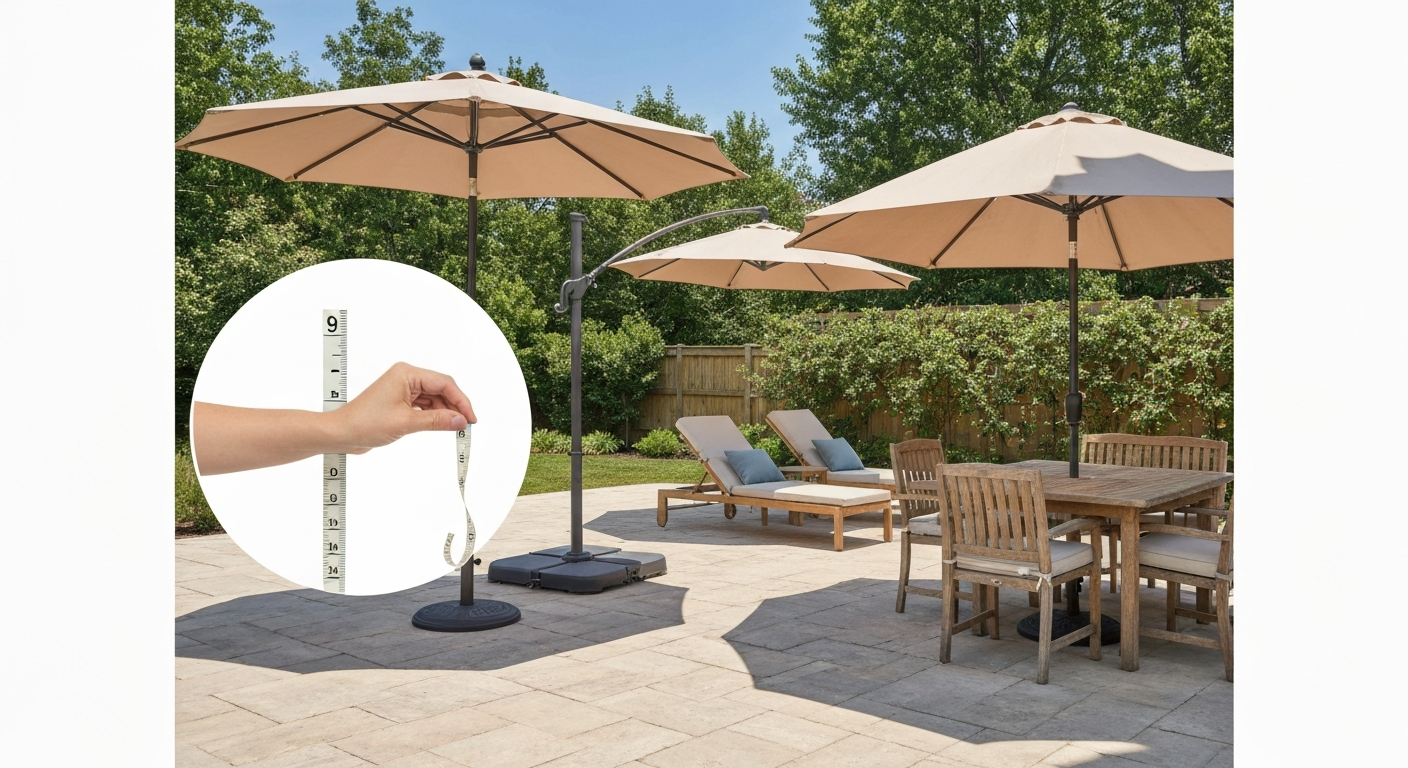
Most patio umbrella wind ratings are marketing language, not certified safety specs. A number like '35 mph wind resistant' sounds reassuring, but unless a manufacturer specifies how the umbrella was tested, what base was used, and under what conditions, that number means very little. What actually keeps an umbrella safe in wind is the whole system: the canopy design, the pole, the base weight, the anchoring method, and how you operate it day to day. A patio umbrella's wind rating depends on how it is installed and tested, so always compare the stated conditions to your setup and typical gusts whole system. This guide walks you through how to read those specs honestly, pick the right umbrella type for your situation, size the base correctly, and know exactly when to close it before something goes wrong.
Patio Umbrella Wind Rating: How to Verify and Buy

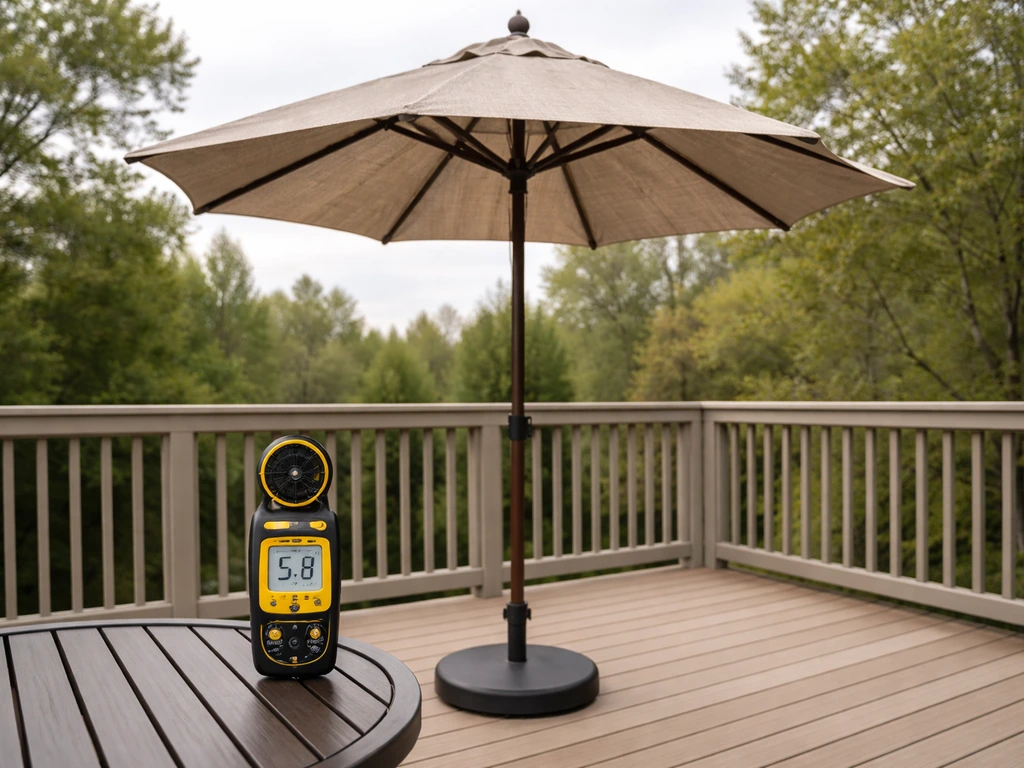
What 'wind rating' actually means for patio umbrellas

Unlike ratings for appliances or building materials, there is no universal, mandatory standard that all patio umbrella manufacturers must meet before slapping a wind speed claim on a product page. ASTM International has published a standard called F3512, which is specifically designed to test and rate market umbrella and base mounting systems for wind safety and durability. The goal is to evaluate whether an umbrella and its anchoring system together can resist wind forces without becoming a projectile. CPSC draft/meeting documents for the ASTM F15 task group similarly frame umbrella wind safety around umbrella and anchoring system performance rather than canopy design alone umbrella and its anchoring system together can resist wind forces. That last part matters: the standard tests the system, not just the canopy. But here is the catch: compliance with ASTM F3512 is voluntary. Many manufacturers simply do not test to it.
What you will typically see when shopping are two very different types of claims. The first is a model-specific engineered rating, where the manufacturer has done actual testing, often including wind tunnel work, and can tell you the speed, the mounting condition assumed, and what 'withstand' means in their test. Umbrosa, for example, documents wind tunnel testing at 25 mph for freestanding use and over 30 mph (Beaufort 6) for permanently mounted installations. Frankford's NOVA series specifies 50 mph sustained winds as an engineered threshold. These are credible claims because they come with conditions attached. The second type is a vague marketing claim: 'wind resistant,' 'designed for breezy conditions,' or 'withstands up to X mph' with no test documentation and no mention of what base was used. That is where you need to be skeptical.
One of the most important things to understand is that wind ratings are almost universally not covered by warranty. Frankford states this explicitly: wind ratings do not form any part of their warranties. Shademaker's manuals similarly exclude wind damage, listing hurricanes, tornadoes, and storms as acts of nature outside warranty coverage. This is standard across the industry. A wind rating is a performance and safety reference point, not a promise that your umbrella will survive a gust without damage or that the manufacturer will replace it if it doesn't.
How to read wind specs and spot misleading claims
When you see a wind speed number on a product listing, your first question should be: what conditions does that assume? A wind rating is only meaningful when you know what base or anchoring method was assumed, whether the figure refers to sustained winds or gusts, and whether the umbrella was tested open or closed. A commercial architectural umbrella from a company like Birdair can carry a 90 mph design wind speed rating, but that number assumes permanent in-ground installation following structural engineering specifications, a specific exposure category, and an importance factor. That same 90 mph rating applied to a freestanding weighted base on your deck is meaningless.
Several manufacturers publish installation-dependent ratings, which are far more honest than a single blanket number. One commercial umbrella brand notes explicitly that the wind rating 'depends on how the umbrella is installed or weighted,' listing a higher rating for in-ground mounting and a lower one for a portable weighted base. When you see a product that distinguishes these, that is a signal of genuine transparency. When a product just says '35 mph' with no further detail, you should treat it as a rough guideline and verify through owner's manual language, warranty terms, and customer reviews.
A few practical ways to verify a wind claim before buying: download the owner's manual if one is available (many brands post PDFs publicly), look for any mention of Beaufort scale numbers alongside mph figures (Beaufort 5 is roughly 25 mph sustained, Beaufort 6 is around 30 to 31 mph), check whether the listing mentions ASTM F3512 compliance, and search for user reviews specifically mentioning wind performance rather than general satisfaction. Reddit threads and outdoor furniture forums tend to surface honest real-world failures that product pages never mention, and the pattern that comes up repeatedly is that failures trace to anchoring problems and turbulence from placement, not canopy quality alone.
Also watch out for location exceptions. If you are comparing options for the best patio umbrellas canada, treat wind ratings as a baseline and match them to your actual setup, not just the headline mph number. Frankford specifically warns that published wind ratings do not apply to rooftop or elevated patio situations above ground level. If your patio is on a second-floor deck, a rooftop terrace, or near a coastal shoreline, expect real-world wind loads to exceed what the rating assumes, sometimes significantly.
Choosing the right umbrella style for your wind situation
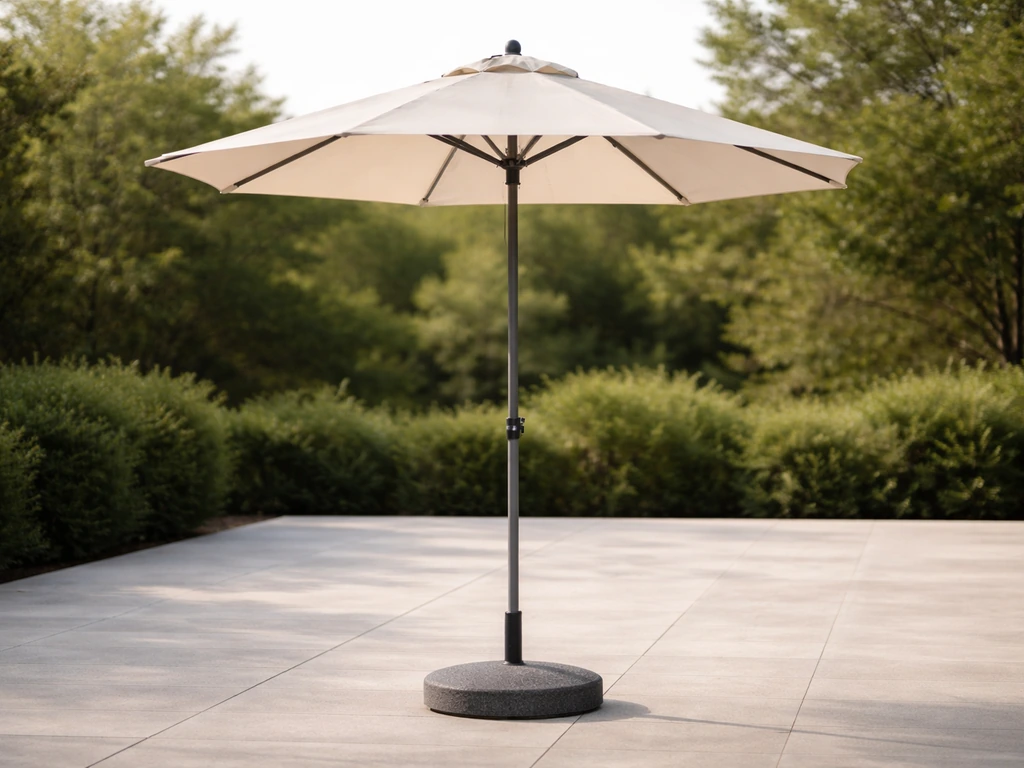
Not all umbrella styles handle wind the same way, and choosing the wrong type for a breezy location is probably the most common mistake people make before they even think about ratings.
Market (center-pole) umbrellas
A traditional market umbrella with a center pole is the most structurally stable design in wind when properly installed, because the pole transfers wind load straight down into the base. The load path is simple and direct. The tradeoff is that the pole runs through the center of the table, which is a layout constraint. For wind resistance, market umbrellas are the easiest to ballast correctly, and you can find solid options with fiberglass ribs and vented canopies that handle moderate wind well. If wind performance is your primary concern and you want a relatively straightforward setup, start here.
Cantilever and offset umbrellas
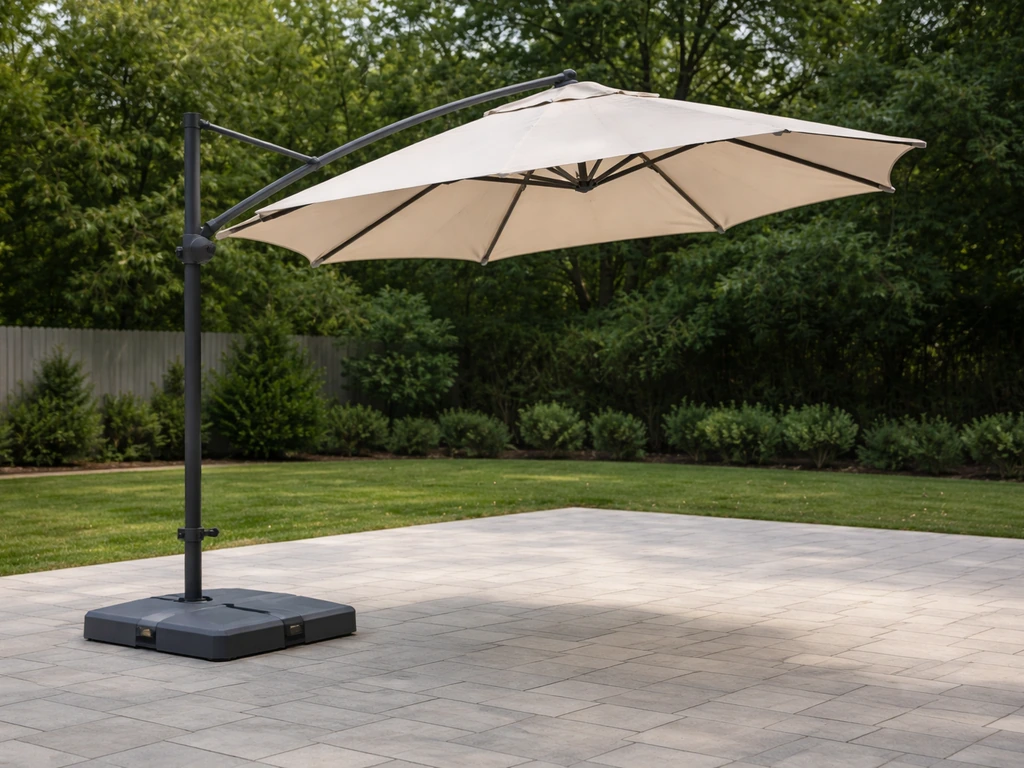
Cantilever and offset umbrellas are popular because they free up table space and allow shade coverage from the side, but they are inherently more vulnerable to wind. The offset arm creates leverage, meaning wind force on the canopy is amplified as a rotational load on the base. This is basic physics: the longer the arm, the more torque is applied to the base for the same wind speed. Cantilever umbrellas require significantly heavier bases than market umbrellas of the same canopy size, and many of the failures you read about in reviews involve cantilevers tipping over in moderate gusts because the buyer used an undersized base. If you want a cantilever in a breezy spot, you need to be especially rigorous about base weight and placement, or invest in a model that allows permanent in-ground anchor mounting.
| Style | Wind Stability | Base Requirement | Best For |
|---|---|---|---|
| Center-pole market | Highest (direct load path) | Moderate (50–100 lbs typical) | Open patios, tables with center holes, moderate wind zones |
| Cantilever/offset | Lower (lever arm multiplies torque) | Heavy (100–200+ lbs or in-ground) | Sheltered patios where shade flexibility matters more than wind exposure |
| Tilt-only market | Good when upright, reduced when tilted | Moderate to heavy | Sunny spots with occasional afternoon breeze, but must be returned to vertical in wind |
Size, height, materials, and design features that affect wind stability
Canopy size
Bigger canopies catch more wind, full stop. A 9-foot canopy has roughly 64 square feet of surface area while an 11-foot canopy has about 95 square feet. In a 25 mph wind, the difference in load on the base is substantial. If you are in a consistently breezy location, resist the urge to size up unnecessarily. A properly supported 9-foot umbrella will outlast a poorly anchored 11-foot one every time. That said, if you need the coverage, address the base weight and anchoring first.
Canopy venting
A vented canopy is one of the most practical wind-resistance features you can look for. A double-vent design (two layers of fabric with a gap between them) or a single vent at the top allows air to escape upward rather than pushing the canopy up like a sail. This reduces lift and the risk of inversion. Venting alone does not make an umbrella windproof, but it meaningfully reduces the aerodynamic load in gusty conditions. If you are choosing between two comparable umbrellas and one is vented, pick the vented one.
Pole and rib materials
Aluminum poles are lightweight and corrosion-resistant but can bend under stress. Fiberglass poles and ribs are the better choice for wind resistance because fiberglass flexes under load without permanently deforming or snapping, the same reason fiberglass is used for fishing rods and flag poles. If a product listing mentions fiberglass ribs or a fiberglass pole, that is a genuine durability upgrade for windy conditions, not just a marketing differentiator. Steel poles are strong but heavy and prone to rust if the coating is compromised.
Tilt mechanisms
Crank-tilt and auto-tilt mechanisms let you angle the canopy for shade, but tilting an umbrella into the wind dramatically increases the effective surface area the wind pushes against, and it shifts the load off-center. Shademaker's own manuals explicitly state not to keep an umbrella in tilt position in windy conditions. This is standard guidance across the industry. If wind picks up and your umbrella is tilted, straighten it first, then close it if winds exceed your safe threshold.
Canopy fabric
Solution-dyed acrylic fabrics (Sunbrella being the most recognized brand) hold up better over time than polyester canopies because the color is baked into the fiber rather than surface-printed, which means UV degradation is slower. More importantly for wind, a tightly woven, quality fabric is less likely to develop tears at stress points where the ribs attach. Cheap polyester canopies often fail at the rib pockets first when subjected to repeated wind loading.
Base requirements and anchoring: what actually stops the umbrella from going airborne
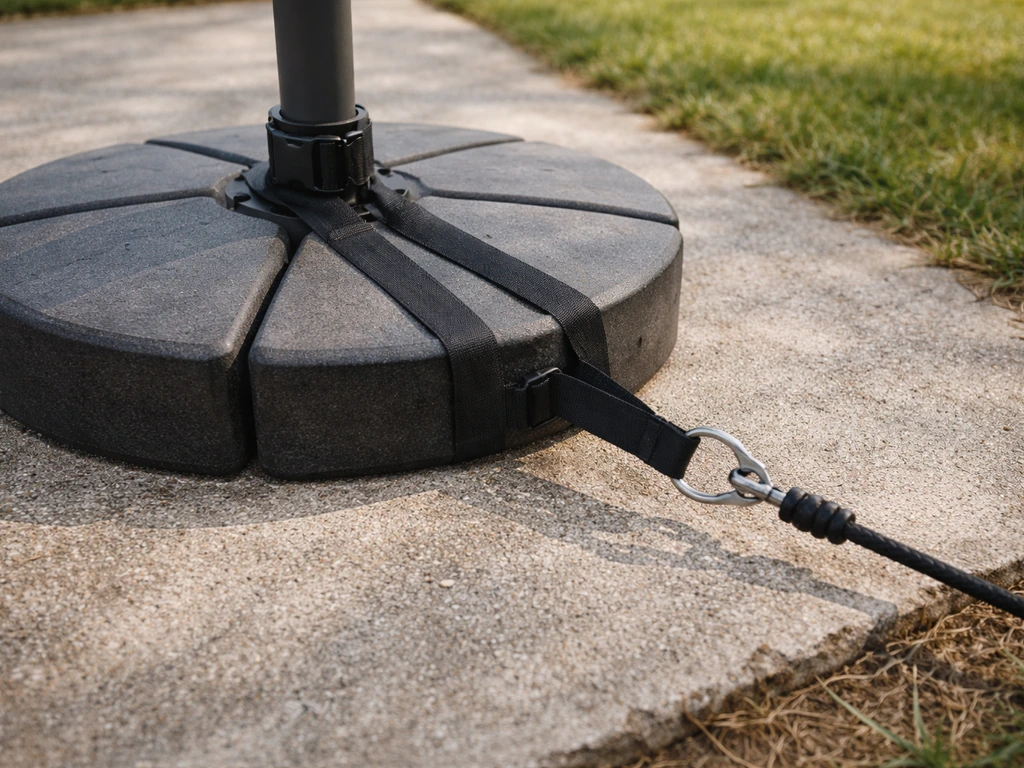
If there is one section to read carefully, it is this one. More umbrellas fail because of inadequate bases and poor anchoring than because of any flaw in the umbrella itself. The wind rating on the canopy is irrelevant if the base cannot hold the umbrella down.
As a rough guide, a standard 9-foot market umbrella in a moderate-wind environment needs at least 50 pounds of base weight, and 75 to 100 pounds is better. A 10- to 11-foot umbrella should be paired with a minimum of 75 to 100 pounds, and if you are in a consistently windy area, 125 pounds is not excessive. Cantilever umbrellas with 10-foot or larger canopies routinely need 150 to 200 pounds of base ballast to be stable, and many manufacturers of quality cantilevers recommend in-ground concrete anchoring as the only truly reliable solution for exposed locations.
The type of base matters as much as the weight. A wide, low-profile base with a large footprint distributes load better than a tall, narrow one. Wheeled bases are a particular problem: Original Parasol Co warns explicitly that wheeled bases are not considered secure fixings, and that an umbrella in a wheeled base can behave like a kite once wind begins to gust. If you want portability, accept that you are trading off wind resistance and close the umbrella before winds pick up.
For permanent or semi-permanent setups in exposed locations, in-ground sleeve anchors are the most reliable option. You pour a concrete sleeve into the ground, and the umbrella pole drops into it. Umbrosa's wind tunnel testing showed their umbrellas could handle over 30 mph in this configuration, while the freestanding threshold was considerably lower. The anchoring method is literally part of the wind rating for serious outdoor umbrella brands. If a manufacturer provides two wind ratings, one for permanent mounting and one for freestanding, always use the freestanding number as your reference unless you are actually installing it permanently.
Placement also functions as a form of anchoring. Positioning an umbrella close to a wall, fence, or structure on the windward side reduces the wind load it sees. Open corners and elevated surfaces are the worst-case scenarios. If your patio is on a rooftop or faces an unobstructed wind exposure, treat every published rating as optimistic and add base weight accordingly.
Operating safely in wind: when to close it and everyday habits
The consistent guidance across serious umbrella brands is to close your umbrella at sustained winds of 25 mph. If you are searching for the best patio umbrella for balcony use, make sure you match this closing guidance to your typical gusts and choose a base that can keep the umbrella from tipping close your umbrella at sustained winds of 25 mph. Frankford recommends this threshold explicitly, Shadowspec recommends closing above Beaufort 5 (roughly 25 mph sustained), and Poggesi cites 38 kph (24 mph) as the upper comfort threshold. These numbers converge on the same point for a reason: even a well-rated umbrella becomes unpredictable when gusts exceed sustained wind speed, and gusts typically run 30 to 40 percent higher than the sustained speed during a storm. A 25 mph sustained wind can produce 35 mph gusts easily.
A higher wind rating does not mean you should leave the umbrella open in high winds, it means the umbrella is built to tolerate brief exposure at that speed without structural failure if it does get caught open. Frankford's NOVA is engineered for 50 mph sustained winds, but that is not an invitation to leave it open in a storm. It means the umbrella is robust enough to survive being caught in conditions before you can get to it, not that it should be used as a wind test subject.
The most practical daily habit is to close the umbrella any time you leave the patio unattended. Shademaker's warranty language puts it plainly: no umbrella should ever be left unattended in the open position. Weather can change quickly, and an open umbrella with no one watching it is a liability. If you have an in-ground installation in a sheltered spot and a robust umbrella, you have more margin, but the habit of closing on departure is the single easiest risk-reduction step available.
- Close at sustained winds of 25 mph or at the first sign of gusting.
- Return the canopy to vertical (remove tilt) before closing in any wind.
- Never leave an umbrella open unattended, regardless of the wind rating.
- For elevated, coastal, or exposed patios, close any time you leave even in calm conditions.
- In severe weather forecasts, remove the umbrella from the base entirely and store it horizontally.
- Check that the locking mechanism (crank lock, pin, or clamp) is fully engaged before walking away.
Matching a wind rating to your location's actual conditions
Before you shop, spend five minutes looking up your area's typical sustained wind speeds and average gust speeds. Weather services publish this data by ZIP code or region, and if you live near a coast, a mountain pass, or an open prairie, your baseline wind exposure is fundamentally different from a sheltered suburban backyard. The Beaufort scale is a useful reference because it translates wind speed ranges into observable descriptions: Beaufort 4 (13 to 18 mph) is a 'moderate breeze' where loose papers blow around; Beaufort 5 (19 to 24 mph) is a 'fresh breeze' where small trees sway; Beaufort 6 (25 to 31 mph) is a 'strong breeze' where large branches move and umbrellas become difficult to control. If you are searching for the best patio umbrella for wind in Canada, use these Beaufort ranges to decide what “safe” wind level you actually need to plan for.
A practical decision framework: if your typical afternoon breezes run 10 to 15 mph with occasional 20 mph gusts, almost any quality umbrella with a proper base will work. If you regularly see 20 to 25 mph sustained winds, look for fiberglass ribs, a vented canopy, and a base of at least 75 pounds for a 9-foot umbrella. If sustained winds regularly reach 25 to 35 mph, you need a purpose-built wind-resistant umbrella with documented testing, a heavy base of 100 pounds or more (or in-ground anchoring), and a strict close-when-not-attended policy. To find the best patio umbrella for wind, prioritize documented wind testing, a vented canopy, and a correctly sized heavy base or in-ground anchoring purpose-built wind-resistant umbrella. Above 35 mph sustained, the honest answer is that no freestanding patio umbrella is rated or appropriate for regular open-position use at those speeds.
Buying checklist: questions to ask before you commit
Use this as a filter when you are narrowing down options. If a manufacturer cannot answer most of these questions, that tells you something about how seriously they take wind performance. If you want the best patio umbrella for rain, prioritize sturdier wind stability and a vented canopy so it can handle gusts when storms roll in wind performance.
- Is there an owner's manual available to download before purchase, and does it include wind guidance and operating limits?
- Does the wind rating specify whether it applies to a freestanding base or a permanent/in-ground installation?
- Does the listing distinguish between sustained wind speed and gust speed?
- Are the ribs fiberglass or aluminum, and what is the pole material and diameter?
- Does the canopy include a vent (single or double)?
- What is the manufacturer's recommended minimum base weight for this canopy size?
- Is wind damage explicitly excluded from the warranty, and if so, what does the warranty actually cover?
- Has the umbrella been tested to ASTM F3512 or any documented wind tunnel standard?
- Are there independent reviews specifically mentioning wind performance, not just general quality?
- Does the manufacturer provide any guidance for elevated or coastal installations?
Wind resistance, UV durability, and rain performance are all connected factors in a quality patio umbrella, and the same questions about honest testing and material quality apply across all of them. A well-built umbrella for wind will generally also hold up better in rain and sun, because the investment in fiberglass, quality fabric, and solid construction pays dividends across all weather conditions. The best advice is to treat wind rating as one input in a larger system decision, not a magic number that resolves everything on its own. If you are trying to figure out what makes a good patio umbrella, start by prioritizing tested wind performance, a properly sized base, and design details like venting and durable pole and rib materials wind rating.
FAQ
Is there a real, reliable “patio umbrella wind rating” standard I can depend on in every product listing?
Not universally. Some brands test to a specific engineered approach and explain the conditions, but many use non-tested marketing language. Treat a number as credible only if the listing or manual states the test method or at least clearly identifies mounting condition (freestanding vs permanent), wind type (gusts vs sustained), and whether it was tested with the umbrella fully open.
What’s the difference between a wind rating for “sustained winds” versus “gusts,” and which should I shop for?
Sustained winds are the steadier average, while gusts are short spikes that are typically higher. Since gusts are what tip umbrellas, you should plan around your local gust speeds and only use sustained wind numbers as a lower bound. If the product never specifies gust vs sustained, assume the claim is less useful for safety planning.
Can I use a higher wind-rated umbrella as an excuse to leave it open in storms?
No. Wind ratings generally mean the umbrella can tolerate being caught briefly before you secure it, not that it is safe for unattended open-position use. The article’s guidance to close at around 25 mph sustained is about real-world unpredictability when gusts exceed the comfort threshold.
Does a vented canopy automatically make the umbrella safe in high winds?
A vented canopy reduces lift and can lower the aerodynamic load, but it does not replace base weight, anchoring, or correct placement. If the base is too light or the umbrella is near an open corner, venting alone cannot prevent tipping or sail-like behavior.
How do I choose a base for wind when my umbrella is cantilever or offset (not a center-pole market umbrella)?
Use base recommendations that are specifically stated for cantilever or offset models, not generic market-umbrella guidance. Because the side arm creates torque, the base must resist rotational force, not just vertical load. If the manufacturer allows only freestanding use, be extra conservative, or consider in-ground anchoring if you are in an exposed location.
Are wheeled bases safe in windy conditions?
They are generally the weak point for wind stability. Even if they are heavy, wheels can let the umbrella shift, and in gusts it can behave like a kite. If you must use a wheeled base, treat it as portable and close the umbrella promptly when wind increases, and never rely on the umbrella staying put during gusts.
If a listing provides two wind numbers (one for permanent mounting, one for freestanding), which one should I trust?
Use the freestanding value unless you are actually installing it permanently (for example, with the same sleeve or anchoring method the manufacturer assumes). Applying the permanent number to a deck base is a common mistake that can undercut safety, because the anchoring method is part of what was tested.
How can I tell whether the umbrella wind claim is engineered or just a vague “wind resistant” statement?
Engineered claims usually include specific test conditions or at least a mount type plus what the number represents (for example, tested at a stated mph, with a stated base condition). Vague claims often omit those details and do not explain what failed safely or what “withstand” means. If there is no manual language or test context, treat the claim as unreliable for shopping decisions.
What should I do if the product doesn’t mention Beaufort scale or gust behavior at all?
Do the comparison using your local weather data for both sustained wind and gusts. Then match the umbrella to a base and design that can handle gust-driven tipping risk, and follow the closure guidance. If you cannot find a usable test context, assume you need heavier ballast and a more conservative “safe” plan.
Is fiberglass pole or ribs enough to guarantee wind durability?
Fiberglass improves flex and durability under stress, but it does not fix anchoring or base sizing. Think of fiberglass as a materials advantage that reduces structural failures, while wind safety still depends on resisting tipping torque and keeping the full system stable.
Does placement near walls or fences materially change wind risk for an umbrella?
Yes. Wind channeling and reduced exposure can lower loads, but open corners and rooftop exposure can greatly increase them. If your patio is elevated or faces unobstructed airflow, treat ratings as optimistic and upsize base weight or choose permanent anchoring where appropriate.
What’s a practical “verification checklist” I can use before paying for a specific umbrella?
Check (1) whether the manual or listing states conditions behind the wind number, (2) whether it differentiates freestanding vs permanent mounting, (3) whether it mentions gust vs sustained or Beaufort, (4) whether the canopy is vented, (5) whether ribs or pole materials are suitable (for example, fiberglass), and (6) whether the base type is appropriate (wide footprint, avoid wheeled for gusty spots). If any of these are missing, reduce your risk tolerance by using heavier ballast and earlier closing.
Should I size up the umbrella canopy to cover more area, or does that always make wind worse?
Wind risk generally increases with canopy size because it increases surface area the wind can act on. If you increase canopy diameter, you must address the base, anchoring, and potentially accept stricter closure habits. When choosing between similar models, prioritize a properly supported smaller umbrella over an under-anchored larger one.
How quickly should I close the umbrella when winds pick up?
Follow the article’s practical rule of closing at about 25 mph sustained, but also use gust behavior as the trigger in your area. If your local forecast shows gusts approaching your chosen threshold, close immediately rather than waiting for damage, since the instability often occurs during the short spikes.