Canvas patio umbrellas are worth choosing when you want a canopy that looks genuinely good from day one, holds its color over several seasons, and feels more substantial than the flimsy polyester canopies that come bundled with budget sets. A true canvas or high-grade woven acrylic canopy typically runs 8.8 to 9.3 oz/yd² (roughly 300 g/m²), resists UV degradation far longer than untreated polyester, and carries the kind of texture and drape that reads as premium in any outdoor setting. The trade-off is cost and care: quality canvas-style fabrics cost more upfront and need occasional cleaning and retreatment to stay water-resistant. If you're willing to do that, the investment pays off in a canopy that still looks sharp after five or more years.
Best Canvas Patio Umbrella: Ultimate Buyer's Guide & Picks

Why canvas beats the cheap alternatives
Most patio umbrellas sold at big-box stores use thin, piece-dyed polyester: the color sits on the fiber surface, UV light breaks down the dye chemistry through photo-oxidative chain scission, and within a couple of seasons you're left with a faded, brittle canopy. Canvas and solution-dyed acrylic fabrics work differently. The pigment is locked into the fiber before it's spun, so there's no surface dye to bleach out. Independent lightfastness testing under ISO 105-B02 (xenon-arc exposure referenced to blue-wool standards) consistently shows solution-dyed acrylics achieving grey-scale ratings of 4 to 5, meaning minimal color change even after years of sun exposure. That's the core reason serious outdoor fabric brands and professional awning shops spec these materials.
Beyond aesthetics, a well-chosen canvas canopy gives you meaningful UV protection. Canopies certified to UPF 50+ block over 98% of UV radiation, tested under EN 13758-1/2 in Europe or AATCC TM-183 in North America. EN 13758-1/2 (DIN EN 13758) specifies spectrophotometric test methods and labelling/classification rules for the Ultraviolet Protection Factor (UPF) of textile materials; see DIN Media, DIN EN 13758-1 (Textiles, Solar UV protective properties, Method of test for apparel fabrics) EN 13758-1/2 (DIN EN 13758) specifies spectrophotometric test methods and labelling/classification rules for the Ultraviolet Protection Factor (UPF) of textile materials.. Both methods use spectrophotometric measurement across the 290–400 nm range, and the classification thresholds (UPF 15, 30, 50, 50+) are consistent across EN, AS/NZS 4399 (Australia/New Zealand), and AATCC-aligned US labeling. If you're buying for a hot-climate garden or a family with young children, that UPF number matters and is worth verifying on the manufacturer's spec sheet rather than just accepting a marketing claim.
What 'canvas' actually means, and how it differs from other fabrics
The word 'canvas' gets used loosely in patio umbrella marketing. Strictly speaking, canvas is a plain-woven, relatively heavyweight cloth traditionally made from cotton or hemp. In outdoor applications, pure cotton canvas is rare because it absorbs water readily, mildews, and breaks down under prolonged UV exposure without significant chemical treatment. What most premium umbrella brands call 'canvas' is actually one of three engineered alternatives, and understanding the differences helps you buy smarter.
- Solution-dyed acrylic (e.g., Sunbrella by Glen Raven): Pigment is incorporated during fiber production, not applied after weaving. This gives outstanding color retention (ISO 105-B02 lightfastness 4–5), inherent mildew resistance, and soft, canvas-like hand feel. Fabric weights typically run 220–320 g/m² (~8.8–9.3 oz/yd²). Sunbrella shade/marine fabric carries up to a 10-year limited warranty on post-2008 collections. This is the benchmark material in the outdoor fabric industry.
- Solution-dyed polyester: The solution-dyeing process closes the color-fade gap between polyester and acrylic considerably, though polyester fiber is inherently more susceptible to UV photo-oxidative degradation than acrylic at the polymer level. It's lighter and often less expensive than acrylic, and a reasonable mid-tier option.
- Olefin (polypropylene): Lightweight, very low water uptake, and moderate UV stability. Less premium in texture and feel than acrylic, but serviceable for covered or lower-sun-exposure settings. Fade resistance is below what solution-dyed acrylic delivers.
- Coated PVC or vinyl-laminated polyester: Very high hydrostatic resistance (measured under ISO 811:2018 / AATCC TM-127 hydrostatic pressure tests), making it effectively waterproof rather than water-resistant. Heavier and stiffer than woven fabrics, with less breathability. More commonly used in commercial umbrellas than residential canvas-look products.
- Cotton canvas: Authentic traditional canvas but poorly suited to year-round outdoor use without heavy treatment. Absorbs moisture, is prone to mildew, and needs regular retreatment with waterproofing agents. Rarely found in quality patio umbrellas today.
For practical purposes, when a retailer describes a patio umbrella as 'canvas,' look at the actual fiber content on the spec sheet. If it says solution-dyed acrylic or Sunbrella-grade acrylic, you're looking at the real thing. If it just says 'polyester' or gives no fiber content at all, temper expectations accordingly.
Pros and cons of canvas canopies
Canvas-style canopies aren't perfect for every buyer. Here's an honest breakdown of where they win and where they fall short.
| Factor | Canvas / Solution-Dyed Acrylic | Standard Polyester |
|---|---|---|
| Color retention (lightfastness) | Excellent (ISO 105-B02 rating 4–5) | Poor to moderate without UV additives |
| UV protection (UPF) | UPF 50+ common (certified) | UPF 30–50, often unverified |
| Water resistance | Water-resistant with DWR coating; not inherently waterproof | Water-resistant; coatings degrade faster |
| Breathability | Good — open weave allows airflow | Variable; coated types trap heat |
| Mildew resistance | High in solution-dyed acrylic | Lower; requires treatment |
| Texture / aesthetics | Rich, woven look; premium appearance | Flat, thin; shows wear quickly |
| Weight | Heavier (8.8–9.3 oz/yd²) | Lighter (5–7 oz/yd² typical) |
| Cost | Higher ($150–$600+ for quality umbrella) | Lower ($40–$200) |
| Maintenance | Annual cleaning + periodic DWR retreatment | Minimal until canopy degrades |
| Longevity | 5–10+ years with care | 2–4 years typical |
The durability advantage is real but contingent on maintenance. Solution-dyed acrylic like Sunbrella is not self-maintaining: the factory-applied durable water repellent (DWR) coating depletes over time, and if you skip retreatment, water will eventually soak through rather than bead off. Sunbrella's official cleaning guidance recommends brushing off loose dirt, then cleaning with a mild soap and water solution, rinsing thoroughly, and air-drying. For deeper mildew spots, a diluted bleach solution (1 cup bleach + ¼ cup mild soap per gallon of water) can be used on Sunbrella without harming the fabric. Once clean, retreating with a product like Sunbrella Restore or a fluorocarbon-based fabric protector restores water beading. Do that once a year and these canopies genuinely last a decade.
How to read canopy specs: fabric weight, weave, coatings, UPF and water resistance
Most umbrella listings are light on spec detail, which is frustrating if you're trying to compare seriously. Here's what to look for and what the numbers mean.
Fabric weight
Fabric weight is expressed in oz/yd² (US) or g/m² (metric). For a residential canvas-style umbrella, a target of 8.8–9.3 oz/yd² (approximately 300 g/m²) is the sweet spot for durability without excessive weight. Lighter than 7 oz/yd² and you're likely in budget-polyester territory. Heavier than 10 oz/yd² typically signals a commercial or industrial product. Request the tech sheet or sample card from the manufacturer; reputable brands like Sunbrella publish these. For a comprehensive fabric performance comparison table, see Cardinal Patio Furniture, Furniture textile properties cross‑reference (fabric performance comparison table) Cardinal Patio Furniture — Furniture textile properties cross‑reference (fabric performance comparison table).
Weave and dye method
A tight plain weave or basket weave provides better UV blockage than an open mesh. Solution-dyeing (dye added to the polymer before extrusion) is the gold standard for color durability. Yarn-dyed fabrics are a step below but still better than piece-dyed (color applied after weaving). Always ask: solution-dyed, yarn-dyed, or piece-dyed? The answer tells you how long the color will last under sun exposure.
UPF rating
UPF 50+ is the top classification under both EN 13758-1/2 (the European standard, also adopted in the UK) and the AATCC TM-183 method used in US industrial testing. A UPF 50+ canopy blocks over 98% of UV radiation. If a product claims UPF protection but cites no test standard or certification lab, treat the claim skeptically. Labs like Hohenstein, Centexbel, Intertek, and SGS provide certified UPF test reports against EN or AATCC methods, and a quality manufacturer will share these on request.
Water resistance
Water resistance in woven canopy fabrics comes from a DWR (durable water repellent) coating, not the fiber itself. It's measured by hydrostatic pressure under ISO 811:2018 (the international/EU/UK standard) or AATCC TM-127 (the US equivalent). Both tests measure the water pressure (in mm or cm of water column) before penetration occurs. For a canvas awning or canopy, a hydrostatic head of 300–500 mm is typical; for a coated or vinyl-backed product, you'll see values many times higher. The key limitation: DWR coatings degrade with UV exposure and washing, which is why annual retreatment is necessary. Waterproof and water-resistant are not the same thing, understand which you're buying.
Frame and construction features that determine strength and wind performance
A premium canopy on a weak frame is a liability. Wind is the most common cause of umbrella failure, and the frame is where that stress concentrates. Here's what to look for.
Pole and rib materials
Aluminum is the most practical pole material for residential use: corrosion-resistant, lightweight, and available in wall thicknesses appropriate for 9 to 13-foot spans. Steel poles are heavier and, unless powder-coated or galvanized thoroughly, will eventually rust at connection points. Fiberglass ribs are a significant upgrade over aluminum ribs because fiberglass flexes under wind load rather than bending permanently or snapping. Quality market umbrellas use 8 ribs minimum; serious performers use 8 fiberglass ribs with secondary spreader ribs for larger canopy diameters. For coastal installations, specify corrosion-resistant hardware: marine-grade 316 stainless steel at fasteners and joints is meaningfully more resistant to chloride corrosion than 304 stainless, which matters in salt-air environments within a mile or two of the coast.
Canopy vents
A double-vent system (two stacked vents at the top of the canopy) is one of the most effective design features for wind performance. The vents allow air to pass through rather than catching and lifting the canopy. Single-vent umbrellas are fine in moderate winds; double vents are worthwhile in consistently breezy or exposed gardens. Look specifically for this feature if you're placing an umbrella in an open yard without fence or hedge wind breaks.
Hub and joint quality
The central hub and rib-to-hub connections are high-stress points. Cast aluminum or reinforced polymer hubs outperform stamped aluminum. Push-button or crank-and-tilt mechanisms should operate smoothly without play or wobble when locked open. Cheap hubs develop slop quickly and allow the canopy to shift or collapse in gusts. When evaluating any umbrella in person, open it fully and gently push laterally on the canopy: any wobble at the hub is a red flag.
Pole diameter
Standard market umbrella poles run 1.5 inches (38 mm) in diameter. Better umbrellas use 1.75 inches (44 mm) or 2 inches (50 mm), which meaningfully increases rigidity and reduces flex under a large canopy. Extra-large umbrellas (11 ft and above) should have 2-inch or larger poles. A thicker pole also gives you more base compatibility options.
Styles and sizes explained
Canvas umbrellas come in three main configurations. The style you need depends almost entirely on where the shade needs to go relative to where you're sitting.
Market (center-pole) umbrellas
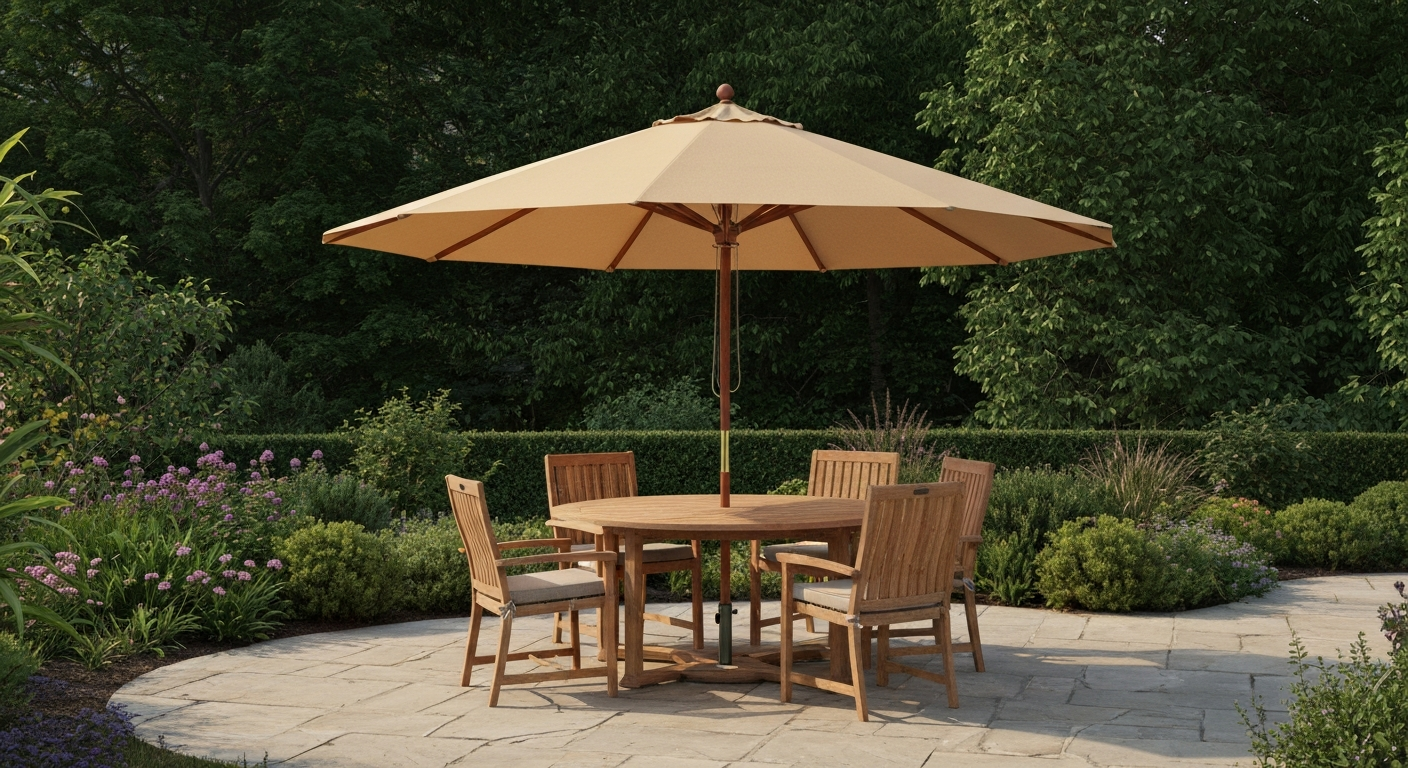
The center-pole market umbrella is the most common style: a straight pole through the middle of the canopy, dropped into a base or through a table hole. They're straightforward to set up, stable when properly weighted, and available in the widest range of canvas fabrics and colors. Standard sizes run 7.5 ft, 9 ft, and 11 ft in diameter. A 9-ft canopy covers a 4-person dining set comfortably; a 6-person or larger table benefits from 11 ft. The limitation is obvious: the center pole occupies the middle of your sitting area, which can be awkward for conversation or games unless the table has a center hole.
Cantilever (offset) umbrellas
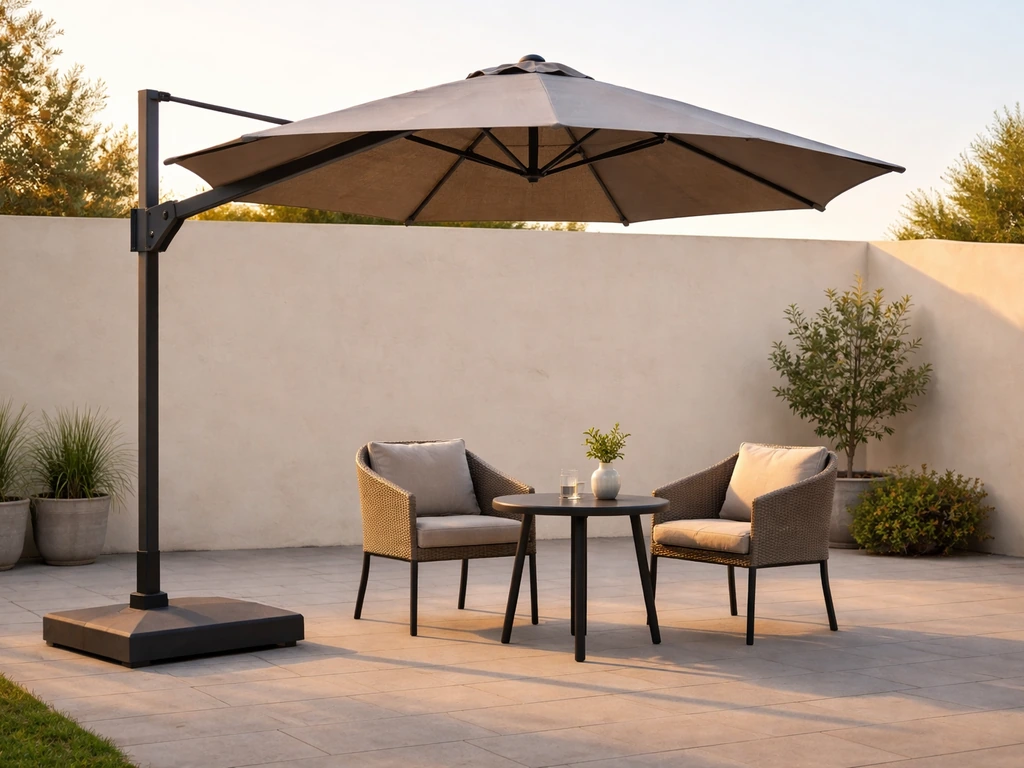
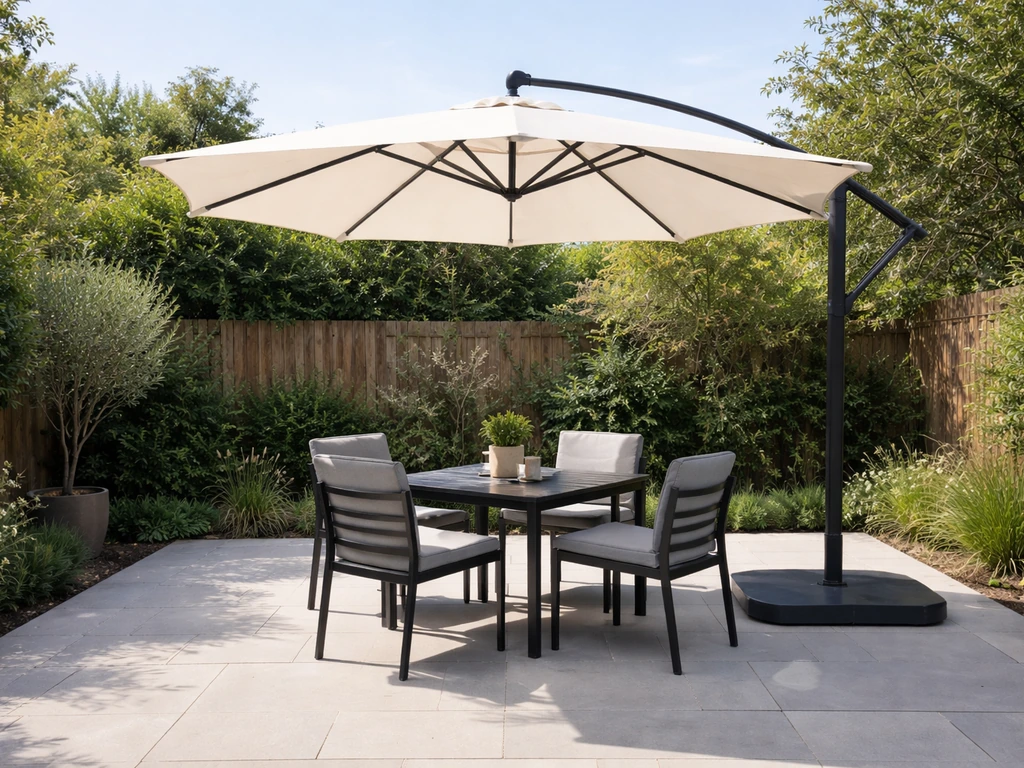
Cantilever umbrellas mount the canopy on a side arm extending from an offset base, keeping the seating area completely pole-free. For model recommendations and UK-specific base and wind guidance, see our guide to the best cantilever patio umbrella UK. They're ideal for sofas, chaise lounges, or any seating that doesn't have a center umbrella hole. The engineering trade-off is that the canopy and arm create significant leverage on the base, requiring much heavier ballast than a center-pole umbrella of the same size. See our guide to the best cantilever patio umbrella 2022 for vetted models, base recommendations, and real-world testing. Quality cantilevers use 360-degree rotation and multi-position tilt, so you can track the sun through the day. For large cantilever options, the topic of span and base requirements deserves its own focus, covered in the next section. See our guide to the best large cantilever patio umbrella for recommended models, base requirements, and side-by-side spec comparisons.
Extra-large umbrellas
Umbrellas 11 ft and larger are in a different performance tier. They provide commercial-grade shade coverage for big outdoor kitchens, large sectional sofas, or pool areas. At this size, wind loading on the canopy increases substantially, frame and rib specs matter more, and base weight requirements jump significantly. If you're shopping at this scale, comparing large canvas patio umbrella options side by side is essential before buying, since small spec differences (rib count, pole diameter, vent design) have real consequences at large diameters. For side-by-side comparisons and recommendations, see our roundup of the best large patio umbrellas to help you choose the right model for your space.
Choosing a canvas umbrella for large areas and large cantilevers
Going big with a canvas canopy means dealing with more wind load, more weight, and more leverage, particularly with cantilever designs. Here are the practical considerations that separate a good large-umbrella purchase from a frustrating one.
Span and coverage math
Canopy diameter and ground coverage aren't the same thing because the ribs angle outward from the pole top. A 10-ft canopy provides roughly 78 sq ft of ground coverage at full perpendicular shade; an 11-ft canopy covers about 95 sq ft. For a large cantilever that reaches 12–13 ft, you're covering approximately 113–133 sq ft. Plan your seating footprint first, then choose the canopy diameter that exceeds it by at least 12 inches on each exposed side.
Reinforcement at large spans
Large cantilever umbrellas should have secondary (inner) ribs that support the outer canopy panel, fiberglass outer ribs, and a cross-arm with a reinforced pivot joint. The arm connecting the canopy to the post takes enormous bending stress at large spans. Look for a center post diameter of at least 2 inches and an arm construction (often aluminum or steel) that specifies wall thickness rather than just material. A thin-walled aluminum arm on a 13-ft cantilever is a safety concern in gusts; a thick-walled unit will flex and recover.
Clearance and head height
Cantilever canopy clearance at its lowest tilt position should be at least 7 ft (2.1 m) above the deck surface for safe standing clearance. Some wide cantilevers drop below 6.5 ft when angled significantly, which becomes a hazard. Check the manufacturer's minimum clearance specification at maximum tilt before buying, especially for designs with crank-tilt mechanisms that allow steep angles. For large cantilever models specifically, comparing specs across options side by side (as covered in detailed large cantilever patio umbrella reviews) helps surface these differences clearly.
Mounting, base and anchoring options
The base is the component most buyers underestimate. An undersized base is how a $400 umbrella becomes a projectile in a moderate wind event. These are the realistic weight requirements, not the minimums that manufacturers print in optimistic marketing.
| Umbrella type / size | Minimum base weight (table mount) | Recommended freestanding base | In-ground / permanent option |
|---|---|---|---|
| 9 ft market umbrella (with table) | ~50 lb | 90 lb | Ground sleeve + concrete fill |
| 9–10 ft market umbrella (no table) | N/A | 90–100 lb | Ground sleeve + concrete fill |
| 11 ft market umbrella (freestanding) | N/A | 100+ lb | Ground sleeve + concrete fill |
| 10–11 ft cantilever offset | N/A | 150–200 lb | Concrete footing or weighted base system |
| 12–13 ft large cantilever | N/A | 200–250+ lb | Permanent concrete footing strongly recommended |
These numbers come from practical testing guidance, not minimum spec sheets. A 9-ft market umbrella used in a table with a pole-hole can get away with roughly 50 lb of ballast in the base because the table itself adds lateral stability. The same umbrella freestanding in open garden needs 90 lb or more. Cantilever umbrellas require dramatically more ballast because the side-offset canopy creates lever-arm forces on the base that a center-pole design does not. If you're mounting a large cantilever on a deck, verify the deck's structural load rating before committing to a 250 lb base sitting in one spot.
Base types compared
- Portable weighted bases (fill-yourself plastic or cast iron): Filled sand/water bases are convenient but often under-rated in capacity. Cast iron bases are more compact for equivalent weight. Good for flexibility and seasonal storage.
- Weighted plate systems (cantilever bases): Stackable concrete or cast-iron plates that bolt to a cantilever pole. Allow incremental weight adjustment. Practical and common for mid-size cantilevers.
- In-ground sleeves: Steel sleeve set in concrete allows the pole to be inserted and removed seasonally. Very stable for market umbrellas in high-wind areas. Requires permanent installation.
- Concrete footing: The most permanent and stable option for large cantilevers. The post is embedded in a concrete footing at the correct depth for soil type. Non-negotiable for 12 ft+ commercial-scale cantilevers in exposed locations.
- Table-mount: The umbrella pole passes through a center hole in a dining table and rests in a base beneath. Reduces freestanding base requirements significantly but limits pole angle.
Regional and climate considerations: UV, rain, wind and the UK
Where you live shapes almost every material and spec decision. A canvas umbrella that performs excellently in southern France or southern California faces different stresses than one used in coastal England or the Pacific Northwest.
High UV / hot, dry climates
In high-UV environments (southern US, Mediterranean, Australia), UPF 50+ certification is non-negotiable and UV-driven photo-oxidative degradation is the primary aging mechanism. Solution-dyed acrylic's intrinsic UV stability is a direct advantage here. Lighter colors reflect more heat but may show dirt faster; darker colors absorb more heat but provide better under-canopy shade quality. For Australian buyers, the AS/NZS 4399 standard uses the same 290–400 nm spectrophotometric methodology as EN 13758; UPF 50+ classification is consistent between the two, so fabric certifications transfer meaningfully across these markets.
Wet climates and the UK specifically
UK garden conditions differ from Mediterranean norms: UV intensity is lower, but rain frequency is high and mildew growth is a genuine concern from extended damp. Solution-dyed acrylic's inherent mildew resistance becomes more relevant here than its UV performance. Water resistance (DWR treatment quality and hydrostatic head) matters more than in dry climates, so prioritize canopy spec sheets that include ISO 811:2018 hydrostatic pressure data. Also notable for UK buyers: EN 13758-1/2 is the applicable UPF standard (adopted into UK standards post-Brexit via retained EN obligations), so EN-certified products are directly appropriate. Wind is another UK-specific consideration: average garden wind speeds in exposed UK locations can regularly hit 20–30 mph in autumn, which is above the operational rating of many standard market umbrellas. Specifying a double-vent canopy and a heavier-than-minimum base is practical advice for UK installations, particularly in coastal or elevated gardens.
Coastal and salt-air environments
Whether you're on the Cornish coast or the Gulf of Mexico, salt air accelerates corrosion at every metal joint and fastener. Marine-grade 316 stainless steel at hardware points is a meaningful upgrade over 304 stainless in chloride-rich environments. Aluminum poles with thick powder coats are generally acceptable; uncoated steel poles are not. Check the specific hardware specification (not just the pole material) before buying for coastal use, and plan to rinse the frame with fresh water after storm events.
Maintenance and keeping your canvas umbrella looking good
Canvas-style canopies are low maintenance, not zero maintenance. The difference between a canopy that looks great at year five and one that looks rough is mostly just following a consistent annual routine.
- Brush off loose dirt, pollen, and debris regularly (monthly during use season) with a soft-bristle brush before dirt becomes embedded in the weave.
- For routine cleaning, mix a small amount of mild liquid soap in lukewarm water and work it into the canopy with a soft brush, then rinse thoroughly. Allow the canopy to air-dry completely before closing — trapping moisture in a folded canopy is the primary cause of mildew.
- For mildew spots on Sunbrella or similar acrylics, use a diluted bleach solution (1 cup bleach + ¼ cup mild liquid soap per gallon of water). Apply, allow to soak briefly, scrub gently, and rinse completely. Unlike polyester, solution-dyed acrylic is bleach-tolerant without color damage.
- After deep cleaning, or when water stops beading on the fabric surface, apply a fluorocarbon-based fabric protector (such as Sunbrella Restore or equivalent 303 Fabric Guard) per the product instructions. This restores DWR performance.
- At the end of each season, clean the canopy, allow it to dry fully, then either store it loosely in a breathable bag or leave it on the frame with a vented canopy cover. Avoid sealed plastic bags, which trap moisture.
- Inspect all frame joints, locking mechanisms, and hardware annually. Tighten any loose bolts, lubricate crank and tilt mechanisms with a silicone spray (avoid petroleum lubricants that attract dirt), and replace worn rib tips before they damage the canopy fabric.
Price ranges and warranty: what to expect at each tier
Canvas-style umbrella pricing is honest once you understand what's driving the cost. Fabric quality, frame materials, and warranty backing are the three levers.
| Price tier | Typical price range (USD) | What you get | Warranty typical |
|---|---|---|---|
| Entry | $60–$150 | Polyester canopy, aluminum pole, basic tilt mechanism, minimal base included | 1 year or none |
| Mid-range | $150–$350 | Better polyester or entry acrylic canopy, fiberglass ribs possible, crank-and-tilt, decent hub | 1–3 years |
| Upper-mid | $350–$600 | Solution-dyed acrylic canopy (Sunbrella or comparable), aluminum or powder-coated steel frame, fiberglass ribs, double vent | 3–5 years frame; up to 5 years canopy |
| Premium | $600–$1,200+ | Certified Sunbrella or equivalent canopy, heavy-duty frame, marine hardware where applicable, full tilt/rotation on cantilevers | 5+ years frame; 5–10 years canopy (Sunbrella shade/marine fabrics up to 10 years) |
Sunbrella's shade and marine fabric warranty (up to 10 years on post-2008 collections, as published in their limited warranty documentation) is the industry benchmark for canopy longevity guarantees. When comparing umbrellas at the premium tier, ask explicitly whether the warranty covers the canopy fabric, the frame, or both, and what the claim process involves. A 10-year canopy warranty is only valuable if the manufacturer is still trading and honoring it; stick to established brands with documented warranty track records.
Buying checklist: what to confirm before you purchase
Run through this list before committing to any canvas umbrella. It catches the spec gaps that lead to buyer's remorse.
- Canopy fiber content: Is it solution-dyed acrylic, solution-dyed polyester, or standard piece-dyed polyester? Confirm on the spec sheet, not just the product title.
- Fabric weight: Is it documented in oz/yd² or g/m²? Target 8.8–9.3 oz/yd² (approximately 300 g/m²) for premium canvas-look quality.
- UPF rating: Is it UPF 50+, and is it certified by an accredited lab (Hohenstein, Intertek, SGS, Centexbel) against EN 13758 or AATCC TM-183?
- Water resistance: Does the listing reference hydrostatic head data (ISO 811:2018 or AATCC TM-127)? Is it water-resistant (DWR) or waterproof (coated/vinyl)?
- Rib material and count: Fiberglass ribs or aluminum? 8 ribs minimum for 9 ft+; secondary ribs for 11 ft+.
- Pole diameter: 1.5 in for standard 9 ft; 1.75–2 in for 11 ft and large cantilevers.
- Vent design: Single or double vent? Double is preferable for exposed locations.
- Hardware material: Standard powder-coated aluminum is fine for most; 316 stainless steel hardware for coastal installations.
- Base weight: Have you confirmed your base meets or exceeds the freestanding requirement for your umbrella type and size?
- Warranty terms: Does the warranty cover both canopy and frame? What is the duration and the claim process?
- Clearance (cantilevers only): What is the minimum canopy height at maximum tilt? Must be at least 7 ft for safe standing clearance.
A quick word on matching umbrella to intent
The right canvas umbrella looks completely different depending on what you're actually trying to do. For a standard patio dining table, a 9-ft market umbrella with a Sunbrella-grade canopy and a 90 lb freestanding base is the sweet spot of value and performance for most buyers. For a lounge area or a space without a table center hole, a mid-size cantilever (10–11 ft) with fiberglass ribs and at least 150 lb of ballast is the practical choice. For coverage of a genuinely large outdoor area, a big deck, a pool surround, or an outdoor kitchen, stepping up to a large cantilever or a large market umbrella (11 ft+) requires paying close attention to frame specs and base requirements, as the performance gap between adequate and inadequate becomes real at those sizes. Whatever style you choose, the canvas fabric tier you select sets the ceiling on how long it looks good, and solution-dyed acrylic is the tier that makes the investment worthwhile.
FAQ
What standards and lab tests are required to evaluate canvas patio‑umbrella fabric for UV protection?
Request spectrophotometric UPF test reports from accredited labs using regionally relevant methods: AATCC TM‑183 (commonly used in the U.S.), EN 13758‑1/2 (EU), and note AS/NZS 4399 mapping for Australia/New Zealand. Ask for reported UPF values across 290–400 nm, the test method used, test conditions, and any certification marks or lab accreditation (e.g., ISO/IEC 17025).
Which tests should be used to compare water resistance of canopy fabrics?
Request hydrostatic pressure (water‑penetration) test reports: ISO 811:2018 (international/EU/UK) and/or AATCC TM‑127 (U.S.). Ask labs to report hydrostatic head in mm (or cm) and test conditions so you can compare coating efficacy and seam performance between products.
How should colour‑fastness and fade resistance be validated?
Ask for accelerated lightfastness/xenon‑arc test data using ISO 105‑B02 or AATCC TM‑16.3 (xenon‑arc). Request reported results as blue‑wool equivalence or grey‑scale ratings and test hours. Where available, include real‑world outdoor exposure data from the vendor (location, years) or third‑party outdoor weathering tests.
What fabric chemistry and specification data must be collected for accurate comparisons?
Collect manufacturer technical sheets listing: fiber type (solution‑dyed acrylic, solution‑dyed polyester, olefin, coated PVC, cotton canvas), dye method (solution/yarn/piece), fabric weight (oz/yd² and g/m²), weave type, DWR/mildew treatments, stated UPF and hydrostatic numbers, and recommended cleaning/retreatment procedures. For solution‑dyed acrylics (e.g., Sunbrella) request sample cards showing typical weights (~8.8–9.3 oz/yd²).
What frame, hardware and corrosion‑resistance data are needed—especially for coastal regions?
Collect materials and finish specs for poles, ribs, fittings, and fasteners: aluminum grade and alloy, coatings/paints, and stainless‑steel grade (specifically 316 vs 304). For coastal/salt‑air use prioritize marine‑grade 316 stainless hardware or properly coated aluminum with manufacturer corrosion warranties. Ask suppliers for corrosion‑resistance test data if available.
Which authoritative test labs and certifiers should you contact for independent verification?
Use accredited textile/testing labs such as Hohenstein, Centexbel, Intertek, SGS, or other ISO/IEC 17025 labs for UPF, hydrostatic head, and xenon weathering reports. Request full test reports (not just summary claims) tied to SKU/sample IDs and dates of testing.