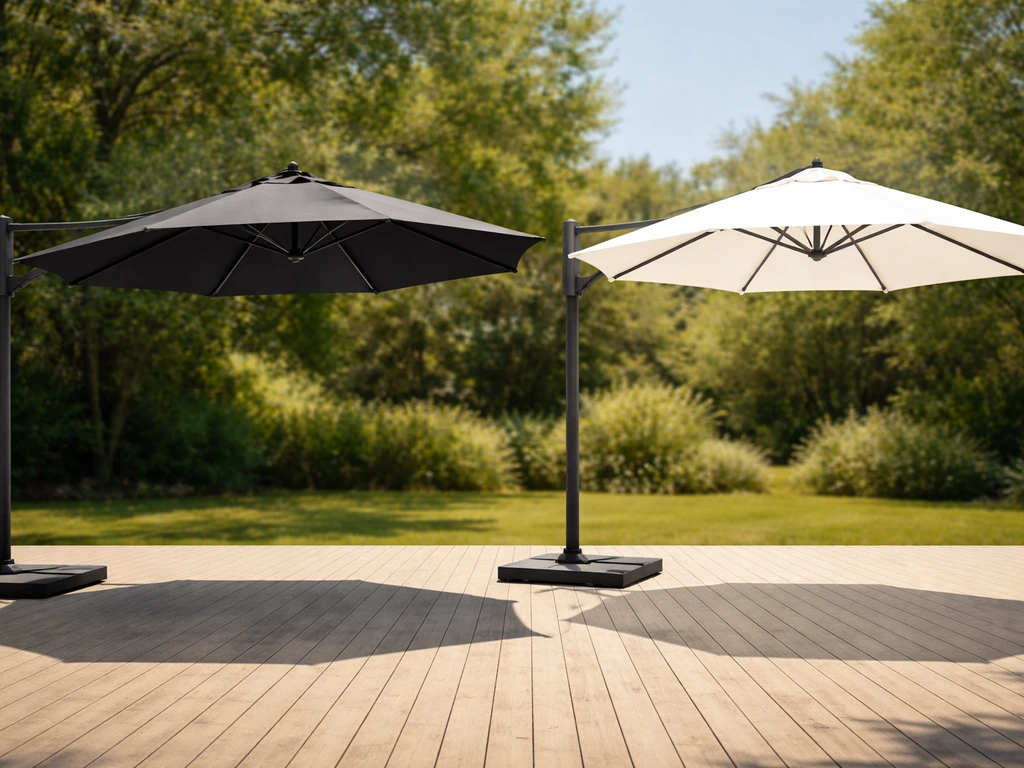
Yes, black patio umbrellas do attract more heat than lighter-colored ones. A black canopy fabric absorbs roughly 86% of incoming solar energy compared to as little as 4–15% for a white or light-colored canopy. That means the black fabric itself gets significantly hotter in direct sun. However, and this is the part most people miss: the shade underneath a black umbrella is not dramatically hotter than the shade under a white one, provided the umbrella is blocking direct sun from reaching you. Most of your outdoor comfort comes from blocking solar radiation, not from what color the canopy happens to be. That said, color and fabric choice still matter, and this article breaks down exactly when they matter and how to choose wisely. See the dedicated section 'does a black patio umbrella make it hotter' for a concise summary and practical tips.
Do Black Patio Umbrellas Attract Heat? Evidence & Buying Guide

Who this is for and what you'll get
If you're shopping for a patio umbrella and wondering whether that sleek black canopy is going to turn your outdoor dining space into a convection oven, this article is for you. It's also for anyone who wants the real story behind UV ratings, reflective coatings, and fabric specs, without wading through marketing copy. By the end, you'll understand the physics in plain terms, know which fabric and design features genuinely reduce heat, and have a checklist you can take straight into your buying decision. Along the way, I'll cover questions that come up naturally alongside this one: whether patio umbrellas are waterproof, how beach use works, and which features actually deliver the best UV protection.
The physics: why dark colors absorb more heat
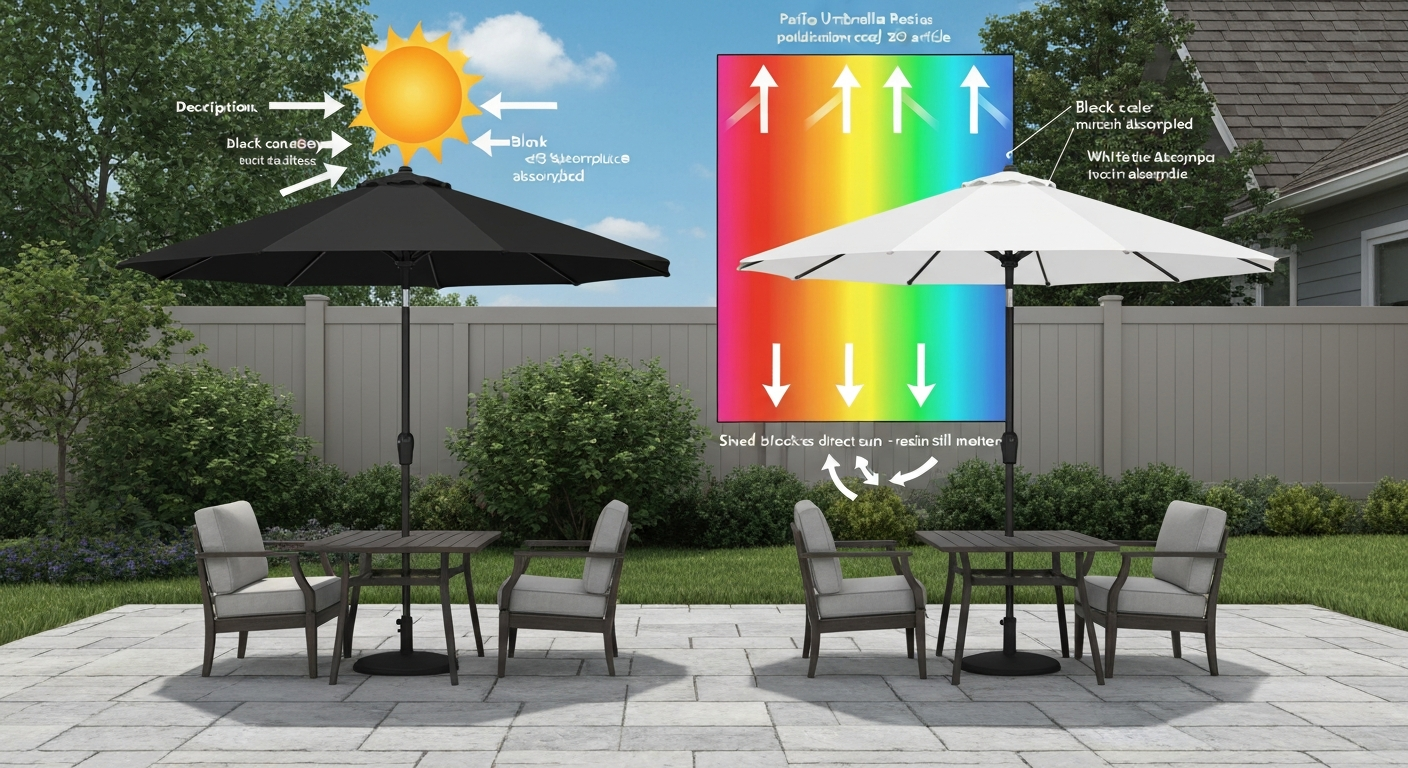
Every material has a solar absorptance value, which tells you what fraction of incoming sunlight it converts to heat. A material with high absorptance soaks up most of the solar energy hitting it; one with high reflectance bounces most of it away. This reflectance property is called albedo. A black canopy fabric measured in peer-reviewed outdoor studies showed a hemispherical solar reflectance of roughly 14%, meaning it absorbs about 86% of the solar energy that hits it. A high-quality white or light-coated fabric can reflect 82–85% of that same solar energy, absorbing only 15–18%. The difference in surface temperature this creates is substantial: laboratory-engineered textiles optimized for cooling showed surface temperature differences exceeding 13°C between a high-reflectance cooling side and a high-absorptance dark side under roughly 1,100 W/m² of solar flux.
There's a second property worth knowing: emissivity. This is how efficiently a material radiates the heat it has absorbed as infrared (long-wave) radiation. Most textile fabrics have high emissivity in the atmospheric window (8–13 µm), typically around 0.86–0.95. High emissivity means the heated canopy is actively radiating that absorbed energy outward in all directions, including downward toward the people sitting underneath it. So a black canopy that runs hot does emit more long-wave infrared radiation toward you than a cooler white one, even if the shade underneath both umbrellas blocks most of the direct sun. That radiated heat is real, and it matters more the closer you are to the canopy surface.
Does a hot canopy actually make the shade hotter?
This is the crux of the question, and the answer is nuanced. Field measurements of parasols and patio umbrellas consistently show that the dominant driver of outdoor heat comfort is mean radiant temperature (MRT), not ambient air temperature. One synthesis of urban shade research found that air temperature under different shade types changed very little, while the difference in MRT across shade conditions spanned roughly 50°C. Umbrella shade drastically cuts the direct shortwave solar radiation reaching you, which is the biggest single factor in how hot you feel outdoors. A white parasol in one field study reduced MRT by approximately 18.3°C and UTCI (a standard heat-stress index) by about 3.7°C compared to no shade. A UV-rated parasol in a hot, humid Japanese study reduced UTCI by 4.4°C and WBGT (wet-bulb globe temperature) by 1.3°C.
So the practical takeaway is this: a black umbrella in good shade position, fully blocking direct sun from reaching you, will feel noticeably cooler than sitting in open sun. The difference between a black and a white umbrella is real but secondary to whether the umbrella is shading you at all. Where the color difference becomes more relevant is in situations where the canopy is low, you're close to it, the day is very hot, or you're sitting under it for extended periods. In those cases, a black canopy running 10–13°C hotter than a white one will radiate measurably more heat downward. You won't boil, but you'll feel it.
Fabric, weave, and lining: what actually keeps you cooler
Canopy color is only one part of the thermal equation. Fabric type, weave density, and whether the canopy has a reflective or light-colored lining all affect how much heat passes through or gets reradiated downward. Here's how the main options compare:
| Fabric Type | Solar Reflectance (approx.) | UV Blocking | Heat Performance | Durability |
|---|---|---|---|---|
| Solution-dyed acrylic (e.g., Sunbrella) | Moderate (varies by color) | High with tight weave | Good; resists fading, maintains properties | Excellent; 5–10 year lifespan common |
| Coated polyester (white/light) | Up to 82–85% | High (>99% with coating) | Very good; low absorptance | Good; coating can degrade over 3–5 years |
| Dark/black solution-dyed acrylic | Low (~10–20%) | High (weave-dependent) | Warmer canopy surface; more radiant heat downward | Excellent; dye is colorfast |
| Olefin (polypropylene) | Moderate | Moderate | Decent; lower cost but fades faster | Fair; less UV stable than acrylic |
| Polyester (uncoated) | Low to moderate | Low without treatment | Poor; fades, loses UV performance quickly | Poor to fair |
| Canvas (cotton blend) | Low | Low | Absorbs moisture and heat; heavy when wet | Fair; not ideal for prolonged sun exposure |
A light-colored or silver lining on the underside of a canopy is one of the most effective practical upgrades you can make. It reflects heat and diffuse radiation back upward rather than emitting it downward toward occupants. If you're committed to a black canopy for aesthetic reasons, actively look for models that specify a light or reflective inner lining. The weave density matters too: a tighter weave blocks more UV and more solar energy from transmitting through to the shaded area, regardless of color. Open-weave or mesh fabrics let more light through, which improves airflow but reduces UV and solar protection.
UV coatings, reflective treatments, and UPF ratings
UPF stands for Ultraviolet Protection Factor, and it works like SPF for clothing and fabrics. UPF 50+ is the top rating and means the fabric blocks more than 98% of UV radiation from passing through. Testing is done under standards including AATCC TM183 and AS/NZS 4399, and some manufacturers also cite ASTM D6544. See the SGS bulletin summarizing UPF test standards (AS/NZS 4399, AATCC TM183) and related procedures such as ASTM D6544, and explaining UPF categories including UPF 50+ SGS bulletin — UPF test standards (AS/NZS 4399, AATCC 183, ASTM D6544) and UPF categories. When you see a UPF claim on an umbrella, those are the methods behind it. The critical thing to understand is that UPF measures transmission through the fabric, not reflection off it. A black fabric can have a very high UPF rating (little UV passes through) while still having low solar reflectance (it absorbs rather than reflects). Both matter, just for different reasons: UPF protects you from UV passing through; solar reflectance keeps the canopy itself cooler.
Reflective coatings and additives like titanium dioxide (TiO2) particles substantially raise solar reflectance on coated textiles. Spectral laboratory methods typically measure solar‑band reflectance/transmittance with a UV‑Vis‑NIR spectrophotometer (e.g., PerkinElmer Lambda series) and mid‑IR emissivity with FTIR, adjusting results to the ASTM G173‑03 solar spectrum per ASTM E903 recommendations. Technical data sheets for high-performance shade fabrics show what's possible at the top end: one example specifies solar reflectance of 85%, solar transmittance of only 4%, UV blocking exceeding 99%, and atmospheric-window emissivity at or above 90%. Compare that to a standard translucent architectural fabric (like Serge Ferrari Soltis 402) which lists solar reflectance of 50% and solar transmittance of 36%. For most residential patio umbrellas, you won't see those spec sheets, but asking for UPF 50+ rated fabric with a light or coated inner lining gets you meaningfully closer to that performance.
One honest caveat: coatings degrade. UV absorbers and reflective treatments applied to polyester can break down with prolonged sun exposure, moisture, and cleaning. Accelerated weathering tests (xenon-arc exposure, ISO 105, AATCC protocols) are how manufacturers estimate longevity, but real-world performance depends on how much direct sun your umbrella sees daily, how you store it, and how you clean it. Solution-dyed acrylic fabrics like Sunbrella hold their optical and UV properties better over time because the color is built into the fiber, not coated on top.
Venting, canopy shape, and airflow design
A vented canopy is one of the most overlooked features for comfort, and it matters for two separate reasons. First, a single or double vent at the top of the canopy lets trapped hot air escape upward rather than pooling beneath the umbrella. Second, venting significantly improves wind stability by reducing the pressure differential across the canopy in gusts. Most quality market umbrellas now include at least one vent tier; double-vented designs work better in both respects.
Canopy shape also plays a role. A flatter canopy sits closer to the occupants, which means more radiant heat from a hot canopy surface reaches them directly. A dome or scalloped edge design creates more separation and allows more air circulation around the perimeter. Cantilever (offset) umbrellas often perform well thermally because their canopy tilts and positions independently, letting you maximize shade coverage while the structure stays clear of the seating area. Larger canopy diameters (10–13 feet) shade a bigger ground area but can trap more stagnant hot air without adequate venting.
Waterproofing and durability: what to actually expect
Most patio umbrella canopies marketed as waterproof are more accurately described as water-resistant. The fabric itself may repel light rain, but the seams, grommets, and rivet points are rarely sealed to a true waterproof standard. Solution-dyed acrylic fabrics are inherently water-resistant (the fiber doesn't absorb moisture easily), but they are not impermeable. Coated polyester canopies can be more waterproof at the fabric level, but the coating is the weak point over time. For real weather events, closing and storing your umbrella is always the right answer regardless of what the marketing says about water resistance.
Frame material durability follows a clear hierarchy: powder-coated aluminum resists rust and is lightweight; stainless steel is more durable but heavier and more expensive; fiberglass ribs flex in wind rather than snapping (useful in exposed locations); wooden frames (teak, eucalyptus) look beautiful but require annual oiling and are more vulnerable to cracking in freeze-thaw conditions. For longevity across all frame types, the single most effective thing you can do is close the umbrella when it's not in use, particularly in wind. An open umbrella in a strong gust is the fastest route to a broken rib regardless of frame quality.
Using a patio umbrella at the beach
You can use a patio umbrella at the beach, but it requires more thought than just carrying one down to the sand. For detailed guidance on 'can you use a patio umbrella at the beach', including anchoring methods and suitable umbrella designs, see the beach-specific section. Standard patio umbrellas are designed for table poles or heavy freestanding bases on a hard patio surface. Sand provides almost no lateral support for a standard pole without a dedicated beach anchor. A 9-foot patio umbrella catching a sea breeze with a poorly anchored base can become a sail, and a flying umbrella is genuinely dangerous to people nearby.
If you want to use a patio-style umbrella at the beach, you have practical options. A sand anchor (a screw-type auger driven 18–24 inches into wet sand) can hold a pole umbrella reasonably securely in moderate wind. Dedicated beach umbrella designs typically have a pointed or auger-style base built in and are made with lighter frames specifically for portability. For casual beach use, a purpose-built beach umbrella in the 7–8 foot range is almost always a better tool. For serious shade coverage on a private beach or rented beach property with a solid surface nearby, a cantilever with a weighted base is viable. Key specs to prioritize for beach use: a vented canopy (wind resistance), fiberglass or aluminum ribs (flexibility and rust resistance from salt air), and a tilt function (sun angle changes fast near the water).
- Use a screw-type sand anchor for pole umbrellas; never leave an unsecured umbrella unattended in wind
- Close the umbrella when you leave or when gusts pick up, even briefly
- Rinse the frame and canopy with fresh water after beach use to remove salt
- Look for corrosion-resistant hardware: stainless steel or marine-grade aluminum for the hub and ribs
- A 7.5–9 ft canopy is more portable and manageable at the beach than a 11–13 ft patio umbrella
Which umbrellas offer the best UV protection
For maximum UV protection, the features that matter most are UPF rating, canopy coverage area, canopy tilt or adjustability, and how well the canopy blocks diffuse (reflected) UV as well as direct UV. Umbrellas can block roughly 94% of UV radiation in direct overhead shade, which is excellent. But UV also reaches you from scattered sky radiation and from reflection off light surfaces like concrete, sand, or water. A tiltable canopy that you can angle to follow the sun, combined with side panels or a deep canopy with low hanging edges, gives more complete protection than a flat canopy directly overhead.
When comparing UV protection features, prioritize these in order: UPF 50+ rated fabric, tight weave construction, canopy diameter appropriate to your space (bigger coverage means more protection at the edges), a tilt mechanism for adjusting to low sun angles, and a light or reflective inner lining to reduce diffuse UV bouncing around beneath the canopy. Color alone does not determine UV protection well: a black tight-weave fabric with UPF 50+ blocks more UV than a loosely woven white fabric. But a white, coated fabric with UPF 50+ will also keep the canopy surface cooler, giving you both benefits. For model recommendations and a short buying guide, see our roundup of the best UV protection patio umbrella options and what to look for.
Style vs. thermal performance: honest trade-offs
Black and dark-colored umbrellas look sharp. They're popular for good reason: they feel modern, hide dirt and staining better than white canopies, and complement contemporary outdoor furniture. The trade-off is real but manageable. A black canopy will run 10–13°C hotter at the fabric surface on a hot sunny day than an equivalent white canopy. If you're sitting close to the canopy (low cantilever over a daybed, for example), you'll feel more radiant heat from a black canopy. If the umbrella is positioned high over a dining table and the canopy has a vent and a light inner lining, the practical comfort difference between black and white shrinks considerably.
| Priority | Best Color Choice | Best Fabric | Notes |
|---|---|---|---|
| Coolest shade temperature | White or light grey | Coated polyester or white solution-dyed acrylic | Prioritize solar reflectance and light inner lining |
| Maximum UV protection | Any tight-weave UPF 50+ | Solution-dyed acrylic or coated polyester | Color matters less than weave density and UPF rating |
| Aesthetics / dark finish | Black, navy, charcoal | Solution-dyed acrylic | Add a vented canopy and light lining to offset heat |
| Beach / portable use | Light colors preferred | Solution-dyed acrylic (lightweight) | Prioritize salt resistance and wind-handling design |
| Year-round durability | Any | Solution-dyed acrylic | Colorfast, UV-stable, water-resistant without coatings |
Practical steps to reduce heat under any umbrella
Regardless of what color umbrella you own or buy, these adjustments make a measurable difference in comfort:
- Position the umbrella to block the sun at its hottest angle (typically 10 a.m. to 4 p.m. in summer); use the tilt function to track the sun rather than relying on overhead shade alone
- Choose a vented canopy design to allow hot air to escape upward rather than building up beneath
- Add a portable misting fan or evaporative cooler near the seating area; cooling from air movement and evaporation complements shade significantly
- Use a light-colored or reflective surface underneath (light-colored pavers, a light rug) rather than dark concrete or dark decking that absorbs and re-radiates heat upward
- If using a dark canopy, look for one with a light or silver-coated lining on the underside; this single feature reduces downward radiant heat more than any other accessory
- Raise the canopy height slightly if your setup allows; more air gap between canopy and occupants reduces the radiant heat transfer
- Plant or position low screening vegetation on the sun's approach side to reduce ground-level reflected UV and thermal radiation reaching your seating area
Buying guidance by priority
Here's how I'd think about the buying checklist depending on what you care about most. For each priority, the must-have features are different, though some overlap.
For the coolest possible shade
- White or light grey canopy in solution-dyed acrylic or coated polyester with high solar reflectance (look for specs near 80–85% if available)
- Double-vented canopy design to allow hot air escape
- Light or reflective inner lining on the canopy underside
- Large canopy diameter (11–13 ft for a table setup) to maximize shade coverage and keep canopy edges farther from occupants
- Tilt mechanism to follow the sun and maintain full shading throughout the day
- Powder-coated aluminum or fiberglass ribs for a lightweight frame that doesn't conduct heat down the pole
For maximum UV safety
- UPF 50+ rated fabric confirmed by AATCC TM183 or AS/NZS 4399 testing
- Tight weave construction: lower solar transmittance means less UV reaching occupants
- Canopy tilt and preferably a telescoping height adjustment to angle toward the sun
- Deeper canopy with lower-hanging edges or optional side panels for blocking low-angle sun and reflected UV (from water, sand, or light pavers)
- UPF 50+ is achievable in dark colors with tight weave; pair it with a light lining for cooler comfort
For aesthetics with dark or black canopy
- Solution-dyed acrylic in black or charcoal for colorfastness and long-term UV stability without coating degradation
- Single or double vent to manage hot air buildup
- Light inner lining is the most important thermal mitigation feature for a dark canopy
- Position the umbrella higher than standard if possible; 8–9 ft pole height puts the hot canopy surface farther from occupants
- Pair with a misting fan or keep air moving at seating level to offset radiant heat from the canopy
For base and stability requirements
- In-ground or table-mount setups: match pole diameter exactly; most residential market umbrellas use 1.5–2 inch diameter poles
- Freestanding base weight: a 9 ft umbrella typically needs a minimum 50 lb base; 11 ft canopies benefit from 75–100 lb bases, especially in any exposed location
- Cantilever umbrellas need significantly heavier or anchored bases; 150–200 lb filled bases are common for 10–13 ft offset canopies
- Beach use: use a dedicated sand screw anchor; don't rely on a standard patio base in sand
Quick decision checklist for shoppers
| Feature | Minimum to look for | Better spec | Why it matters |
|---|---|---|---|
| Fabric type | Polyester with UV treatment | Solution-dyed acrylic (e.g., Sunbrella) | Durability, UV stability, color retention |
| UPF rating | UPF 30 | UPF 50+ | Blocks 98%+ of UV through fabric |
| Canopy color (thermal) | Light colors preferred for heat | White with reflective lining | Lower canopy temp, less radiant heat downward |
| Venting | Single vent | Double vent | Reduces trapped heat, improves wind stability |
| Canopy size | 9 ft for 4-person table | 11–13 ft for larger seating groups | More coverage = more UV and solar protection |
| Tilt mechanism | Manual push-button tilt | Auto-tilt or multi-position tilt | Follow sun angle through the day |
| Frame material | Powder-coated steel | Powder-coated aluminum or fiberglass ribs | Weight, rust resistance, flexibility in wind |
| Base weight (freestanding) | 50 lb for 9 ft canopy | 75–100 lb for 11 ft+ | Stability in wind |
| Waterproofing | Water-resistant canopy fabric | Sealed seams plus water-resistant fabric | Protects in light rain; close in heavy rain regardless |
| Beach use suitability | Avoid standard patio bases in sand | Sand screw anchor or purpose-built beach model | Safety in exposed, windy beach conditions |
Maintenance tips to protect your investment
A good umbrella can last 7–10 years if you treat it right. The coatings, dyes, and water-resistant treatments that give it UV protection and heat performance are the first things to degrade with neglect. Here's what actually extends lifespan:
- Close the umbrella when it's not in use or when winds exceed about 20–25 mph; this is the single biggest factor in frame longevity
- Use a canopy cover or storage bag during the off-season; UV exposure degrades fabric even when the umbrella isn't open and in use
- Clean the canopy with mild soap and lukewarm water; avoid bleach on solution-dyed acrylic fabrics as it can degrade the fiber's UV stability over time. Bleach at low dilution is sometimes acceptable for mildew on certain synthetic fabrics, check your manufacturer's care guide
- Rinse thoroughly after cleaning; soap residue can attract dirt and break down water-resistant finishes
- After beach or coastal use, rinse the entire umbrella including all metal hardware with fresh water to remove salt, which accelerates corrosion on even powder-coated frames
- Inspect ribs and hub joints at the start of each season; a loose rib puts mechanical stress on others and a small crack in a fiberglass rib should be replaced before it fails mid-use
- Re-treat the canopy fabric with a spray-on water repellent (such as Scotchgard Outdoor) every 1–2 seasons if you notice water soaking in rather than beading; this restores the surface treatment without replacing the canopy
- Store wooden frame umbrellas indoors or under cover in winter; apply teak oil or appropriate wood treatment annually to prevent cracking and moisture damage
FAQ
Do black patio umbrellas attract more heat than lighter colors?
Yes. Dark canopies (including black) absorb a much larger fraction of incoming solar radiation than light or specially treated ‘cool’ fabrics. That higher solar absorptance raises the canopy surface temperature, so a black umbrella will generally get hotter in sun than a white or high‑reflectance umbrella.
If the canopy surface is hotter, does that make the shaded area noticeably hotter for people underneath?
It can, but the effect is primarily radiative. Shade reduces direct sun and thus lowers mean radiant temperature (MRT) a lot, which provides most of the cooling benefit. A hotter black canopy emits more long‑wave infrared back toward people beneath it, so the net comfort under a black umbrella will usually be slightly warmer than under a light or high‑reflectance umbrella — however, shade still delivers large comfort gains versus direct sun.
How big are the real‑world differences in comfort between black and light umbrellas?
Field studies show umbrellas reduce heat stress indices (WBGT/UTCI) by amounts typically in the 1–4°C range; well‑reflective/white canopies give the largest MRT reductions. Laboratory and field comparisons have produced canopy surface temperature differences of many degrees Celsius (e.g., >10°C in some tests), which can translate to modest but noticeable differences in perceived warmth under the canopy.
Does umbrella color change UV protection (UPF)?
Color matters for UV in combination with fabric construction and treatments. A darker, tightly woven fabric will often block more UV than a loose weave white fabric, but many white or light patio textiles are treated or coated to achieve high UPF (e.g., UPF 50+). So UPF depends primarily on weave density, fiber treatment/coatings and certified test results rather than color alone.
What fabric properties besides color control heat and UV blocking?
Key properties are solar reflectance (how much sunlight is reflected vs absorbed), infrared emissivity (how much thermal IR the fabric emits), weave density (affects transmittance), fabric thickness/layering, and surface coatings or backings (metalized films, reflective pigments, UV absorbers). Venting and canopy geometry also change airflows and radiative exchange under the umbrella.
What are ‘cool’ or reflective umbrella fabrics and do they work?
Cool fabrics use optical/design strategies or reflective coatings to increase solar reflectance (often >80–90% on a reflecting side) while maintaining desired color or aesthetic. In tests, engineered cool textiles have produced large daytime surface temperature reductions (often >10°C) and appreciable improvements in shaded comfort compared with untreated dark fabrics. They are effective when properly specified.