For most backyard setups, aluminum wins on price and weight, but fiberglass wins on wind resistance and long-term durability. If you live somewhere with regular afternoon gusts, near the coast, or you want a large cantilever umbrella that will hold up for years without babying, fiberglass ribs are worth the extra cost. If you want something light, easy to move, and you're not in a punishing environment, a well-made aluminum frame will do the job just fine.
Fiberglass vs Aluminum Patio Umbrella: Buyer's Guide

Kent Lang
15 Jul 2026
Fiberglass vs aluminum at a glance
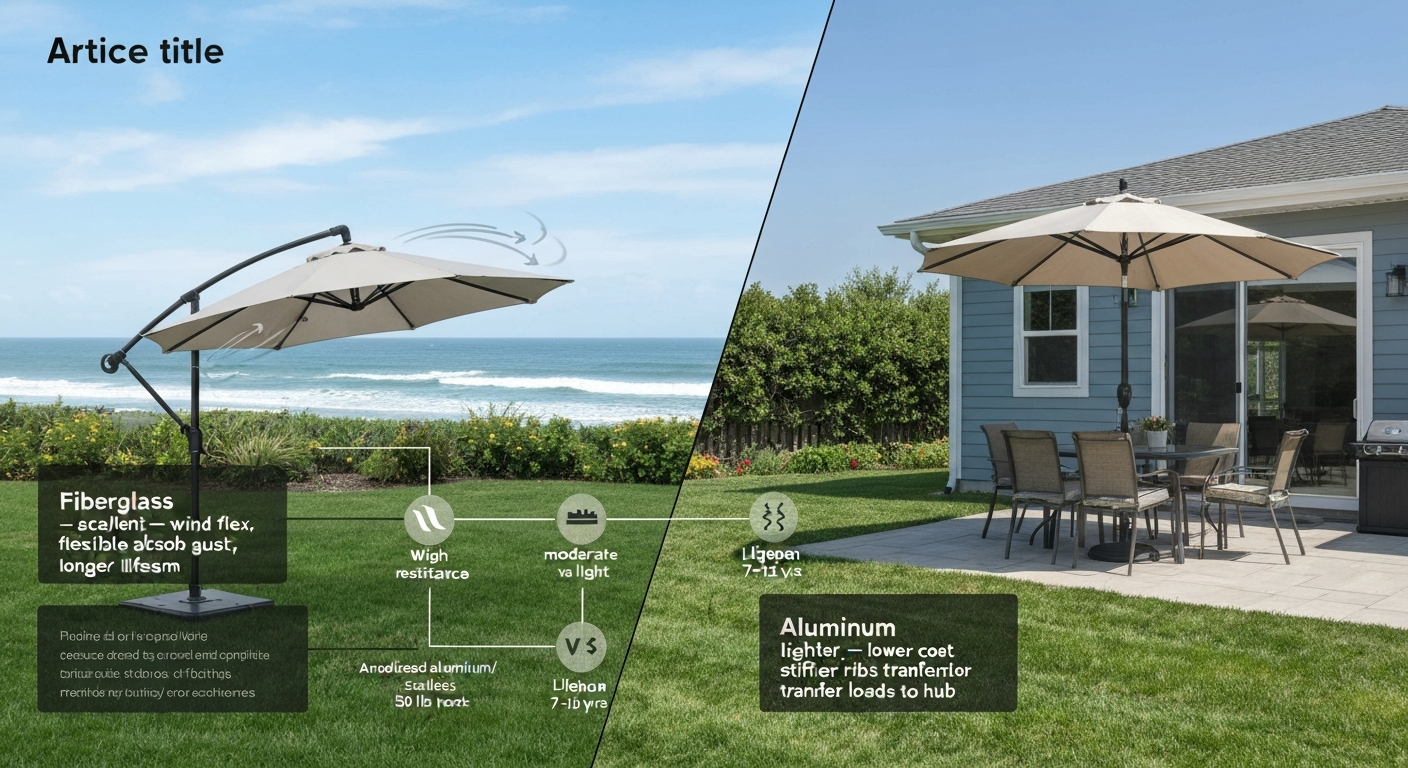
Both materials are widely used in quality patio umbrellas, and both can last for years when properly maintained. The real differences show up in how each material handles wind loads, how much the assembled umbrella weighs, and how they hold up in salt air or high humidity over time. Fiberglass ribs flex under gusts and spring back, which protects the hubs and pole from peak stress. Aluminum ribs are stiffer and transfer more of that load directly to the hardware, which is fine until it isn't. Aluminum poles tend to be lighter than fiberglass poles of comparable diameter, which affects portability but also base requirements. Cost-wise, fiberglass components typically add 20 to 50 percent to the price of a comparable aluminum-frame umbrella in the same size range.
Quick picks for common situations
- Windy coastal yard or open patio: fiberglass ribs, anodized aluminum or stainless hardware, minimum 50 lb base per foot of umbrella diameter
- Occasional shade on a calm suburban deck: aluminum frame with powder-coat finish, standard weighted base (50–75 lb for a 9 ft market umbrella)
- Large cantilever (offset) umbrella that stays put all season: fiberglass ribs, heavy-duty pole, 200 lb+ freestanding base
- Rental or event use where umbrellas move constantly: aluminum frame for its lighter weight and easier transport
- Budget-conscious first umbrella in a mild climate: aluminum frame, look for 1.5-inch pole diameter or larger and anodized finish
Side-by-side comparison
| Factor | Fiberglass | Aluminum |
|---|---|---|
| Wind resistance | Excellent — ribs flex up to ~50 mph in tested models, absorbing gust energy | Good — stiffer ribs transfer load to hubs; more prone to bending or unseating under sudden gusts |
| Weight (ribs + pole) | Ribs are light; fiberglass poles heavier than aluminum of same diameter | Lighter overall; aluminum density ~2.70 g/cm³ makes for easy one-person moves |
| Corrosion resistance | Excellent — fiberglass is inert; hardware corrosion depends on fastener/hub material | Good with anodizing or quality powder coat; bare aluminum oxidizes but resists salt air reasonably well when sealed |
| Expected lifespan | 10–15+ years with normal care; ribs resist UV degradation well | 7–12 years typical; coating integrity is the limiting factor in coastal or humid climates |
| Cost (relative) | Higher — typically 20–50% more than comparable aluminum frame | Lower upfront; good value in mild climates |
| Repairability | Good — fiberglass-rib models often sell replacement ribs and hubs as spare parts | Varies — quality brands offer parts; budget stamped-aluminum frames are often non-serviceable |
| Canopy fabric compatibility | Compatible with all common fabrics (polyester, olefin, solution-dyed acrylic) | Compatible with all common fabrics; heavier pole may affect certain snap-on canopy fittings |
| Best style match | Cantilever/offset, large market umbrellas, exposed/windy sites | Market umbrellas, portable setups, covered patios, budget builds |
How the frames are actually built
Most patio umbrellas in the 9 to 13 foot range use 8 to 12 ribs radiating from a central hub, which connects to the lift mechanism on the pole. The ribs are where material choice matters most, because they take the most bending stress during wind events. Fiberglass ribs are almost always pultruded, meaning continuous glass fibers run lengthwise through the rod or profile inside a cured resin matrix. That process gives pultruded fiberglass a high axial tensile strength (typically 250 to 700+ MPa depending on fiber volume and resin) and a flexural modulus of around 20 to 40 GPa. Unicomposite, Pultruded fiberglass rods: properties & applications summarizes supplier and literature ranges for E‑glass pultruded profiles, noting axial tensile strengths of roughly 250–700+ MPa and longitudinal flexural modulus around 20–40 GPa Unicomposite — Pultruded fiberglass rods: properties & applications. For comparison, 6061-T6 aluminum, the alloy commonly used in structural tubing, has a modulus of elasticity around 69 GPa. That stiffer modulus is not an advantage here. It means aluminum ribs resist bending but don't give when the wind hits, which sends that force straight into the hub joint and pole.
Aluminum poles are typically extruded from 6063 alloy, which extrudes and finishes beautifully for anodizing or powder coating but is slightly lower in strength than 6061. The pole wall thickness and diameter matter more than the alloy grade for everyday use. A 1.5-inch diameter pole is the entry-level standard for market umbrellas; commercial-grade and large-format cantilever models step up to 1.75-inch or 2-inch poles. Fiberglass poles, where used, tend to be larger in diameter to achieve similar stiffness because their modulus is lower than aluminum. Hubs are typically molded nylon or die-cast metal with rivet or bolt fasteners. On better fiberglass-rib umbrellas, the hubs are engineered to allow some rotational flex at the rib joint, which helps the whole system work together under a gust rather than concentrating stress at a single fastener.
Wind resistance: why flex is actually a good thing
This is where fiberglass earns its premium price. When a gust hits an open umbrella canopy, the load spikes fast and then drops. Aluminum ribs are stiff, so that spike goes directly into the hub and the pole-to-rib connection. If the load is high enough, aluminum ribs bend plastically (they don't spring back) or the hub hardware lets go. Fiberglass ribs do something smarter: they store that energy as elastic strain and release it when the gust passes, returning to their original shape. Brands like FiberBuilt publish wind-test figures as high as 50 mph for specific fiberglass-rib models. That said, most manufacturers, including those with fiberglass frames, recommend closing umbrellas when sustained winds approach 20 mph. Wind damage is excluded from virtually all frame warranties, so the flexibility advantage is about surviving occasional surprise gusts, not about leaving your umbrella open in a storm.
There's a nuance worth noting on the fatigue side. Repeated bending cycles, especially out-of-plane flex at the hub joint, can cause matrix cracking in pultruded fiberglass over time. This is a real failure mode but it's mostly a concern on lower-quality ribs with poorly designed hub connections. Well-made commercial fiberglass-rib umbrellas account for this in their joint design. The practical takeaway: fiberglass ribs from a reputable manufacturer handle wind better than aluminum ribs of comparable size, but you should still inspect rib-to-hub connections periodically and avoid leaving large umbrellas open in sustained winds regardless of material.
Weight, portability, and what that means for your base
Aluminum is genuinely lighter. Aluminum's density is about 2.70 g/cm³, and its excellent strength-to-weight ratio is why it's used in aerospace and outdoor furniture alike. A standard 9-foot aluminum market umbrella typically weighs 10 to 18 pounds for the frame assembly. A fiberglass-rib model of similar size usually lands in the same range for the ribs but can be heavier overall if the pole is also fiberglass. If you need to move your umbrella regularly, store it seasonally, or carry it to different spots on a large patio, aluminum's weight advantage is real and practical.
Where things flip is the base calculation. An umbrella's weight doesn't keep it stable; a properly weighted base does. Umbrella manufacturers specify minimum base weights by model and size, and those numbers are worth taking seriously. Treasure Garden, for example, lists a 200 lb minimum base weight for their 11-foot cantilever models. A general rule of thumb is 50 lb of base weight per foot of umbrella diameter, though cantilever designs need significantly more because the pole is offset and the leverage arm is longer. A lighter aluminum umbrella frame does not mean you can use a lighter base. The base requirement is driven by the canopy size and offset geometry, not the frame weight.
Pole diameter also matters for compatibility with tables and bases. Most freestanding bases and table holes are sized for 1.5-inch or 1.75-inch poles. Some larger fiberglass-pole umbrellas use a 2-inch pole, which requires a specific base or an adapter. Check the pole diameter before you buy a new umbrella if you're reusing an existing base or table, and confirm the base weight rating matches the manufacturer's minimum for your model.
Market vs cantilever: how material choice shifts
For a traditional center-pole market umbrella on a covered or semi-sheltered patio, aluminum is a perfectly reasonable choice and the lighter weight makes it easier to tilt, reposition, and store. For a cantilever (offset) umbrella in an exposed location, fiberglass ribs make a meaningful difference because the canopy is farther from the pole and the wind moment arm is larger. The stress on ribs and hubs is higher in cantilever designs, and that's exactly where fiberglass flexibility earns its keep.
Corrosion resistance and how long each material actually lasts
Fiberglass itself is essentially inert. It doesn't oxidize, doesn't react with salt air, and doesn't corrode. The limiting factor on a fiberglass-rib umbrella is the hardware: the fasteners at the hub, the lift mechanism, and any metal components in the pole. Stainless steel fasteners and quality aluminum hubs extend the life of a fiberglass-rib frame significantly in coastal or high-humidity environments. Without proper hardware, you can have beautiful fiberglass ribs attached to corroded junk.
Aluminum's corrosion story is more nuanced. Bare aluminum forms a passive oxide layer that resists further oxidation, which is why raw aluminum doesn't rust like steel. But chloride environments (salt air, pool splash zones) attack that oxide layer, and anodized or powder-coated finishes are what actually protect aluminum umbrellas in those conditions. Anodizing, especially Type II with sealed oxide at 18 to 30 micrometers, performs well in salt air. Powder coat works too, but it relies entirely on the coating staying intact. Chips and scratches expose bare metal and accelerate pitting, particularly in environments tested by the ASTM B117 salt-spray standard that coatings manufacturers use. For coastal locations, look specifically for anodized aluminum, not just powder-coated, or pair a powder-coated frame with annual touch-up maintenance.
In practical terms, a quality fiberglass-rib umbrella with stainless hardware should last 10 to 15 years or more with normal care. A quality anodized aluminum umbrella in a mild to moderate climate typically lasts 7 to 12 years. In a harsh salt-air environment, that aluminum lifespan can drop to 4 to 7 years if the coating isn't properly maintained. Fiberglass ribs hold their structural integrity much better in those conditions because the material itself is not reactive. The comparison between steel and aluminum poles is also worth understanding if you're weighing those options, since galvanized steel behaves quite differently in humidity than either aluminum or fiberglass.
Maintenance by material
- Fiberglass ribs: wipe down with mild soap and water seasonally; inspect hub fasteners annually for looseness or early corrosion; no coating required on the ribs themselves
- Aluminum poles (powder-coated): clean with mild soap and water; inspect for chips or scratches; touch up bare spots with matching paint or clear coat before moisture infiltrates
- Aluminum poles (anodized): clean with mild soap; avoid abrasive pads that damage the oxide layer; anodized surfaces generally need less maintenance than powder coat but still benefit from periodic rinsing in coastal areas
- All metal hardware and hubs: rinse thoroughly after exposure to pool chemicals or salt spray; dry before storing; apply a light coat of silicone lubricant to moving parts (crank mechanisms, tilt joints) at the start and end of each season
- Canopy care: rinse regularly to remove pollen and debris; for mildew, a dilute bleach-and-detergent solution works on solution-dyed acrylic fabrics like Sunbrella per the manufacturer's care guidance; allow to dry completely before closing to prevent mold buildup in stored folds
Canopy fabric compatibility
Neither fiberglass nor aluminum frames impose meaningful restrictions on canopy fabric choice. Both work with polyester, olefin, and solution-dyed acrylic. For guidance on canopy choices, see our piece on the best fabric for patio umbrella to compare polyester, olefin, and solution-dyed acrylic options. The frame material affects how the canopy is stressed during wind events, though. A fiberglass-rib frame that flexes under gusts distributes the canopy load more gradually, which reduces peak stress on seams and canopy attachment points. That's one reason you'll often see solution-dyed acrylic canopies (like Sunbrella or Outdura) paired with fiberglass-rib commercial frames: both are premium products with long life expectancies, and they're well matched for demanding environments. Outdura's solution-dyed acrylic fabrics, for example, are rated for 30,000 to 60,000 Wyzenbeek double-rub cycles and are tested for thousands of hours of UV exposure. Pairing that with an aluminum frame in a coastal setting is still fine, but pairing it with a fiberglass frame maximizes the return on the canopy investment because the frame won't fail first.
If you're considering different canopy fabric options alongside your frame material decision, the choices between polyester, olefin, and acrylic involve trade-offs in UV resistance, moisture handling, and cost that are worth understanding separately from the frame discussion. For a focused comparison of olefin vs polyester patio umbrellas, see our guide on olefin vs polyester patio umbrellas.
Repairability and long-term parts support
This is an area where the quality tier matters more than the material. Premium fiberglass-rib umbrellas from brands like FiberBuilt and Treasure Garden are designed with replaceable components: individual ribs, hub assemblies, and canopies can be ordered separately and swapped out without replacing the whole umbrella. Treasure Garden, product catalog (construction specs: ribs, pole diameters, hubs, spare parts) lists rib counts, pole diameters, hub types, and available spare parts for their commercial fiberglass and aluminum umbrella lines blank" rel="noopener noreferrer">Treasure Garden — product catalog (construction specs: ribs, pole diameters, hubs, spare parts). That changes the economics significantly over a 10-year ownership horizon. A broken rib on a $600 umbrella that costs $30 to replace is a very different situation from a budget aluminum-frame umbrella where the stamped ribs are integrated into a non-serviceable hub assembly and replacement means buying a new umbrella.
On the aluminum side, the same split exists. Quality commercial aluminum market umbrellas from established brands offer replacement canopies and hardware through authorized dealers. What you want to avoid is a low-cost aluminum umbrella with a riveted, non-disassemblable hub assembly, because once a rib bends or a hub cracks, the umbrella is done. Check whether spare parts are available before you buy, regardless of frame material. This applies especially to large or expensive umbrellas where the investment justifies a longer service life.
Buying checklist before you order
- Measure your space and confirm the canopy diameter you need (9 ft for a standard 4-person table, 11–13 ft for larger dining sets or cantilever coverage)
- Decide on pole style: center-pole market umbrella or cantilever/offset; cantilever requires significantly heavier bases and more clearance
- Match base weight to manufacturer's minimum specification for your specific model, not just the umbrella size in general
- Confirm pole diameter (1.5 in, 1.75 in, or 2 in) is compatible with your table hole or existing base before purchasing
- For coastal or poolside locations: prioritize fiberglass ribs, anodized (not just powder-coated) aluminum hardware, and stainless steel fasteners
- For windy exposed locations: choose fiberglass ribs regardless of climate; verify the model has been wind-tested and check the manufacturer's recommended closure wind speed
- Check parts availability: can you order replacement ribs, canopies, and hub components from the manufacturer or authorized dealers?
- Review the warranty terms: confirm what is covered (frame, canopy, hardware separately), the duration, and whether minimum base weight requirements must be met to keep warranty valid
- Choose canopy fabric based on your sun exposure and maintenance tolerance: solution-dyed acrylic for maximum UV and fade resistance, olefin for a mid-range balance, polyester for budget builds in shaded or low-sun settings
- Plan for off-season storage: even the best-built umbrella lasts longer when stored or covered from October to April in climates with freezing temperatures or sustained winter storms
Which one should you actually buy?
If you're in a calm, sheltered yard and budget is a real consideration, a quality aluminum-frame umbrella will serve you well. For a quick rundown on the best material for patio umbrella pole, see our guide on choosing the best material for patio umbrella pole. For a broader comparison of materials and a recommendation on the best patio umbrella material, see our detailed guide. Look for anodized or quality powder-coated finish, a pole diameter of at least 1.5 inches, and a brand that sells replacement canopies. For a comparison of wood and aluminum poles, see patio umbrella wood vs aluminum. You don't need to spend extra on fiberglass for a covered back porch or a spot behind a fence line.
If you're on a coastal property, on an exposed deck above a hillside, or buying a large cantilever umbrella that will be open daily through a real summer season, spend the extra money on fiberglass ribs. The flex under gusts genuinely protects the umbrella's structural integrity, the material itself doesn't corrode, and the better-made fiberglass-rib umbrellas are designed to be serviceable for a decade-plus. For examples and buying guidance, see our guide to the best fiberglass patio umbrella. That's a better long-term value even though the upfront cost is higher. Pair it with a properly weighted base, use a quality solution-dyed acrylic canopy, and you'll have an umbrella that holds up where an aluminum frame would eventually give out.
For the middle ground, a hybrid makes sense: aluminum pole for the lighter weight and cost savings, fiberglass ribs for the wind performance. Many commercial-grade umbrellas are built exactly this way. It's worth knowing that umbrella pole material is its own discussion with its own set of trade-offs between aluminum, steel, wood, and fiberglass poles specifically, and the right pole material can depend on your style preference and installation setup as much as your climate.
FAQ
What's the short difference between fiberglass and aluminum patio umbrella frames?
Fiberglass (pultruded GFRP) ribs and poles are lighter, more flexible and designed to bend and absorb gust energy; aluminum is stiffer, often stronger in compression for a given cross‑section, and is typically extruded or tubular. Fiberglass trades higher flexibility and corrosion immunity for potential UV/ageing and joint fatigue issues; aluminum trades lower flexibility and higher peak load transmission for easy machining, anodize/powder‑coat finish options, and predictable metal behavior (see MatWeb/ASM and pultrusion reviews).
Which material handles wind better?
Fiberglass ribs usually perform better in gusty conditions because they flex and dissipate gust energy instead of transmitting a sudden peak load to the hub and pole. Aluminum frames can be very strong if heavily engineered but their higher stiffness increases the chance of hub/pole or rib failure in sudden gusts unless overbuilt and properly anchored. Manufacturer claims vary; many fiberglass models list tested gust ratings but still recommend closing umbrellas in sustained winds (manufacturer guidance: Treasure Garden, FiberBuilt).
How do weight and portability compare?
Aluminum poles and ribs are typically heavier for a given stiffness than fiberglass ribs but pole weight varies by alloy and wall thickness. Fiberglass ribs/poles are lighter, making the canopy easier to open and transport; heavier aluminum poles provide a perception of sturdiness and can lower base weight requirements in some designs. Exact numbers depend on alloy (6061/6063) and tube dimensions (ASM/MatWeb references).
Which is more corrosion resistant for coastal yards?
Untreated aluminum forms a protective oxide and, when anodized or properly powder‑coated and sealed, performs well in coastal environments. Powder coatings can fail if scratched; anodizing plus sealing is preferred in chloride environments. Fiberglass is inherently corrosion‑resistant to salts but metal connectors, fasteners and hubs must be corrosion‑protected. For harsh coastal exposure, choose anodized aluminum with marine‑grade specs or fiberglass with stainless fasteners and protected hubs (see anodize/ASTM B117 guidance).
How do maintenance needs differ?
Fiberglass: rinse debris, inspect ribs for cracks near hubs, keep UV‑sensitive resins shaded or reconditioned if available; replace damaged ribs. Aluminum: rinse salt/chemicals, inspect powder coat/anodize for chips and touch up to prevent corrosion, check for bent ribs and loose fasteners. For both, follow canopy fabric care (Sunbrella/Outdura recommendations) and store umbrellas closed in high winds or winter. Manufacturers recommend cleaning, inspection and following canopy care guides for longevity.
Which lasts longer—fiberglass or aluminum?
Lifespan depends on design, environment and maintenance. Properly finished aluminum (anodized/sealed or quality powder coat) can last many years without structural loss, but coatings can fail in coastal/marine climates. Fiberglass resists corrosion and can last long structurally but may suffer matrix degradation or fatigue at joints over many years. Both can achieve multi‑year service life if maintained and not exposed continually to severe conditions (see pultrusion fatigue literature).