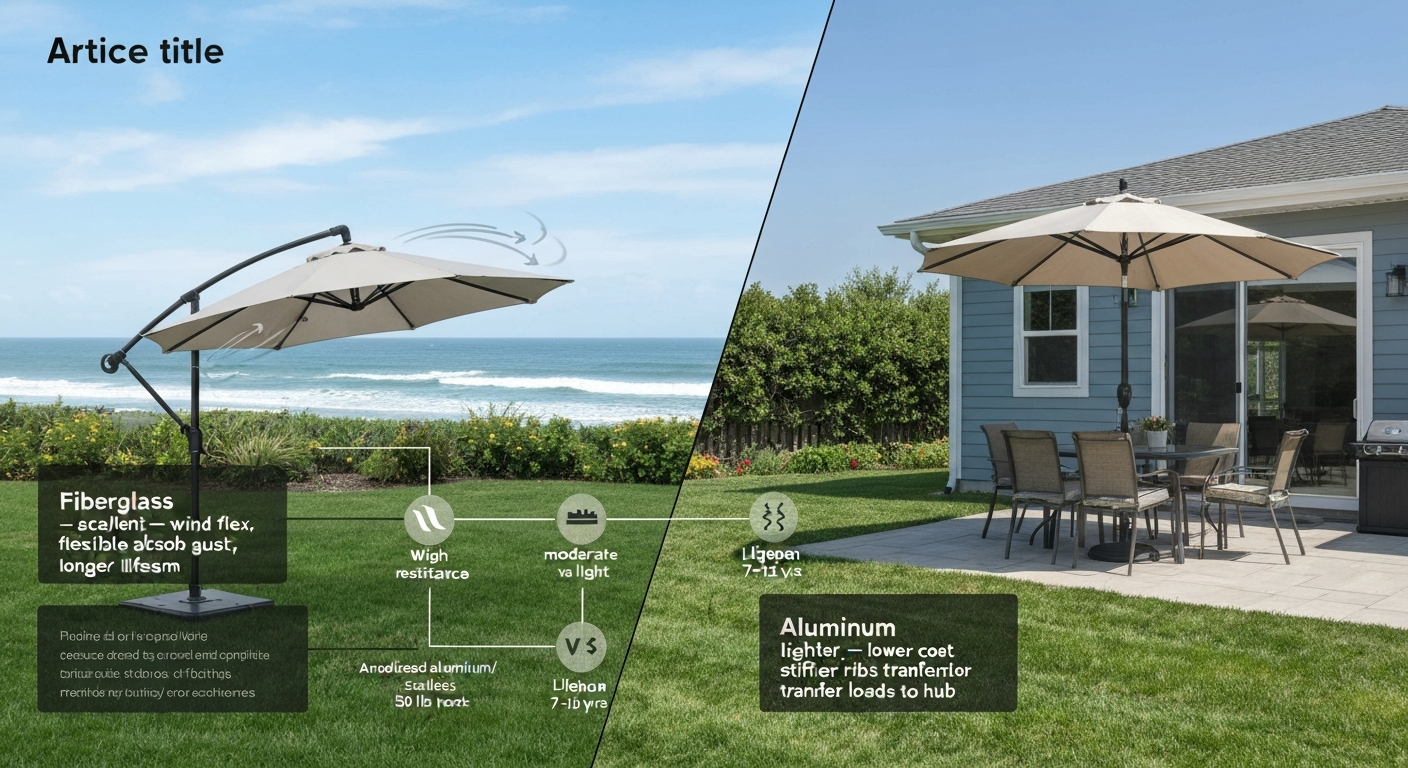
For most homeowners, aluminum is the better choice for a patio umbrella pole and frame. It weighs roughly one-third as much as steel (density around 2.70 g/cm³ versus 7.8–7.85 g/cm³ for mild steel), resists corrosion without constant upkeep, and handles everyday outdoor exposure well for a decade or more with minimal maintenance. Steel isn't a bad material, a thick-walled, powder-coated or galvanized steel pole is genuinely strong and costs less upfront, but the weight penalty, corrosion risk, and extra maintenance requirements tip the balance toward aluminum in most residential and light-commercial situations. The exception is when you need raw structural stiffness on a very large or heavily loaded frame, or when budget is the overriding concern and you're not near salt air.
Is Steel or Aluminum Better for Patio Umbrella? Quick Guide

Quick verdict: which material wins and where the trade-offs land
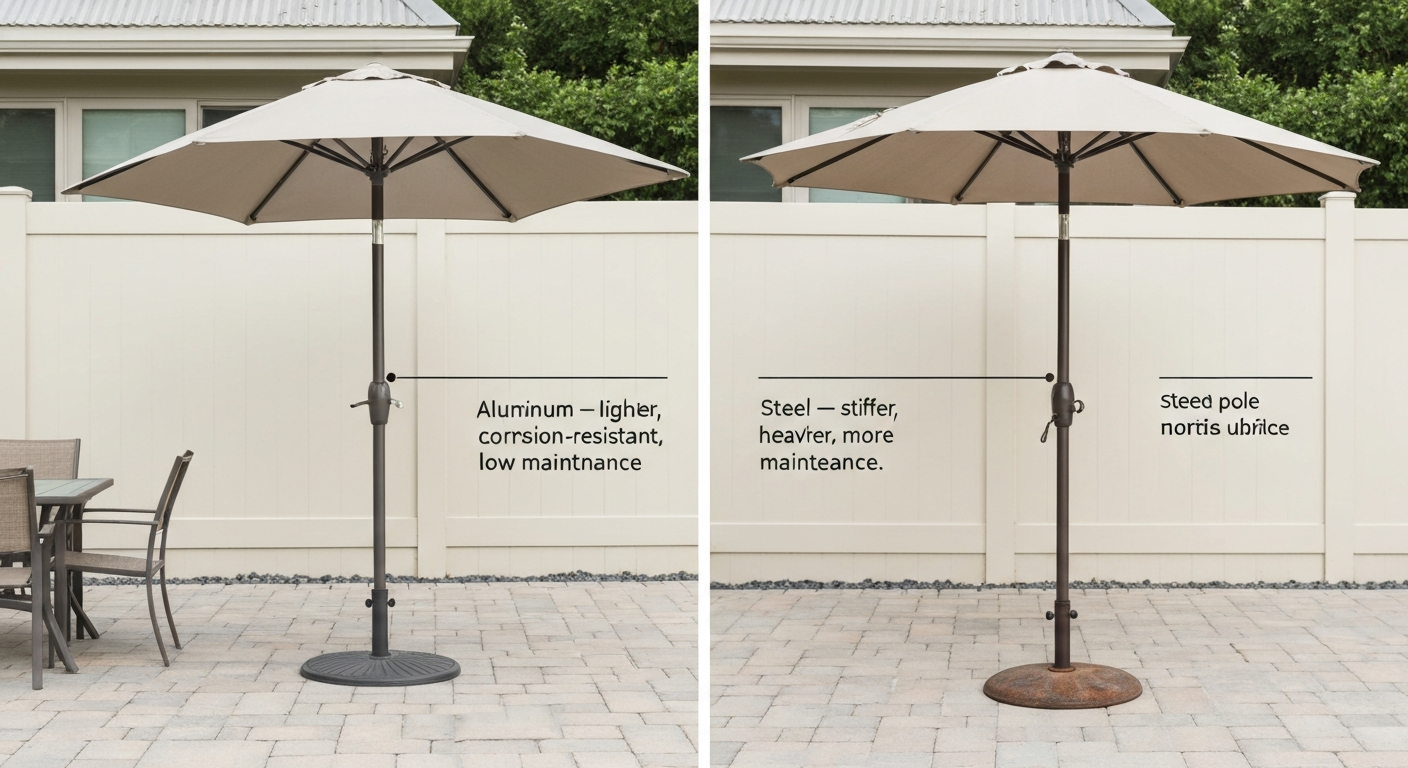
Aluminum wins for the majority of buyers. It is lighter, naturally corrosion-resistant, easier to carry and set up, and the dominant material in mid-range and premium residential umbrellas for good reason. Steel wins on raw stiffness (modulus of elasticity around 200–210 GPa versus aluminum's 69 GPa) and has a lower purchase price at the budget end, where you'll find basic 9-ft steel market umbrellas under $60 at big-box retailers. However, that stiffness advantage only matters if the pole diameter and wall thickness are sized to take advantage of it, a thin-walled steel pole can flex or dent just as badly as a comparable aluminum one. For coastal homes, aluminum is clearly preferable because steel corrodes aggressively in salt air even with protective coatings, unless you step up to stainless steel (304 or 316 grade), which costs significantly more. For windy yards, the pole material is less important than rib construction, canopy venting, and base weight, fiberglass ribs on an aluminum pole consistently outperform all-steel frames in gust conditions.
Head-to-head: steel vs. aluminum at a glance
| Factor | Steel (mild/carbon) | Aluminum (6061/6063 alloy) |
|---|---|---|
| Density | ~7.8–7.85 g/cm³ | ~2.70 g/cm³ |
| Stiffness (modulus) | ~200–210 GPa | ~69 GPa |
| Tensile strength (typical) | ~250 MPa yield (A36) | ~276 MPa yield (6061-T6) / lower for 6063 |
| Corrosion resistance (bare) | Poor — rusts without coating | Good — forms passive oxide layer |
| Coastal/salt-air suitability | Poor unless galvanized or stainless | Good; anodized or powder-coated for best results |
| Weight (relative) | Heavy | About 1/3 the weight of steel by volume |
| Typical 9-ft pole price range | ~$50–$120 (budget end) | ~$80–$700+ (wide range by quality) |
| Maintenance demand | Moderate to high (touch up chips, inspect for rust) | Low (clean periodically, touch up chips) |
| Expected lifespan (well-maintained) | 10–20 years (coated/galvanized) | 15–25+ years (quality alloy, good finish) |
| Recyclability | High | High |
Strength and structural durability
Steel is stiffer, but that doesn't automatically mean a steel umbrella pole is stronger in practice. The modulus of elasticity for mild structural steel (around 200–210 GPa) is roughly three times that of aluminum alloy (around 69 GPa), meaning steel resists bending deflection better for the same cross-section. On paper, that's a significant advantage. In real umbrella applications, though, manufacturers compensate by using larger-diameter aluminum poles or thicker wall sections, and the practical stiffness of a well-made aluminum pole is entirely adequate for 9-ft to 11-ft residential canopies.
Where strength numbers get interesting is at the yield point. Common 6061-T6 aluminum has a 0.2% proof (yield) strength of around 276 MPa, actually higher than the roughly 250 MPa minimum yield for ASTM A36 mild steel. This means a 6061-T6 aluminum pole won't permanently deform at loads a basic mild-steel pole would. Budget steel poles often use lower-grade carbon steel that doesn't reach A36 specs, so the comparison isn't always in steel's favor. The ribs are equally important: aluminum ribs are standard, but fiberglass (pultruded composite) ribs flex under gust loads rather than fracturing, which is why high-end umbrellas often combine an aluminum pole with fiberglass ribs regardless of the cost tier.
Pole wall thickness matters more than the material label. A cheap 1.0 mm-wall steel pole from a budget umbrella will perform worse than a 2.0–2.5 mm-wall 6061-T6 aluminum pole from a quality manufacturer. When you're comparing models, check the actual pole diameter (common sizes run 1.5 inch / 38 mm for residential, 2 inch / 51 mm for commercial) and the wall thickness if the manufacturer publishes it. Thicker walls mean a more durable pole in either material.
Wind resistance and real-world performance
Consumer testing and independent reviews consistently show that umbrella wind performance comes down to three things in order of importance: base weight and anchoring, canopy venting, and rib construction. The pole material is a secondary factor. That said, material choice still matters in wind because failure modes differ. A thin steel pole tends to bend permanently or crack at a stress concentration point (around rib socket holes or the tilt mechanism) under a gust that exceeds its yield point. An aluminum pole does the same. Fiberglass ribs, by contrast, flex significantly before failing, which is why most reviewers, including those who've tested umbrellas in real gusts, recommend fiberglass ribs as the single best upgrade for windy yards.
For practical wind limits, consumer umbrellas, regardless of pole material, should generally be closed in sustained winds above about 15–25 mph. Some commercial-grade vented cantilever designs quote tested ratings up to 35–44 mph under specific test conditions, but those rely on heavy-duty frames, dual vents, and secure anchoring, not just the pole material. A vented canopy (single or double vent) reduces lift dramatically and is a far more effective wind-resistance feature than upgrading from aluminum to steel. If you're in a consistently windy yard, the checklist is: close the umbrella in high winds, use a base of at least 50 lbs for a standard 9-ft market umbrella (Treasure Garden's manufacturer guidance for many of their 9-ft models), add in-ground anchoring or a weighted base plate if gusts are frequent, and prioritize fiberglass ribs over pole material.
Corrosion, coastal performance and long-term durability
This is where aluminum's advantage over steel is most decisive. Bare aluminum forms a passive aluminum oxide layer that slows further corrosion without any coating. Bare mild steel rusts immediately in humid and salt-air environments, there is no passive protection. In ISO 12944 corrosion terms, a coastal environment typically falls in the C4 (high) to C5-M (marine, very high) category, and the coating systems required to protect steel at those exposure levels are substantially thicker and more demanding than residential powder-coat finishes.
For steel to survive in coastal conditions, it needs hot-dip galvanizing or stainless steel construction. Hot-dip galvanizing (per EN ISO 1461 / ASTM A123) provides a sacrificial zinc coating, on sections thicker than 6 mm, the minimum coating is around 85 μm, and extends steel life dramatically. But most residential umbrella poles are thin-walled extrusions, not structural sections, so coating continuity and adhesion at cut ends, holes, and welds is critical. Any chip or scratch that breaks through to bare steel in a salt-air environment will rust visibly within weeks. Powder-coated steel (without galvanizing beneath) is not a reliable coastal option for the long term.
Stainless steel (grade 304 or 316) is the other option. Grade 316 contains molybdenum and is the specified grade for chloride/marine environments, it resists pitting and crevice corrosion substantially better than 304. Density runs around 8.0 g/cm³ (even heavier than mild steel), and it costs significantly more. A few premium umbrella makers use stainless hardware and reinforcement on aluminum poles, which is a sensible hybrid approach. One caution: aluminum and stainless steel in direct contact in a salt-air environment can form a galvanic couple that accelerates corrosion of the aluminum. SINTEF research on aluminum-stainless bolted connections documents this effect in chloride environments, use insulating washers or ensure coatings fully separate the metals.
For aluminum in coastal settings, anodized or marine-grade powder-coated finishes are the right choice. Architectural anodizing (Type II, with film thickness typically 10–20 μm or more for exterior use, as guided by the Aluminum Anodizers Council) provides good corrosion resistance in marine exposures. Quality powder coatings for coastal use specify thicker films (60 μm or more) and full edge sealing. Regular rinsing with fresh water after salt exposure significantly extends life for either material.
Weight, portability and day-to-day handling
Aluminum is about one-third the weight of steel by volume, and you notice this every time you move the umbrella. A typical 9-ft aluminum pole section weighs perhaps 4–7 lbs depending on diameter and wall thickness. A comparable mild-steel pole can run 12–18 lbs or more, and stainless steel is heavier still. For a patio umbrella you store seasonally, move for cleaning, or reposition for shade angles, this weight difference is not trivial. If you're setting up a market umbrella solo, aluminum is the clear practical choice. Steel makes more sense in a fixed, rarely-moved installation where the extra mass actually helps with stability.
Cantilever (offset) umbrellas deserve special mention here. Their poles are longer, their frames more complex, and the leverage forces on the base are greater than a center-pole market umbrella. Aluminum is the dominant material for cantilever frames specifically because the weight savings matter more as the overall structure gets larger and heavier. Moving a large cantilever with a steel frame and a 100+ lb base is genuinely difficult; aluminum makes the upper frame manageable.
Maintenance, finishes and protective treatments
Powder coating is the most common finish on both steel and aluminum umbrella poles, and it works well on both, with different durability profiles. On aluminum, powder coat adheres to a passivated surface and commercial systems carry warranties often in the 10–30-year range (conditional on formulation, film thickness, and environment, per industry guidance). On steel, powder coat without a primer or galvanized underlayer is less reliable because any breach in the coating allows moisture to undercut the film and rust from beneath. For steel poles, the ideal finish stack is galvanizing plus a powder-coat topcoat, which gives you sacrificial zinc protection under the decorative coat.
Anodizing is available on aluminum but not on steel. It's a better long-term coating for aluminum in demanding environments because it becomes part of the surface rather than sitting on top of it. The trade-off is that anodized finishes come in fewer colors than powder-coat options and cannot be field-repaired, a deep scratch stays visible. Powder-coated poles (both steel and aluminum) can be touched up with matching paint pens or automotive touch-up paint; this isn't a perfect fix, but it does prevent a small chip from becoming a rust or corrosion problem.
- Rinse salt-air exposure or pool-chemical splash off with fresh water at least monthly during the season.
- Inspect powder-coated finishes each spring — touch up any chips or scratches before the season starts.
- For steel poles, use a zinc-rich primer on touch-ups to maintain sacrificial protection at the repair site.
- Store umbrellas with a UV-resistant cover or in a garage/shed over winter to extend finish life regardless of material.
- Check all rib-to-hub connections and tilt mechanisms annually — these are where both steel and aluminum frames fail first due to stress concentration.
Cost, expected lifespan and value over time
Budget steel umbrellas (basic 9-ft market styles) routinely appear under $60 at big-box retailers, making them the lowest entry price in the category. Basic aluminum 9-ft models start around $80–$100. Mid-range commercial-grade aluminum frames with quality canopies (Sunbrella or similar) run $200–$700 for market styles and $400–$1,500 or more for larger cantilever models. There isn't really a mid-range steel category, steel tends to appear either at the budget end or as stainless premium hardware on otherwise aluminum frames.
Over a 10-year horizon, the value calculation usually favors aluminum. A $60 budget steel umbrella in a humid or coastal environment may show significant rust and frame degradation within 3–5 years without diligent maintenance. A $120–$150 quality aluminum umbrella with a powder-coated finish and aluminum ribs will typically last 10–15 years in inland residential use with basic care. Step up to a $300–$400 aluminum frame with fiberglass ribs and a quality canopy and you're looking at 15–25 years realistically. The lifecycle cost per year of a mid-range aluminum umbrella is generally lower than replacing cheap steel models every few years.
Steel pays off when you need a very large, fixed commercial installation where raw structural stiffness matters, the frame will be hot-dip galvanized, and labor cost to move the umbrella is negligible. It also makes sense as a budget-first, short-term solution for renters or seasonal patios where longevity isn't a priority. For everyone else, aluminum delivers better long-term value.
Base and installation requirements
The pole material doesn't change the fundamental base requirements much, what drives base weight is canopy size, pole height, and umbrella style. A standard 9-ft market umbrella in calm conditions needs a minimum base of around 50 lbs (Treasure Garden's published minimum recommendation for many 9-ft models). A 10–11 ft umbrella or anything in a breezy location should go up to 75–100 lbs. Cantilever umbrellas exert substantially more leverage because the canopy is offset, and their bases are typically 100–150 lbs or more; many manufacturers specify separate weighted base plates or in-ground mounting anchors for permanent cantilever installations.
Pole diameter compatibility matters and is worth checking before you buy. Most residential market umbrellas use 1.5-inch (38 mm) poles; commercial-grade and larger models often use 2-inch (51 mm) poles. Cantilever systems have their own proprietary base mounts that are not interchangeable. If you're replacing an umbrella pole or swapping into an existing base, verify the pole diameter and the base sleeve ID (inner diameter) match, a 1.5-inch pole in a 2-inch sleeve is loose and unsafe in wind. Some bases include reducer inserts to accommodate multiple sizes, but check before assuming.
| Umbrella Style | Typical Pole Diameter | Recommended Base Weight (minimum) | Mounting Notes |
|---|---|---|---|
| 9-ft market / center-pole | 1.5 in (38 mm) | 50 lb | Freestanding base or table-hole mount; check sleeve ID |
| 10–11 ft market / center-pole | 1.5–2 in (38–51 mm) | 75–100 lb | Larger canopy = more wind load; use in-ground sleeve for permanence |
| Cantilever / offset (9–11 ft) | Proprietary varies | 100–150 lb+ | Dedicated base plate; in-ground anchor for windy sites |
| Large commercial (11–13 ft+) | 2 in (51 mm) or larger | 150 lb+ or in-ground | Commercial mounts or concrete anchor recommended |
Practical pros and cons: steel
Steel's main real-world advantage is raw structural rigidity at a low price point. A thick-walled mild steel pole resists bending under static loads better than an equivalently-dimensioned aluminum pole because of its higher modulus. For very large umbrella canopies or commercial café installations where the frame is fixed, this matters. Steel is also widely available and simple to fabricate, which keeps budget-end pricing very low.
- Lower upfront cost — budget 9-ft steel umbrellas under $60 are common
- Higher modulus of elasticity (~200–210 GPa) gives excellent stiffness per cross-section
- Thick-walled or galvanized steel is durable in inland, non-coastal settings
- Good structural option for fixed commercial installations with heavy-duty galvanized or stainless construction
- Corrodes readily — bare mild steel rusts without intact protective coating
- Heavy: roughly 3x the weight of an equivalent aluminum pole, making setup and storage harder
- Requires more diligent maintenance — chips and scratches must be touched up quickly to prevent rust spread
- Not suitable for coastal/salt-air use without galvanizing plus topcoat, or stainless steel (which is expensive and even heavier)
- Budget steel models often use thin-walled, low-grade carbon steel that doesn't live up to material-strength advantages on paper
Practical pros and cons: aluminum
Aluminum is the default choice for mid-range and premium patio umbrellas for a reason: it handles the real-world demands of outdoor furniture better than steel in almost every residential scenario. The passive oxide layer that forms on aluminum protects the underlying metal without any coating, which means corrosion is far less aggressive even if the finish is scratched. Weight, coastal performance, and low maintenance are its clearest advantages.
- Lightweight — roughly 1/3 the weight of steel by volume, making setup, transport, and storage practical
- Naturally corrosion-resistant — passive oxide layer slows surface corrosion even without coatings
- Excellent coastal and humid-environment performance with anodized or quality powder-coat finish
- Lower maintenance demands — clean periodically, touch up chips, no anti-rust urgency for minor scratches
- Wide range of quality tiers: 6063 alloy is common in mid-range frames; 6061-T6 (yield ~276 MPa) in higher-end structural applications
- Dominant material in quality residential cantilever and market umbrellas — largest selection of models
- Lower modulus (~69 GPa) means it deflects more than steel for the same cross-section — needs appropriate diameter/wall thickness
- Aluminum-to-stainless contact in salt-air environments can create galvanic corrosion — use insulating barriers at fastener points
- Quality mid-range aluminum umbrellas cost more upfront than budget steel options
How material choice interacts with umbrella style
Market and center-pole umbrellas
Market umbrellas (the classic center-pole style) are the most forgiving in terms of material choice. The pole is vertical, the load path is straightforward, and the canopy size is typically modest enough that either aluminum or steel works structurally. For a budget 9-ft market umbrella in an inland setting, a powder-coated steel pole is a reasonable choice if cost is the priority. For anything you plan to use for more than a few seasons, or anywhere near salt air or a pool, aluminum is the better investment.
Cantilever and offset umbrellas
Cantilever umbrellas place much higher demands on the pole and frame because the canopy hangs off to one side, creating significant bending and torsional loads on the main post and cross-arm. Aluminum is overwhelmingly the preferred material here, the weight savings make handling practical, and the corrosion resistance means the complex joinery of a cantilever frame (lots of fastener points and moving parts) doesn't become a rust problem over time. Some premium cantilever systems use stainless steel hardware at critical connection points on an aluminum frame, which is a smart approach if you keep an eye on galvanic isolation.
Freestanding and large commercial umbrellas
For large commercial installations, café umbrellas 11 ft or larger, often in-ground mounted, hot-dip galvanized steel or heavy-gauge aluminum both appear as legitimate choices. Commercial-grade aluminum extrusions (often 6061-T6 for structural sections) handle these spans well. 6063 aluminium alloy is commonly used for extruded furniture and frames with typical properties: density ≈ 2.70 g/cm³, modulus ≈ 69 GPa, and tensile/yield values that depend on temper (for example, T5/T1 UTS ≈ 160–170 MPa and lower yield strengths than 6061) 6063 aluminium alloy is commonly used for extruded furniture and frames with typical properties: density ≈ 2.70 g/cm³, modulus ≈ 69 GPa, and tensile/yield values that depend on temper (for example, T5/T1 UTS ≈ 160–170 MPa and lower yield strengths than 6061).. Where steel appears in commercial applications, it's usually galvanized structural steel in an in-ground base system, not a portable setup. For residential freestanding umbrellas, aluminum is still the practical default.
Alternatives: fiberglass, wood, and composite poles compared to steel and aluminum
Steel and aluminum aren't the only options, and understanding where fiberglass and wood fit helps clarify why aluminum dominates the quality end of the market.
| Material | Weight | Corrosion Resistance | Flexibility / Gust Behavior | Maintenance | Typical Use Case |
|---|---|---|---|---|---|
| Mild steel | Heavy (~7.8 g/cm³) | Poor (needs coating) | Stiff — bends permanently under overload | Moderate to high | Budget market umbrellas; fixed commercial with galvanizing |
| Aluminum (6061/6063) | Light (~2.70 g/cm³) | Good (passive oxide + coating) | Stiff — adequate with proper sizing | Low | Most residential and commercial quality umbrellas |
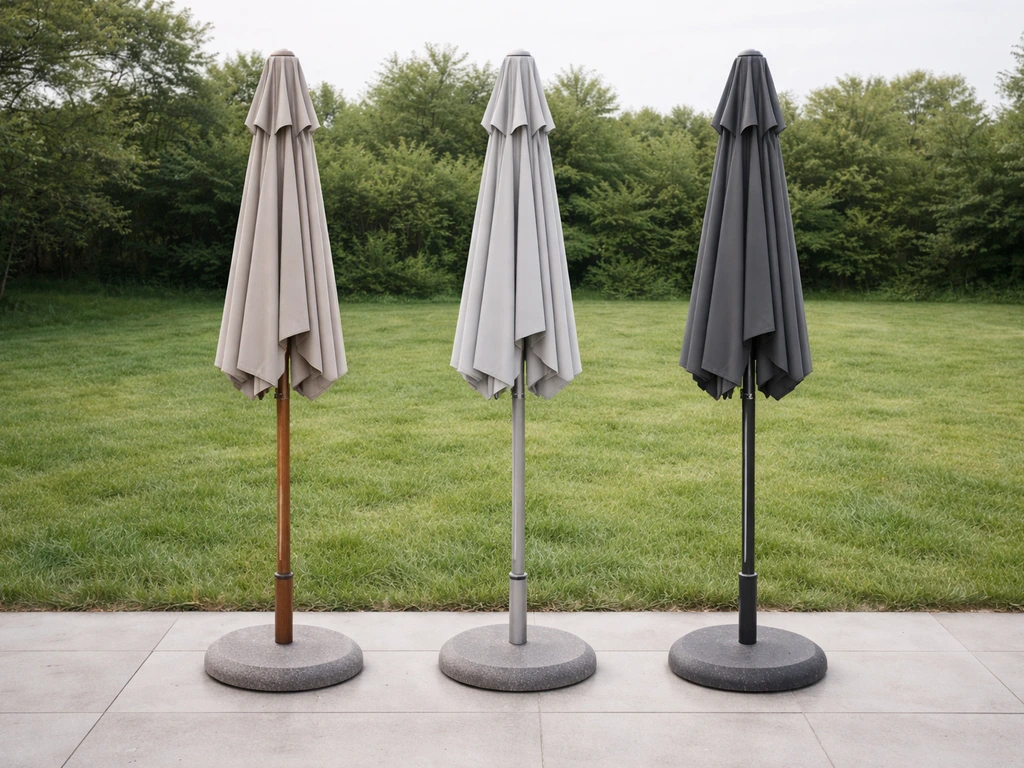
| Fiberglass (pultruded composite) | Very light (~1.5–2.0 g/cm³) | Excellent | Flexes elastically under gusts — resists fracture | Very low | Ribs on quality umbrellas; full-frame specialty and marine applications |
| Wood (hardwood/teak) | Medium (varies by species) | Moderate — requires oiling/sealing | Moderate flex; can crack if dried out | High (seasonal oiling, crack inspection) | Aesthetic-focused residential, traditional market styles |
| Stainless steel (304/316) | Very heavy (~8.0 g/cm³) | Excellent (316 for marine) | Very stiff | Low (wipe clean) | Premium coastal/marine hardware, high-end commercial poles |
Fiberglass ribs are worth singling out because they appear on aluminum-pole umbrellas and represent the single most effective performance upgrade for wind-prone settings. Pultruded fiberglass composites have densities around 1.5–2.0 g/cm³ (lighter than aluminum), don't corrode, and, most importantly, flex elastically under gust loads rather than yielding permanently or snapping. How to pick a patio umbrella that performs, Houzz expert guidance (notes on fiberglass) reports that pultruded E‑glass fiberglass ribs flex under gust loads rather than fracturing, which reduces catastrophic breakage in high winds How to pick a patio umbrella that performs — Houzz expert guidance (notes on fiberglass). This is why reputable reviewers consistently recommend fiberglass ribs over all-metal rib construction for coastal and windy environments, regardless of whether the pole is aluminum or steel. If fiberglass ribs are a priority, check our guide to the best fiberglass patio umbrella for top-rated models and concise buying tips. A full-frame fiberglass pole exists in specialty applications and is worth exploring if you're in a genuinely demanding marine environment.
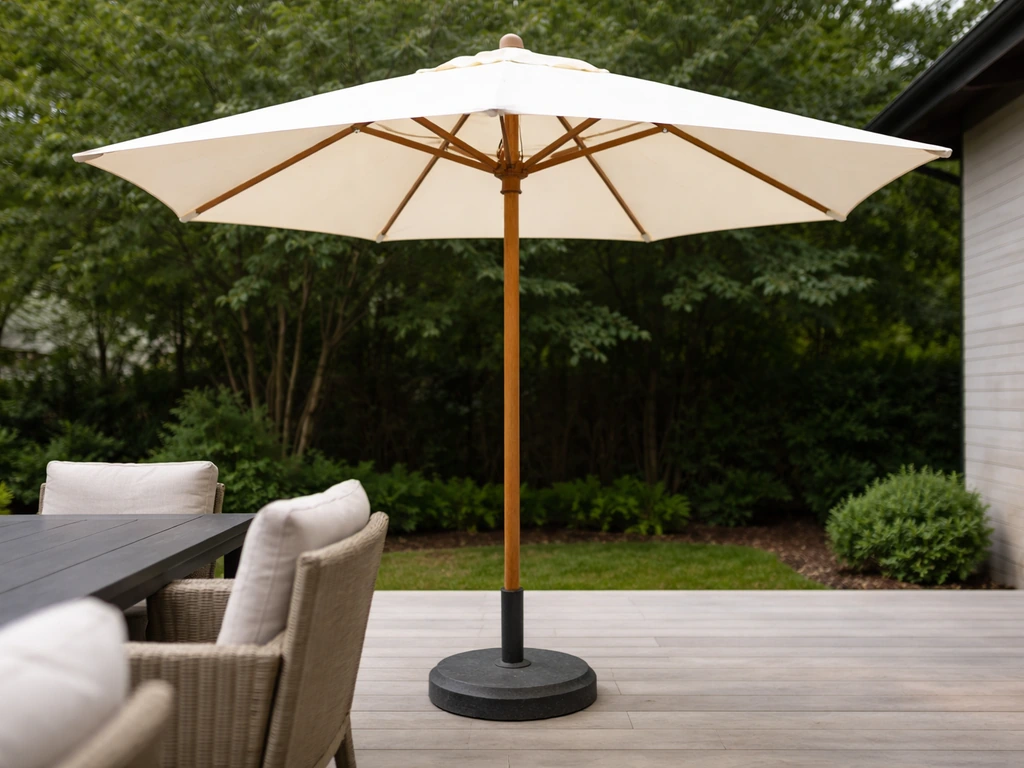
Wood poles (teak or other durable hardwoods) occupy a niche for buyers who prioritize aesthetics over performance engineering. A well-maintained teak umbrella looks beautiful, but it requires seasonal oiling, regular inspection for cracking, and protection from standing water. It doesn't offer structural or corrosion advantages over aluminum, it's purely an aesthetic choice. If wood's appeal resonates with you, understanding the maintenance commitment is essential before buying.
Fabric matters too: how canopy material interacts with pole choice
The canopy fabric you choose changes what you need from the pole and frame. A heavier, denser fabric (like solution-dyed acrylic or high-density olefin) puts more static load on the ribs and hub, which slightly favors a stiffer, heavier-walled frame. A lighter polyester canopy reduces that load but may fade faster and offer less UV protection over time. If you're investing in a quality aluminum frame with fiberglass ribs, which you'd do for longevity and wind performance, it makes sense to match it with a quality canopy fabric that justifies the frame investment.
Olefin and polyester are the most common canopy fabrics at the mid-range price point. For a deeper comparison of canopy fabrics, see our guide on olefin vs polyester patio umbrellas. Olefin (solution-dyed polypropylene) offers good UV resistance and color retention with a slightly different texture and feel compared to polyester. Polyester is lighter and less expensive but can fade more quickly under sustained UV exposure. For coastal settings, where both the frame and the fabric face salt-air stress, a solution-dyed fabric (olefin or acrylic) paired with an aluminum frame and quality finish is the combination most likely to last a full decade without a replacement. For guidance on choosing canopy materials that balance durability, UV protection, and salt-air resistance, see our guide to the best fabric for patio umbrella. UV protection ratings on canopies (UPF ratings, typically UPF 30–50+ on quality fabrics) are independent of pole material but part of the overall umbrella package, a UV-protecting canopy with a corroded steel pole is a waste of fabric investment.
Buying guidance for specific situations
Windy yards
If your yard gets regular gusts above 15 mph, prioritize a vented canopy, fiberglass ribs, and a base of at least 75 lbs for a 9-ft umbrella. The pole material, aluminum over steel, is a secondary concern. Close the umbrella when sustained winds arrive. An aluminum pole with fiberglass ribs and a dual-vent canopy will outperform a steel pole with standard aluminum ribs and no vent in every wind test that matters.
Coastal homes and salt-air environments
Choose aluminum with an anodized or marine-grade powder-coated finish. Avoid bare steel and powder-coated steel without galvanizing entirely. If stainless hardware appears on the frame (common in premium aluminum cantilever models), ensure there are insulating barriers or full coating coverage between the aluminum and stainless contact points to prevent galvanic corrosion. Rinse the entire frame with fresh water regularly, monthly at minimum during the season.
Budget buyers
A budget steel 9-ft market umbrella under $60 is a reasonable entry point for an inland, non-coastal setting where longevity isn't the priority, renters, seasonal patios, temporary setups. Expect 3–5 years of service with basic maintenance. If you're in a position to stretch to $120–$150 for a quality aluminum frame, the lifecycle math favors that investment over replacing a budget steel model every few years.
Portability and frequent moving
Aluminum, unambiguously. The weight difference is felt immediately and on every setup. If you're repositioning the umbrella to follow the sun, moving it for dinner parties, or taking it out of storage solo, aluminum makes the task manageable. A steel pole of equivalent size is genuinely awkward to carry alone.
Large patio or café use
For 11-ft or larger umbrella canopies on a commercial or large residential patio, specify commercial-grade aluminum alloy (6061-T6 for structural sections where possible), pole diameter of 2 inches or more, fiberglass ribs if available in the model line, and in-ground base anchoring. Budget $400–$1,500+ for a setup that will last in this use category. Steel makes sense here only if in-ground galvanized structural installation is planned by a professional.
Quick decision checklist before you buy
- Location: inland or coastal/poolside? (Coastal = aluminum or galvanized steel only; poolside = aluminum preferred)
- Wind conditions: regular gusts above 15 mph? (Yes = prioritize fiberglass ribs, vented canopy, and heavy base over pole material)
- Umbrella style: market/center-pole or cantilever/offset? (Cantilever = aluminum strongly preferred for weight and frame complexity)
- Portability needs: moved frequently or fixed? (Frequent movement = aluminum; fixed and large = either material with proper anchoring)
- Base weight: does your current base match the pole diameter and the canopy size? (Minimum 50 lb for 9-ft; 75–100 lb+ for 10–11 ft; 100–150 lb+ for cantilever)
- Pole diameter: confirm the pole OD matches the base sleeve ID — check for 1.5-inch or 2-inch compatibility
- Finish: powder-coated steel or aluminum (inspect chip resistance); anodized aluminum for coastal use; galvanized underlayer for any outdoor steel
- Rib material: fiberglass ribs for wind-prone or coastal settings; aluminum ribs for standard inland residential use
- Canopy fabric: UV-resistant, solution-dyed fabric (olefin or acrylic) for maximum longevity — match fabric quality to frame quality
- Budget horizon: calculate cost per year of expected lifespan, not just purchase price
Related topics worth digging into
The steel vs. aluminum question is one piece of a larger material decision for patio umbrellas. If you're still narrowing down your choice, the comparison between fiberglass and aluminum poles goes deeper on how composite materials handle wind loads and coastal exposure, relevant if you're in a demanding environment. The wood vs. aluminum comparison covers the aesthetics-versus-practicality trade-off for buyers drawn to natural materials. See our patio umbrella wood vs aluminum comparison for a focused look at the aesthetics, maintenance, and durability trade-offs. For the frame material picture as a whole, reviewing the full breakdown of patio umbrella materials will help you see how steel, aluminum, fiberglass, and wood rank across every performance factor. And once you've settled on a frame, the fabric side of the equation, covering olefin versus polyester, UV ratings, and how canopy weight affects frame demands, rounds out the full buying decision.
Final takeaways and next steps
Aluminum is the right default for most homeowners buying a patio umbrella today. For a concise comparison of options, see our guide to the best material for patio umbrella pole. It's lighter, corrosion-resistant, lower maintenance, and available in a wide range of quality tiers that give you real performance for the money. For a concise comparison of options and a recommended pick, see our guide to the best patio umbrella material. Steel's place in the category is mostly at the budget end for inland use, or in heavy-duty commercial installations where galvanized structural steel is specified professionally. Stainless steel is the coastal-premium option if budget isn't a concern, but even then, most buyers are better served by a quality aluminum frame with stainless hardware at the critical joints.
The practical next step is to lock in your umbrella style (market or cantilever), measure your base or verify the pole diameter your existing base accepts, confirm your site conditions (coastal, inland, pool proximity, typical wind), and then set a budget range. From there, filter for fiberglass ribs if wind is a concern, a quality finish if coastal, and a canopy fabric that matches the service life you expect from the frame. Those three decisions, material, ribs, and fabric, made together will get you to the right umbrella far faster than any single-attribute comparison.
FAQ
Concise verdict — is steel or aluminum better for a patio umbrella pole/frame?
For most homeowners, aluminum is the better all‑around choice: lighter, naturally corrosion‑resistant (with anodize or powder coat), easier to move, and low maintenance. Steel (especially galvanized or powder‑coated) can be stronger and stiffer for very large or commercial umbrellas and windy/anchored installations, but it’s heavier and requires proper corrosion protection (galvanizing or high‑quality paint) for coastal or wet environments.
How do steel and aluminum compare for strength and stiffness?
Steel is stiffer (Young’s modulus ≈200 GPa) and typically has similar or higher yield strength per cross‑section than common aluminum extrusions. Aluminum alloys used for umbrellas (6061/6063) have much lower modulus (~69 GPa) so an aluminum pole must be larger in diameter or wall thickness to match steel stiffness. In practice, a well‑designed aluminum pole performs adequately for typical market and cantilever umbrellas; steel provides an advantage for very large canopies or commercial duty when stiffness and resistance to bending matter most.
Which material is better for wind resistance?
Wind performance depends more on canopy size/venting, ribs, base/anchoring and design than just pole material. Steel poles offer higher bending resistance for large, unvented canopies and secure anchored installs. Aluminum combined with flexible ribs (especially fiberglass ribs) and a vented canopy often performs best for consumer use because it flexes rather than breaks. Regardless of material, close umbrellas in sustained winds above ~15–25 mph and use adequate base/anchoring.
Which material resists corrosion and is better for coastal environments?
Aluminum (anodized or powder‑coated) and stainless steel (304/316) resist corrosion well. Plain carbon steel must be protected—hot‑dip galvanizing plus a paint or powder finish or marine‑grade coating is required for coastal use. 316 stainless steel gives the best chloride (sea‑air) resistance. Use compatible fasteners and insulating barriers to avoid galvanic corrosion between aluminum and stainless in salt environments.
How do steel and aluminum compare for weight and portability?
Aluminum is substantially lighter (density ~2.7 g/cm³) versus steel (~7.8–8.0 g/cm³). That makes aluminum umbrellas easier to carry, store, tilt, and mount in portable bases. Steel frames are heavier and more stable inherently, which can be an advantage for fixed or heavily loaded cantilever systems but reduces portability.
What about maintenance and finishes (galvanizing, powder coat, anodizing, stainless)?
Aluminum: best practice is anodizing (architectural films ~10–20 μm) or high‑quality powder coating (marine‑grade for coastal) plus routine washing. Steel: hot‑dip galvanizing (EN ISO 1461) provides sacrificial protection; add powder coat or paint for appearance and extra barrier. Stainless steel requires little maintenance but can still pit in very aggressive marine settings. Regular cleaning, inspecting fasteners, and touch‑up coatings extends life.