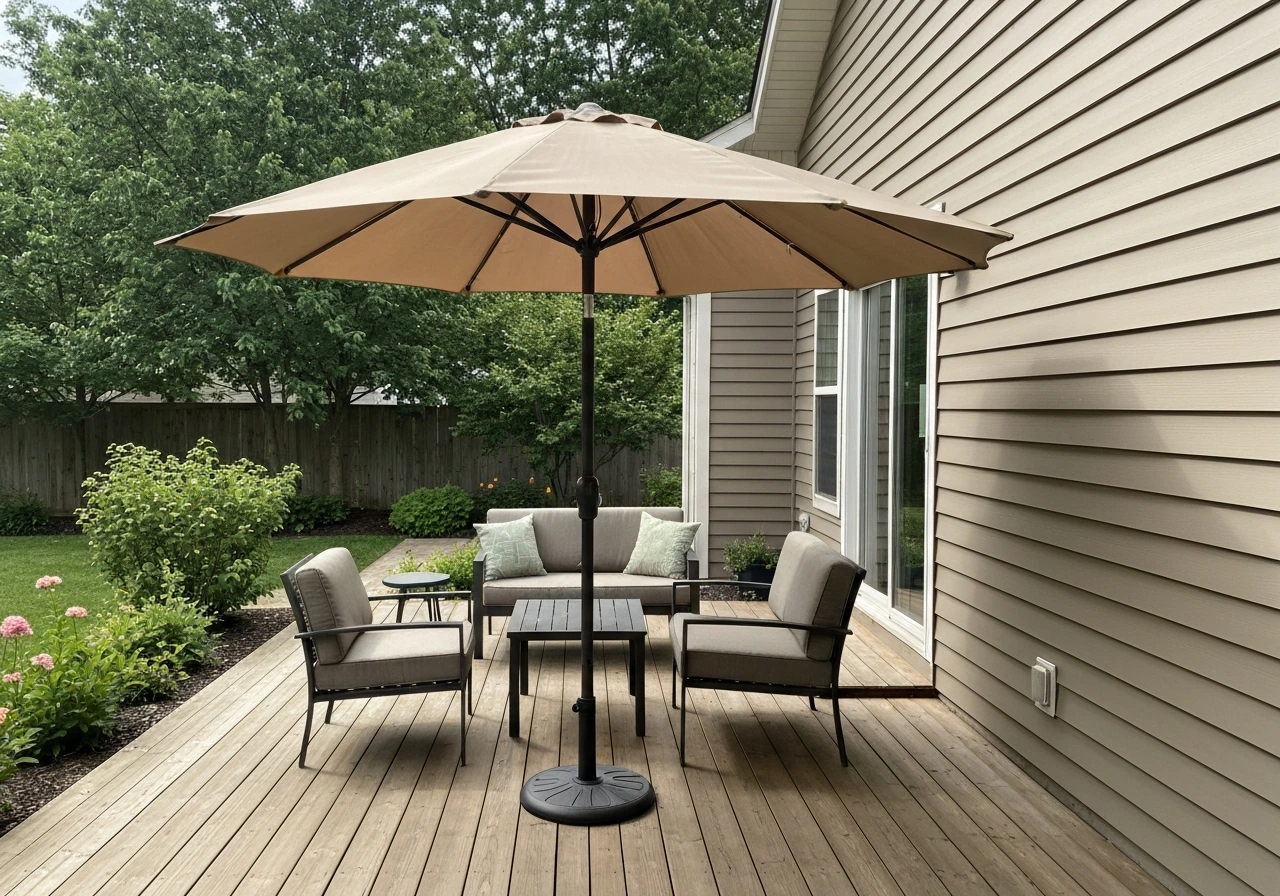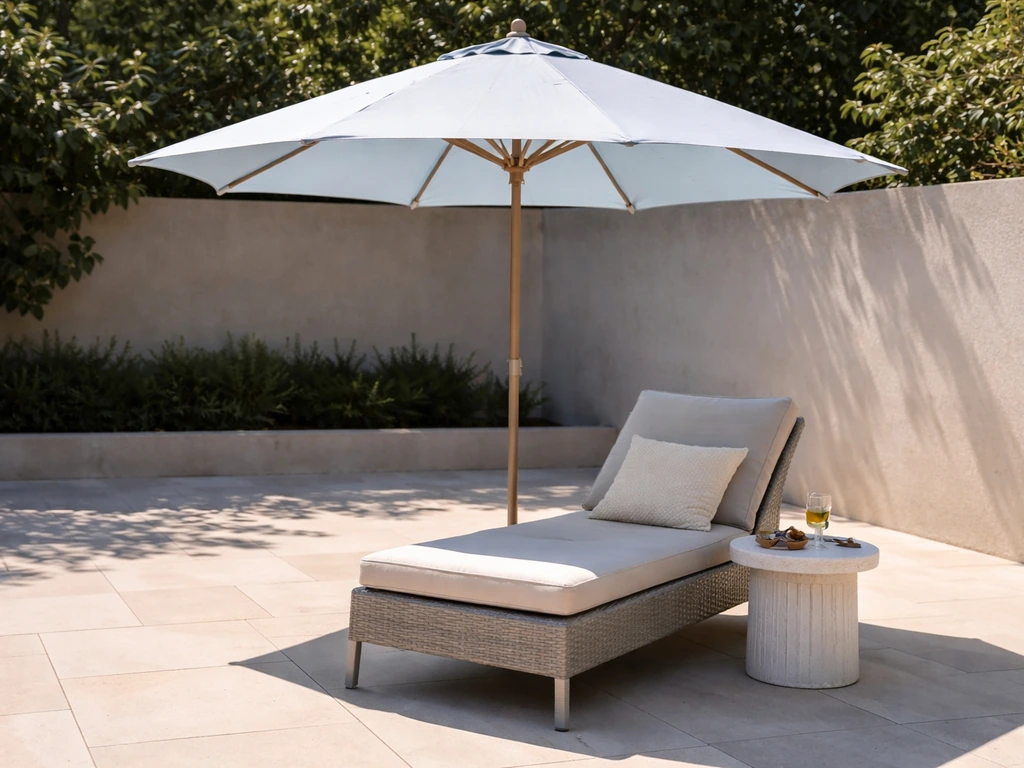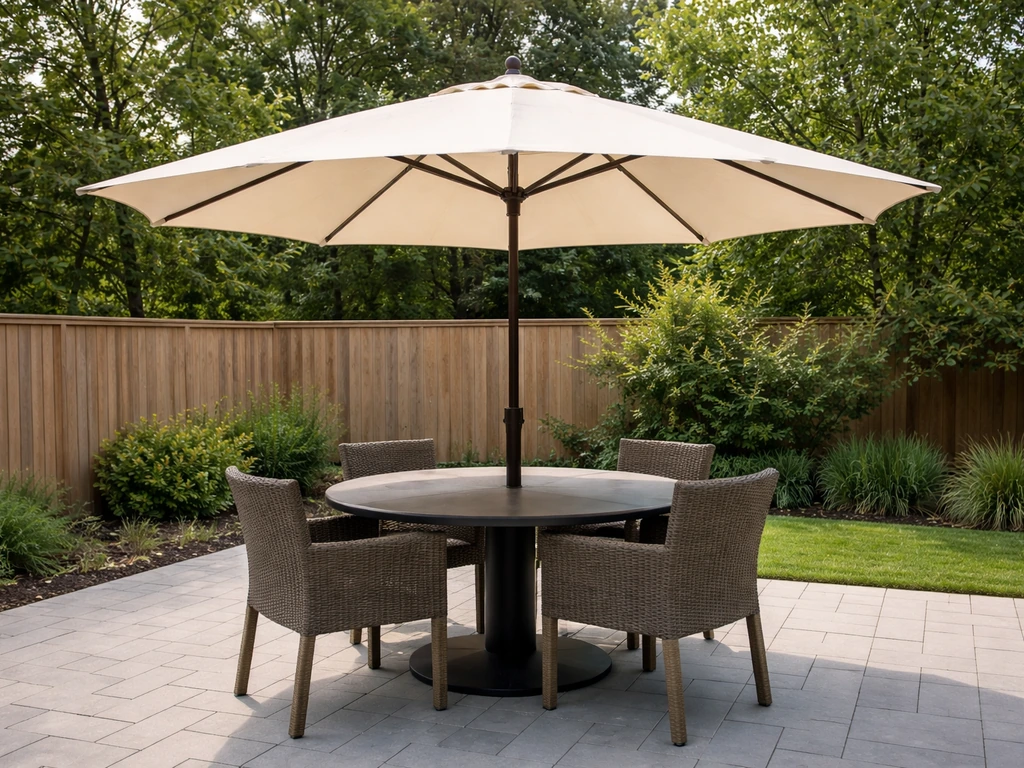
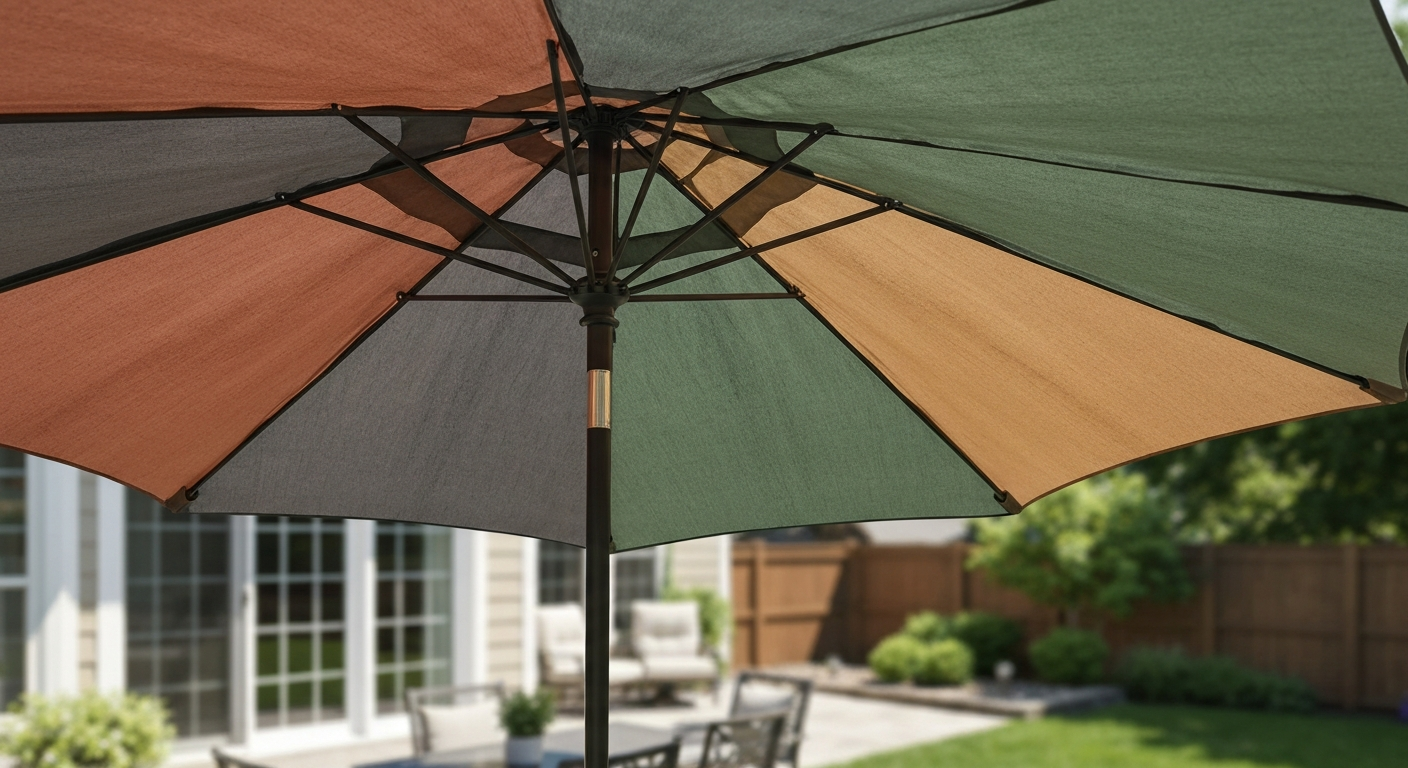
The color that fades the least on a patio umbrella is not actually determined by the hue itself, it is determined by how and where the dye was applied. That said, among color families, earthy mid-tones like terracotta, slate blue, forest green, taupe, and warm tan consistently hold their appearance longer than bright primaries or deep jewel tones, especially when printed on solution-dyed acrylic fabric. If you want the most practical answer: choose a medium-value color (not stark white, not saturated red or navy) in a solution-dyed acrylic or solution-dyed olefin fabric, and you will get noticeably better color retention than almost any other combination.
What Color Patio Umbrella Fades the Least: Best Choices
Kent Lang
12 Aug 2026
Why color and fabric type both matter, and which one matters more
Most people start this question thinking about color, and that is a reasonable instinct. But after testing and reviewing patio umbrellas across many seasons, the biggest lesson is that the fabric construction and dyeing process dwarf color choice when it comes to actual fade resistance. A deep navy solution-dyed acrylic will outlast a pale beige top-dyed polyester by years, even though the navy appears to fade more dramatically when it does eventually change. Color choice shapes how fading looks and how noticeable it is, fabric and dye technology determine how much fading actually happens at the molecular level.
The physics and chemistry behind why umbrellas fade
Fading is fundamentally a photochemical problem. When ultraviolet radiation from the sun hits a dyed fabric, it transfers energy to the dye molecules. That energy breaks the chemical bonds in the dye's chromophore, the part of the molecule that absorbs specific wavelengths of visible light and gives a color its appearance. When enough bonds are broken, the dye either stops absorbing the same wavelengths or absorbs different ones, and what you see is a washed-out, shifted, or bleached-looking canopy.
Heat accelerates this process significantly. High surface temperatures increase molecular mobility and speed up the oxidative reactions that degrade dye chromophores. Moisture compounds the problem further: water can act as a carrier that moves degradation byproducts through the fabric and can itself participate in hydrolysis reactions that break down certain dye-fiber bonds. This is why an umbrella left out through rain, heat, and direct afternoon sun in a hot climate degrades far faster than the same umbrella in a cooler, drier climate.
It is worth separating two things that look the same from a distance: visible color loss and chemical dye destruction. Visible fading can happen even when the dye is chemically intact, simply because surface soiling, chalking of fiber finishes, or physical abrasion changes how light reflects off the canopy. True chemical fading (photodegradation) is measured using color difference in CIE Lab* color space, where a Delta-E (ΔE) value of 0 means no measurable change and larger values represent greater objective color shift. Even a ΔE of 3-5 is noticeable to the human eye under direct comparison, which is why standardized testing matters. For example, ASTM G154 & accelerated weathering explanation (Q‑Lab) describes fluorescent UV and xenon‑arc accelerated tests that report exposure in hours/AFUs and use control standards like Blue Wool to estimate outdoor colorfastness.
How fabric construction and finishes affect fading
Weave density plays a supporting role. A tighter weave means each yarn is partially shielded by adjacent yarns, reducing direct UV exposure per fiber. Most quality outdoor umbrella canopies use a relatively tight plain or twill weave for exactly this reason. A loose open weave, common in cheaper beach umbrellas, exposes more fiber surface area per square inch to UV radiation and tends to degrade faster.
UV inhibitors and stabilizers are the other major variable in construction. These include UV absorbers (benzotriazoles and benzophenones are the most common), which intercept UV photons before they reach the dye molecule, and hindered amine light stabilizers (HALS), which are radical scavengers that interrupt the oxidative chain reactions that degrade both dye and polymer. When these are incorporated into the fiber itself (as happens in solution-dyed processes) rather than applied as a surface finish, they do not wash or abrade away over time. Surface-applied UV coatings do provide initial protection but diminish with cleaning, UV exposure, and weathering. One important nuance from the research: the effectiveness of a UV absorber varies depending on the specific dye chemistry and shade depth, so there is no single additive that protects every color equally well.
Water repellent finishes (typically fluorocarbon or silicone-based) are primarily about moisture management, but they do indirectly help with fading by preventing moisture-assisted dye degradation and reducing the growth of mildew that can discolor fabric. These finishes can be refreshed with spray-on DWR (durable water repellent) products as the original treatment wears off.
Solution-dyed vs. top-dyed: the most important distinction you can make
The single most impactful factor in fade resistance is where the dye lives in relation to the fiber. In solution-dyed (also called mass-dyed or dope-dyed) fabrics, pigment is mixed directly into the liquid polymer before it is extruded into yarn. The color is literally built into the fiber from the inside out. In top-dyed or piece-dyed fabrics, undyed yarn is woven into fabric first, and then the dye is applied to the surface or soaked in afterward. That surface or near-surface dye is far more vulnerable to UV and moisture than pigment locked inside the fiber structure.
Brands like Sunbrella and Outdura use solution-dyed acrylic. Dickson-Constant's SEAMARK line uses solution-dyed processes and publishes AATCC colorfastness grades of 4 to 5 out of 5 on their technical datasheets, backing those numbers with 5 to 10 year limited warranties against color variation under normal outdoor exposure. AATCC Test Method TM16 (Colorfastness to Light) is the standard laboratory procedure used to quantify lightfastness and compare outdoor fabrics’ fade resistance under accelerated exposure AATCC 16 Colorfastness to Light – AATCC Test Methods (AATCC). That kind of documented, testable performance is what separates genuine outdoor fabrics from general-purpose polyester that happens to be sold with an outdoor umbrella.
Fabric comparison: solution-dyed acrylic, olefin, and polyester
| Fabric Type | Dyeing Method | Fade Resistance | Typical Warranty | Key Tradeoffs |
|---|---|---|---|---|
| Solution-dyed acrylic (e.g., Sunbrella) | Pigment in polymer before extrusion | Excellent — AATCC grade 4-5 | 5–10 years (color) | Higher cost; heavier than polyester |
| Solution-dyed olefin / polypropylene | Pigment in polymer before extrusion | Very good — comparable to acrylic | 3–5 years typical | Less soft hand feel; lower melting point |
| Solution-dyed polyester | Pigment in polymer before extrusion | Good — better than top-dyed polyester | 1–3 years typical | Moderate UV resistance; value option |
| Top-dyed / piece-dyed polyester | Dye applied to surface after weaving | Fair to poor | Often none or <1 year | Inexpensive; fades noticeably within 1-2 seasons |
| Olefin (conventionally dyed) | Surface or solution varies by brand | Moderate — check specs | Varies | Low moisture absorption is a plus |
Solution-dyed acrylic is the benchmark for patio umbrella canopies. It is not cheap, but it is genuinely the best performing fabric for long-term outdoor color retention by a meaningful margin. Solution-dyed olefin is a legitimate runner-up, especially at mid-price points. Standard polyester, the fabric used on most umbrellas under $80, starts fading noticeably within one to two seasons in sunny climates, regardless of color choice.
What to look for when buying: materials and construction priorities
Before you even think about color, run through this checklist when evaluating any umbrella canopy: For step-by-step buying advice, see our guide on how to choose a patio umbrella.
- Look for "solution-dyed" or "mass-dyed" in the fabric description — not just "UV-resistant" or "fade-resistant," which are vague marketing terms.
- Check for a named fabric brand: Sunbrella, Outdura, Dickson, Phifer Sheerweave, or equivalent commercial awning fabric indicates a product with documented performance.
- Look for an AATCC lightfastness rating or reference to AATCC Test Method 16 testing. A grade of 4 or 5 is what you want for outdoor exposure.
- Check the warranty specifically for color: a legitimate fade warranty of 5 years or more signals the manufacturer has confidence in the dyeing process.
- Verify whether UV inhibitors or stabilizers are incorporated into the fiber (not just applied as a surface treatment).
- Examine weave density in person if possible — a tighter, heavier canopy fabric generally holds up better than thin, lightweight material.
Color families that hold up best over time
Given a quality fabric system, certain color families consistently show less visible change over multiple seasons. For specific recommendations on the best color for patio umbrella, see our detailed guide on choosing durable, low-fade hues for outdoor canopies. The underlying reason is a combination of dye chemistry stability and how the human eye perceives color shifts in those hues.
- Earthy neutrals: taupe, tan, sand, warm gray, and greige tones use pigment blends that tend to be chemically stable, and any shift toward a slightly lighter or more muted tone reads as natural aging rather than obvious bleaching.
- Forest and sage greens: mid-tone greens formulated for outdoor use use pigment systems that hold well; avoid vivid lime or chartreuse greens, which rely on less stable yellow chromophores.
- Slate and dusty blues: mid-value, slightly desaturated blues (think coastal or slate, not electric or royal) use phthalocyanine-based pigments that are among the most lightfast available.
- Terracotta and rust tones: iron-oxide based pigments used in these palettes are inherently photostable and age gracefully, often looking intentionally weathered rather than faded.
- Off-white and cream: these show less contrast change than pure white when the surface begins to yellow or chalk, though they still show dirt more readily.
What these colors share is either inherently photostable pigment chemistry or a mid-value tonal range where gradual lightening is less visually dramatic. On a solution-dyed acrylic canopy, any of these colors should remain recognizable and attractive after five or more years of outdoor use.
Colors that tend to fade fastest, and why
Bright, highly saturated hues are almost universally the worst performers. The problem is partly chemistry and partly optics. Achieving vivid red, orange, or bright yellow often requires dye families (including certain anthraquinone-type disperse dyes and azo dyes) that have lower intrinsic lightfastness. Laboratory research on anthraquinone disperse dyes on polyester, for example, shows photodegradation that is both dye-type and substrate-dependent, meaning the same vivid color can fade at very different rates depending on the fiber it is on.
- Bright red and coral: red pigments and dyes are notoriously difficult to stabilize; many reds shift toward pink or orange within a season or two on lower-grade fabrics.
- Vivid yellow and golden yellow: yellow chromophores are among the least lightfast in the spectrum, which is why yellows often fade first in multi-color prints.
- Deep navy and black: these colors do not necessarily fade faster chemically, but the contrast between the original deep saturated tone and any fading is immediately visible; even a small ΔE registers as obvious bleaching or patchiness.
- Bright turquoise and teal: these rely on combinations of blue and yellow dye systems; if the yellow component degrades first, the color shifts noticeably toward blue or green.
- Pure white: while technically having no dye to lose, white canopies are vulnerable to yellowing from UV degradation of the fabric polymer itself and show soiling very clearly.
The perception issue with dark colors is worth expanding on. Dark navy or charcoal may show a ΔE of 4-6 after a season of intense sun, while a tan canopy might show a ΔE of 2-3. The tan still looks great; the navy looks obviously faded. On higher-end solution-dyed acrylics, even deep navies and blacks hold up well, but they require a better quality fabric to stay looking fresh than a neutral tone does.
Balancing fade resistance with sun protection and staying cool
Color choice has a real effect on how hot you feel sitting under an umbrella, and that is worth factoring into the decision alongside fade resistance. For guidance on which hues keep you coolest, see our guide on what color patio umbrella is coolest. Darker colors absorb more solar radiation and re-radiate heat downward, which means a deep navy or charcoal canopy creates a noticeably warmer microclimate underneath on a hot day. Light colors and white canopies reflect more visible light and tend to feel cooler, but they can also increase glare if the sun angle bounces light toward your seating area.
Research from Lawrence Berkeley National Laboratory on cool color technology shows that specially formulated pigments can be designed to reflect near-infrared (NIR) radiation while maintaining a dark visible hue, meaning a dark color does not necessarily have to absorb as much solar heat as a conventional pigment would. Some higher-end outdoor fabric manufacturers are beginning to incorporate this kind of NIR-reflective pigment technology. If thermal comfort is a priority alongside fade resistance, look for fabrics specifically marketed as "cool roof" or "NIR-reflective" in addition to their lightfastness ratings.
On the UV protection side, canopy color has less impact than fabric density and weave. A tightly woven fabric blocks UV regardless of color, and UPF ratings are primarily a function of construction rather than hue. That said, darker colors do absorb UV photons rather than transmitting them, which means less UV reaches you sitting underneath, but the difference between a well-constructed light canopy and a dark one is minimal. For a focused discussion on how color affects UV protection and cooling, see what color patio umbrella is best for sun protection. If UV protection is the main concern, that is a separate topic worth exploring.
How fading actually looks: light colors vs. dark colors and the role of pattern
The way fading appears visually depends enormously on the starting color. A mid-tone sand or sage green that fades slightly just looks a little more muted, which most people find acceptable, even pleasant, as a weathered aesthetic. A vivid cobalt blue that fades patches to a chalky medium blue looks damaged and old. A stark white that yellows or grays reads as dirty even if it is perfectly clean. This is not just an impression: the eye is calibrated to the original color, and any shift in a high-contrast or saturated starting point is disproportionately noticeable.
Patterns and textures add useful camouflage. A woven stripe, jacquard weave, or multi-color print distributes the visual impact of fading across multiple tones rather than concentrating it in one solid field. An umbrella that fades from a bold stripe to a slightly softer stripe reads as aged; the same umbrella in solid cobalt reads as a different umbrella. This is a real practical advantage worth factoring in if longevity of appearance is important. Heathered yarns work similarly, the blended color variation built into the fabric absorbs visual change over time.
Uniformity of fading matters too. An umbrella that sees consistent sun exposure across the whole canopy fades evenly and continues to look coherent. One that sits in partial shade, where one panel gets full afternoon sun and another stays shaded, develops uneven fading that looks far worse than overall gradual lightening. If your setup creates this kind of uneven exposure, rotating the umbrella periodically helps significantly.
Practical maintenance steps to slow fading
Even the best solution-dyed acrylic canopy benefits from consistent care. These habits make a measurable difference in how long a canopy looks good:
- Close the umbrella when not in use. This is the single most effective thing you can do — it dramatically reduces cumulative UV exposure.
- Store the canopy indoors or in a breathable cover during extended non-use periods, especially over winter.
- Clean it regularly with mild soap and water; use a soft brush, rinse thoroughly, and let it dry fully before closing. Mildew accelerates fiber degradation and is far easier to prevent than remove.
- Avoid harsh detergents, bleach, or pressure washers — these strip UV-protective finishes and can damage fiber structure even in solution-dyed fabrics.
- Reapply a spray DWR treatment once a year or when water stops beading on the surface; this restores moisture resistance and helps prevent the moisture-assisted dye degradation discussed earlier.
- Position the umbrella to avoid concentrated heat sources like reflected heat from light-colored paving or nearby glass, which can accelerate thermal degradation.
- If possible, orient the umbrella so exposure is consistent across panels, or rotate periodically to prevent uneven fading.
A quick buying decision framework
Putting it all together, here is the practical hierarchy for choosing a patio umbrella that holds color as long as possible: For a short list of recommended models, see our guide to the best fade-resistant patio umbrellas.
- First, prioritize fabric: choose solution-dyed acrylic or solution-dyed olefin over generic polyester. This matters more than any other single decision.
- Second, verify the dyeing process: look for "solution-dyed" explicitly on the product or spec sheet. "UV-resistant" without that qualifier is not the same thing.
- Third, check documented performance: AATCC lightfastness grade 4-5 and a manufacturer warranty of at least 5 years for color are reliable indicators of actual performance.
- Fourth, choose a color in the mid-tone, low-saturation range: terracotta, sage, slate, tan, or similar earthy neutrals will show fading the least visually over time.
- Fifth, consider a stripe or multi-tone pattern if aesthetics matter long-term: patterns age more gracefully than solids.
- Finally, commit to basic care: even a great canopy degrades faster without routine cleaning, storage, and closing when not in use.
The honest takeaway is that no patio umbrella is completely immune to fading, even the best Sunbrella canopy will shift slightly over years of intense outdoor exposure. The goal is to minimize that change and keep it even and gradual rather than patchy and obvious. Get the fabric right, choose a forgiving color, and take care of it, and a quality umbrella should look genuinely good for a decade or more. For recommendations on specific models and fabrics that resist fading, see patio umbrella that will not fade. For specific guidance on matching shade, maintenance, and appearance trade-offs, see our guide on how to choose patio umbrella color.
FAQ
What color patio umbrella fades the least?
The color that fades the least is the one made from a high‑performance, solution‑dyed outdoor fabric (e.g., solution‑dyed acrylic or solution‑dyed polyester) rather than any specific visible hue. Among colors, neutrals and medium‑valued shades (beiges, tans, medium grays) generally show less noticeable fading over time because visual change is less obvious than on very dark or highly saturated colors. But fabric construction and dye process are the dominant factors — choose solution‑dyed fabric with proven lightfastness and a fade warranty.
Why does fabric/dye type matter more than the visible color for fading?
Fading is a chemical/physical process driven by photodegradation of dye chromophores and polymer hosts under UV, oxygen, heat and moisture. Solution‑dyeing embeds pigment into the fiber mass (not just the surface) and allows incorporation of UV stabilizers during fiber manufacture, so color loss is far slower. Surface‑dyed or piece‑dyed fabrics and topical finishes are more vulnerable because the colorant sits on or only near the surface and can be degraded or washed out more readily.
What are the main physical and chemical mechanisms of fading?
Photofading occurs when UV and high‑energy visible light break chemical bonds in dye molecules (chromophores), producing colorless or different‑colored fragments. Oxidation, hydrolysis, and thermal effects accelerate breakdown. The polymer/fiber can also degrade, altering dye binding. Environmental factors (UV spectrum, oxygen, humidity, temperature) and dye chemistry determine the rate and appearance of fading.
Which umbrella fabric types are most fade‑resistant?
Most fade‑resistant options: solution‑dyed acrylic (e.g., Sunbrella and similar awning grades), high‑quality solution‑dyed polyester, and engineered olefin/polypropylene textiles designed for outdoor use. Look for manufacturer technical data showing AATCC/ISO lightfastness or accelerated weathering results and multi‑year color warranties.
How do solution‑dyed acrylic, olefin and polyester compare?
Solution‑dyed acrylic: excellent outdoor colorfastness when manufactured for awnings/upholstery; resists UV and mildew, often carries 5–10 year limited color warranties. Olefin/polypropylene: good UV resistance and low moisture absorption; colorfastness varies by grade and additive package. Solution‑dyed polyester: can be very good if formulated for exterior use, but some lower‑grade polyesters fade faster than acrylics. Avoid surface/tube‑dyed or cheaply piece‑dyed fabrics for long‑term exposure.
Which visible colors hold up best and which fade fastest?
Best: medium neutrals (beige, tan, light–medium gray) and some engineered light colors — they show less noticeable visual change. Worst (most noticeable fading): very dark, highly saturated colors (deep reds, navy, black, emerald) and some bright pigments (especially certain reds and yellows) because photochemical loss or bleaching produces obvious contrast. Note: a technically UV‑stable deep color can still hold up very well if the fabric/dye system is high quality.