For most Canadian backyards and balconies, the best wind-resistant patio umbrella is a vented market-style umbrella with an aluminum or fiberglass frame, at least 8 ribs, and a minimum 50 lb base, with a cantilever as the upgrade pick for larger patios where you need shade without a center pole. Models from Treasure Garden, Hampton Bay (Home Depot Canada), and mid-range Sunbrella-fabric options on Wayfair.ca cover most budgets, and any of them will hold up in the 30–50 km/h gusts that are routine across the Prairies, Atlantic coast, and southern BC. The single biggest upgrade you can make is not the umbrella itself but the base: most wind failures in residential settings trace back to an under-weighted base, not a broken frame.
Best Patio Umbrella for Wind in Canada: Top Picks & Balcony Guide

Kent Lang
30 Jul 2026
Our picks at a glance
These are category recommendations based on what is actually sold through Canadian retailers as of mid-2026, what specs look like at each price point, and how the designs hold up in wind based on manufacturer test data and independent assessments. None of these are affiliate picks, the point is to give you a framework so you can verify current pricing and availability yourself before buying.
| Category | Style | Key wind feature | Canopy size | Budget tier (CAD) | Where to find in Canada |
|---|---|---|---|---|---|
| Best overall | Vented market umbrella, aluminum frame | Double-vent canopy, 8+ fiberglass ribs | 9–10 ft | $150–$300 | Home Depot Canada, Wayfair.ca |
| Best cantilever/offset | Offset cantilever, cross base | Auto-tilt, vented top, steel or aluminum pole | 10–13 ft | $350–$700 | Wayfair.ca, Home Depot Canada |
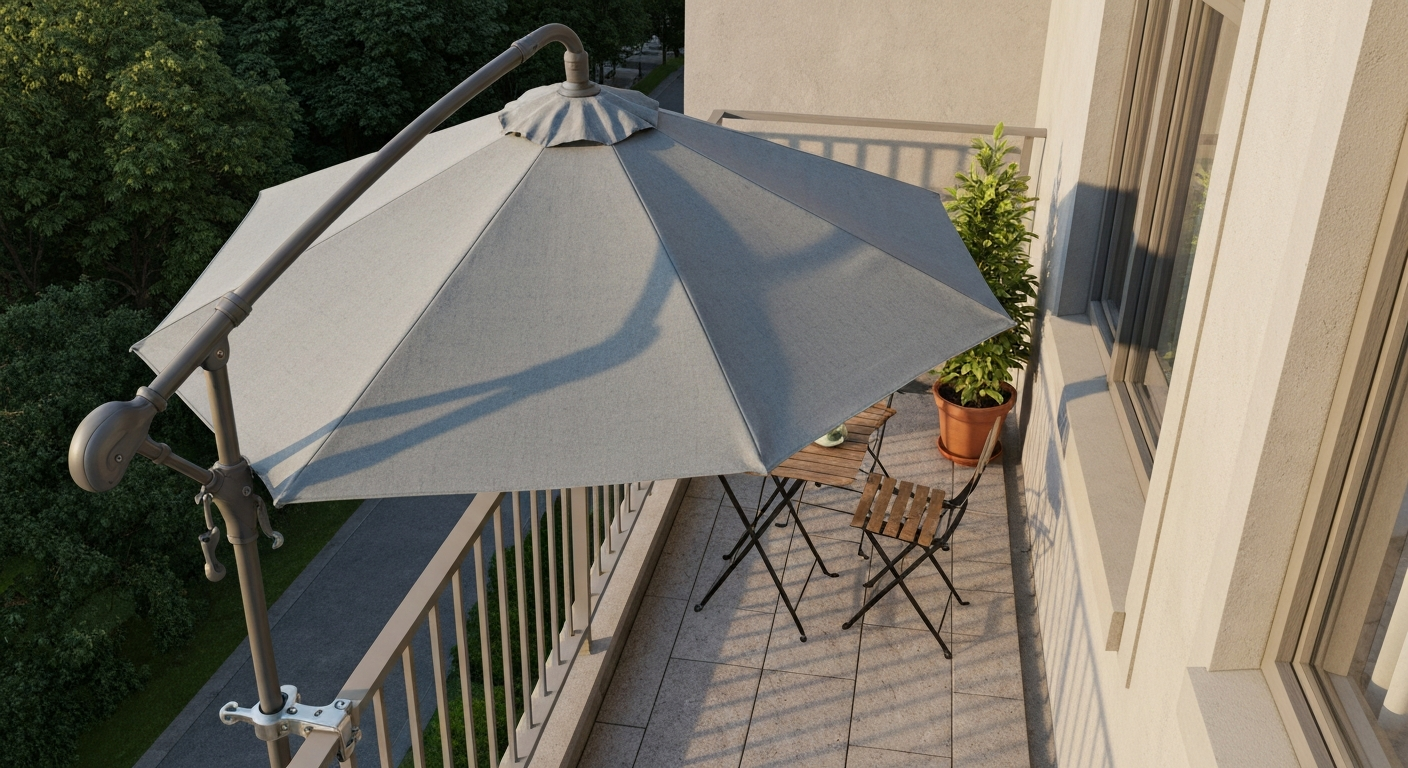
| Best for balconies | Compact market or clamp-mount, 6–7.5 ft | Lightweight frame, tilt, small base or rail clamp | 6–7.5 ft | $80–$200 | IKEA Canada, Walmart Canada, Amazon.ca |
| Budget pick | Basic market umbrella, steel frame | Single vent, 8 ribs, push-button tilt | 9 ft | $60–$120 | Walmart Canada, Amazon.ca |
| Premium pick | Sunbrella-fabric market or cantilever | Double vent, Sunbrella acrylic canopy, fiberglass ribs | 10–11 ft | $400–$900+ | Wayfair.ca, specialty patio retailers |
A quick note on budget: the $60–$120 tier will get you through a season or two in moderate conditions, but the frames are usually steel (heavier, prone to rust at joints) and the canopy fabric is polyester that fades and degrades faster under UV. If you are on a balcony with frequent gusts above 40 km/h, spending $200–$350 on a mid-range aluminum-frame model with fiberglass ribs is genuinely worth it. The premium Sunbrella tier is mostly justified by fabric longevity (Sunbrella carries a 5-year fade warranty) rather than dramatically better wind performance.
Why wind resistance actually matters in Canada
Canada is not a gentle-wind country. blank" rel="noopener noreferrer">Environment and Climate Change Canada's adjusted historical wind data (AHCCD) shows mean annual wind speeds at 10 m height ranging from about 14 km/h in sheltered southern Ontario locations to over 20 km/h along coastal BC, the Prairies, and Atlantic Canada. Gust events are significantly higher: summer thunderstorm outflows on the Prairies routinely hit 60–80 km/h, and Atlantic Canada gets sustained winds well above 50 km/h during fall and winter storms. Even Toronto and Vancouver see frequent afternoon gusts in the 40–55 km/h range during shoulder seasons.
The real risk is not just a broken umbrella. An unsecured patio umbrella in a 50 km/h gust becomes a projectile. The CPSC has issued safety alerts specifically about airborne beach and patio umbrellas causing serious injuries and fatalities, and the physics are straightforward: a 9 ft (2. The CPSC Safety Alert, Beware! Airborne Beach Umbrellas Can Kill (May 2024) documents serious injuries and fatalities from flying umbrellas and recommends securement levels (e.g., about 75 lb resisting force or anchors rated to hold against ~30 mph gusts) blank" rel="noopener noreferrer">CPSC Safety Alert — Beware! Airborne Beach Umbrellas Can Kill (May 2024). 7 m) umbrella canopy has roughly 4–5 square metres of surface area. At 50 km/h, using the basic wind-pressure formula (q = 0.5 × ρ × V²), that translates to dynamic pressure of about 116 Pa, meaning roughly 460–580 N of lateral force on the canopy, or close to 60 lbs of push. An under-weighted base does not stand a chance.
Balcony dwellers face an additional layer of risk. You are not just worried about the umbrella falling over on your deck, you are worried about it going over the railing and landing on people or property below. On an upper-floor condo balcony, a 15 kg umbrella and base in freefall is a serious hazard. That is why anchoring solutions and base weight requirements for balconies need to be taken seriously, not treated as optional.
Regional wind patterns to know
- Prairies (AB, SK, MB): Frequent sustained winds 20–30 km/h with summer storm gusts to 80+ km/h. Chinook winds in southern Alberta can hit 100 km/h. Cantilever umbrellas require very heavy bases here.
- Coastal BC: Persistent marine winds, especially in fall and winter. Summer afternoons in Greater Vancouver can gust to 40–50 km/h. Corrosion resistance matters as much as wind resistance.
- Atlantic Canada (NS, NB, NL, PEI): Highest mean wind speeds in the country. Open-yard umbrellas without 75+ lb bases are genuinely dangerous here from late summer through fall.
- Central Canada (ON, QC): Thunderstorm outflows bring sudden gusts. Generally lower mean winds but unpredictable peak events in summer.
- Northern Canada and exposed lakefronts: Wind exposure varies dramatically but elevated sites and lakefronts can see sustained above-average speeds.
Wind ratings explained in plain English
There is no single universal wind-rating standard that all umbrella manufacturers follow, which makes comparison shopping genuinely confusing. For a concise overview of how manufacturers express these values, see our patio umbrella wind rating guide. Here is what actually exists and what it means.
ASTM F3512 is the most relevant standard for residential market umbrellas. It defines a wind-tunnel test method where umbrellas are subjected to progressively higher wind speeds and assessed for structural failure, base displacement, and canopy damage. A manufacturer claiming compliance with ASTM F3512 has had the product tested under a defined protocol, that is more meaningful than a vague '35 mph wind-rated' marketing claim with no test reference. Some premium commercial-grade umbrellas (often sold under brands like Alizé or Tuuci) have published wind-tunnel data showing survival at 60–75 km/h with appropriate bases. Most residential models are realistically in the 40–55 km/h range before failure risk rises significantly.
The Beaufort scale is a useful shorthand. Force 5 (fresh breeze, 29–38 km/h) is where cheaper umbrellas start to flex visibly and budget bases start to shift. Force 6 (strong breeze, 39–49 km/h) is where quality becomes the difference between a stable umbrella and a spinning sail. Force 7 (near gale, 50–61 km/h) is where virtually all residential umbrellas should be closed and secured, regardless of quality. No consumer-grade umbrella is designed for sustained near-gale conditions. Even manufacturers who advertise high wind ratings include a close-in-high-winds instruction in their manuals.
What manufacturers call a 'wind rating' is often the threshold at which the canopy begins to distort or the base begins to move, not a safe operating limit. Think of it as a ceiling, not a target. For everyday use, aim for an umbrella rated at least 15–20 km/h above your typical local gust speed, so you have a meaningful safety margin before you need to rush outside to close it.
The features that actually make an umbrella wind-resistant
Canopy venting
A vented canopy is the single most impactful wind-resistance feature on the canopy itself. A vent is a gap or secondary canopy at the peak that lets air escape upward rather than pushing the whole canopy laterally. Single-vent designs (one opening at the peak) are common in the $100–$300 range and make a real difference. Double-vent designs (two stacked vents) are better and typically appear in mid-range and premium models. Without any venting, air pressure builds under the canopy and creates the sailing effect that flips or spins umbrellas. With a good double vent, that pressure is relieved and the umbrella stays stable at higher wind speeds.
Frame and pole materials
Aluminum is the right choice for most Canadian buyers. It is rust-resistant (important for coastal and high-humidity climates), lighter than steel (easier to move and store seasonally), and strong enough for residential use. Look for a pole diameter of at least 38 mm (1.5 in) for 9–10 ft umbrellas; larger canopies should have 48 mm (1.9 in) poles. Steel frames are heavier and cheaper but corrode at welded joints within a few seasons in wet climates. Wood poles (often teak or eucalyptus) look great but flex more in wind and require annual maintenance, not ideal for high-wind sites.
Ribs: count and material
More ribs means a more evenly supported canopy that distributes wind load better. Eight ribs is the minimum for any wind-exposed site; cheaper umbrellas sometimes have six, which leaves larger unsupported fabric panels that flex and strain the hub under gusts. Fiberglass ribs are better than aluminum ribs in windy conditions because fiberglass flexes without snapping, it acts like a flexible spine rather than a rigid one. Aluminum ribs are strong but can crack at stress points during sharp gusts. You will find fiberglass ribs more commonly in the $200+ range.
Canopy fabric
The fabric needs to be solution-dyed acrylic (like Sunbrella or similar) or high-density polyester with a UV-stabilized coating. Solution-dyed acrylics hold their colour much longer under UV and resist moisture absorption, which means they do not become heavy and saggy in rain, a heavier canopy creates more wind load. Budget polyester fabrics fade within one or two seasons and degrade structurally, making the umbrella less safe over time. For wind-heavy regions, a canopy that stays light and taut is important.
Tilt mechanisms
Auto-tilt (also called push-button tilt or collar tilt) lets you angle the canopy to follow the sun without opening the umbrella or readjusting the whole setup. From a wind standpoint, a tilted canopy presents a different angle to the wind, it can actually reduce lateral wind load on a gusty afternoon by angling the canopy away from the prevailing wind direction. The trade-off is that a tilted canopy also changes how load transfers to the base, so a tilted umbrella requires a heavier base than the same umbrella held vertical.
How different umbrella styles handle wind and rain
Market (center-pole) umbrellas
This is the most common style and generally the most stable in wind, assuming an appropriate base. The center pole transfers wind load straight down through the base, which is the most efficient load path. A well-built 9 ft aluminum market umbrella with a double vent and 60 lb base will handle Canadian summer conditions reliably. For rain, a center-pole umbrella sheds water reasonably well because the canopy is supported evenly, but you do get drips around the center pole opening and the pole area is wet after any rain event. Water pooling is rare with quality fabric but can happen with sagging budget polyester.
Cantilever (offset) umbrellas
Cantilever umbrellas have a lateral arm extending from an off-center pole, which means the canopy hangs over a space without a center support. This is fantastic for shade flexibility but creates a significant mechanical disadvantage in wind: the arm acts as a lever, multiplying the wind force felt at the base. A cantilever umbrella that is stable in the same wind as a market umbrella typically needs a base that weighs two to three times as much, manufacturer specs often call for 150–400 lb ballast for 11–13 ft cantilever canopies. If you do not take base weight seriously with a cantilever, you will flip it in a moderate gust. For rain, cantilever designs often shed water better because the canopy can be positioned to slope away from seating, but the complex hinge and tilt mechanisms can collect water and corrode if not maintained.
Small balcony and compact umbrellas
A 6–7.5 ft market umbrella or a purpose-built balcony umbrella (sometimes called a rectangle umbrella or half umbrella) is the right starting point for balcony use. Smaller canopy area means proportionally less wind load, which makes anchoring more manageable. However, balcony umbrellas face a unique challenge: you often cannot use a heavy freestanding base because the floor load capacity of a balcony slab is limited (more on this in the balcony section below), so anchoring to the railing or wall becomes necessary. A compact umbrella with a railing clamp mount eliminates the base-weight problem but introduces its own structural requirements.
Size guidance: matching diameter and height to your wind exposure
Bigger is not always better when wind is the primary concern. A larger canopy creates more surface area and therefore more wind load. A 13 ft cantilever canopy has roughly twice the area of a 9 ft market umbrella, which means roughly twice the lateral wind force at any given wind speed. If you are in a high-wind zone (coastal BC, Prairies, Atlantic Canada), there is a real argument for choosing a 9–10 ft umbrella and getting the coverage right through positioning, rather than buying a 13 ft model and fighting the base-weight requirements.
| Canopy diameter | Approx. canopy area | Recommended min. base weight (market) | Recommended min. base weight (cantilever) | Realistic max. gust (vented, quality frame) |
|---|---|---|---|---|
| 7.5 ft (2.3 m) | ~4.4 m² | 30–40 lb (14–18 kg) | N/A (style rare at this size) | 50–55 km/h |
| 9 ft (2.7 m) | ~5.7 m² | 50–60 lb (23–27 kg) | ~150 lb (68 kg) | 45–55 km/h |
| 10 ft (3.0 m) | ~7.1 m² | 60–75 lb (27–34 kg) | ~175–200 lb (80–90 kg) | 40–50 km/h |
| 11 ft (3.4 m) | ~9.5 m² | 75–100 lb (34–45 kg) | ~250–300 lb (113–136 kg) | 35–45 km/h |
| 13 ft (4.0 m) | ~12.6 m² | 100–130 lb (45–59 kg) | ~350–400 lb (159–181 kg) | 30–40 km/h |
Height is less discussed but matters for wind exposure. A taller umbrella pole puts the canopy in faster-moving air, wind speed increases with height above ground, a phenomenon well-documented in the NBCC structural wind-load calculations. For a first-floor patio at ground level, the difference is minor. For a rooftop patio or an elevated deck, a shorter umbrella (with a lower canopy height) will sit in slower-moving air near the surface boundary layer and will be more stable than a tall one.
For rain coverage, larger is better because rain falls at an angle in wind. A 9 ft umbrella in a 20 km/h wind with rain provides effective coverage over roughly a 6–7 ft area, not the full 9 ft, because the rain is blowing laterally. A 10–11 ft umbrella gives you a meaningful buffer here. The trade-off, again, is higher wind load requiring a heavier base.
Balcony constraints and anchoring solutions
Balcony umbrella use in Canada involves more constraints than most product listings acknowledge. If you live in a condo or apartment, three layers of rules apply simultaneously: the National Building Code of Canada (NBCC) and your provincial building code set structural limits; your municipality may have specific bylaws about balcony projections and fixtures; and your condo corporation or strata council will have bylaws about what you can attach to, hang from, or install on a balcony. Checking all three before buying a mounting system is not optional, it is how you avoid a fine, a strata dispute, or a serious accident.
Freestanding bases on balconies
The instinct is to buy a big heavy base and put it on the balcony. The problem is that balcony slabs are designed for distributed live loads (typically 1.9–4.8 kPa or about 40–100 lb/ft² depending on jurisdiction and use), and a single 100 lb base concentrated on a small foot plate creates a point load that can exceed local slab capacity, especially on older concrete balconies. As a general rule, keep freestanding bases to 50 lb or less on typical residential balconies unless you have confirmed the structural capacity. Use a smaller canopy (7.5 ft or under) so the wind loads are proportionally lower and a lighter base remains adequate.
Railing clamps
A railing clamp mount attaches the umbrella pole directly to the balcony railing, eliminating the need for a floor base entirely. This is the most common solution for condo balconies and works well for umbrellas up to about 7.5 ft. The critical requirements are that the clamp is rated for the umbrella's wind load, that it fits your railing profile (round, square, or flat-top rails each need different clamp styles), and that your railing itself is structurally sound enough to handle the additional lateral force. Many condo balcony railings are designed to resist lateral loads from people leaning on them, not from umbrella wind loads applied at height. If your railing wobbles or is glass-panel type, a clamp mount may not be appropriate.
Through-deck anchors and wall mounts
Through-deck anchors (a sleeve bolted through the deck surface into the structure below) offer the most secure connection for a high-wind site. However, they require drilling into the balcony slab or deck, which almost always requires strata or condo corporation approval and, depending on the scope, a building permit. Wall-mount brackets attach the umbrella pole to an exterior wall and are similarly effective but involve attaching to the building structure, which is governed by the NBCC and provincial codes. Both solutions are genuinely worth pursuing if you are on an exposed high-rise balcony, they are the only anchoring methods that reliably keep an umbrella in place above 50 km/h gusts.
A note on condo and strata bylaws
The Canadian Condominium Institute (CCI-National) and provincial strata management organizations publish guidance on unit owner responsibilities and modifications. The vast majority of condo bylaws prohibit permanent alterations to balconies without written approval from the corporation. Even a railing clamp that leaves no permanent marks may technically require approval in some buildings. Get it in writing before you install anything.
Base and ballast: getting this right matters more than the umbrella itself
I cannot stress this enough: base failure is the most common cause of wind incidents with patio umbrellas. Wind-tunnel testing documented by manufacturers like Alizé, and independent assessments referenced by Consumer Reports, consistently show that the base tips or slides long before the umbrella frame or canopy fails. A well-built umbrella on an under-weighted base will fail in conditions that a cheap umbrella on the right base would handle fine.
For a ground-level patio with a 9–10 ft market umbrella, use a base weighing at least 50–60 lb (23–27 kg). Fill-style plastic bases (designed to be filled with sand or water) are acceptable but sand is significantly better than water, sand-filled bases hold roughly 1.4 times the weight of the same volume of water and do not freeze-crack in Canadian winters the way water-filled bases do. If your umbrella pole sits in a table with an umbrella hole, make sure the table itself is weighted or anchored, a glass-top patio table on light legs provides almost no base resistance and can be tipped entirely.
For cantilever umbrellas, follow the manufacturer's minimum base weight spec precisely, and when in doubt, go heavier. Treasure Garden, for example, specifies minimum base weights of 130–400 lb depending on the model and canopy size, and those numbers are based on actual testing. The cross-base designs that come with most cantilever umbrellas are not adequate on their own, they need to be loaded with weight plates or a purpose-built weighted base.
Maintenance, storage, and staying safe seasonally
Canadian climate puts umbrellas through genuine stress. UV radiation in summer (especially at elevation or in high-albedo environments like near water or light-coloured decks) degrades both canopy fabric and frame coatings. Freeze-thaw cycles crack hub joints and rust steel components. Ice loading on an open or partially-open umbrella in early or late season is a real risk, wet snow accumulating on a canopy can add 20–40 kg quickly, collapsing ribs or tipping the base.
- Close and strap the umbrella any time wind is forecast above 40 km/h or when you are leaving for more than a few hours. This single habit prevents the vast majority of wind incidents.
- Bring the umbrella inside or store it with a protective cover over winter. Outdoor storage of an uncovered umbrella through a Canadian winter dramatically shortens its lifespan.
- Check hub joints, rib connections, and the pole for corrosion or cracks at the start of each season. A cracked rib or corroded joint fails catastrophically under gust loads rather than gradually.
- Clean canopy fabric mid-season with mild soap and water. For Sunbrella and similar solution-dyed acrylics, a light brush and rinse removes mildew spores that degrade the fabric if left unchecked.
- Lubricate tilt mechanisms and the crank with a silicone-based spray annually. Seized cranks lead to forcing the mechanism, which cracks hubs.
- If you have a cantilever, check the locking pin or crank-lock mechanism every spring. This is a high-stress point and the part that fails first on cheaper models.
- Never leave an umbrella open and unattended in strong wind. No residential umbrella is designed for sustained gale-force conditions, regardless of what the marketing says.
Buying in Canada: price tiers, where to shop, and what to expect
Canadian retail for patio umbrellas is dominated by a handful of channels, and knowing where each tier lives helps you shop efficiently. Home Depot Canada and Walmart Canada carry the widest range of budget and mid-range options, with most Hampton Bay (Home Depot's house brand) umbrellas falling in the $100–$350 range and carrying reasonable warranty support through Canadian stores. Wayfair.ca has the deepest selection in the mid and premium tiers, with Sunbrella-fabric cantilevers starting around $400–$500 CAD. IKEA Canada's LINDÖJA system is worth considering for balcony use, affordable, modular, and widely available, though fabric and frame quality is below the mid-range tier. Amazon.ca carries a wide range but return logistics for large items can be complicated; prioritize sellers with Canadian warehouse locations for easier returns.
| Budget tier | Approx. price range (CAD) | What you get | What you give up | Best for |
|---|---|---|---|---|
| Entry | $60–$120 | Steel or aluminum frame, polyester canopy, 6–8 ribs, single vent or no vent, basic push-tilt | Durability (2–3 seasons), wind resistance, UV longevity | Occasional use, sheltered patios, renters |
| Mid-range | $150–$350 | Aluminum frame, 8+ ribs, fiberglass ribs on better models, single or double vent, push-button tilt, better polyester or entry acrylic fabric | Sunbrella-level fabric longevity, premium hub quality | Most Canadian homeowners, moderate wind exposure |
| Premium | $400–$900+ | Aluminum or powder-coated steel frame, fiberglass ribs, Sunbrella or equivalent acrylic canopy, double vent, auto-tilt, 5-year fabric warranty | Price, availability (often order-only) | High-wind zones, permanent installations, long-term value |
One Canadian-specific note: import duties and cross-border shipping add cost to US-only retailers. Stick to retailers with Canadian distribution (Home Depot Canada, Wayfair.ca, IKEA Canada, Walmart Canada, Amazon.ca with Canadian sellers) to avoid surprise brokerage fees, especially on large items. Many patio umbrella manufacturers ship from US warehouses and the brokerage charges can add $40–$80 CAD to an order.
Quick buying checklist before you order
Before you click buy, run through these checks to make sure you are getting the right umbrella for your actual conditions. For product-specific recommendations, see our guide to the best patio umbrella for wind.
- Check your region's typical summer gust speeds via Environment Canada's historical data. Look for the 90th percentile gust speed, not the mean wind speed.
- Measure your usable space and choose a canopy diameter that fits with at least 2 ft clearance on each side from furniture, walls, or railings.
- Confirm the pole diameter matches your existing base hole, or budget for a compatible new base at the right weight.
- For balconies: check your strata or condo bylaws before buying a wall mount or through-deck anchor. For railing clamps, confirm your railing profile and load capacity.
- Verify the umbrella has at least one vent (double vent preferred) and 8+ ribs. If the listing does not mention rib count or venting, contact the retailer or skip it.
- Check the frame material. Aluminum or fiberglass ribs are better than steel for coastal or high-humidity sites.
- Look for a weight or ballast specification in the product details. If the manufacturer does not list a minimum base weight, that is a red flag.
- Confirm the canopy fabric: solution-dyed acrylic or UV-coated high-density polyester for longevity. Plain polyester without UV stabilization is a one-to-two season material in Canada.
- Check return policy and warranty: major Canadian retailers generally allow 30–90 day returns on patio furniture. Manufacturer warranties on frames are typically 1–3 years; Sunbrella fabric carries a 5-year warranty.
- Budget for a cover: a quality weatherproof cover adds $20–$50 and meaningfully extends the umbrella's life through a Canadian off-season.
Going deeper on specific topics
This article covers the Canada-specific angle broadly, but several topics deserve more detail depending on your situation. If you want a deeper breakdown of what specific features make a patio umbrella wind-resistant at a technical level, including hub design, rib geometry, and how venting works aerodynamically, that is worth reading through carefully before making a final decision. For a focused technical guide, see our article on what makes a patio umbrella wind-resistant, which explains hub design, rib geometry, venting aerodynamics, and other engineering details. For a concise primer on materials, canopy design, and durability, see our overview of what makes a good patio umbrella. If you are specifically a balcony dweller, the overlap between wind resistance and compact umbrella design is substantial, and understanding what separates a purpose-built balcony umbrella from a downsized market umbrella matters. For a focused comparison of compact, railing‑friendly designs, see our best patio umbrella for balcony guide. For anyone wanting to understand the specific wind-speed numbers that should guide their purchase decision, the question of how much wind a patio umbrella can actually withstand and what patio umbrella wind ratings mean in practice are both topics that go into the engineering side in more detail. And if you want a broader look at the overall Canadian patio umbrella market without the wind-specific filter, a general best patio umbrellas Canada overview covers styles and brands across more use cases. For another relevant comparison, see how much wind can a patio umbrella withstand. For a broader roundup, see our best patio umbrellas Canada buyers' guide for styles, brands, and retailer comparisons. For guidance focused on keeping you dry, see our guide to the best patio umbrella for rain.
FAQ
What are the key research questions to answer when writing a Canada‑focused article on the best patio umbrella for wind?
Identify regional wind climates (coastal BC, Prairies, Central, Atlantic, North) and peak gust statistics; what realistic wind speeds umbrellas should be expected to tolerate; what national and local building codes, condo/strata rules, and balcony load/attachment limits apply; how manufacturers rate wind resistance and what test standards back those ratings; which umbrella features (venting, frame materials, rib count, canopy fabric, tilt/vent designs) measurably improve wind performance; how different umbrella styles and sizes behave in wind and rain; practical anchoring, base and ballast strategies for slab and balcony settings; supplier availability and price tiers in Canada; and recommended maintenance, storage and safety protocols to reduce failure and injury risk.
What authoritative data sources are needed to characterize Canadian wind climates and gust exposures?
Use Environment and Climate Change Canada (ECCC) station‑level hourly and gust observations (Climate Data Online, GeoMet API) for location‑specific hourly/gust statistics, and AHCCD for long‑term mean wind speeds. Supplement with regional climate summaries (provincial/coastal station reports) to capture microclimate differences (coastal gusts, prairie gustiness). These provide the empirical wind speeds to set realistic design/use limits and worked examples.
Which regulatory and code documents must be checked for balcony anchoring and attachment guidance?
Consult the National Building Code of Canada (NBC/NBCC) and NRC commentaries for wind‑load and structural design guidance, plus provincial/municipal building codes and bylaws (e.g., BC code, Toronto balcony rules). For multiunit buildings, review condominium/strata governance documents (CCI resources and local bylaws) to confirm permitted anchors, permanent fixtures and weight/load limits on balconies.
What product‑level sources are essential to evaluate umbrella claims and recommended bases?
Gather manufacturer technical specifications and product manuals (pole/ rib materials, canopy size, venting, recommended base/ballast weights, 'do not use above X wind' notes). Check manufacturer base and accessory pages for compatible ballast specs. Use retailer pages (Home Depot Canada, Wayfair.ca, IKEA Canada, Amazon.ca, Walmart Canada) to verify Canadian availability, pricing, shipping and return policies for specific SKUs.
How should laboratory and independent tests be used in the article?
Cite independent lab and editorial tests (e.g., Consumer Reports) to compare real‑world wind performance, failure modes and where manufacturers overstate claims. Include manufacturer wind‑tunnel test reports and ASTM‑referenced test methods (ASTM F3512 for market umbrellas) to interpret and validate wind‑resistance claims. Prefer controlled test data over unverified manufacturer marketing.
Which standards and safety guidance are necessary to reference?
Reference ASTM standards relevant to umbrella testing (ASTM F3512 for market umbrellas, ASTM F3681 for beach umbrellas where applicable) and safety guidance/alerts from authorities such as the U.S. CPSC for airborne‑umbrella hazards. Use these documents to explain safe securement thresholds and industry test methods.