Most residential patio umbrellas are designed to handle sustained winds up to about 20–25 mph (32–40 kph) when open, and quality wind-rated models can push that to 30–35 mph (48–56 kph) with the right base and frame. Beyond 35 mph, even well-built umbrellas risk serious damage or becoming a safety hazard, and any reputable manufacturer will tell you to close the canopy before you hit that threshold. The honest ceiling for open-canopy use, even on premium commercial-grade models with fiberglass frames and vented canopies, sits around 50–55 mph (80–88 kph) under ideal anchoring conditions, but that is a structural limit in controlled testing, not a number to chase in your backyard.
How Much Wind Can a Patio Umbrella Withstand: MPH Guide and Safety

Kent Lang
27 Jul 2026
Wind-speed thresholds and Beaufort context
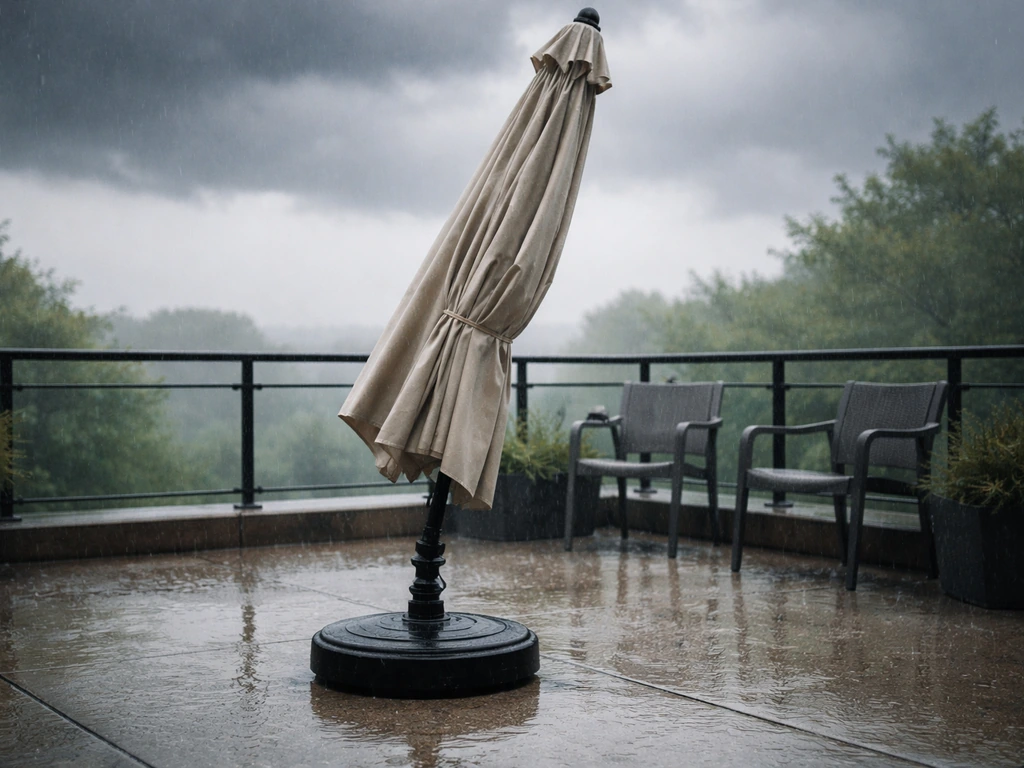
The Beaufort wind scale gives you the most useful real-world framing here, because it maps wind speed to visible, observable conditions rather than just abstract numbers. At Beaufort 5 (19–24 mph / 31–39 kph), small trees start to sway and you will feel meaningful resistance if you try to push an open canopy back into position. Beaufort 6 (25–31 mph / 40–50 kph) is the point where even the NOAA description specifically calls out umbrellas: "large branches in motion; umbrellas used with difficulty. The Beaufort Wind Scale, National Weather Service (NOAA) maps Beaufort numbers to mph/kph/knots with plain-language descriptions (e.g., Beaufort 5 = 19–24 mph “Fresh breeze”; Beaufort 6 = 25–31 mph “Strong breeze”, “umbrellas used with difficulty”; Beaufort 7 = 32–38 mph “Near gale”) Beaufort Wind Scale — National Weather Service (NOAA). " That is not a coincidence, it is your close-it-now signal. Beaufort 7 (32–38 mph / 51–61 kph) means whole trees are moving and an open umbrella is actively dangerous. Most well-designed residential umbrellas are built to survive brief gusts in this range when closed, but should never be left open.
Wind speed chart: what to do at every level
| Wind Speed (mph) | Wind Speed (kph) | Beaufort Scale | Conditions | Recommended Action |
|---|---|---|---|---|
| 0–12 mph | 0–19 kph | 1–3 (Light) | Calm to gentle breeze; leaves rustle | Umbrella safe to use open |
| 13–18 mph | 21–29 kph | 4 (Moderate) | Small branches move; loose paper blows around | Umbrella generally safe; check base is secure |
| 19–24 mph | 31–39 kph | 5 (Fresh) | Small trees sway; wavelets on open water | Use with caution; close if gusting frequently |
| 25–31 mph | 40–50 kph | 6 (Strong) | Large branches move; umbrellas used with difficulty | Close the umbrella — do not leave open |
| 32–38 mph | 51–61 kph | 7 (Near Gale) | Whole trees in motion; walking into wind is difficult | Umbrella closed and secured; move to shelter if portable |
| 39–46 mph | 63–74 kph | 8 (Gale) | Twigs breaking; progress impeded on foot | Secure umbrella and weighted base; consider storing indoors |
| 47+ mph | 76+ kph | 9+ (Severe) | Structural damage to property | Store umbrella indoors immediately |
The CPSC's 2025 beach umbrella advisory drew a specific line at 30 mph, requiring that compliant products either resist at least 75 lbf of upward force or remain secure at that speed under ASTM F3681. That 30 mph figure is a reasonable working maximum for any residential umbrella in open use, and it aligns almost exactly with the top end of Beaufort 6, the scale's own "umbrellas used with difficulty" category.
How wind actually breaks patio umbrellas
Understanding the failure modes helps you evaluate what you are buying. Wind does not just push an umbrella sideways, it creates uplift, torque, and bending stress simultaneously, and those forces scale with the square of wind speed. Double the wind speed and you get four times the force, which is why a calm 15 mph afternoon and a gusty 30 mph evening feel like completely different scenarios for your canopy.
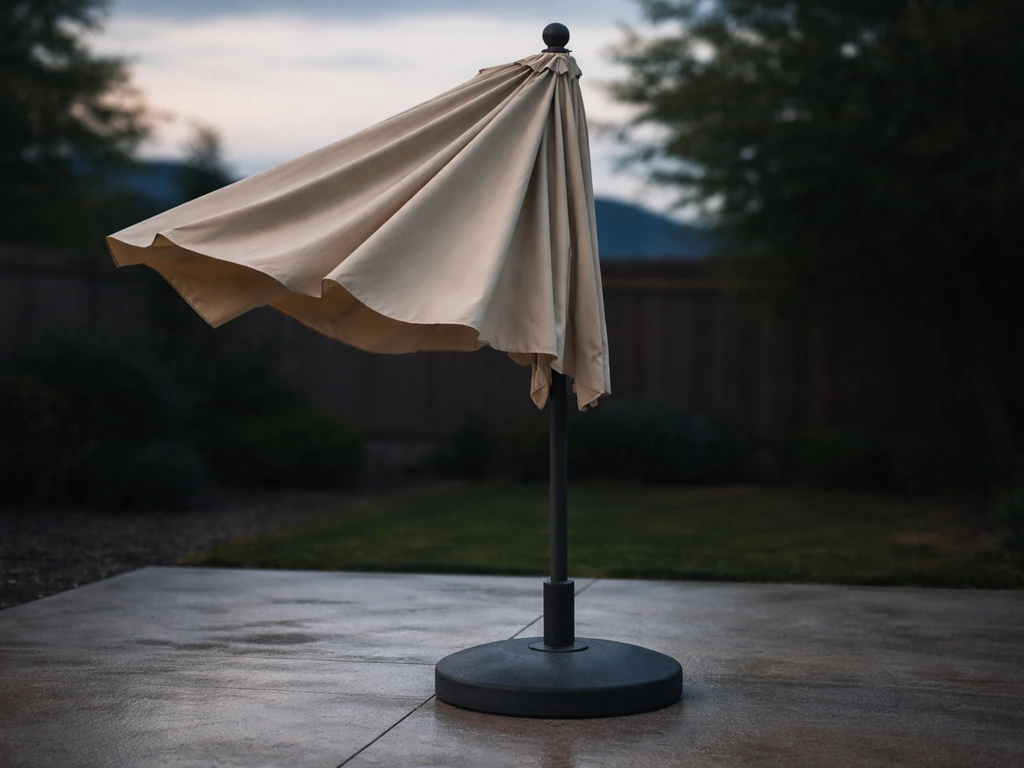
- Lift and inversion: A canopy acts like an airfoil. As wind catches the underside, it generates significant upward lift. In gusty conditions this can flip the canopy upward (inversion), bending or snapping the ribs at their pivot points. Vented canopies reduce this by allowing air to escape through the top rather than building pressure underneath.
- Rib breakage: The ribs are the most common point of failure. Aluminum ribs take a permanent bend under peak gust loading and do not recover. Fiberglass ribs flex and spring back, which is why they are the preferred material on wind-rated models. An 8-rib or 10-rib canopy distributes load better than a 6-rib frame — especially on 9 ft or larger canopies.
- Pole torque and base separation: Wind applies a rotational force at the base of the pole, trying to tip the entire assembly. If the base is too light or the pole is set too high, the umbrella pivots and falls. A 9 ft center-pole umbrella in a 50 lb base will tip well before the canopy structure fails.
- Fabric tearing and seam failure: Heavy sustained winds stress the fabric at attachment points (seams, rib sleeves, and the hub). Cheaper polyester fabrics fray and tear; solution-dyed acrylic fabrics like Sunbrella are significantly more resistant and hold shape better across repeated wind events.
- Crank and tilt mechanism damage: Many entry-level umbrellas have plastic or lightweight alloy cranks that strip or crack when the canopy is forced open or closed under wind load. This is a common and frustrating mid-season failure.
Construction features that actually make umbrellas wind-resistant
Frame and ribs
Fiberglass ribs are the single most important frame upgrade for wind resistance. They flex under gust loading and return to shape instead of permanently bending the way aluminum does. For a 9 ft canopy, look for 8 ribs minimum; a 10-rib or 12-rib frame on larger canopies meaningfully reduces the load each individual rib has to carry. The main pole material matters too: a 1.5-inch diameter or larger aluminum or steel pole is far more resistant to the torque forces that come from wind than a skinny 1-inch pole. Some commercial-grade umbrellas use 2-inch or larger poles specifically for wind environments.
Vented canopies
A vent is one of the most effective passive wind-resistance features you can buy. Single vents allow air to escape through the top of the canopy, reducing upward pressure and the risk of inversion. Double vents, where a second smaller canopy sits above the main one, creating a gap for airflow, are even better. They will not eliminate the physics of wind, but they meaningfully lower peak uplift forces and stabilize the canopy in gusty conditions. If you are shopping in a windy climate, a vented canopy is not optional.
Fabric type and porosity
Solution-dyed acrylic (Sunbrella and comparable brands) is the commercial standard for patio umbrella canopy fabric. It is colorfast, mildew-resistant, and resists tearing at seams and attachment points far better than budget polyester. Slightly porous fabrics also allow minor airflow through the weave, reducing drag compared to fully solid panels. That said, fabric quality alone does not make an umbrella wind-resistant, it has to be paired with a solid frame and proper venting. Think of the fabric as the last line of defense, not the first. For recommendations focused on waterproof performance, see our guide to the best patio umbrella for rain.
Canopy shape and size
Smaller canopies catch less wind, which is obvious, but the shape matters too. Octagonal canopies distribute load more evenly across ribs than square canopies. Dome-shaped or curved profiles shed wind better than flat canopies, which present a more perpendicular surface to airflow. The aerodynamic drag equation (D = 0. See the Drag Equation, NASA Glenn Research Center for the canonical form D = 0.5·ρ·Cd·A·V² and a concise explanation of the terms Drag Equation — NASA Glenn Research Center. 5 × air density × drag coefficient × area × velocity²) tells you that drag scales directly with canopy area, so going from a 9 ft to an 11 ft umbrella roughly doubles the canopy area and doubles the wind force the frame and base have to handle. That is not a reason to avoid larger umbrellas, but it is a reason to upgrade the base weight and frame quality when you size up.
Wind ratings and testing claims: what to trust
The most reliable wind ratings come from umbrellas tested to ASTM F3512-21, the standardized wind-tunnel test method for market/center-pole umbrellas. For buyer guidance see patio umbrella wind rating summaries that compare ASTM-certified test results across models. This standard defines two test procedures: Procedure A (safety, covering structural integrity under peak loads) and Procedure B (durability, covering repeated wind cycling). Performance ratings from this standard map back to Beaufort scale categories, which makes them genuinely useful for comparison. If a manufacturer does not reference a specific test standard, their stated wind rating is essentially a marketing number with no verifiable methodology behind it.
For beach and portable umbrellas, ASTM F3681-24/25 is the relevant standard. The CPSC references it directly in their 2025 advisory, requiring compliant products to either resist 75 lbf of upward force or stay planted in 30 mph winds when installed per instructions. Seeing ASTM F3681 compliance on a beach umbrella label is meaningful; seeing it absent should give you pause.
Some premium manufacturers do publish impressive numbers. Fiberbuilt, for instance, lists many of their commercial market umbrellas as capable of handling gusts up to 50–55 mph. TUUCI's engineered commercial parasol systems with specified mounts are rated for sustained winds up to 55–74 mph in some dealer installations. These numbers are real in the context of those products mounted exactly as specified, but replicate those conditions in a residential freestanding base and the numbers change significantly. Always read the fine print on mounting requirements.
Decision rules for choosing an umbrella by site exposure and size
Where your umbrella lives matters as much as what it is made of. An umbrella in a sheltered courtyard surrounded by walls faces a completely different load than one on an exposed deck or rooftop. Here are practical rules of thumb I use when advising on umbrella selection by site and size.
- Sheltered sites (fenced yard, surrounded by walls or trees): A standard 9 ft market umbrella with a 50 lb base and fiberglass ribs handles typical conditions well. Upgrade to a vented canopy if you get regular afternoon gusts.
- Semi-exposed sites (open deck, one exposed side): Step up to a minimum 75 lb base for a 9 ft umbrella. Choose a vented canopy and fiberglass ribs. A 10 ft umbrella here needs at least 100 lb of ballast.
- Fully exposed sites (rooftop, lakefront, oceanfront): A 9 ft umbrella needs 100+ lb of base weight or an in-ground anchor. Seriously consider whether a freestanding umbrella is the right product at all — a wall-mounted or in-ground parasol system with engineered hardware is a better answer for consistently windy exposed locations.
- For every additional foot of canopy diameter beyond 9 ft, add at least 25 lb of base weight and upgrade the pole diameter if the manufacturer offers that option.
- Cantilever/offset umbrellas need even heavier bases than same-size center-pole models because the pole arm creates significant leverage. A 10 ft cantilever in a semi-exposed site needs 150–200 lb minimum, and many manufacturers recommend bolted or weighted slab mounting.
- If you regularly experience gusts above 20 mph, choose a model with a wind rating tied to a named test standard (ASTM F3512 or F3681), not a marketing figure.
- Close the umbrella before you leave home for the day if the forecast shows winds above 20 mph or if afternoon thunderstorms are expected. This single habit extends umbrella life more than any product upgrade.
Base weight and anchoring: the numbers that matter
The base is where most wind failures actually originate, not because the canopy or pole breaks first, but because the whole assembly tips over. Getting the base weight right is the most impactful safety decision you make after buying the umbrella itself.
| Umbrella Size | Minimum Base Weight (Freestanding) | Recommended Base Weight (Semi-Exposed) | Notes |
|---|---|---|---|
| 7–8 ft market umbrella | 25–35 lb | 40–50 lb | Light use; sheltered patios only at lower weights |
| 9 ft market umbrella | 50 lb | 75 lb | Most common residential size; upgrade base first |
| 10–11 ft market umbrella | 75 lb | 100–125 lb | Larger canopy area increases wind load significantly |
| 10–11 ft cantilever/offset | 150 lb | 200+ lb | Lever-arm effect requires much heavier ballast |
| 13 ft+ commercial umbrella | 200–250+ lb | Bolted/in-ground mount recommended | Treasure Garden AG28 specifies ~250 lb filled base weight |
| Balcony/small 6–7 ft umbrella | 15–25 lb (table-mount preferred) | Wall or rail mount preferred | Freestanding bases on balconies add weight without safety margin |
Balcony mounting: a separate conversation
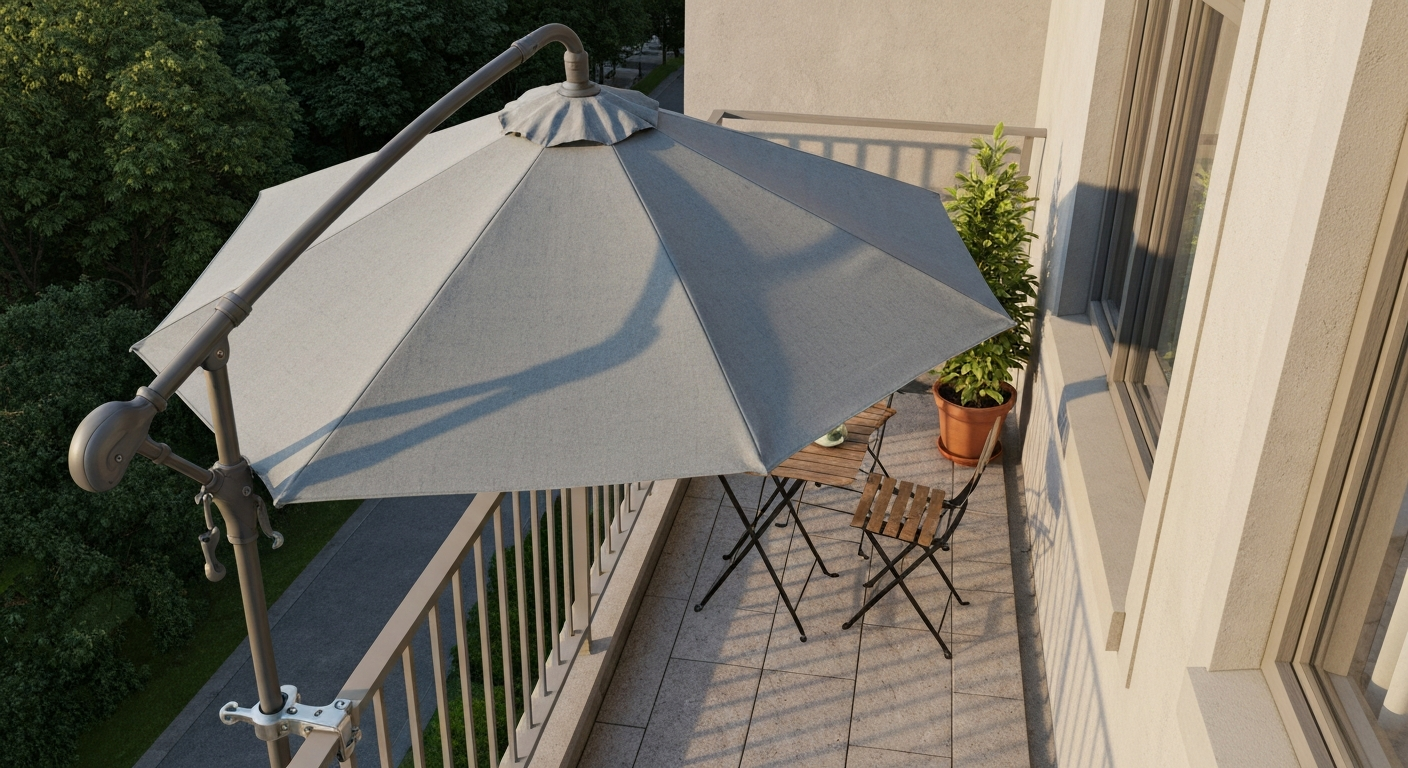
Balconies create a specific anchoring challenge because you cannot just pile on more weight. Most residential balconies are engineered to support 40–60 lbs per square foot for live load, and a 200 lb base sitting on a small footprint can approach that limit quickly, especially when you add furniture. On a balcony, a railing-mount or wall-mount bracket is almost always a better answer than a freestanding weighted base. These bracket systems bolt directly into the railing or wall structure, bypassing the weight problem entirely and providing a genuinely rigid anchor. Before drilling anything, verify the railing's structural capacity with a contractor or your building management, balcony railings vary enormously in what they can handle. A smaller 7–9 ft umbrella on a proper railing mount in a sheltered position is far safer than a 10 ft umbrella in a heavy freestanding base on an exposed balcony. If you are shopping specifically for balcony use, this is worth digging into further alongside options designed for compact outdoor spaces. See our guide to the best patio umbrella for balcony for model recommendations and railing- or wall-mount options tailored to small outdoor spaces.
Which umbrella type handles wind best
The three common types, market (center-pole), cantilever/offset, and small balcony models, each have distinct trade-offs in wind conditions. None is universally best, but there is a right answer for most situations.
| Type | Wind Resistance Pros | Wind Resistance Cons | Best For |
|---|---|---|---|
| Market / center-pole | Simple structure; load transfers straight down through center pole to base; easy to close quickly; widely available in wind-rated versions | Requires heavy freestanding base for wind stability; pole through table limits furniture layout | Sheltered to semi-exposed patios where quick closing is practical |
| Cantilever / offset | No center pole under table; can be positioned to minimize canopy exposure angle | Lever-arm geometry dramatically increases torque on base; requires much heavier base or fixed mount; harder to reposition quickly in sudden gusts | Sheltered patios where aesthetics matter and base can be very heavy or fixed |
| Small balcony / compact | Lower canopy area means lower wind force; railing-mount options bypass weight issues entirely | Less shade coverage; most lack wind-rated certifications; tilt mechanisms on budget models fail quickly in wind | Balconies and compact spaces with railing or wall mounting available |
For genuinely windy sites, a center-pole market umbrella with a vented canopy, fiberglass ribs, and a properly weighted base consistently outperforms a cantilever in real-world use. The cantilever looks better and gives you more table flexibility, but the physics work against it in wind. If you are trying to find the best umbrella for consistently windy conditions, the frame construction and rib material matter far more than the style category. For more on selecting the best patio umbrella for wind, see our detailed buying guide.
Cold climates, Canadian conditions, and year-round durability
Wind resistance is only part of the durability question if you live somewhere with real winters. In Canada and the northern U.S., the challenge is not just summer gusts, it is a freeze-thaw cycle that cracks plastic hubs and fittings, UV degradation that weakens fabrics over a short outdoor season, and the practical question of what to do with a large umbrella from October through April. For Canadian buyers, see our guide to the best patio umbrella for wind Canada for models and mounting options rated for northern climates.
For cold-weather climates, solution-dyed acrylic fabric holds up far better than polyester through repeated wet-dry-freeze cycles. Powder-coated aluminum frames resist rust and corrosion better than untreated steel, which matters when spring melt brings sustained moisture. Fiberglass ribs also have an advantage in cold weather: they remain flexible at low temperatures, while aluminum becomes more brittle. If you are buying in Canada or a northern climate, these material choices are not just about wind, they are about the umbrella surviving a full seasonal cycle. For specific brand and model recommendations suited to northern conditions, see our guide to the best patio umbrellas in Canada.
On winter storage: virtually every manufacturer recommends bringing the canopy (and ideally the whole umbrella) indoors for winter. A canopy left on the frame through snow and ice loading is a rib-breakage scenario waiting to happen, snow adds unexpected weight, ice can lock the canopy open, and freeze-thaw cycles stress every joint and pivot. At minimum, remove and store the canopy fabric in a dry location. Store the pole and base in a garage or shed if space allows. Umbrellas that have a removable canopy design (where the fabric detaches from the frame easily) make this significantly less annoying and extend usable life by several seasons.
Seasonal maintenance steps
- At the start of each season, check all rib pivot points and the hub for cracks, play, or corrosion. Fiberglass ribs that are cracked at the pivot need replacement before use in wind.
- Inspect the pole base socket and tighten any fasteners. A loose pole-to-base fit adds wobble that amplifies wind movement.
- Clean the canopy fabric before storage with mild soap and water; mildew that sits through winter weakens fabric seams.
- Check the crank mechanism and tilt hardware. Replace any plastic components that show cracking before they fail mid-wind-event.
- At the end of season, close the umbrella, remove the canopy if the design allows, and store both separately in dry conditions.
- Do not store a water-filled base with water in it over winter — the expansion from freezing will crack plastic base shells.
Day-to-day safety habits that extend umbrella life
The most durable umbrella you can buy will last half as long if you leave it open every time you step inside. Sustained wind above 20–25 mph is the working close-it threshold for everyday use, multiple commercial umbrella manuals, including Frankford's NOVA line, specifically recommend closing at sustained winds above 25 mph. That is a reasonable number to internalize. If you are heading inside for more than a few minutes and there is any wind moving the canopy, close it. The hardware that wears out fastest (cranks, tilt pivots, rib stress points) fails most often because of repeated wind buffeting, not a single catastrophic gust.
A few additional habits worth building: use the velcro tie-wrap or closure strap whenever the umbrella is closed and you are not actively using it, this prevents the canopy from catching air and trying to open on its own in a gust. Weight your base with water or sand as specified by the manufacturer and do not assume it is heavy enough at partial fill. Check the wind forecast before outdoor entertaining; closing a 10 ft umbrella with guests around a table mid-meal is awkward at best and dangerous at worst. Plan for it in advance.
One last thing worth being honest about: no patio umbrella is designed to be left open unattended in changing weather conditions. The products that claim impressive wind resistance numbers are tested in controlled conditions with specified mounting hardware and calibrated wind sources. Your backyard, lake house deck, or rooftop terrace is not a wind tunnel, and gusts, which can spike well above sustained wind speeds in seconds, are harder on umbrella hardware than any steady-state test. Buy the best frame and base you can reasonably afford, match the base weight to your site exposure, learn the Beaufort 6 threshold (25–31 mph) as your close-it trigger, and you will get years of reliable use from a well-chosen umbrella. For more on selecting the right features and build quality, see our guide on what makes a good patio umbrella.
FAQ
Quick answer: how much wind can a patio umbrella withstand (mph, kph, Beaufort)?
Short answer: Most consumer patio umbrellas are safe in light to moderate breezes up to about 18–24 mph (29–39 kph; Beaufort 4–5). Many higher-quality, vented or engineered market/commercial umbrellas can resist gusts in the 40–55 mph (64–89 kph; Beaufort 7–9) range when permanently and properly mounted with the correct base or in‑ground anchor. Cantilever and very large commercial parasols sometimes claim tested performance above 55 mph but only with specified mounting hardware and ballast. Never assume a freestanding residential umbrella is safe above 30–35 mph (48–56 kph) unless it is explicitly wind‑rated and installed per the manufacturer’s instructions.
Wind‑speed chart with recommended homeowner actions (mph ↔ kph ↔ Beaufort)
Use this practical chart: - 0–12 mph / 0–19 kph (Beaufort 0–3, calm to gentle breeze): safe to use; normal operation. - 13–18 mph / 20–29 kph (Beaufort 4, moderate breeze): use caution; close very lightweight umbrellas; secure base. - 19–24 mph / 30–39 kph (Beaufort 5, fresh breeze): close most consumer umbrellas; only heavy/vented, well‑anchored units should remain up for short periods. - 25–31 mph / 40–50 kph (Beaufort 6, strong breeze): close and stow virtually all residential umbrellas; risk of damage and uplift. - 32–38 mph / 51–61 kph (Beaufort 7, near gale): severe risk; remove canopy from frame or dismount; only engineered, permanently mounted commercial systems may be rated. - 39–54+ mph / 62–87+ kph (Beaufort 8–10, gale to storm): close, disassemble, and store; expect structural failure for unsupported umbrellas. Decision rule: if gusts exceed about half of an umbrella’s published wind rating (or exceed ~25–30 mph for un-rated consumer models), close and secure the umbrella.
How does wind damage umbrellas (mechanics and common failure modes)?
Wind damages umbrellas by creating large aerodynamic forces (drag and uplift) on the canopy that transfer to ribs, hub, and pole. Key failure modes: - Canopy tearing or seam failure from high local stress or oscillation. - Rib bending or fracture from repeated or peak loads. - Hub or tilt mechanism shearing or deforming. - Pole uprooting from inadequate base ballast or anchors (uplift/overturn). - Abrupt gusts causing the umbrella to act like a parachute and become airborne (dangerous projectile). The force scales with V^2 (drag equation), so a modest increase in wind speed causes a large force increase; venting and flexible ribs reduce peak loads and lower failure risk.
What construction and design features increase wind resistance?
Look for these measurable features: - Vented canopy (single or double vent): reduces uplift and peak loads. - Fiberglass ribs: flex rather than plastically deform, absorbing gusts. - High rib count (8+ for 9'+ canopies): spreads load and reduces stress per rib. - Stiffer hub and reinforced tilt mechanism: resists shear and deformation. - Canopy shape: dome or vented dome sheds wind better than flat canopies. - Low‑porosity, solution‑dyed acrylic or outdoor polyester: resists tearing; fabric porosity affects drag—moderate porosity can reduce peak loads. - Pole material and wall thickness: heavy aluminum or steel poles with sufficient wall thickness or purpose‑engineered alloy increase stiffness. - Engineered commercial mounting plates or in‑ground sockets: provide significantly higher resistance than plain freestanding bases.
How do I estimate wind force on a canopy (simple rule of thumb)?
Use the drag relation qualitatively: force ∝ area × V^2. Practical rule: doubling wind speed increases aerodynamic force about fourfold. For example, a 9 ft (≈2.7 m) round canopy (area ≈18 ft²/1.7 m²) experiences modest forces at 15–20 mph but much larger forces at 40–50 mph. Because exact Cd and exposure vary, rely on manufacturer wind ratings, vented designs, and conservative ballast rather than DIY force calculations unless you have engineering data.
Anchoring and base‑weight guidance (ballast numbers and mounting notes)
General ballast guidance: - Small (6–7 ft / 1.8–2.1 m) umbrellas: 20–50 lb (9–23 kg) ballast in a dedicated base may be adequate for light breezes. - Standard 9–11 ft (2.7–3.4 m) center‑pole umbrellas: 50–125 lb (23–57 kg) recommended depending on canopy size and exposure (50–75 lb for sheltered sites; 75–125+ lb for exposed sites or larger canopies). - Large cantilever/offset umbrellas and commercial parasols: typically require bolted bases, in‑ground anchors, or 200–300+ lb (91–136 kg) systems—follow manufacturer spec. Balcony and deck limits: many residential railings or balcony floors have load limits; avoid heavy poured bases unless structure rated. Alternatives: use bolted mounts to structure, in‑ground sockets, or engineered balcony clamps rated by the manufacturer. Decision rule by exposure: if your site is exposed (open yard, waterfront), choose the higher end of ballast ranges or permanent mounting.